Multi-location businesses face a unique attribution challenge: when customers interact with ads online but convert at different physical locations, traditional tracking breaks down. A prospect might click a Facebook ad in Chicago, research on their phone during a commute, then walk into your Denver location a week later. Without the right attribution strategy, that conversion looks organic—and your marketing team has no idea which campaigns actually drove it.
This disconnect leads to misallocated budgets, undervalued channels, and scaling decisions based on incomplete data. The stakes are high: multi-location brands often spend six or seven figures on advertising across regions, yet many can't confidently answer which locations benefit from which campaigns.
The complexity multiplies when you consider that each location might have different customer behaviors, seasonal patterns, and competitive dynamics. What works in your Miami market might fail in Minneapolis. Your Seattle location might attract customers who research for weeks, while your Austin store converts same-day browsers.
This guide covers seven battle-tested strategies to solve multi-location attribution, from unified tracking infrastructure to location-specific conversion modeling. Whether you're managing five locations or five hundred, these approaches will help you connect every touchpoint to revenue—regardless of where the final conversion happens.
1. Build a Unified Tracking Infrastructure Across All Locations
The Challenge It Solves
When each location operates with different tracking systems, UTM conventions, or CRM platforms, you create data silos that make cross-location analysis impossible. One location might tag campaigns as "Facebook_Q1" while another uses "fb_jan_promo." Your corporate marketing team runs national campaigns but can't measure location-specific results because the data doesn't connect.
This fragmentation means you're essentially running blind. You can't compare performance across locations, identify your strongest markets, or understand which regional strategies deserve more investment. Every location becomes its own island of data, and corporate leadership loses visibility into what's actually working.
The Strategy Explained
A unified tracking infrastructure means establishing consistent naming conventions, tracking parameters, and data collection methods across every location. This starts with standardized UTM parameters that include location identifiers, flows through to consistent event tracking on your website and apps, and ends with all data feeding into a centralized attribution platform.
The key is creating a tracking taxonomy that works at both the corporate and local level. Your UTM structure might include campaign name, location code, channel, and content variant. For example: utm_campaign=spring_sale&utm_location=chi_loop&utm_source=facebook&utm_content=variant_a. This structure lets you analyze performance by campaign, location, channel, or creative—without losing granularity.
Think of it like building a common language across your organization. When everyone speaks the same tracking language, data flows seamlessly from local touchpoints to corporate dashboards.
Implementation Steps
1. Document your current tracking setup across all locations and identify inconsistencies in naming conventions, tracking tools, and data collection methods.
2. Create a standardized UTM taxonomy that includes required parameters (campaign, source, medium) and location-specific parameters (location code, region, store ID) that every location must use.
3. Implement a centralized tracking system like Cometly that can ingest data from all locations, normalize inconsistent historical data, and provide both location-specific and company-wide reporting views.
4. Train local marketing teams on the new standards and create documentation with examples for common campaign types so everyone implements tracking consistently.
5. Set up automated validation to flag campaigns that don't follow the naming convention before they launch, preventing data quality issues before they start.
Pro Tips
Build flexibility into your taxonomy for location-specific campaigns while maintaining consistency in core parameters. Some locations will run unique promotions or test different strategies—your tracking structure should accommodate this without breaking the unified reporting. Also, version your tracking standards and communicate updates clearly. As your business evolves, your tracking needs will too, and everyone needs to stay aligned on the current standards.
2. Implement Location-Aware Conversion Tracking
The Challenge It Solves
The biggest attribution gap for multi-location businesses is connecting digital ad exposure to physical location conversions. Someone clicks your ad in one city but converts at a store in another. Traditional online conversion tracking only captures e-commerce transactions or form fills—it completely misses in-store purchases, phone calls to specific locations, or appointments booked at physical offices.
Without location-aware tracking, you're measuring only a fraction of your actual conversions. Your digital campaigns might be driving significant foot traffic and in-store revenue, but if your attribution system can't see those conversions, you'll undervalue the channels that matter most to your business.
The Strategy Explained
Location-aware conversion tracking connects online interactions to offline conversions by capturing store visits, in-store purchases, and location-specific actions as trackable events. This requires integrating your point-of-sale systems, appointment booking platforms, and phone tracking with your attribution platform so that every conversion—regardless of where it happens—gets connected to the marketing touchpoints that drove it.
Modern attribution platforms can match online ad clicks to in-store conversions using several methods: matching customer identifiers (email, phone, customer ID) across systems, geolocation data that confirms store visits, and unique promotion codes tied to specific campaigns. When someone clicks your ad, visits your website, then converts at a physical location three days later, your system should capture that entire journey.
The goal is making offline conversions as trackable as online ones. Every store visit, in-store purchase, or phone call to a location becomes a measurable event that flows back to your attribution platform.
Implementation Steps
1. Integrate your point-of-sale system with your attribution platform so in-store purchases can be matched to online customer profiles using email addresses, phone numbers, or loyalty program IDs.
2. Set up location-specific conversion events in your tracking system for each type of offline conversion: store visits, in-store purchases, phone calls, appointment bookings, and any other location-specific actions that indicate conversion.
3. Implement call tracking with dynamic number insertion so phone calls to each location can be attributed to specific campaigns, and configure your system to capture which location the customer called.
4. Create a customer matching strategy that connects online sessions to offline conversions—this might use email capture, phone number collection, or loyalty program enrollment to create a persistent customer identifier across touchpoints.
5. Configure your attribution platform to weight location conversions appropriately in your models, recognizing that an in-store purchase might be more valuable than a website form fill depending on your business model.
Pro Tips
Don't wait for perfect data before implementing location-aware tracking. Start with what you can measure—even if you can only track 40% of in-store conversions initially, that's infinitely better than tracking 0%. You can refine your matching logic and improve coverage over time. Also, consider implementing a simple post-purchase survey asking "How did you hear about us?" as a backup attribution signal for conversions you can't automatically track.
3. Deploy Server-Side Tracking for Cross-Location Accuracy
The Challenge It Solves
Browser-based tracking has become increasingly unreliable for multi-location attribution. iOS privacy changes, cookie restrictions, and ad blockers mean that traditional pixel-based tracking misses a significant portion of customer interactions. This is especially problematic for multi-location businesses where customers often research on mobile devices, switch between devices, and take days or weeks to convert.
When your tracking relies entirely on browser cookies and pixels, you lose visibility into cross-device journeys. A customer might interact with your ads on their iPhone, research on their laptop, then convert at a physical location—and your browser-based tracking might only capture one of those touchpoints, making attribution impossible.
The Strategy Explained
Server-side tracking moves data collection from the customer's browser to your own servers, where it can't be blocked by privacy settings or ad blockers. Instead of relying on pixels and cookies that fire in the browser, your server captures events directly and sends them to your attribution platform and ad platforms.
This approach is particularly powerful for multi-location businesses because it creates a more complete view of customer journeys across devices and touchpoints. When someone clicks an ad, your server records that interaction with a unique customer identifier. When they later convert at a physical location, your server connects that conversion to their earlier interactions—even if they switched devices or cleared their cookies.
Server-side tracking also lets you enrich conversion data before sending it to ad platforms. You can append location information, customer lifetime value, or other business data that helps ad platforms optimize more effectively.
Implementation Steps
1. Set up a server-side tracking infrastructure using a platform like Cometly that can receive events from your website, mobile apps, CRM, and point-of-sale systems without relying on browser-based tracking.
2. Configure your server to capture critical events—ad clicks, website visits, form submissions, phone calls, and in-store conversions—and send them to your attribution platform with consistent customer identifiers.
3. Implement a customer identification strategy that works across touchpoints: this might combine email addresses, phone numbers, customer IDs, and probabilistic matching to connect interactions from the same person across devices and sessions.
4. Set up server-side event forwarding to your ad platforms (Meta, Google, TikTok) so they receive accurate conversion data even when browser-based pixels are blocked, maintaining the quality of their optimization algorithms.
5. Create fallback tracking that uses both server-side and browser-based methods, allowing your system to capture events through whichever method works for each customer's privacy settings and device configuration.
Pro Tips
Server-side tracking requires more technical setup than dropping pixels on your website, but the data quality improvement is worth it. Start by implementing server-side tracking for your highest-value conversion events—in-store purchases, high-value leads, appointments—then expand to capture more touchpoints over time. Also, make sure your server-side setup complies with privacy regulations by respecting customer opt-outs and handling personal data appropriately.
4. Create Location-Specific Attribution Models
The Challenge It Solves
Not all locations have the same customer journey. Your urban locations might attract walk-in traffic with short consideration periods, while suburban locations might rely on customers who research extensively before visiting. Coastal markets might respond better to social media advertising, while midwest locations might depend more on search and local directories.
Applying a one-size-fits-all attribution model across all locations masks these regional differences. You might conclude that Facebook drives 30% of conversions company-wide, but that average hides the reality that Facebook drives 50% of conversions in your Miami location and only 10% in your Minneapolis location. Making budget decisions based on averaged data leads to misallocation—overspending in markets where a channel underperforms and underspending where it excels.
The Strategy Explained
Location-specific attribution models recognize that different regions have different customer behaviors and weight touchpoints accordingly. Instead of using a single attribution model company-wide, you create models tailored to each location's unique journey patterns.
This might mean using a first-touch model for locations with short sales cycles where the initial ad click typically leads to same-day conversion, while using a multi-touch model for locations where customers interact with multiple channels over weeks before converting. You might also adjust how you value different touchpoints based on regional behavior—giving more credit to retargeting in markets where customers need multiple exposures, or emphasizing search in areas where intent-driven queries dominate.
The key is analyzing actual customer journey data for each location and building models that reflect how customers really behave in that market, rather than forcing all locations into the same attribution framework.
Implementation Steps
1. Analyze customer journey patterns for each location by examining time-to-conversion, number of touchpoints before conversion, and which channels typically appear in converting paths for each market.
2. Segment your locations into groups with similar journey characteristics—you might have urban quick-conversion locations, suburban research-heavy locations, and rural locations with unique patterns.
3. Configure different attribution models for each location segment in your attribution platform, adjusting touchpoint weighting and lookback windows based on actual journey data from each market.
4. Compare results between your location-specific models and a company-wide averaged model to quantify how much attribution accuracy improves when you account for regional differences.
5. Use the location-specific attribution data to inform budget allocation decisions, shifting spend toward channels that perform well in each specific market rather than making decisions based on company-wide averages.
Pro Tips
Start with broad location segments before creating individual models for every location. You might group locations by region, market size, or customer demographic profile. This gives you most of the benefit of location-specific modeling without the complexity of managing hundreds of different models. Also, review and update your models quarterly as market conditions and customer behavior evolve—attribution models should reflect current reality, not historical patterns.
5. Centralize Multi-Location Reporting Without Losing Granularity
The Challenge It Solves
Multi-location businesses need reporting that works at multiple levels. Corporate leadership needs to see company-wide performance and compare regions. Regional managers need to see how their territory performs against others. Local managers need detailed insights into their specific location's results. Creating reports that satisfy all these needs without drowning everyone in data is a significant challenge.
Many businesses end up with either overly simplified corporate dashboards that hide important location-level insights, or fragmented location-specific reports that make cross-location comparison impossible. Marketing teams waste hours manually combining data from different systems to answer basic questions like "Which locations are getting the best ROI from Facebook ads?"
The Strategy Explained
Centralized multi-location reporting means building a single reporting system that aggregates data from all locations while maintaining the ability to drill down into location-specific performance. This requires a reporting architecture that organizes data hierarchically—company level, region level, location level—and lets users navigate between these views seamlessly.
The best approach uses a hub-and-spoke model where all location data flows into a central attribution platform, but reporting views can be customized for different roles. Corporate executives see high-level dashboards with regional comparisons and trend analysis. Regional managers see their territory with location-level breakdowns. Local managers see detailed performance for their specific location with benchmarks against similar locations.
This structure ensures everyone works from the same data source while seeing the insights most relevant to their decision-making level.
Implementation Steps
1. Implement a centralized attribution platform like Cometly that can ingest data from all locations and organize it hierarchically by company, region, and individual location.
2. Create role-based reporting views that automatically filter data based on user permissions—corporate users see everything, regional managers see their territory, local managers see their location.
3. Build standardized dashboards for each reporting level with the metrics most relevant to that role: corporate dashboards focus on overall ROI and regional comparisons, regional dashboards emphasize location performance within the territory, and local dashboards dive deep into campaign-level results.
4. Set up automated reporting that delivers the right insights to the right people on a regular schedule—weekly performance summaries for local managers, monthly regional comparisons for regional leaders, quarterly strategic reviews for executives.
5. Create a data dictionary that defines how metrics are calculated consistently across all locations so everyone interprets reports the same way and discussions focus on insights rather than methodology debates.
Pro Tips
Include benchmarking features in your reporting so each location can see how they perform against similar locations, regional averages, or company-wide metrics. This context makes location-specific data more actionable—a local manager might think their 3% conversion rate is good until they see that similar locations average 5%. Also, enable export and sharing features so users can pull custom reports when needed without requiring data team intervention for every question.
6. Sync Enriched Conversion Data Back to Ad Platforms
The Challenge It Solves
Ad platforms like Meta and Google rely on conversion data to optimize their algorithms. When conversions happen offline or across multiple touchpoints, these platforms only see a fraction of your actual results. Their algorithms think campaigns are underperforming because they can't see the in-store purchases, phone calls, or delayed conversions that happened after the initial click.
This incomplete data leads to poor optimization. Facebook might pause ad sets that are actually driving significant in-store revenue because it only sees the online conversions. Google might bid aggressively on keywords that generate clicks but no in-store purchases, while underbidding on keywords that drive high-value offline conversions.
The Strategy Explained
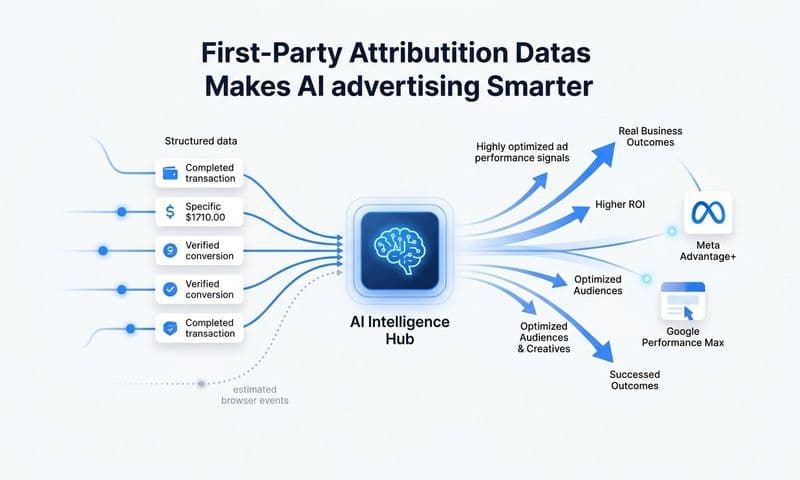
Conversion sync sends verified, location-attributed conversion events back to your ad platforms so their algorithms can optimize based on complete data. Instead of letting Meta or Google only see the conversions that happen immediately on your website, you feed them enriched conversion data that includes in-store purchases, phone calls, and other offline conversions.
This works through server-side conversion APIs that let you send conversion events directly to ad platforms with additional context: which location the conversion happened at, the actual revenue value, the customer's lifetime value, and any other business data that helps the platform optimize better. When you send this enriched data back, ad platforms can identify which campaigns, ad sets, and creatives truly drive valuable conversions—not just which ones generate clicks.
The result is better ad optimization, improved ROAS, and more accurate performance measurement across all your advertising channels.
Implementation Steps
1. Set up server-side conversion tracking through Meta's Conversions API, Google's Enhanced Conversions, and similar APIs for other platforms you advertise on.
2. Configure your attribution platform to send verified conversion events to these APIs, including location information, conversion value, and customer identifiers that help platforms match conversions to ad interactions.
3. Implement event enrichment that appends business context to conversion events before sending them—add customer lifetime value predictions, location-specific revenue data, or product category information that helps platforms optimize more effectively.
4. Use Cometly's Conversion Sync feature to automatically send enriched conversion data back to your ad platforms, ensuring they receive complete conversion information for better optimization and more accurate attribution.
5. Monitor the impact of conversion sync on your campaign performance by comparing metrics before and after implementation—you should see improved ROAS as platforms optimize based on complete data rather than partial visibility.
Pro Tips
Start by syncing your highest-value conversion events—in-store purchases, qualified leads, appointments—before expanding to every possible conversion action. This ensures platforms receive the most important signals first. Also, use conversion values consistently across all platforms so you can compare performance accurately. If you send a $100 purchase to Meta but a $120 purchase to Google (including shipping), your cross-platform comparisons will be misleading.
7. Use AI-Powered Analysis to Surface Cross-Location Insights
The Challenge It Solves
When you're managing attribution data across dozens or hundreds of locations, manual analysis becomes impossible. There are too many campaigns, too many locations, too many customer segments, and too many variables to analyze effectively using spreadsheets and manual reporting. Important insights get buried in the data volume—you might miss that your Denver location's Instagram ads dramatically outperform other locations, or that certain creative variants work better in specific regions.
Marketing teams end up making decisions based on incomplete analysis because they simply don't have time to examine every location's performance across every channel and campaign. Opportunities to optimize and scale successful strategies go unnoticed because the signal gets lost in the noise.
The Strategy Explained
AI-powered analysis uses machine learning to automatically identify patterns, anomalies, and opportunities across your multi-location attribution data. Instead of manually comparing hundreds of campaigns across dozens of locations, AI surfaces the insights that matter: which locations are outperforming expectations, which campaigns should be scaled, which channels are underperforming in specific markets, and which creative variations resonate in different regions.
Modern attribution platforms with AI capabilities can analyze your data continuously and proactively alert you to important changes. The AI might notice that your Phoenix location's cost per acquisition suddenly increased by 40%, or that a specific ad creative is driving 3x better results in coastal markets compared to inland locations. These insights would take hours of manual analysis to discover, but AI surfaces them automatically.
The goal is augmenting human decision-making with machine analysis that can process far more data than any person could manually review.
Implementation Steps
1. Implement an AI-powered attribution platform like Cometly that can analyze performance data across all your locations and identify statistically significant patterns and anomalies automatically.
2. Configure AI-driven alerts that notify you when important changes occur—significant performance improvements or declines, unusual spending patterns, or opportunities to scale successful campaigns to similar locations.
3. Use Cometly's AI Chat feature to ask natural language questions about your cross-location performance and get instant analysis without building custom reports or writing complex queries.
4. Review AI-generated recommendations regularly to identify optimization opportunities: campaigns to scale, budgets to reallocate, underperforming locations that need strategy adjustments, or successful tactics from one location that could work in others.
5. Create a feedback loop where you track the results of AI-recommended optimizations and use that data to improve future recommendations—the AI learns which suggestions drive results and refines its analysis over time.
Pro Tips
Don't treat AI recommendations as automatic decisions—use them as hypotheses to test. The AI might suggest scaling a campaign based on strong performance, but you should verify that the underlying business fundamentals support that recommendation before committing significant budget. Also, combine AI insights with local market knowledge. Your regional managers might have context about seasonal factors, competitive changes, or local events that explain AI-detected patterns and inform how you respond to them.
Putting It All Together
Multi-location attribution isn't a single fix—it's a system of connected strategies that work together to give you complete visibility into what's driving revenue across every location. The businesses that win are those that implement these strategies systematically rather than trying to solve everything at once.
Start with the foundation: unified tracking infrastructure and location-aware conversion tracking. You can't optimize what you can't measure, and these two strategies ensure you're capturing the data you need across all locations. Once your tracking foundation is solid, layer in server-side tracking to improve data accuracy and capture cross-device journeys that browser-based tracking misses.
With reliable data flowing in, focus on analysis and optimization. Implement location-specific attribution models that reflect how customers actually behave in each market. Build centralized reporting that gives every stakeholder the insights they need without drowning them in irrelevant data. Use conversion sync to feed your complete conversion data back to ad platforms so their algorithms optimize based on reality, not partial visibility.
Finally, leverage AI to surface insights you'd never find through manual analysis. When you're managing attribution across multiple locations, AI becomes essential for identifying patterns, catching anomalies, and recommending optimizations at scale.
The payoff is significant. Companies that implement comprehensive multi-location attribution typically see 20-40% improvements in marketing efficiency as they reallocate budgets toward channels and campaigns that truly drive location-specific revenue. They scale successful strategies faster because they can identify what works and replicate it across similar locations. They waste less budget on underperforming campaigns because they catch problems early through automated alerts and AI-powered analysis.
Most importantly, they make decisions based on complete data rather than guesswork. When you can confidently answer "Which campaigns drove revenue to which locations?" you transform marketing from a cost center into a predictable growth engine.
Ready to elevate your marketing game with precision and confidence? Discover how Cometly's AI-driven recommendations can transform your ad strategy—Get your free demo today and start capturing every touchpoint to maximize your conversions.