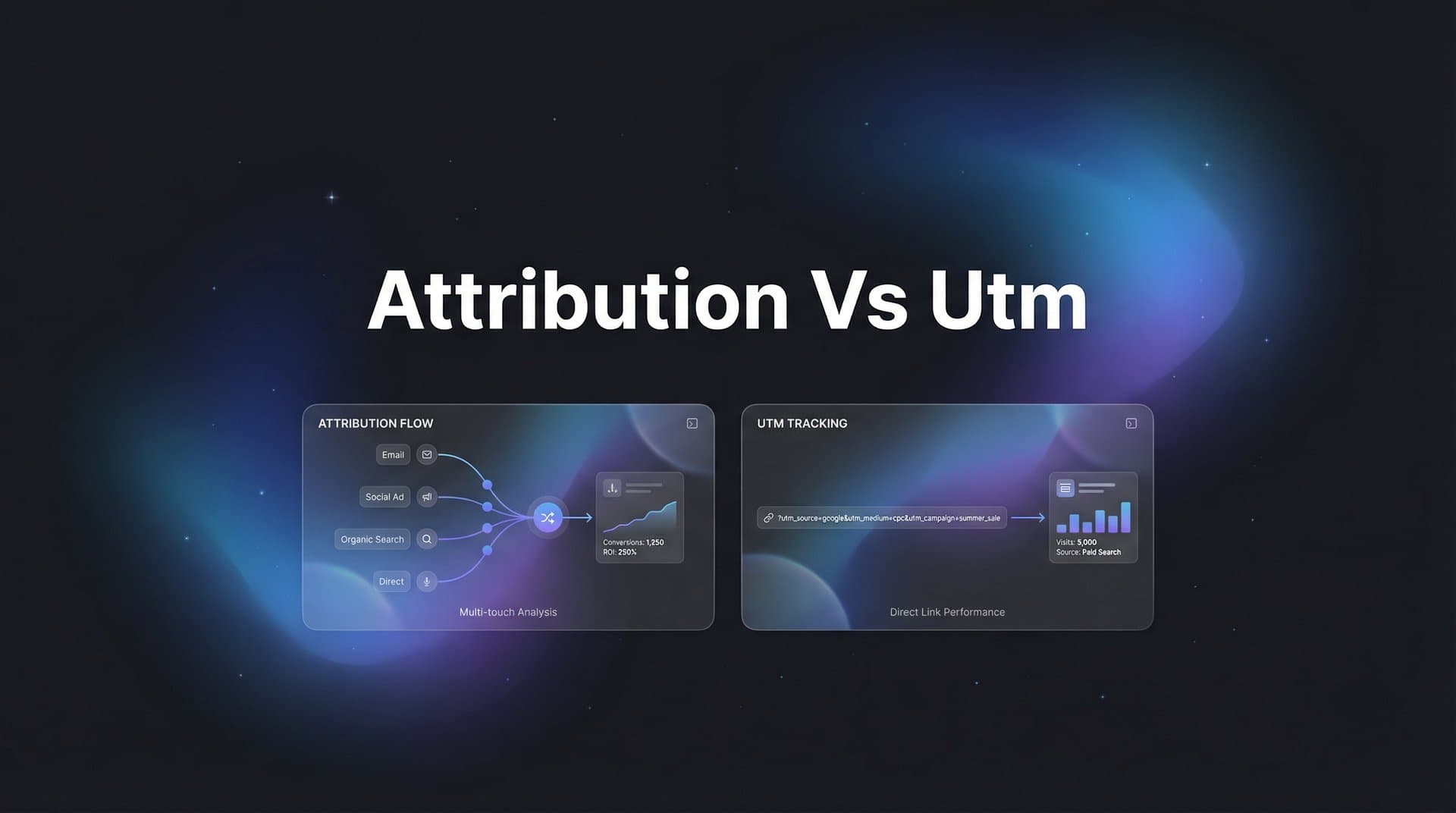
Digital marketers face a persistent challenge: understanding which tracking method gives them the clearest picture of campaign performance. UTM parameters and attribution models both promise visibility into marketing effectiveness, but they serve fundamentally different purposes.
UTMs tell you where traffic came from; attribution tells you what actually drove revenue.
Many teams use one or the other, missing the powerful insights that come from combining both strategically. This guide breaks down seven actionable strategies to leverage attribution and UTM tracking together, helping you move beyond surface-level metrics to understand the complete customer journey.
Whether you're struggling with iOS tracking limitations, juggling multiple ad platforms, or trying to prove ROI to stakeholders, these strategies will help you build a measurement framework that actually works.
1. Layer UTM Parameters as Attribution Data Inputs
The Challenge It Solves
Most marketers treat UTM parameters and attribution platforms as separate systems. You tag your campaigns with UTMs, check Google Analytics for traffic sources, then wonder why your attribution platform shows different conversion paths. This disconnect creates data silos that prevent you from seeing the complete customer journey.
The real power emerges when you use UTMs as structured data inputs that feed directly into your attribution system, creating a unified view of every touchpoint.
The Strategy Explained
Think of UTM parameters as the building blocks that attribution platforms use to construct the full conversion story. When someone clicks your Facebook ad tagged with utm_source=facebook and utm_campaign=spring_sale, that's just the beginning. Your attribution platform captures that initial touchpoint, then continues tracking as they return through organic search, click a retargeting ad, and finally convert.
Without properly structured UTM data feeding into attribution, you lose the ability to identify which specific campaigns, ad sets, or creative variations initiated successful conversion paths. The attribution platform needs clean, consistent UTM data to map the journey accurately.
This approach transforms UTMs from simple traffic labels into foundational data that powers sophisticated multi-touch analysis.
Implementation Steps
1. Audit your current UTM tagging to identify gaps where traffic sources lack proper parameters—every paid link, email, and social post needs complete UTM coverage.
2. Configure your attribution platform to ingest UTM parameters as first-party data points, ensuring each tagged touchpoint becomes part of the tracked customer journey.
3. Create a mapping document that shows how each UTM parameter flows into your attribution reporting dimensions, so your team understands how click-level data becomes journey-level insights.
Pro Tips
Test your UTM-to-attribution data flow by creating a controlled customer journey yourself. Click through your own tagged campaigns, complete a conversion, then verify that your attribution platform captured every UTM-tagged touchpoint correctly. This validation catches configuration issues before they corrupt your reporting.
2. Build a Multi-Touch Attribution Framework Using UTM Source Data
The Challenge It Solves
Last-click attribution gives all credit to the final touchpoint before conversion—usually a branded search or direct visit. This approach systematically undervalues your awareness and consideration campaigns. Your Facebook prospecting ad might introduce customers to your brand, but if they convert days later through direct traffic, Facebook gets zero credit in a last-click model.
You end up cutting budgets from campaigns that actually drive conversions, just because they don't get last-click credit.
The Strategy Explained
Multi-touch attribution distributes conversion credit across all UTM-tagged touchpoints in the customer journey. A customer might first discover you through a LinkedIn ad (utm_source=linkedin), return via an email campaign (utm_source=email), click a retargeting ad (utm_source=facebook), and finally convert through organic search.
Different attribution models assign credit differently. Linear attribution splits credit equally across all touchpoints. Time-decay gives more credit to recent interactions. Position-based (U-shaped) emphasizes first and last touch. Data-driven attribution uses machine learning to assign credit based on actual conversion patterns.
The key is using your UTM source data as the foundation for these models. Each utm_source, utm_medium, and utm_campaign becomes a trackable touchpoint that receives appropriate credit based on your chosen model.
Implementation Steps
1. Select two or three attribution models to run simultaneously—start with last-click (your baseline), first-click (shows acquisition impact), and linear (shows the full journey).
2. Configure your attribution platform to apply these models to your UTM-tagged touchpoint data, creating parallel views of how different channels contribute to conversions.
3. Compare model outputs to identify channels that perform better or worse under different attribution lenses—this reveals which campaigns drive early awareness versus final conversions.
Pro Tips
Don't just pick one model and stick with it forever. Run quarterly model comparisons to see how attribution perspectives change your channel performance rankings. The channels that look strong across multiple models are your true performers. Those that only shine in last-click might be capturing demand rather than creating it.
3. Solve Cross-Platform Tracking Gaps with Server-Side Attribution
The Challenge It Solves
Browser-based UTM tracking faces increasing limitations. iOS App Tracking Transparency blocks many tracking scripts. Safari's Intelligent Tracking Prevention deletes cookies after seven days. Ad blockers strip UTM parameters from URLs. Privacy-focused browsers reject third-party tracking entirely.
You're losing visibility into significant portions of your traffic, which means your attribution models are making decisions based on incomplete data.
The Strategy Explained
Server-side tracking captures conversion events directly on your server, bypassing browser-based limitations. When a customer completes a purchase, your server sends that conversion data—along with associated UTM parameters and customer identifiers—directly to your attribution platform and ad platforms.
This approach doesn't rely on cookies or JavaScript that browsers can block. The conversion data flows from your server to your tracking systems through secure API connections. You capture the complete customer journey even when browser-based tracking fails.
Server-side attribution also enriches your data. You can attach customer lifetime value, subscription tier, or other CRM data to conversions, giving you attribution insights that go far beyond basic conversion counts.
Implementation Steps
1. Implement server-side tracking using your attribution platform's API to send conversion events directly from your backend when purchases, signups, or other key actions occur.
2. Configure your server to capture and preserve UTM parameters when users first land on your site, storing them in your database so they're available when the conversion happens days or weeks later.
3. Set up conversion sync to send enriched server-side events back to your ad platforms (Meta, Google, TikTok), improving their algorithm optimization with data that browser tracking would have missed.
Pro Tips
Run parallel tracking for 30 days—capture conversions through both browser-based UTM tracking and server-side attribution. Compare the results to quantify exactly how much conversion data you were losing to tracking limitations. This data justifies the implementation effort and reveals which traffic sources are most affected by browser restrictions.
4. Create a Unified Naming Convention Across UTMs and Attribution
The Challenge It Solves
Inconsistent UTM naming creates chaos in attribution reporting. Your team tags Facebook campaigns as "facebook," "Facebook," "fb," and "meta" interchangeably. Email campaigns show up as "email," "newsletter," "email_campaign," and "mail." When your attribution platform tries to aggregate performance by source, it sees these as separate channels instead of unified reporting categories.
You end up with fragmented data that makes accurate attribution analysis nearly impossible.
The Strategy Explained
A standardized UTM taxonomy ensures every campaign uses the same parameter structure and naming conventions. This consistency allows your attribution platform to accurately group touchpoints, track customer journeys, and assign conversion credit across campaigns.
Your naming convention should define exact values for common parameters. For utm_source, you might standardize: facebook, google, linkedin, email, organic_social. For utm_medium: cpc, display, email, social, referral. For utm_campaign: use a structured format like product_audience_offer_date.
When everyone on your team follows the same taxonomy, your attribution data becomes clean, aggregatable, and trustworthy. You can confidently compare channel performance, track campaign effectiveness over time, and make budget decisions based on accurate attribution insights.
Implementation Steps
1. Document your official UTM naming convention in a shared resource that defines approved values for utm_source, utm_medium, utm_campaign, utm_content, and utm_term.
2. Create a UTM builder tool or spreadsheet template that enforces your naming convention, preventing team members from creating inconsistent tags.
3. Audit existing campaigns to identify and correct naming inconsistencies—update active campaign URLs and create redirects for historical links to preserve data continuity.
Pro Tips
Build a UTM validation step into your campaign launch checklist. Before any campaign goes live, someone should verify that UTM parameters match your naming convention exactly. This simple quality control prevents the data fragmentation that undermines attribution accuracy. Consider using URL shorteners that enforce your UTM structure automatically.
5. Use Attribution Insights to Optimize UTM-Tagged Campaigns
The Challenge It Solves
Ad platform algorithms optimize toward the conversions they can see—which is increasingly limited by tracking restrictions. When iOS users convert, Meta's pixel might not capture that conversion, so the algorithm doesn't learn which audiences and creative drive iOS purchases. Your campaigns optimize based on incomplete data, missing opportunities to scale what actually works.
You're leaving performance on the table because your ad platforms can't see the full conversion picture.
The Strategy Explained
Attribution platforms with server-side tracking capture conversions that browser-based pixels miss. By sending these enriched conversion events back to your ad platforms through Conversion API integrations, you give the algorithms complete data to optimize against.
When Meta's algorithm sees that your UTM-tagged prospecting campaign (utm_source=facebook&utm_campaign=prospecting_q1) drove conversions that the pixel missed, it can better identify high-value audiences and optimize delivery accordingly. The same applies to Google, TikTok, and other platforms.
This feedback loop transforms attribution from a reporting tool into an optimization engine. Your attribution insights directly improve campaign performance by feeding better data to the algorithms that control your ad delivery.
Implementation Steps
1. Configure your attribution platform to send server-side conversion events back to your ad platforms using their respective Conversion APIs (Meta CAPI, Google Enhanced Conversions, TikTok Events API).
2. Match conversion events to specific UTM-tagged campaigns so platforms can attribute conversions accurately to the right campaigns, ad sets, and creative variations.
3. Monitor attribution-informed campaign performance for 14-30 days to identify which campaigns show improved optimization as algorithms receive more complete conversion data.
Pro Tips
Compare campaign performance before and after implementing attribution-informed conversion sync. Look specifically at campaigns targeting iOS users or privacy-focused audiences. These segments typically show the biggest performance improvements because they're most affected by browser tracking limitations. The lift you see validates the value of your attribution investment.
6. Compare Attribution Models to Validate UTM Performance Claims
The Challenge It Solves
Different attribution models tell dramatically different stories about which UTM-tagged campaigns drive revenue. Your email campaigns might look mediocre in last-click attribution but stellar in first-click. Your branded search campaigns dominate last-click but contribute little in time-decay models. Without comparing models, you risk making budget decisions based on a single, potentially misleading perspective.
You need multiple attribution lenses to understand the true value of each campaign.
The Strategy Explained
Running parallel attribution models reveals how different channels contribute at various stages of the customer journey. First-click attribution highlights which UTM sources introduce new customers. Last-click shows which sources close deals. Linear attribution demonstrates consistent touchpoint presence. Position-based reveals channels that excel at both awareness and conversion.
When you analyze your UTM-tagged campaigns through these different lenses, patterns emerge. Prospecting campaigns (utm_campaign=prospecting) typically perform better in first-click models. Retargeting campaigns (utm_campaign=retargeting) dominate last-click. Email nurture sequences show strength in linear models because they maintain consistent presence throughout the journey.
This multi-model perspective prevents you from over-investing in last-click channels while starving the awareness campaigns that actually fill your funnel.
Implementation Steps
1. Configure your attribution platform to run at least three models simultaneously—first-click, last-click, and either linear or position-based for a balanced middle perspective.
2. Create a comparison dashboard that shows how each UTM source and campaign performs across different attribution models, highlighting channels that excel in specific journey stages.
3. Use model comparison insights to segment your budget allocation—invest in first-click winners for growth, maintain last-click performers for conversion efficiency, and support linear leaders for sustained engagement.
Pro Tips
Look for channels that perform consistently across all attribution models. These are your most reliable performers. Channels that only shine in one model likely serve a specific journey stage. That's not bad—it just means you need to understand their role. A prospecting campaign that dominates first-click but fails last-click is doing its job perfectly: introducing new customers who convert later through other channels.
7. Automate Attribution-Informed Reporting Beyond Manual UTM Analysis
The Challenge It Solves
Manual UTM analysis means downloading Google Analytics data, exporting ad platform reports, matching campaigns across spreadsheets, and attempting to piece together conversion paths. This process takes hours, introduces errors, and provides only a snapshot view. By the time you finish the analysis, the data is already outdated.
You need real-time visibility into how UTM-tagged campaigns contribute to revenue, not weekly spreadsheet updates.
The Strategy Explained
Automated attribution dashboards connect directly to your ad platforms, CRM, and website to track every UTM-tagged touchpoint in real time. When a customer clicks your Facebook ad (captured via UTM), opens your email (captured via UTM), and converts, the attribution platform automatically maps that journey and assigns credit based on your chosen models.
You get live visibility into which campaigns drive conversions, how customer journeys evolve, and where to allocate budget for maximum return. No manual data exports. No spreadsheet matching. No delayed insights.
This automation also enables AI-powered recommendations. Modern attribution platforms analyze patterns across thousands of customer journeys to identify which UTM-tagged campaigns, audiences, and creative variations drive the highest-value conversions. You move from descriptive reporting to prescriptive optimization.
Implementation Steps
1. Connect your attribution platform to all traffic sources (ad platforms, email, CRM) and conversion points (website, app, backend systems) so it captures every UTM-tagged touchpoint and resulting conversion automatically.
2. Build automated dashboards that show real-time attribution performance by UTM source, medium, and campaign—replace your manual reporting spreadsheets with live data views.
3. Set up automated alerts for significant attribution changes, such as when a previously strong UTM campaign shows declining conversion contribution or when a new campaign begins driving unexpected revenue.
Pro Tips
Schedule weekly reviews of your automated attribution dashboard rather than building reports from scratch. Use that saved time to act on insights: pause underperforming campaigns, scale winners, and test new variations. The goal of automation isn't just faster reporting—it's more time for optimization. Let the platform handle data aggregation while you focus on strategic decisions.
Putting It All Together
Mastering the relationship between UTM tracking and attribution isn't about choosing one over the other—it's about understanding how they complement each other. UTM parameters provide the structured data that attribution platforms need to map customer journeys. Attribution models provide the multi-touch perspective that reveals what UTM-tagged campaigns actually contribute to revenue.
Start with strategy one: establish clean UTM parameters that feed into your attribution platform. This foundation ensures every touchpoint gets captured accurately. Then progressively implement server-side tracking to capture what browser-based UTMs miss, especially as privacy restrictions continue tightening.
The marketers who win aren't those with the most data; they're the ones who connect click-level UTM data to revenue-level attribution insights. They understand that a Facebook prospecting campaign might never show up in last-click reports but still fills the funnel with customers who convert later. They know which email sequences maintain engagement throughout long consideration cycles. They can prove ROI because they track the complete journey, not just the final click.
These seven strategies give you a roadmap to build measurement that scales with your growth. You'll move beyond surface-level traffic metrics to understand which campaigns truly drive business outcomes. You'll optimize with confidence because your attribution insights reveal what actually works, not just what gets last-click credit.
Ready to see which of your campaigns actually drive revenue, not just clicks? Get your free demo and discover how Cometly's AI-driven recommendations can transform your ad strategy. Start capturing every touchpoint, from initial awareness to final conversion, and maximize your marketing ROI with precision attribution that goes beyond basic UTM tracking.