

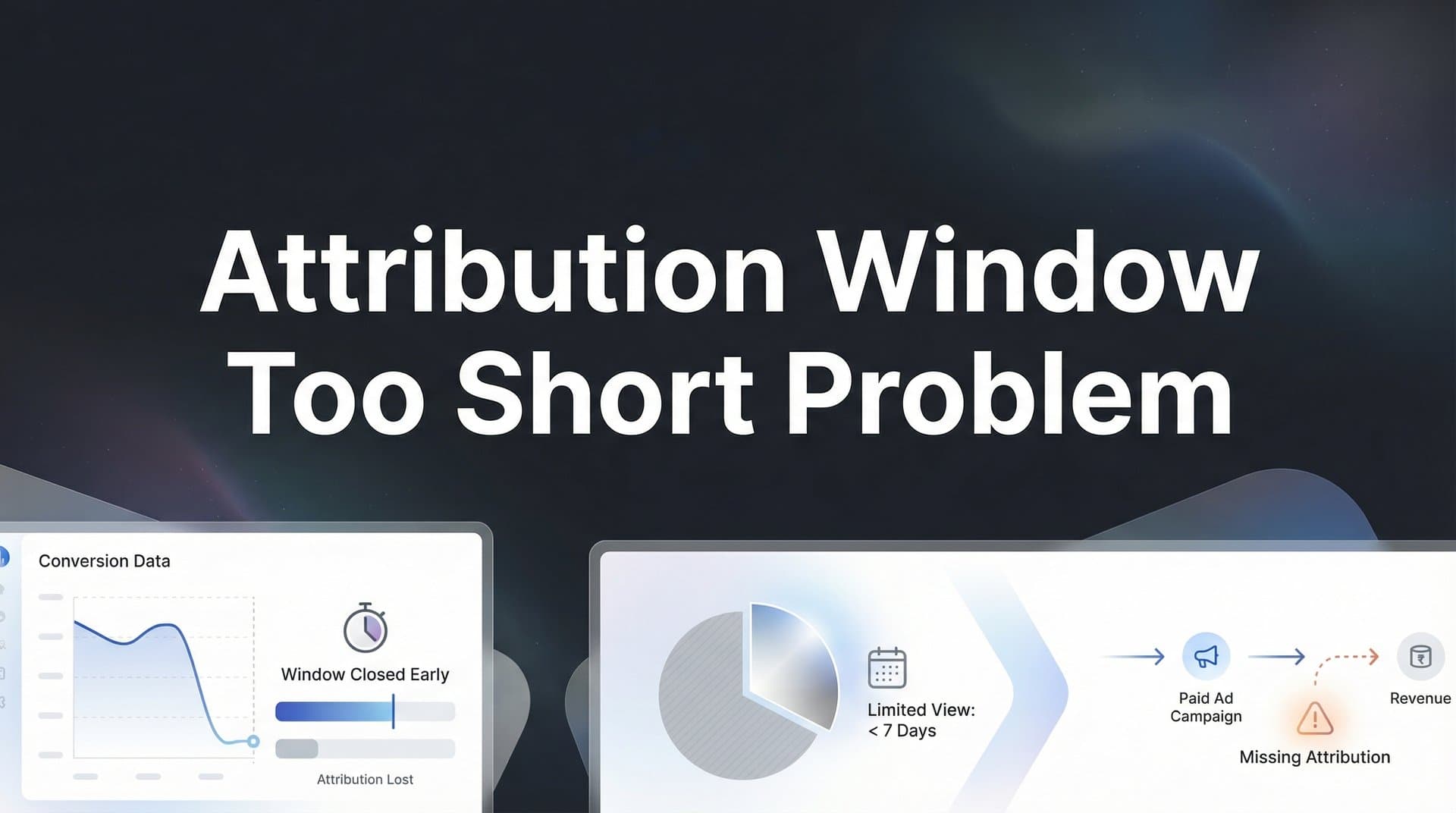
You've just pulled the plug on a Meta campaign that showed disappointing conversion numbers. Three weeks later, your sales team mentions a surge in closed deals—and when you dig into the CRM, you realize those customers all clicked that same campaign you killed. The revenue was there. The performance was strong. But your attribution window was too short to connect the dots.
This scenario plays out in marketing departments every day. Modern buying cycles, especially in B2B and considered purchases, often stretch across weeks or months. Yet most ad platforms measure success within a narrow 7 to 30-day window. Everything that happens outside that timeframe? It vanishes from your reports, gets credited to "direct" traffic, or shows up as organic—even when paid campaigns did the heavy lifting.
The result is a costly blind spot. You're making budget decisions based on incomplete data, potentially cutting winners and scaling losers. Even worse, you're feeding your ad platform algorithms partial information, which degrades their ability to optimize over time. Let's break down why this happens, how to spot it, and what you can do to capture the full picture of your marketing performance.
Why Standard Attribution Windows Miss the Bigger Picture
Attribution windows define the timeframe during which a conversion can be credited to a specific ad interaction. If someone clicks your ad on Monday and converts on Tuesday, that conversion gets attributed to your campaign. But if they convert three weeks later, most platforms won't make that connection.
Meta's current default is a 7-day click and 1-day view window. This means conversions are only counted if they happen within seven days of clicking an ad, or within one day of viewing it. Google Ads typically uses a 30-day click window for Search and Shopping campaigns. These settings became standard partly due to privacy changes—iOS 14.5 forced Meta to reduce its previous 28-day default—and partly because shorter windows align with platform reporting capabilities. Understanding Facebook Ads attribution window limitations is essential for accurate performance measurement.
The problem? Real buying cycles don't respect these arbitrary cutoffs.
Consider B2B software purchases. A marketing director might click your ad, visit your site, download a resource, and then spend two weeks evaluating competitors, getting internal buy-in, and scheduling demos. By the time they convert, your original ad interaction is 20 days old—well outside Meta's 7-day window. That conversion shows up as "direct" or gets credited to the last touchpoint, usually a branded search or email click.
Even in B2C, considered purchases follow similar patterns. Someone researching a $2,000 mattress doesn't buy on the first visit. They compare options, read reviews, wait for paychecks, and return when ready. If your attribution window closed after seven days, you'll never see the connection between your awareness campaign and that eventual purchase.
This creates a systematic data gap. Conversions that happen outside the attribution window don't disappear—they still show up in your revenue reports. They just get misattributed to whatever channel the customer used last, typically direct traffic, organic search, or email. Your paid campaigns lose credit for the demand they actually generated, making them look less effective than they are.
The Real Cost of Truncated Attribution Data
When your attribution windows are shorter than your actual buying cycle, the consequences cascade through your entire marketing operation. The most immediate damage is budget misallocation. You're cutting campaigns that appear to underperform while scaling tactics that simply happen to be last-touch before conversion.
Picture this: Your top-of-funnel awareness campaign on Meta introduces your brand to cold audiences. These people need time to research, compare, and decide. Meanwhile, your branded search campaign captures people already familiar with your company—many of whom first discovered you through that Meta campaign. With a short attribution window, the Meta campaign shows few conversions while branded search looks like a star performer. You shift budget accordingly, not realizing you're starving the channel that feeds your bottom-funnel success.
This pattern systematically undervalues awareness and consideration campaigns while overvaluing bottom-funnel tactics. Your reports suggest that branded search, retargeting, and email are your most efficient channels. In reality, they're harvesting demand that other channels created. When you cut the demand-generating campaigns, your "efficient" bottom-funnel channels eventually run out of qualified prospects to convert. This is a core attribution problem in marketing that affects businesses of all sizes.
The damage extends beyond your own decision-making. Ad platform algorithms rely on conversion data to optimize delivery. When Meta's algorithm receives conversion signals, it learns which audiences, placements, and creative variations drive results. It then uses that learning to find more people likely to convert.
But if your attribution window is too short, the algorithm only sees a fraction of your actual conversions. It's optimizing based on incomplete information. A campaign that drives significant revenue outside the attribution window sends no conversion signal back to the platform. The algorithm interprets this silence as poor performance and shifts delivery away from audiences that might actually be highly valuable—they just need more time to convert.
This creates a compounding problem. Your incomplete data trains the algorithm incorrectly, which degrades performance, which makes your campaigns look even worse in your truncated reporting, which leads to more bad decisions. You're stuck in a cycle of optimization based on partial truth.
How to Identify If Short Attribution Windows Are Hurting Your Campaigns
The attribution window problem doesn't announce itself with flashing warnings. It hides in the gaps between your platform reports and your actual business outcomes. But once you know what to look for, the signs become clear.
Start with your direct traffic. If you see spikes in direct visits or conversions that correlate with paid campaign launches, that's a red flag. Direct traffic should be relatively stable—it represents people typing your URL directly or using bookmarks. When it surges right after you ramp up paid spend, those visitors likely came from your campaigns but converted outside the attribution window. They're showing up as direct because the tracking connection expired.
Next, compare your in-platform conversion reports to your CRM revenue data. Pull your ad platform reports for a specific month and note the total conversions reported. Then go into your CRM and pull all customers who converted that same month, segmented by their first known touchpoint. How many customers have a first touchpoint from paid ads but don't show up in your platform conversion reports? That gap represents conversions your attribution window missed. Proper attribution tracking tools can help bridge this data gap.
The most revealing analysis is measuring your actual time-to-conversion. Export customer data from your CRM that includes both the first interaction date and the conversion date. Calculate the time difference for each customer. If your median time-to-conversion is 14 days but you're using a 7-day attribution window, you're missing at least half your conversions in your platform reporting.
Break this down by channel and campaign type. Top-of-funnel campaigns typically show longer time-to-conversion than bottom-funnel tactics. If your cold audience prospecting campaigns have a 21-day median time-to-conversion but your attribution window is 7 days, those campaigns will consistently look like they underperform—even if they're actually your most profitable channel when measured over the full customer journey.
Watch for the "organic credit steal" pattern. Pull a report of customers attributed to organic search in your analytics platform. Then check how many of those same customers had previous interactions with paid campaigns. If a significant portion of your "organic" conversions actually touched paid ads first, your short attribution window is causing paid channels to lose credit they deserve.
Another telling sign is when your sales team's feedback contradicts your marketing reports. If sales consistently mentions that customers discovered you through a specific campaign, but that campaign shows poor conversion metrics in your dashboard, the disconnect likely stems from attribution window limitations. Your sales team sees the full journey because they talk to customers. Your dashboard only sees what happens within the tracking window.
Solutions for Extending Your Attribution Visibility
Fixing the attribution window problem requires moving beyond native platform tracking to systems that maintain connections across your entire customer journey, regardless of time elapsed. The solution isn't just about measurement—it's about capturing and utilizing data that platforms can't track on their own.
Server-side tracking forms the foundation of extended attribution. Unlike browser-based tracking that relies on cookies with limited lifespans, server-side tracking captures interactions on your server and maintains those connections in your own database. When someone clicks your Meta ad, server-side tracking logs that interaction with a persistent identifier tied to that user. When they convert three weeks later, your system can still connect that conversion back to the original ad click, even if browser cookies have expired.
This approach bypasses the technical limitations that force platforms to use short attribution windows. Browser cookies get deleted, tracking pixels get blocked, and cross-domain tracking breaks down. Server-side tracking sidesteps these issues by maintaining the customer journey data on your infrastructure, where it persists as long as you need it to. Implementing proper attribution window settings for ads alongside server-side tracking maximizes your data accuracy.
The next critical piece is connecting your ad platforms to your CRM data. Your CRM knows when deals close, what revenue they generate, and which marketing touchpoints influenced them. When you integrate this CRM data with your ad tracking, you can attribute revenue to campaigns based on actual business outcomes, not just platform-defined conversion windows.
This integration works in both directions. First, you pull CRM conversion data back into your attribution system to understand which campaigns actually drove revenue, regardless of when that revenue occurred. Second, you push enriched conversion events back to ad platforms. When someone converts in your CRM, you send that conversion signal to Meta, Google, or other platforms with full context about the customer journey.
This second part—feeding data back to platforms—solves the algorithm optimization problem we discussed earlier. Instead of platforms only seeing conversions that happen within their limited attribution windows, they receive signals about all conversions, including those that occurred weeks after the initial ad interaction. This gives their algorithms complete information to optimize against, improving targeting and performance over time.
Multi-touch attribution models complete the picture by crediting all touchpoints that contributed to a conversion, regardless of when they occurred. Instead of giving all credit to the last click before conversion (which favors whatever channel happens to fall within the attribution window), multi-touch models distribute credit across awareness, consideration, and conversion touchpoints based on their actual influence. A thorough multi-touch attribution tool comparison can help you find the right solution for your needs.
A customer might click a Meta ad (awareness), visit from organic search a week later (consideration), click a retargeting ad two weeks after that (re-engagement), and finally convert via direct traffic three weeks in (conversion). With a 7-day attribution window, only the retargeting ad gets credit. With multi-touch attribution tracking the full journey, you see how each channel contributed and can make informed decisions about budget allocation across the entire funnel.
Building an Attribution System That Matches Your Sales Cycle
The goal isn't just to extend your attribution window arbitrarily—it's to build a measurement system that reflects how your customers actually buy. This starts with understanding your true sales cycle length through data, not assumptions.
Begin by analyzing your CRM data to map the typical customer journey. Look at closed deals from the past six months and identify the first known touchpoint for each customer. Calculate the time between that first touchpoint and conversion. Don't just look at the average—examine the distribution. What percentage of customers convert within 7 days? Within 14 days? Within 30 days? This distribution reveals whether your current attribution windows capture most conversions or miss significant portions of your customer base. Following attribution window best practices ensures your measurement aligns with actual buyer behavior.
For many businesses, this analysis reveals uncomfortable truths. A SaaS company might discover that while 20% of customers convert within 7 days, 50% convert between 8-30 days, and another 30% take even longer. Using a 7-day attribution window means missing 80% of conversions in platform reporting. That's not a measurement problem—it's a business intelligence failure that leads to bad decisions.
Once you understand your actual sales cycle, implement tracking that captures every touchpoint from first interaction through final conversion. This means tracking not just ad clicks and website visits, but also form submissions, email opens, sales calls, and CRM stage changes. Each interaction adds context to the customer journey and helps you understand which combinations of touchpoints drive conversions.
The technical implementation requires connecting your marketing stack components. Your ad platforms need to pass click IDs and campaign parameters to your website. Your website needs to capture these parameters and associate them with user sessions. When users submit forms or create accounts, these marketing parameters need to flow into your CRM. When deals close in your CRM, that conversion data needs to flow back to your attribution system and ultimately back to your ad platforms. Companies with longer sales cycles should explore B2B marketing attribution tools designed specifically for complex buyer journeys.
This creates a closed loop where every touchpoint is captured, every conversion is tracked back to its originating campaigns, and every platform receives the conversion signals it needs to optimize effectively. You're no longer limited by arbitrary attribution windows—you're measuring the full customer journey as it actually unfolds.
The final step is feeding enriched conversion data back to ad platforms through their conversion APIs. When someone converts in your CRM, send that conversion event to Meta, Google, and other platforms with full details: which ads they interacted with, what revenue they generated, and how long the journey took. This enriched data trains platform algorithms on complete information, improving their ability to find and convert similar customers.
Modern attribution platforms automate this entire process, maintaining connections between ad interactions and conversions regardless of time elapsed, then syncing conversion data back to platforms to improve optimization. The result is marketing data that reflects reality rather than the limitations of cookie-based tracking and short attribution windows.
Capturing the Complete Picture
The attribution window problem isn't a minor measurement quirk—it's a fundamental disconnect between how platforms track performance and how customers actually buy. When your attribution windows are shorter than your sales cycle, you're making decisions in the dark, cutting campaigns that work and scaling tactics that simply happen to be last-touch before conversion.
The good news is this problem is entirely solvable. You don't need to accept the limitations of native platform tracking. By implementing server-side tracking, connecting your CRM data to your ad platforms, and using attribution models that reflect your actual customer journey, you can measure marketing performance based on business outcomes rather than arbitrary time windows.
More importantly, extending your attribution visibility isn't just about better reporting—it's about better optimization. When you feed complete conversion data back to ad platforms, their algorithms can optimize based on reality instead of partial information. Your campaigns perform better because the systems running them finally have the data they need to find and convert your best customers.
Start by analyzing your current situation. How long does your typical sales cycle run? What percentage of conversions fall outside your current attribution windows? How much revenue is being misattributed to direct or organic channels when paid campaigns actually deserve credit? These questions reveal the gap between your current measurement system and your business reality.
Ready to elevate your marketing game with precision and confidence? Discover how Cometly's AI-driven recommendations can transform your ad strategy—Get your free demo today and start capturing every touchpoint to maximize your conversions.



