You're staring at three different dashboards on Monday morning. Meta Ads Manager says your Facebook campaign drove 47 conversions yesterday. Google Analytics credits 32 conversions to organic search. Your CRM shows 38 new customers came through, but the source field is a mess of conflicting data. Which one is telling the truth?
The uncomfortable answer: probably none of them.
This is the attribution problem in marketing—the fundamental challenge of knowing which touchpoints actually influence your conversions. It's not a minor technical headache. It's a systemic issue that causes smart marketers to kill winning campaigns, pour budget into underperforming channels, and feed garbage data to the algorithms that determine their ad success. And it's getting worse as privacy regulations tighten and customer journeys become more fragmented across devices and platforms.
Why Every Marketing Dashboard Tells a Different Story
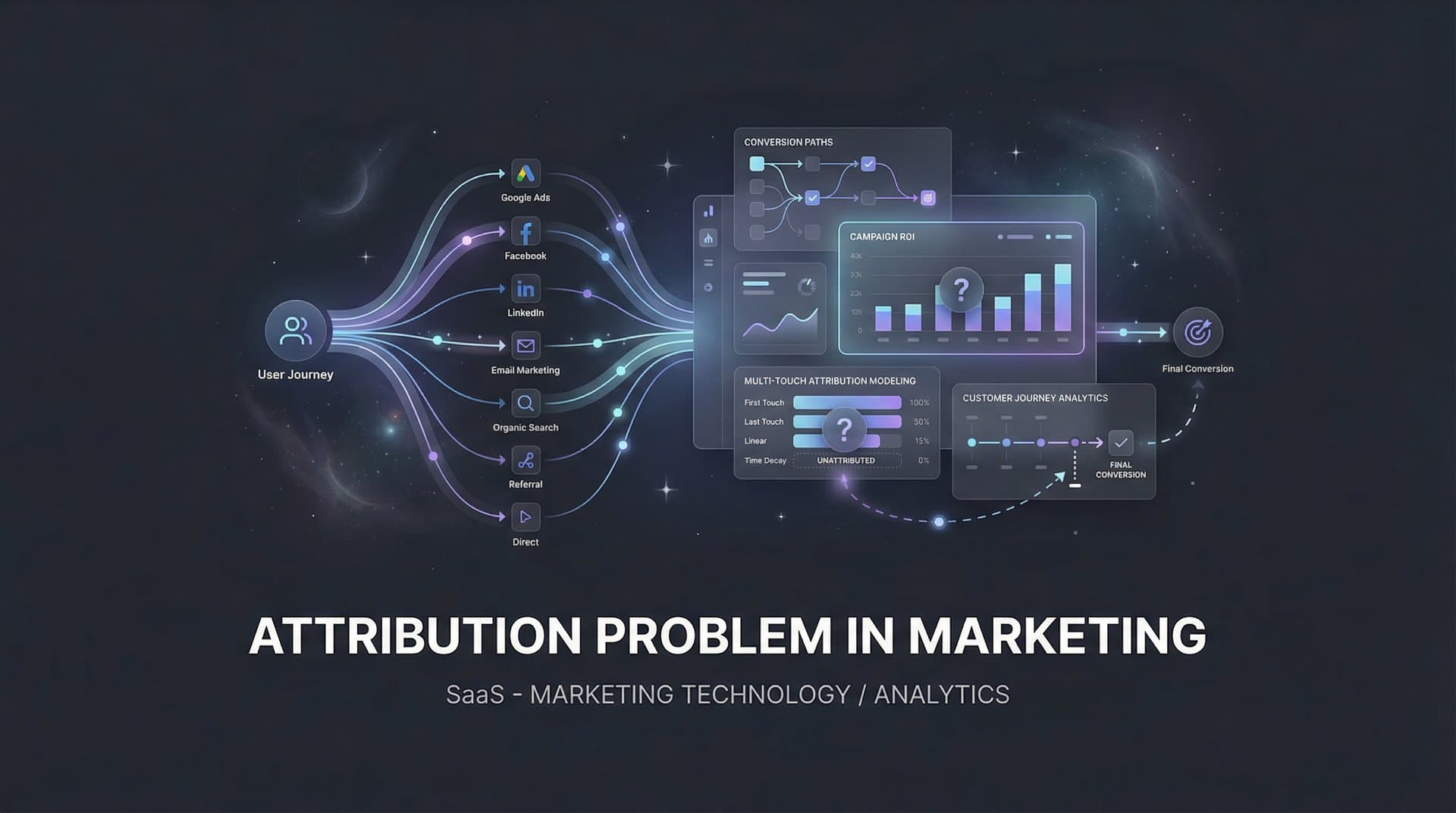
Here's what's actually happening when you see those conflicting numbers. Each ad platform operates like a detective investigating the same crime but only interviewing witnesses in their own jurisdiction. Meta sees the Facebook ad click. Google sees the search query. TikTok sees the video view. Each one builds a case for why they deserve credit for the conversion, using their own tracking methodology and their own definition of success.
The problem isn't that these platforms are lying—it's that they're working with incomplete information and filling the gaps with assumptions.
Think about how your customers actually buy. Someone sees your Facebook ad on their phone during their morning commute. They don't click—just notice your brand. Later that day, they search your company name on their work computer and visit your site. They browse but don't convert. Three days later, they see a retargeting ad on Instagram, click through on their tablet, and finally make a purchase on their laptop after clicking a Google search ad.
That's five touchpoints across four devices over three days. Which one "caused" the conversion?
Meta's pixel might have tracked the Instagram click on the tablet, but it lost sight of the customer when they switched to their laptop. Google Analytics saw the desktop sessions but missed the mobile touchpoints entirely because the user wasn't logged in. Your Facebook Ads Manager is making its best guess based on modeled data—essentially statistical estimates filling in the blanks where actual tracking failed.
The situation got dramatically worse after Apple's iOS 14.5 update in 2021. When Apple required apps to ask permission before tracking users across other apps and websites, roughly 75% of iOS users opted out. Overnight, platforms like Meta lost visibility into massive portions of the customer journey. The data gaps became chasms.
Now add cookie deprecation to the mix. As browsers phase out third-party cookies, traditional tracking methods are becoming less reliable by the day. Ad blockers eliminate even more visibility. The result is that every platform is working with a partial picture, then using modeled estimates to complete the puzzle—and each platform's model makes different assumptions about what probably happened in the blind spots. Understanding these common attribution challenges in marketing analytics is essential for any modern marketer.
This is why your dashboards don't match. They're not measuring the same thing. They're each telling a story based on the fragments they can see, filling in the rest with educated guesses that serve their own narrative.
The Real Cost of Getting Attribution Wrong
Bad attribution data doesn't just create confusing reports. It drives expensive mistakes that directly impact your bottom line.
The most common casualty is budget misallocation. When you trust last-click attribution—which most platforms default to—you end up pouring money into bottom-funnel channels that get credit for closing deals they didn't actually create. Your branded search campaigns look like superstars because they capture people who already decided to buy. Meanwhile, the awareness campaigns that introduced those customers to your brand in the first place appear to underperform, so you cut their budget.
You're essentially rewarding the finish line and starving the starting blocks.
The flip side is equally damaging: killing winners. Many campaigns contribute meaningfully to conversions without being the final touchpoint. A compelling video ad might introduce your product to someone who later converts through a different channel. If that video campaign doesn't get credit under your attribution model, it looks like a waste of money. You pause it, and three weeks later your overall conversion volume drops—but you don't connect the dots because the impact wasn't immediate or obvious.
Related reading: our complete guide to AI product video ad generator.
Then there's the algorithmic poison problem. When you feed incomplete or inaccurate conversion data back to ad platforms, their machine learning systems optimize toward the wrong signals. Meta's algorithm might think it's successfully targeting high-intent buyers when it's actually just finding people who were already going to convert through other channels. Google's Smart Bidding could be inflating bids for audiences that don't actually need the extra push.
The platforms are trying to help you succeed, but they can only work with the data you give them. Garbage in, garbage out—except now the garbage is being processed by sophisticated AI that amplifies the problem at scale.
This creates a vicious cycle. Inaccurate attribution leads to bad budget decisions. Bad budget decisions generate more misleading data. That data trains algorithms to optimize for the wrong outcomes. The algorithms then spend your money less efficiently, which makes your attribution problem look even worse. This is precisely the dilemma of attribution in marketing that frustrates so many teams.
Common Attribution Models and Their Blind Spots
Most marketers default to whatever attribution model their primary platform uses without questioning whether it actually reflects reality. Let's examine what each common model gets right—and where it falls dangerously short.
Last-click attribution gives 100% of the credit to the final touchpoint before conversion. It's simple, easy to track, and completely misleading for any business with a considered purchase. A customer might interact with your brand seven times over two weeks—seeing display ads, reading blog content, watching product videos—before finally clicking a retargeting ad and buying. Last-click gives all the credit to that final retargeting ad, ignoring everything that built the relationship and trust necessary to close the deal.
This model systematically undervalues awareness and consideration activities while making bottom-funnel tactics look artificially successful. It's like giving the closer on a sales team 100% credit for every deal while ignoring the SDRs who qualified the leads and the account executives who nurtured the relationships.
First-click attribution swings to the opposite extreme, crediting the initial touchpoint that introduced someone to your brand. This makes your top-of-funnel campaigns look brilliant while ignoring all the work required to move prospects from awareness to purchase. Just because someone first heard about you from a podcast ad doesn't mean that podcast deserves full credit when they convert three months later after multiple email touches and a demo call.
The discovery moment matters, but it's rarely the whole story.
Linear attribution attempts to be fair by distributing credit equally across all touchpoints. If someone had five interactions before converting, each gets 20% credit. This feels democratic, but it's mathematically naive. Not all touchpoints have equal influence. The product demo that addressed key objections probably mattered more than the generic display ad they scrolled past. Linear attribution treats them the same, which means it's still not reflecting reality—just spreading the inaccuracy more evenly.
Time-decay attribution gives more credit to recent touchpoints, operating on the assumption that interactions closer to the conversion had more influence. This makes intuitive sense for some businesses, but it can undervalue the crucial early touchpoints that created awareness and interest. The blog post that first explained why someone needed your solution might have been the most influential moment in their journey, even if it happened weeks before they bought. For a deeper dive into these frameworks, explore our guide on what is marketing attribution model.
The fundamental problem with all these models is that they apply mathematical formulas to human behavior. They distribute credit based on timing or position rather than actual influence. A truly accurate attribution model would need to understand causation—which touchpoints actually changed someone's likelihood of converting versus which ones just happened to be present in the journey.
What Accurate Attribution Actually Requires
Solving the attribution problem isn't about picking the right model. It's about building a data foundation that captures the complete customer journey—not just the fragments visible to individual platforms.
The first requirement is server-side tracking. Traditional browser-based tracking relies on pixels and cookies that users can block, delete, or opt out of. When someone uses an ad blocker or browses in private mode, your tracking breaks. When they switch devices, you lose the thread. Server-side tracking sends data directly from your servers to ad platforms and analytics tools, bypassing many of these limitations.
This isn't just a technical upgrade—it's the difference between seeing 60% of your customer journey and seeing 90% of it. Server-side tracking captures conversions that browser-based methods miss entirely, giving you a more complete picture of what's actually working. Implementing proper attribution marketing tracking is foundational to solving these visibility gaps.
Second, you need unified tracking across every platform and touchpoint. Your ad platforms, website analytics, CRM, and conversion events should all feed into a single source of truth. When these systems operate in isolation, you get the conflicting dashboard problem we started with. When they're connected, you can see how a Facebook ad impression led to a Google search, which led to a website visit, which led to a CRM opportunity, which led to a closed deal.
This unified view is what makes multi-touch marketing attribution possible. You can't accurately distribute credit across touchpoints if you can't see all the touchpoints in the first place.
Third, you need the ability to compare multiple attribution models side-by-side. Different models will value your channels differently, and understanding those differences helps you make better decisions. If a campaign looks strong under last-click but weak under first-click, that tells you something about its role in the customer journey. If it performs consistently across models, you can be more confident in its true impact.
The goal isn't to find the one perfect attribution model—it's to understand how different perspectives on your data reveal different insights. That nuanced understanding is what separates sophisticated marketers from those flying blind.
Building an Attribution System That Reflects Reality
Theory is nice, but let's talk about what this actually looks like in practice. Building accurate attribution requires connecting your entire marketing ecosystem into a coherent system.
Start by connecting every data source that touches your customer journey. Your ad platforms need to talk to your analytics. Your analytics need to talk to your CRM. Your CRM needs to feed conversion data back to your ad platforms. Every gap in this chain is a place where attribution breaks down and data gets lost.
This is where platforms like Cometly become essential. Rather than manually trying to stitch together data from Meta, Google, TikTok, your website, and your CRM, you need a unified attribution platform that automatically captures every touchpoint and connects them into complete customer journeys. This gives you the enriched view necessary to understand what's actually driving conversions—not just what each isolated platform thinks is driving conversions. Choosing the right marketing attribution solutions can make or break your measurement strategy.
Once you have complete data flowing in, use it to improve your ad platform optimization. The conversion events you send back to Meta, Google, and other platforms train their algorithms. When you send them enriched, accurate conversion data that includes the full context of each customer journey, their machine learning systems can optimize more effectively. They're not guessing which audiences convert—they're working with reliable signals about what actually works.
This creates a virtuous cycle that's the opposite of the garbage-in-garbage-out problem. Better attribution data leads to better optimization. Better optimization leads to more efficient ad spend. More efficient ad spend generates clearer performance signals. Those signals make your attribution even more accurate. Understanding how marketing attribution software vs traditional analytics differ helps you appreciate why dedicated tools matter.
Finally, regularly audit your attribution data against actual revenue. Your attribution system should tell a story that matches your financial reality. If your dashboards say you're profitable but your bank account disagrees, something is wrong with your attribution. If certain channels consistently show strong attributed conversions but don't correlate with revenue growth, dig deeper.
The best attribution system is one you can trust to make budget decisions with confidence. That trust comes from validation—checking that your attributed conversions actually reflect real business outcomes, not just modeled estimates or platform-serving narratives.
The Path Forward for Modern Marketers
The attribution problem in marketing isn't getting easier. Privacy regulations will continue tightening. Customer journeys will keep fragmenting across more devices and channels. The platforms you rely on will keep filling data gaps with modeled estimates that serve their interests more than yours.
But here's the opportunity: most of your competitors are still accepting platform-reported metrics at face value. They're making budget decisions based on incomplete data and wondering why their marketing efficiency keeps declining. The marketers who invest in accurate, unified attribution now will have a massive advantage—not just in understanding what's working, but in feeding better data to the algorithms that determine ad success. Leveraging AI-powered marketing attribution tools can accelerate this competitive edge.
This isn't about achieving perfect attribution. That's impossible when human behavior is complex and data collection has inherent limitations. It's about building a system that gives you a substantially more complete and accurate view than the fragmented, platform-specific metrics you're probably relying on today.
The cost of getting attribution wrong—misallocated budgets, killed winners, poisoned algorithms—is too high to ignore. The solution exists. The question is whether you'll implement it before your competitors do.
Ready to elevate your marketing game with precision and confidence? Discover how Cometly's AI-driven recommendations can transform your ad strategy—Get your free demo today and start capturing every touchpoint to maximize your conversions.