You're running ads on Facebook, Google, TikTok, and LinkedIn. Your monthly ad spend just crossed $50,000. Leadership wants to know which campaigns are actually driving revenue. You open your analytics dashboard and... you're looking at pageviews, sessions, and bounce rates. None of it tells you which ad convinced someone to become a customer three weeks later.
This is the frustration that defines modern digital marketing. Traditional analytics tools show you what happened on your website—how many people visited, which pages they viewed, how long they stayed. But they struggle to answer the question that actually matters: which marketing efforts made money?
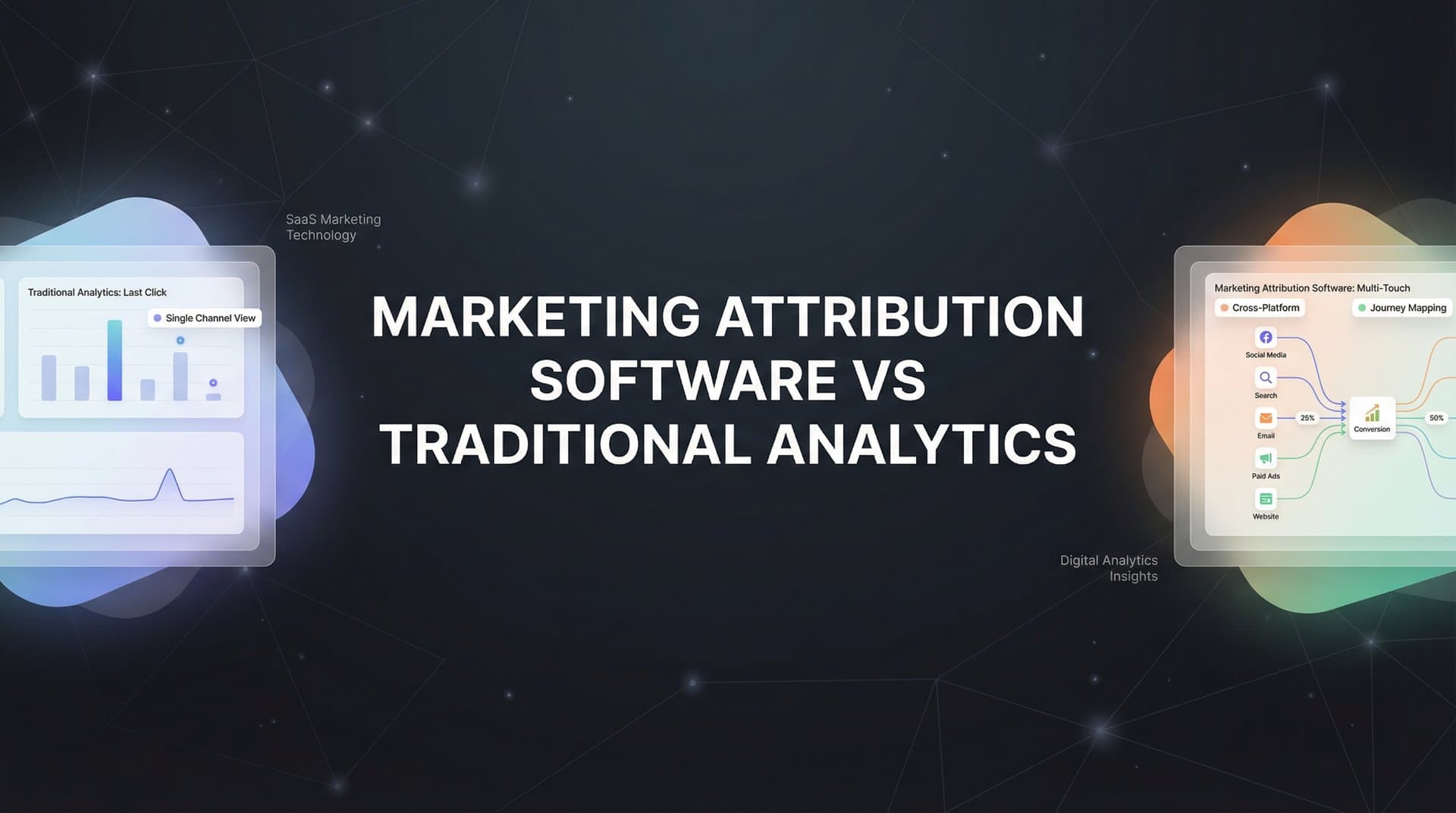
Marketing attribution software emerged to solve exactly this problem. While traditional analytics focus on website behavior, attribution platforms track the complete customer journey from first ad impression through final purchase. They connect marketing touchpoints to actual revenue outcomes. Both types of tools have their place in a modern marketing stack, but understanding the fundamental differences between them is crucial for any marketer who needs to optimize ad spend and prove ROI.
The Core Difference: Measuring Visits vs. Measuring Revenue
Traditional analytics platforms like Google Analytics were built to answer a specific question: how do people use my website? They excel at tracking on-site behavior. You can see which pages get the most traffic, where visitors drop off in your funnel, how long people spend reading your content, and which traffic sources send the most sessions.
This website-centric view provides valuable insights for UX optimization and content strategy. If your pricing page has a 90% bounce rate, that's a problem you need to fix. If blog posts about a specific topic consistently drive engagement, you should create more of that content.
Marketing attribution software starts with a fundamentally different question: which marketing efforts actually make money? Instead of focusing on website sessions, attribution platforms track individual customer journeys across multiple touchpoints and platforms. They follow a prospect from their first interaction with your brand—maybe a Facebook ad impression—through every subsequent touchpoint—a Google search, an email click, a retargeting ad—all the way to the moment they become a paying customer.
The distinction becomes crystal clear when you look at what each tool optimizes for. Traditional analytics help you improve your website. Attribution software helps you improve your marketing spend. If someone sees your Facebook ad on Monday, clicks a Google ad on Wednesday, and purchases on Friday after clicking an email, traditional analytics typically credits only that final email click. Attribution software shows you the complete sequence and assigns appropriate credit across all three touchpoints.
This difference matters enormously for paid advertisers. When you're spending thousands of dollars per month across multiple platforms, you need to know which campaigns generate actual customers, not just which ones generate the most website sessions. A campaign might send lots of traffic that bounces immediately—traditional analytics would show high traffic, but attribution software would reveal zero revenue contribution. Conversely, an awareness campaign might generate few direct clicks but influence dozens of conversions—invisible in traditional analytics, but clearly valuable in attribution data.
The fundamental tension is this: traditional analytics measure what happened on your website, while attribution software measures what happened in your marketing. For marketers trying to prove ROI and optimize ad spend, that second question is the one that actually matters.
Where Traditional Analytics Falls Short for Paid Advertisers
The limitations of traditional analytics become painfully obvious when you're running paid campaigns across multiple platforms. The first major blind spot is cross-platform tracking. Someone sees your Facebook ad while scrolling on their phone during lunch. That evening, they search for your brand on their laptop and click your Google ad. Three days later, they return directly to your site and make a purchase.
Traditional analytics typically credits that conversion to "direct traffic" or possibly to the Google ad if you're using last-click attribution. Facebook, which started the entire customer journey, gets zero credit. When you review your campaign performance, Facebook looks like it's underperforming while Google looks like a star. You might decide to shift budget from Facebook to Google—exactly the wrong decision based on incomplete data.
This cross-platform blind spot compounds when you're advertising on three, four, or five different platforms simultaneously. Traditional analytics can tell you that someone visited your site multiple times before converting, but they can't reliably tell you which ad platforms influenced those visits. You're essentially flying blind when making budget allocation decisions. Understanding cross channel marketing attribution becomes essential for accurate performance measurement.
The second critical limitation hit the industry hard starting in 2021: iOS privacy changes and cookie deprecation. When Apple introduced iOS 14.5 and required apps to ask permission for tracking, traditional pixel-based tracking accuracy plummeted. Many users opted out of tracking, creating massive gaps in conversion data. Marketers suddenly found their analytics dashboards showing 30-50% fewer conversions than their payment processors reported actually happened.
Browser-based tracking faces similar challenges. Safari blocks third-party cookies by default. Firefox does the same. Chrome is phasing them out. Ad blockers strip tracking pixels. Privacy-conscious users clear their cookies regularly. Every one of these actions creates holes in your traditional analytics data. You're making budget decisions based on incomplete information, and you might not even realize how incomplete it is.
The third major shortcoming is last-click attribution bias. Most traditional analytics platforms default to giving 100% credit to the last touchpoint before conversion. This systematically undervalues awareness and consideration campaigns while overvaluing bottom-funnel activities. Your brand awareness campaign on TikTok might be filling your pipeline with interested prospects, but if they ultimately convert after clicking a retargeting ad, TikTok gets zero credit in last-click models.
This bias distorts budget decisions in predictable ways. Marketers see retargeting campaigns with great "ROI" and awareness campaigns with poor "ROI," so they shift budget toward retargeting. But retargeting only works if you're generating awareness first. Cut the awareness budget too much, and your retargeting pool shrinks. Your overall results decline even as your reported efficiency metrics improve. You're optimizing for the wrong thing because your data tells an incomplete story.
What Marketing Attribution Software Actually Tracks
Marketing attribution software takes a fundamentally different approach to tracking. Instead of relying solely on browser-based cookies and pixels, modern attribution platforms use server-side tracking. When someone clicks your ad or visits your site, the conversion event is recorded directly on the platform's servers rather than depending on browser-based tracking that users can block.
This server-side approach bypasses many of the limitations plaguing traditional analytics. Ad blockers can't block it. Privacy settings can't disable it. Cookie clearing doesn't affect it. You capture conversion data that traditional analytics miss entirely, giving you a more complete and accurate picture of campaign performance.
The second core capability is multi-touch marketing attribution. Rather than giving 100% credit to a single touchpoint, attribution software distributes credit across all the touchpoints that influenced a conversion. Different models handle this distribution differently. Linear attribution splits credit equally across all touchpoints. Time-decay attribution gives more credit to touchpoints closer to the conversion. Position-based attribution emphasizes the first and last touchpoints while still crediting middle interactions.
More sophisticated platforms offer data-driven attribution that uses machine learning to analyze your actual conversion patterns and assign credit based on which touchpoints statistically have the most influence. This removes the guesswork from attribution modeling and bases credit distribution on your real customer behavior patterns.
The third critical feature is direct integration with your entire marketing ecosystem. Attribution software connects directly to your ad platforms—Facebook, Google, TikTok, LinkedIn—pulling in impression data, click data, and ad spend. It integrates with your CRM to track when leads become opportunities and when opportunities become customers. It connects to your payment processor or e-commerce platform to capture actual revenue data.
This unified view reveals the complete customer journey. You can see that a prospect first encountered your brand through a Facebook ad, clicked a Google ad two days later, engaged with three different retargeting ads over the following week, and finally converted after receiving an email. Each touchpoint is visible, and each receives appropriate credit based on your chosen attribution model.
Many attribution platforms also enable conversion data syncing back to ad platforms. This addresses another critical limitation of traditional tracking: ad platform algorithms need accurate conversion data to optimize targeting and bidding. When iOS privacy changes created conversion tracking gaps, ad platforms had less data to work with, making their optimization less effective. Attribution software with server-side tracking captures conversions that pixels miss, then feeds that data back to ad platforms so their algorithms can optimize more effectively.
The result is a closed loop: better tracking leads to better data, which leads to better ad platform optimization, which leads to better campaign performance. You're not just measuring more accurately—you're actually improving results by giving ad platforms the conversion signals they need.
When to Use Each: A Practical Framework
Understanding the differences between traditional analytics and attribution software doesn't mean choosing one over the other. Most sophisticated marketing operations use both tools because they serve complementary purposes. The key is knowing which tool to use for which decisions.
Traditional analytics remains invaluable for understanding on-site behavior and optimizing user experience. When you need to identify which pages have high bounce rates, where users drop off in your checkout flow, or which blog topics drive the most engagement, traditional analytics tools are built exactly for these questions. They excel at revealing technical issues, page load problems, and content performance patterns.
Use traditional analytics when you're making decisions about your website, your content strategy, or your user experience. If you're redesigning your pricing page, traditional analytics will show you how users currently interact with it. If you're planning your content calendar, traditional analytics reveal which topics resonate with your audience. These insights are valuable and actionable, even if they don't directly answer ROI questions.
Marketing campaign attribution software becomes essential when you're running paid campaigns across multiple platforms and need to make budget allocation decisions. If you're spending $10,000 per month or more on ads, you need accurate data about which campaigns and channels actually drive conversions. Attribution software provides this clarity by tracking the complete customer journey and connecting marketing touchpoints to revenue outcomes.
The decision point often comes when marketers face pressure to prove ROI or justify their ad spend. If leadership is asking which campaigns are worth the investment, traditional analytics can't provide a satisfying answer. They can tell you which traffic sources send the most sessions, but they can't reliably tell you which marketing efforts generate customers and revenue. That's when attribution software becomes not just helpful but necessary.
Many successful marketing teams use both tools in their stack with clear role separation. Traditional analytics handles website optimization, content performance, and user behavior insights. Attribution software handles campaign performance, budget allocation, and ROI reporting. The two tools complement each other rather than competing. You might use traditional analytics to identify that your demo request page has a high drop-off rate, then use attribution software to determine which ad campaigns are driving the most valuable demo requests despite that friction.
The practical framework is this: if you're primarily focused on organic traffic, content marketing, and website optimization, traditional analytics might be sufficient. If you're running paid campaigns across multiple platforms with significant budget at stake, attribution software fills critical gaps that traditional tools can't address. And if you're doing both—which most growing companies are—you benefit from having both tools working together in your stack.
The Hidden Cost of Attribution Gaps
The consequences of inaccurate attribution extend far beyond just not knowing which campaigns work. Poor attribution data creates a cascade of bad decisions that compounds over time, quietly eroding marketing effectiveness and wasting budget in ways that aren't immediately obvious.
The most common mistake is over-investing in bottom-funnel campaigns while starving awareness efforts. When you only see last-click data, retargeting campaigns and branded search look incredibly efficient. They show high conversion rates and low cost-per-acquisition. Meanwhile, your top-of-funnel awareness campaigns on Facebook or TikTok show poor direct ROI. The natural response is to shift budget toward what appears to be working—retargeting and branded search—and away from what appears wasteful—awareness campaigns.
This creates a slow-motion disaster. Retargeting only works if you have an audience to retarget. Branded search only converts if people already know your brand. When you cut awareness spending, you're shrinking the pool of prospects who can later be retargeted or search for your brand. Your bottom-funnel campaigns continue showing good efficiency metrics in the short term, but the pipeline slowly dries up. Three months later, you're wondering why conversions are declining even though your "best performing" campaigns are still running strong.
The second hidden cost involves ad platform optimization. Facebook, Google, and other platforms use machine learning algorithms to optimize ad delivery and targeting. These algorithms need accurate conversion data to learn which audiences and placements drive results. When you're missing 30-40% of your conversions due to tracking limitations, you're feeding these algorithms incomplete data.
The result is that you pay more for worse results. Ad platforms can't effectively optimize toward conversions they can't see. They might be showing your ads to people who actually convert, but if those conversions aren't being tracked and reported back, the algorithm thinks those audiences don't work. It adjusts targeting away from what's actually effective and toward what's visible in incomplete data. You're essentially training the algorithm to optimize for the wrong thing.
The compounding effect of poor attribution is particularly insidious. Bad data leads to bad decisions about budget allocation. Bad budget allocation leads to declining performance. Declining performance leads to pressure to cut marketing spend or prove ROI. The inability to prove ROI—because your attribution data is incomplete—leads to further budget cuts. Marketing becomes viewed as a cost center rather than a growth driver, and the entire function gets constrained.
Meanwhile, competitors with accurate attribution are making smarter decisions. They're investing confidently in awareness campaigns because they can see the full customer journey. They're feeding better data to ad platform algorithms, getting better optimization results. They're proving clear ROI to leadership, securing bigger budgets. The gap between companies with good attribution and those without widens over time, and it's not always obvious why one company's marketing seems to work so much better than another's.
The hidden cost isn't just wasted ad spend—though that's significant. It's the opportunity cost of not being able to scale what works because you don't know what actually works. It's the strategic disadvantage of making decisions based on incomplete information while competitors operate with clarity. It's the organizational friction that emerges when marketing can't definitively prove its value.
Making the Right Choice for Your Marketing Stack
The decision about whether you need marketing attribution software comes down to a few key questions about your current situation and goals. Start by honestly assessing your paid advertising spend. If you're spending less than $5,000 per month on ads, traditional analytics might provide sufficient insights for now. But once your monthly ad spend crosses $10,000 or $20,000, the cost of making wrong budget allocation decisions quickly exceeds the investment in proper attribution tools.
The second question is how many platforms you're advertising on. If you're only running Google Ads and all your conversions happen in a single session, traditional analytics can track that reasonably well. But if you're running campaigns across Facebook, Google, LinkedIn, TikTok, and other platforms—and customers typically interact with multiple platforms before converting—you're operating with significant blind spots without marketing channel attribution software.
The third question is whether you can currently prove which campaigns drive revenue. Try this exercise: open your analytics dashboard and identify exactly which campaigns generated your most valuable customers last month. If you can't answer that question with confidence, or if the data you have feels incomplete or contradictory, you've likely outgrown traditional analytics alone.
Several warning signs indicate you've reached the point where attribution software becomes necessary. If you're increasing ad spend but seeing diminishing returns and can't pinpoint why, that's a red flag. If different platforms report wildly different conversion numbers and you're not sure which to trust, that's another indicator. If leadership is pressuring you to prove marketing's impact on revenue and you're struggling to provide clear answers, attribution software addresses exactly that challenge. Understanding the common attribution challenges in marketing analytics can help you identify these gaps.
When evaluating attribution platforms, prioritize a few critical capabilities. Server-side tracking is essential for capturing conversions that browser-based tracking misses. Look for platforms that offer multiple attribution models rather than forcing you into a single approach—different models provide different insights, and flexibility matters. Direct integrations with your ad platforms, CRM, and payment systems are crucial for creating that unified view of the customer journey.
Also consider the platform's ability to sync conversion data back to ad platforms. This closed-loop capability doesn't just improve your reporting—it actively improves campaign performance by giving ad algorithms better data to optimize with. Some attribution platforms offer this feature, others don't, and it makes a meaningful difference in results. A thorough marketing attribution software comparison can help you evaluate these capabilities across vendors.
The implementation timeline matters too. Some attribution solutions require extensive technical setup and weeks of data collection before providing useful insights. Others can be deployed quickly and start delivering value within days. Consider your team's technical resources and how urgently you need better data when evaluating options.
Finally, think about scalability. You might be advertising on three platforms today, but if you plan to expand to five or six platforms next year, choose attribution software that can grow with you. The last thing you want is to outgrow your attribution solution just as you've finally gotten it fully implemented.
The right choice isn't always the most expensive or feature-rich platform. It's the one that solves your specific attribution challenges, integrates with your existing stack, and provides the insights you need to make confident budget allocation decisions. For many marketing teams, that means investing in attribution software that complements rather than replaces their traditional analytics tools.
Moving Forward With Confidence
Traditional analytics and marketing attribution software serve fundamentally different purposes in your marketing stack. Traditional analytics excel at measuring website behavior—how visitors interact with your content, where they drop off in your funnel, which pages drive engagement. These insights remain valuable for optimizing user experience and content strategy.
Marketing attribution software solves a different problem: connecting marketing touchpoints to actual revenue outcomes. For marketers running paid campaigns across multiple platforms, attribution software fills critical gaps that traditional tools can't address. It tracks complete customer journeys, assigns appropriate credit across touchpoints, bypasses browser-based tracking limitations, and provides the data needed to make confident budget allocation decisions. Platforms focused on marketing revenue attribution excel at connecting spend to actual business outcomes.
The choice isn't between one tool or the other—it's about using the right tool for each decision. Use traditional analytics to optimize your website and content. Use attribution software to optimize your marketing spend and prove ROI. Together, they provide the complete picture you need to grow efficiently.
As privacy regulations tighten and cookie-based tracking continues declining, the gap between traditional analytics and attribution software will only widen. Marketers who invest in proper attribution now position themselves to make smarter decisions, scale more confidently, and prove clear value to leadership. Those who rely solely on traditional analytics will find themselves making increasingly important decisions based on increasingly incomplete data.
The path forward is clear: understand what each tool does well, recognize where traditional analytics fall short for paid advertising, and build a marketing stack that gives you the insights you need to optimize spend and drive growth. Accurate attribution isn't just about better reporting—it's about making better decisions that compound into better results over time.
Ready to elevate your marketing game with precision and confidence? Discover how Cometly's AI-driven recommendations can transform your ad strategy—Get your free demo today and start capturing every touchpoint to maximize your conversions.