You're running campaigns across Meta, Google, and TikTok. Your Meta dashboard shows 150 conversions this month. Google Analytics reports 98. Your CRM logged 127 closed deals. So which number is real?
This isn't a minor reporting discrepancy. It's the attribution nightmare that's costing marketers thousands in wasted spend every single day.
When your data tells three different stories, you can't confidently scale what's working or cut what's failing. You end up making decisions based on incomplete information, doubling down on campaigns that look successful in one platform while the actual revenue tells a completely different story. The stakes are real: misattributed data doesn't just mess up your reports—it actively sabotages your growth strategy.
Here's what makes this challenge so frustrating: the tools you're using aren't broken. They're just fundamentally limited in what they can see. Each platform operates in its own silo, tracking only the slice of the customer journey that happens within its walls. Privacy changes have made the problem exponentially worse. And the complexity of modern buyer behavior—switching devices, taking weeks to convert, interacting with multiple touchpoints—has turned attribution from a simple tracking exercise into a sophisticated data puzzle.
This guide breaks down exactly why attribution falls apart and, more importantly, what you can do about it. We'll walk through the core challenges creating data gaps in your marketing stack and show you how modern approaches are solving problems that seemed unsolvable just a few years ago.
The Data Fragmentation Problem: When Your Platforms Live in Different Universes
Picture your marketing stack as a group of people describing the same elephant while blindfolded. Meta touches the trunk and insists the elephant is long and flexible. Google grabs the leg and argues it's sturdy and cylindrical. Your CRM feels the tail and reports something thin and rope-like. They're all technically correct—and all completely missing the full picture.
This is data fragmentation in action. Each platform tracks conversions using its own methodology, its own attribution window, and its own definition of what counts as a conversion. Meta might credit a conversion to an ad someone clicked three days ago. Google Analytics might attribute the same conversion to organic search because that was the last touchpoint before purchase. Your CRM records the conversion based on when the deal actually closed, which could be weeks after any digital interaction.
The double-counting problem makes this even messier. When someone clicks your Meta ad, then searches your brand name on Google and clicks a search ad, then converts—both Meta and Google will claim credit for that conversion. If you're looking at platform dashboards separately, you'll see two conversions when only one person actually bought. Scale this across hundreds of conversions per month, and your reported numbers can inflate dramatically compared to actual revenue.
But here's where it gets truly problematic: these disconnected systems can't show you the sequence of events that led to conversion. You might see that Meta generated 50 conversions and Google generated 40, but you have no idea how many of those conversions involved both platforms. Did the customer see your Meta ad first, then search on Google? Or did they search first, see your Meta ad, then come back through organic? Without understanding these interaction patterns, you're essentially flying blind. Understanding channel attribution in digital marketing becomes essential for connecting these dots.
The fragmentation extends beyond ad platforms. Your website analytics, email marketing tool, CRM, and even offline conversion tracking all operate as separate islands. A customer might engage with your email campaign, click through to your website, browse on mobile, then convert days later on desktop after seeing a retargeting ad. Each system sees only its piece of this journey, and none of them can connect the dots to show you the complete path to purchase.
This creates a fundamental trust problem with your data. When your dashboards contradict each other, which one do you believe? Most marketers default to whichever platform shows the best results, which is exactly the wrong approach. The platform showing the highest conversion count is often the one with the most aggressive attribution model, not necessarily the one driving the most actual revenue.
Privacy Changes That Shattered the Old Playbook
Remember when tracking was simple? You dropped a pixel on your website, and it captured everything. Those days are gone, and they're not coming back.
Apple's iOS 14.5 update in 2021 introduced App Tracking Transparency, fundamentally changing how mobile tracking works. Suddenly, apps had to ask users for permission to track their activity across other apps and websites. Most users said no. For marketers relying on Meta's pixel to track conversions from mobile ads, this created massive blind spots overnight. The pixel that used to capture nearly every conversion was now missing a significant portion of iOS users who opted out of tracking.
The impact wasn't subtle. Many advertisers saw their reported conversion counts drop substantially, not because their ads stopped working, but because the tracking mechanism could no longer see the conversions happening. This created a cruel irony: campaigns that were actually performing well looked like failures in the dashboard because the data simply wasn't being captured. These attribution challenges in digital marketing have fundamentally reshaped how we approach measurement.
Browser-level tracking prevention has been equally disruptive. Safari's Intelligent Tracking Prevention limits how long cookies persist and blocks third-party cookies entirely. Firefox's Enhanced Tracking Protection does the same. And while Google has delayed its plan to deprecate third-party cookies in Chrome, the direction is clear: browser-based tracking is being systematically dismantled across the web.
These privacy changes don't just reduce the volume of data you collect—they introduce bias into your attribution. The conversions you can still track tend to come from users who are less privacy-conscious or using older devices. Meanwhile, conversions from privacy-aware users on modern devices go completely dark. Your data no longer represents your full customer base; it represents only the subset that's still trackable through browser-based methods.
The attribution window problem compounds these challenges. Meta and Google have shortened their attribution windows in response to privacy restrictions. Where you might have previously tracked conversions up to 28 days after an ad click, many platforms now default to 7-day click attribution. For businesses with longer sales cycles, this means legitimate conversions that happen outside these shortened windows simply don't get attributed to any marketing activity.
What makes this particularly frustrating is that the conversions are still happening—you're still making sales, closing deals, and generating revenue. The problem is that your tracking infrastructure can no longer connect those outcomes back to the marketing touchpoints that drove them. It's like running a successful restaurant but having a broken cash register that only records half your transactions. The business is working, but your data makes it look like it's failing.
The Multi-Touch Attribution Maze: When Every Touchpoint Claims Victory
Here's a truth that every marketer knows but most reporting systems ignore: customers almost never convert from a single touchpoint. The path to purchase looks more like a winding journey than a straight line.
Think about how you make significant purchases. You probably see an ad, visit the website, leave, see another ad, read reviews, compare alternatives, come back through search, browse on mobile, and finally convert days or weeks later on desktop. That's six or seven touchpoints before a single conversion. Now imagine trying to decide which one "deserves" credit for that sale.
First-click attribution gives all credit to the initial touchpoint. It's great for understanding what brings people into your funnel, but it completely ignores everything that happened afterward. If someone clicked your brand awareness campaign three weeks ago and converted yesterday after seeing a retargeting ad, first-click attribution credits the awareness campaign—even though the retargeting ad might have been the actual trigger that drove the conversion.
Last-click attribution does the opposite: it credits only the final touchpoint before conversion. This model makes your bottom-of-funnel campaigns look like heroes while completely undervaluing the upper-funnel work that introduced customers to your brand in the first place. Your retargeting campaigns will look incredibly efficient under last-click, but that's only because they're capturing credit from all the earlier touchpoints that did the heavy lifting.
The challenge intensifies with longer sales cycles. B2B companies often have buying journeys that span 30, 60, or even 90 days. A prospect might engage with a LinkedIn ad in January, attend a webinar in February, receive nurture emails throughout March, and finally convert in April. Which touchpoint mattered most? The honest answer is that they all contributed, but figuring out how to weight their relative importance is incredibly complex. This is why common attribution challenges in B2B marketing require specialized approaches.
Linear attribution tries to solve this by giving equal credit to every touchpoint. Sounds fair, right? But it's overly simplistic. Not all touchpoints are created equal. The ad that introduced someone to your product and the retargeting ad that finally convinced them to buy played fundamentally different roles in the conversion process. Treating them as equally valuable misses crucial insights about what's actually driving decisions.
Time-decay and position-based models attempt more sophisticated weighting, but they introduce their own assumptions. Time-decay gives more credit to recent touchpoints, which works well for impulse purchases but poorly for considered B2B sales. Position-based models credit the first and last touches more heavily, which captures the "bookends" of the journey but potentially undervalues crucial middle touchpoints where customers were doing research and building trust.
The real maze is that there's no universally correct attribution model. The right approach depends on your sales cycle, your product complexity, and your customer behavior patterns. But most marketers are stuck using whatever attribution model their primary platform defaults to, which means they're making strategic decisions based on an arbitrary weighting system they didn't consciously choose. A comprehensive multi-touch marketing attribution platform can help navigate these complexities.
Cross-Device and Cross-Channel Blind Spots
Your customers don't live in a single device or channel, so why does your attribution assume they do?
The cross-device challenge is straightforward but brutal: someone sees your ad on their phone during their morning commute, browses your website on their work computer during lunch, and converts on their tablet at home that evening. Traditional cookie-based tracking sees these as three completely different people. Your analytics show three separate sessions with no connection between them, and your attribution has no idea these interactions are part of the same buying journey.
This isn't a rare edge case. Many customers regularly switch between mobile and desktop throughout their day. The person who clicks your Instagram ad on their phone is often the same person who later searches your brand name on their laptop. But without a way to connect these devices to a single user, your attribution treats them as separate journeys—which means you're dramatically undercounting how many touchpoints actually contribute to each conversion.
The offline conversion gap creates even bigger blind spots. Someone might click your Facebook ad, then call your sales team to close the deal. Or they might research online and purchase in-store. These offline conversions are completely invisible to your digital attribution unless you have systems in place to manually connect them back to the original touchpoint. For businesses with phone sales or retail locations, this can mean the majority of your actual conversions never show up in your marketing dashboards. Implementing marketing attribution for phone calls is critical for capturing this revenue.
Attribution windows add another layer of complexity. Most platforms use 7-day or 28-day click attribution windows, meaning they'll only credit conversions that happen within that timeframe after someone clicks your ad. But what if your sales cycle is longer? What if someone clicks your ad, goes through a 45-day evaluation process, and then converts? That conversion falls outside the attribution window, so it gets reported as "direct" or "organic" even though paid advertising was the original driver.
The delayed conversion problem is particularly painful for high-consideration purchases. Software tools, professional services, and B2B products often have sales cycles measured in months, not days. A prospect might engage with your content in January, enter your nurture sequence, have multiple sales conversations, and finally convert in March. By that time, the original ad click that started the journey is ancient history according to standard attribution windows.
Cross-channel measurement struggles with similar issues. A customer might discover you through a podcast ad, search your brand on Google, click a Meta retargeting ad, sign up for your email list, and convert after receiving a promotional email. That's five different channels, and unless you have a unified system tracking all of them, you'll never see how they worked together to drive that conversion. Each channel will report its own metrics in isolation, giving you no insight into the sequence or interaction effects.
How Modern Attribution Solutions Close These Gaps
The good news? The attribution challenges we've outlined aren't unsolvable. Modern approaches have emerged that address these problems directly, and they work fundamentally differently than the old pixel-based tracking methods.
Server-side tracking represents the most significant shift in how conversion data gets captured. Instead of relying on browser pixels that can be blocked by privacy settings, server-side tracking sends data directly from your server to ad platforms and analytics tools. When someone converts on your website, your server logs that event and transmits it to Meta, Google, and your analytics platform—regardless of whether the user's browser allows cookies or tracking pixels.
This approach solves multiple problems simultaneously. It's privacy-compliant because it doesn't rely on third-party cookies or cross-site tracking. It's more accurate because it captures conversions that browser-based pixels miss. And it's more reliable because server-to-server communication isn't affected by ad blockers, browser settings, or device limitations. For marketers who saw their conversion tracking collapse after iOS 14.5, server-side tracking recovers much of that lost visibility.
Unified attribution platforms take this a step further by connecting data from all your marketing touchpoints in one place. Instead of checking Meta's dashboard for Meta conversions and Google's dashboard for Google conversions, a unified platform pulls data from all your ad accounts, your website analytics, your CRM, and even offline conversion sources. This creates a single source of truth where you can see the complete customer journey across every channel and device. The best marketing attribution tools provide this unified view while maintaining data accuracy.
The power of unified platforms isn't just convenience—it's the ability to see interaction patterns that are invisible in siloed systems. You can track how many customers saw both a Meta ad and a Google ad before converting. You can identify whether email nurture sequences increase conversion rates from retargeting campaigns. You can connect phone calls and in-store purchases back to the digital ads that drove them. This complete view transforms attribution from guesswork into genuine insight.
AI is playing an increasingly important role in making sense of complex attribution data. Machine learning models can analyze thousands of conversion paths to identify patterns human analysts would miss. They can weight touchpoints based on actual conversion probability rather than arbitrary rules. And they can provide specific recommendations: "Your Google Search campaigns are consistently the first touchpoint for high-value customers—consider increasing budget there" or "Conversions from Meta ads spike 3 days after email sends—align your campaign timing."
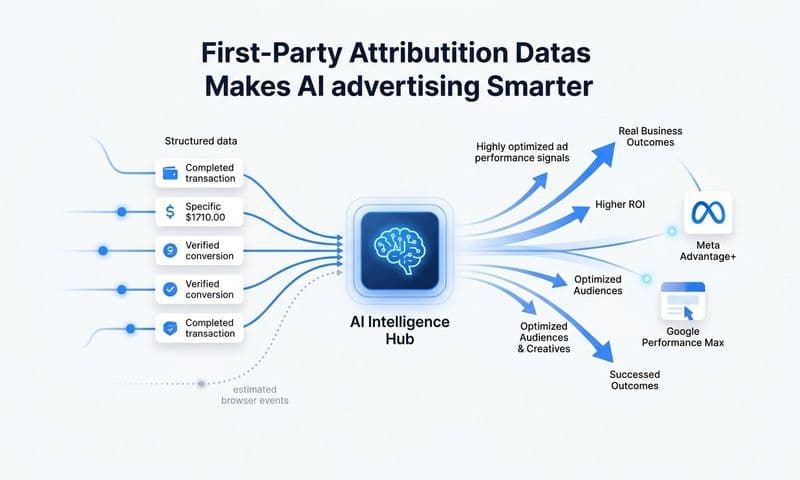
Conversion sync closes the feedback loop by sending enriched conversion data back to ad platforms. When your attribution system knows that a conversion came from a high-value customer who made a $10,000 purchase, it can feed that information back to Meta and Google. This helps their algorithms optimize for the outcomes you actually care about rather than just raw conversion volume. The ad platforms learn which types of users are most valuable, improving targeting and bidding decisions over time. Understanding marketing attribution software for revenue attribution helps you implement this feedback loop effectively.
The combination of these approaches—server-side tracking for accurate data capture, unified platforms for complete journey visibility, AI for pattern recognition, and conversion sync for platform optimization—addresses the core attribution challenges that have plagued marketers for years. You get more complete data, better insights, and ad platforms that optimize toward your actual business goals rather than proxy metrics.
Building an Attribution Strategy That Delivers Real Insights
Understanding attribution challenges is one thing. Actually fixing them requires a systematic approach. Here's how to build an attribution strategy that works for your specific business.
Start with an honest audit of your current setup. Log into each platform you use and document what attribution model it's using by default. Check your Google Analytics settings, your Meta Ads Manager, your Google Ads account, and any other platforms where you're running campaigns. You'll probably discover that different platforms are using different models, which explains why their numbers never match. This audit isn't about finding the "right" model yet—it's about understanding why your current data tells conflicting stories.
Next, map out your actual customer journey. Talk to your sales team about how long deals typically take to close. Review your CRM data to see how many touchpoints customers have before converting. Look at your website analytics to understand whether people typically convert on their first visit or come back multiple times. This real-world understanding of your sales cycle should drive your attribution strategy, not the other way around. Learning how to use data analytics in marketing provides the foundation for this analysis.
Choose attribution models based on your sales cycle length and business goals. If you're selling low-cost products with quick purchase decisions, last-click attribution might work fine—most conversions happen close to the final touchpoint anyway. But if you're selling complex B2B solutions with 60-day sales cycles, you need multi-touch attribution that captures the full journey. Many businesses benefit from using multiple models in parallel: last-click for day-to-day optimization and multi-touch for strategic budget allocation.
Implement server-side tracking if you haven't already. This is non-negotiable for accurate attribution in the current privacy environment. Browser-based pixels alone will miss too many conversions to give you reliable data. Server-side tracking ensures you're capturing conversions from iOS users, privacy-focused browsers, and anyone using ad blockers. The technical implementation varies by platform, but the investment pays for itself in data accuracy.
Connect your offline conversions to your digital attribution. If you have phone sales, implement call tracking that ties phone numbers back to the campaigns that drove them. If you have retail locations, create systems to capture online research activity that leads to in-store purchases. These offline conversions are often your highest-value transactions—leaving them out of your attribution creates a massive blind spot in your most important revenue streams.
Feed accurate conversion data back to your ad platforms. This is where attribution moves from reporting to optimization. When Meta and Google receive enriched conversion data—including revenue values, customer lifetime value predictions, and which conversions came from your ideal customer profile—their algorithms can optimize toward outcomes that actually matter to your business. This feedback loop turns attribution from a backwards-looking reporting exercise into a forward-looking optimization engine. Effective marketing analytics and reporting makes this process seamless.
Review and refine regularly. Attribution isn't a set-it-and-forget-it system. As your business evolves, your sales cycle changes, and privacy regulations shift, your attribution strategy needs to adapt. Schedule quarterly reviews of your attribution setup to ensure it's still capturing the data you need and providing insights that drive real decisions.
Turning Attribution Insights Into Confident Scaling Decisions
Attribution challenges aren't just technical problems to solve—they're barriers to growth that keep you from confidently scaling what's working. When your data is fragmented, incomplete, or contradictory, every budget decision becomes a gamble. You're never quite sure which campaigns are truly driving revenue and which ones are just claiming credit for conversions they didn't cause.
The marketers who win in the current environment are the ones who've moved beyond basic platform reporting to unified attribution systems that show the complete picture. They're using server-side tracking to capture conversions that browser pixels miss. They're connecting online and offline touchpoints to understand the full customer journey. And they're feeding enriched conversion data back to ad platforms to improve optimization over time.
This isn't about achieving perfect attribution—that's impossible in a world of cross-device journeys and privacy restrictions. It's about building systems that are accurate enough to make confident decisions. When you can see which campaigns consistently appear early in high-value customer journeys, you can invest more in top-of-funnel awareness. When you understand which retargeting sequences drive the highest conversion rates, you can optimize your creative and targeting. When you know which channels work together synergistically, you can coordinate your campaigns for maximum impact.
The gap between marketers using fragmented attribution and those using unified systems is widening. As privacy changes continue to erode traditional tracking methods, businesses relying on outdated approaches will fall further behind. Meanwhile, companies that invest in modern attribution infrastructure will have clearer visibility, better optimization, and more confident scaling decisions.
Your attribution challenges are solvable. The tools exist to capture complete journey data, connect touchpoints across channels and devices, and turn that data into actionable insights. The question isn't whether better attribution is possible—it's whether you're ready to implement the systems that make it happen.
Ready to elevate your marketing game with precision and confidence? Discover how Cometly's AI-driven recommendations can transform your ad strategy—Get your free demo today and start capturing every touchpoint to maximize your conversions.