Your marketing dashboard shows thousands of clicks, hundreds of leads, and dozens of closed deals. But when your CFO asks which campaigns actually drove revenue, you're left piecing together fragments from Google Analytics, your CRM, LinkedIn reports, and spreadsheets that never quite line up. Sound familiar?
B2B attribution isn't just complicated—it's fundamentally broken for most marketing teams. Unlike B2C purchases where someone sees an ad and buys within hours, your prospects spend months researching, involving multiple stakeholders, jumping between devices, and interacting with your brand across channels you may not even be tracking. By the time they convert, the trail has gone cold, cookies have expired, and you're left guessing which touchpoints actually mattered.
The stakes couldn't be higher. Misattribution doesn't just bruise egos—it leads to budget decisions that starve high-performing channels while feeding underperformers. It creates friction between marketing and sales teams who can't agree on what's working. And it leaves you defending marketing spend based on gut feeling rather than data.
This guide breaks down the most common attribution challenges B2B marketers face and, more importantly, shows you practical ways to solve them. Because accurate attribution isn't about settling debates over credit—it's about making confident decisions that actually scale revenue.
Why B2B Attribution Operates in a Different Universe
If you've ever tried applying B2C attribution logic to B2B campaigns, you've probably discovered it fails spectacularly. The difference isn't just scale—it's fundamental to how businesses buy.
Consider the timeline. A consumer sees a Facebook ad for running shoes, clicks through, and purchases within the same session. Total journey: fifteen minutes. Your B2B prospect downloads a whitepaper in January, attends a webinar in March, requests a demo in May, and finally signs a contract in August. That's a seven-month journey with weeks or months between touchpoints.
Here's the problem: most tracking technologies weren't built for this reality. Browser cookies typically expire after 30 to 90 days. Google Analytics sessions timeout after 30 minutes of inactivity. By the time your prospect converts months later, the original touchpoint data has evaporated. You're trying to connect dots that no longer exist in your tracking system.
Then there's the buying committee challenge. That consumer buying running shoes? One person, one decision. Your B2B deal? The marketing manager who clicked your LinkedIn ad, the director who attended your webinar, the VP who sat through the demo, and the CFO who approved the contract. Traditional attribution tracks individuals, but B2B deals happen at the account level.
This creates a visibility gap. You might see that someone from Acme Corp downloaded your ebook, but you have no idea that three other people from the same company engaged with different touchpoints. Your attribution model gives credit to one interaction while missing the coordinated research happening across the buying committee.
And let's talk about what happens offline. Your prospect attends your booth at a trade show, has a discovery call with sales, sits through an in-person demo, and exchanges emails with your customer success team. None of these interactions generate tracking pixels or UTM parameters. Yet they're often the most influential touchpoints in the entire journey.
Most marketing analytics platforms are blind to these offline moments. So you end up with attribution models that credit the last digital touchpoint before conversion—usually a direct website visit or branded search—while completely ignoring the conference conversation that actually sold the deal. Your data tells a story, but it's missing entire chapters.
When Your Data Lives in Separate Worlds
Picture your marketing data as a jigsaw puzzle scattered across different rooms of your house. Google Ads knows about clicks and conversions. Facebook has its own version of events. Your CRM tracks opportunities and revenue. Google Analytics sees website behavior. Each system holds pieces of the truth, but none of them talk to each other.
This fragmentation isn't just inconvenient—it makes accurate attribution mathematically impossible. When your ad platform says it drove 50 conversions but your CRM only shows 30 new opportunities, which number do you trust? When Google Analytics attributes a conversion to organic search but your CRM shows the lead came from a LinkedIn campaign, who's right?
The answer is usually that both systems are partially correct and partially wrong. They're measuring different things at different points in the journey using different tracking methods. Google Analytics might credit organic search because that's how the prospect landed on your website for the final conversion. But LinkedIn actually introduced them to your brand three months earlier. Without a unified view, you're making budget decisions based on incomplete information.
Cross-device tracking adds another layer of complexity. Your prospect discovers your brand on their phone during their morning commute. They research your solution on their work laptop during the day. They share your case study with colleagues on a conference room screen. They finally convert on a tablet at home over the weekend.
To your tracking systems, these look like four different people. Traditional cookie-based attribution can't connect these sessions because cookies don't transfer between devices. You end up with a fragmented journey that looks like four separate prospects when it's actually one person moving through their day.
Privacy changes have accelerated this fragmentation crisis. iOS updates now block tracking by default, meaning a significant portion of mobile traffic is invisible to your attribution tools. Browser changes are phasing out third-party cookies entirely. The tracking methods that worked five years ago are increasingly unreliable.
Many marketers respond by installing more tracking pixels and integrations, hoping that more data will solve the problem. But adding more disconnected data sources just creates more silos. You don't need more data—you need connected data that flows between systems and maintains identity across the customer journey.
The real solution requires a unified platform that sits above your individual marketing tools and connects the dots between them. Think of it as a translation layer that takes the partial truth from each system and reconstructs the complete customer journey. Without this unified view, you're not just missing attribution accuracy—you're missing the insights that drive better marketing decisions. Understanding attribution challenges in digital marketing is the first step toward solving them.
The Attribution Model Trap
Let's say you finally solve the data fragmentation problem. Your tracking is solid, your systems are connected, and you're ready to implement attribution. Now comes the question that stumps most B2B marketers: which attribution model should you use?
First-touch attribution is appealingly simple. It gives all credit to the first touchpoint that introduced the prospect to your brand. Great for measuring awareness campaigns, terrible for everything else. In B2B, the first touch might happen months before conversion and involve a prospect who wasn't even in-market yet. Giving that touchpoint 100% credit ignores all the nurturing, education, and relationship-building that actually closed the deal.
Last-touch attribution flips the script—all credit goes to the final touchpoint before conversion. This is what most CRM systems default to, which is why direct traffic and branded search often get overvalued. The problem? By the time someone's ready to convert, they've already been influenced by multiple earlier touchpoints. Last-touch attribution rewards the finish line while ignoring the entire race.
Multi-touch attribution sounds like the perfect solution. Spread credit across all touchpoints based on their influence. Models like linear, time-decay, and position-based try to weight different stages of the journey. But here's the catch: multi-touch attribution only works if you have complete, connected data across all touchpoints.
Remember that fragmentation problem? If your tracking has gaps—and in B2B, it always has gaps—then your multi-touch model is distributing credit across an incomplete journey. You might think you're getting sophisticated attribution when you're actually just spreading inaccuracy across more touchpoints.
The model you choose should match your actual business reality. If you're running mostly bottom-of-funnel campaigns targeting in-market buyers, last-touch might be perfectly adequate. If you're investing heavily in awareness and thought leadership, you need a model that values early-stage touchpoints. If you have a complex, multi-month sales cycle with multiple channels, you need multi-touch—but only if your data infrastructure can support it.
Many B2B marketers make the mistake of choosing an attribution model based on what sounds sophisticated rather than what matches their data quality and business model. They implement multi-touch attribution with fragmented data and wonder why the results don't make sense. Or they stick with last-touch because it's simple, then struggle to justify spending on awareness campaigns that never get credit. Learning about types of marketing attribution models helps you make an informed choice.
The right approach starts with honest assessment. How complete is your tracking? How long is your sales cycle? What types of campaigns are you running? Choose the model that fits your current reality, not the one that sounds best in theory. And be prepared to evolve your model as your data infrastructure improves.
The Missing Piece: Account-Level Attribution
Here's a scenario that plays out constantly in B2B marketing. Your attribution report shows that Jane Smith from Acme Corp converted after clicking a LinkedIn ad. You credit LinkedIn with the conversion and allocate more budget accordingly. What you don't see is that three other people from Acme Corp engaged with your content through different channels—a Google search, an email campaign, and a referral from a partner.
Individual-level attribution misses the forest for the trees. In B2B, accounts buy—not individuals. That LinkedIn click from Jane might have been the conversion trigger, but the real story is that Acme Corp as an organization was researching your solution across multiple channels and stakeholders.
Traditional marketing analytics platforms track cookies and user sessions. They're built for B2C scenarios where one person equals one buying decision. But when you're selling to businesses, you need to roll up all individual touchpoints to the account level to understand what's really driving deals.
This requires tight integration between your marketing tools and your CRM. Your CRM is where account-level data lives—company names, deal stages, revenue amounts, and the relationships between contacts at the same organization. Your marketing platforms know about clicks, impressions, and conversions. To get account-level attribution, you need to connect these two worlds. A dedicated B2B marketing attribution agency can help bridge this gap.
The challenge is that most marketing platforms don't natively understand accounts. They see individual email addresses and cookie IDs. Your CRM sees companies and opportunities. Bridging this gap requires matching individual contacts to their parent accounts, then aggregating all marketing touchpoints for everyone at that account.
When you make this shift, attribution looks completely different. That "underperforming" content marketing campaign that never gets last-touch credit? It might be influencing multiple stakeholders at your highest-value accounts. That expensive trade show that's hard to measure? It could be generating awareness across buying committees that convert months later through other channels.
Account-level attribution also reveals dark social and word-of-mouth influence that individual tracking misses. When someone at Acme Corp shares your content internally or mentions your brand in a Slack channel, traditional attribution sees nothing. But when you track at the account level, you notice increased engagement from multiple contacts at the same company—a signal that your brand is spreading through the organization.
Implementing account-level attribution requires more than just a setting you toggle on. You need clean CRM data with properly deduplicated accounts. You need a way to match marketing touchpoints to CRM contacts and roll them up to accounts. And you need reporting that shows both individual and account-level views so you can understand the complete picture.
The payoff is worth the effort. Account-based marketing only works if you have account-based attribution to measure it. Otherwise, you're running ABM campaigns but measuring success with individual-level metrics that miss the whole point. Leveraging B2B marketing analytics gives you the complete view you need.
Solutions That Actually Move the Needle
Enough about problems—let's talk about what actually works. The B2B attribution challenges we've covered aren't theoretical. They're daily frustrations that cost real marketing budgets. But they're also solvable with the right approach and tools.
Server-side tracking has become essential for B2B marketers who want reliable data. Unlike client-side tracking that depends on browser cookies and pixels, server-side tracking captures conversion events directly from your server. When someone fills out a form or completes a purchase, your server sends that data to your analytics and ad platforms—no cookies required.
This approach bypasses the privacy restrictions and ad blockers that break traditional tracking. iOS updates that block pixels? Not a problem when you're tracking server-side. Cookie deprecation? Doesn't affect server-to-server data transmission. You get more complete, more accurate data because you're not relying on the user's browser to cooperate.
Server-side tracking also lets you enrich conversion data before sending it to ad platforms. You can include customer lifetime value, account information, and CRM data that helps ad algorithms optimize for the outcomes that actually matter to your business. Instead of optimizing for form fills, you can optimize for high-value accounts or closed revenue. Our guide on attribution marketing tracking covers these techniques in depth.
But server-side tracking alone doesn't solve the fragmentation problem. You still need a unified platform that connects data across all your marketing channels and your CRM. This is where modern attribution platforms come in—they sit above your individual tools and create a single source of truth for your customer journey.
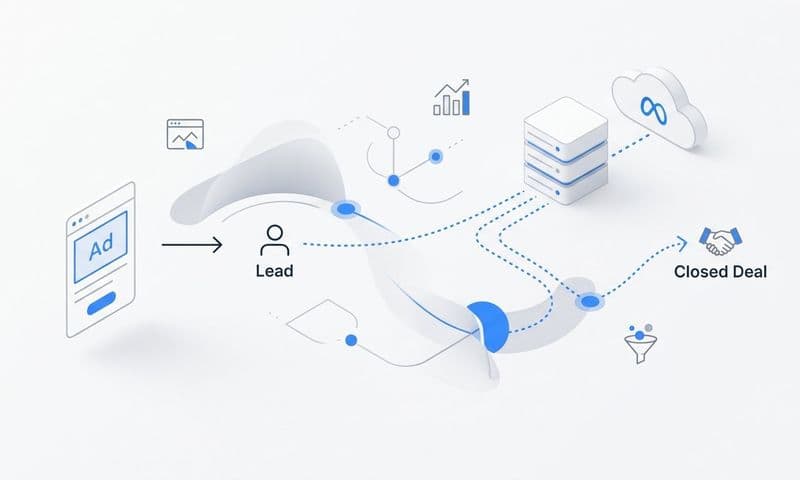
These platforms work by ingesting data from all your marketing channels, your website, and your CRM, then matching and deduplicating records to create unified customer profiles. When someone clicks a LinkedIn ad, downloads a whitepaper, attends a webinar, and eventually converts, the platform connects all these touchpoints to the same person and account.
The real power comes from real-time data flow. Instead of reconciling data in spreadsheets days or weeks after campaigns run, unified platforms track everything as it happens. You can see which accounts are engaging with your brand right now, which channels are driving pipeline today, and which campaigns need budget adjustments this week. Exploring marketing attribution platforms for revenue tracking helps you find the right solution.
AI-powered analysis has become crucial for making sense of complex B2B journeys. When you're dealing with dozens of touchpoints across months-long sales cycles, pattern recognition becomes humanly impossible. AI can identify which combinations of touchpoints correlate with closed deals, which channels work best together, and which marketing activities predict future revenue.
This isn't about replacing human judgment—it's about augmenting it. AI can surface insights like "accounts that engage with both webinars and case studies convert at 3x the rate" or "LinkedIn ads perform best when followed by email nurture within 48 hours." These are patterns that exist in your data but would take weeks of manual analysis to discover. Learn more about how machine learning can be used in marketing attribution to unlock these insights.
The most effective attribution solutions combine all these elements: server-side tracking for data accuracy, unified platforms for connected insights, CRM integration for account-level view, and AI analysis for pattern recognition. When these pieces work together, you move from fragmented guesswork to confident, data-driven decisions.
Building Attribution You Can Actually Trust
The technology matters, but it's only part of the solution. The most sophisticated attribution platform in the world won't help if your underlying data is messy or your team doesn't trust the insights it produces.
Start with data hygiene. Before worrying about attribution models or AI analysis, make sure your foundational data is clean. That means deduplicated CRM records, consistent naming conventions across campaigns, proper UTM parameter usage, and regular audits to catch tracking gaps. Garbage in, garbage out applies just as much to attribution as anything else.
Create a single source of truth for campaign naming and tracking. When your Google Ads team uses one naming convention, your LinkedIn team uses another, and your content team doesn't use UTM parameters at all, your attribution data becomes impossible to aggregate. Establish standards and enforce them consistently across all channels.
Focus on actionable insights over perfect attribution. You'll never have 100% complete data or perfectly accurate credit assignment. That's okay. The goal isn't perfection—it's confidence. Can you identify your top-performing channels with reasonable accuracy? Can you spot underperforming campaigns quickly enough to adjust? Can you defend your budget allocation with data?
These questions matter more than whether your attribution model is theoretically optimal. A simple attribution approach with clean data beats a sophisticated model built on fragmented information every time. Understanding what a marketing attribution model is helps you set realistic expectations.
Build feedback loops between marketing and sales. Your attribution data should tell a story that sales recognizes as true. If your model says LinkedIn is your top channel but sales says most deals come from referrals, something's wrong. Regular alignment meetings where marketing and sales compare notes help validate attribution accuracy and catch blind spots.
These conversations also surface the offline touchpoints that don't appear in your tracking. When sales mentions that trade show conversations are consistently mentioned in deals, you know to factor that into your attribution analysis even if the data doesn't perfectly capture it.
Test and iterate your attribution approach. Start with a simple model that matches your current data quality, then evolve as your infrastructure improves. Run parallel attribution models to compare results. Look for consistency across different approaches—if multiple models point to the same insights, you can trust them more confidently.
Document your attribution methodology so everyone understands what you're measuring and how. When stakeholders know the limitations and assumptions in your attribution model, they can interpret results appropriately. Transparency builds trust, even when the data isn't perfect.
From Attribution Chaos to Marketing Confidence
B2B attribution challenges are real, but they're not insurmountable. The marketers who succeed aren't the ones with perfect data—they're the ones who acknowledge the complexity, implement practical solutions, and focus on insights that drive better decisions.
The shift from fragmented guesswork to unified attribution transforms how marketing teams operate. Instead of defending budgets with anecdotes and assumptions, you can point to data that connects marketing activity to revenue. Instead of arguing about which channel deserves credit, you can see how channels work together to move accounts through the pipeline. Instead of flying blind between campaign launch and closed deals, you can optimize in real time based on what's actually working.
This isn't just about settling attribution debates or producing prettier reports. It's about making confident decisions that compound over time. When you know which campaigns drive pipeline, you can double down on what works and cut what doesn't. When you understand the complete customer journey, you can design better experiences that move prospects toward conversion. When you connect marketing touchpoints to revenue, you can finally prove marketing's impact in the language executives understand.
The tools and approaches exist to solve these challenges. Server-side tracking provides reliable data collection. Unified platforms connect fragmented systems. CRM integration enables account-level insights. AI analysis surfaces patterns in complex journeys. The question isn't whether accurate B2B attribution is possible—it's whether you're willing to invest in the infrastructure and processes that make it work.
Start where you are. Audit your current tracking to identify the biggest gaps. Clean up your data foundations. Choose an attribution approach that matches your business reality. Build alignment between marketing and sales. Then iterate and improve as you learn what works for your specific situation.
Ready to elevate your marketing game with precision and confidence? Discover how Cometly's AI-driven recommendations can transform your ad strategy—Get your free demo today and start capturing every touchpoint to maximize your conversions.