You're spending $10,000 a month on Facebook ads, another $8,000 on Google, and $5,000 on LinkedIn. Your dashboard shows conversions coming from all three platforms. You add them up: 150 conversions total. But when you check your CRM, you only closed 87 actual customers last month.
What happened to the other 63 conversions?
Here's the uncomfortable truth: they never existed as separate customers. That single person who clicked your Facebook ad, then searched your brand on Google, then finally converted through a LinkedIn retargeting campaign? All three platforms claimed credit for that one conversion. You're not measuring reality—you're measuring overlapping claims.
This is the attribution blindness that burns marketing budgets every single day. Without proper attribution marketing tracking, you're flying blind, making budget decisions based on incomplete data, and wondering why your "winning" channels stop working when you scale them.
Attribution marketing tracking solves this problem by creating a single source of truth about your customer journeys. It connects every touchpoint—from first click to final purchase—and shows you which marketing efforts actually drive revenue. Not which platforms claim credit. Not which channels get the last click. Which combinations of marketing activities genuinely move prospects toward conversion.
This guide will walk you through everything you need to understand and implement attribution tracking that actually works. You'll learn how the technology functions, which attribution models fit your business, how to build a tracking infrastructure that survives privacy changes, and most importantly, how to turn attribution data into decisions that improve your ROI.
The Foundation: How Attribution Tracking Actually Works
Attribution marketing tracking is the systematic process of identifying and crediting the marketing touchpoints that contribute to conversions. Think of it as creating a detailed map of every interaction a prospect has with your brand before they become a customer.
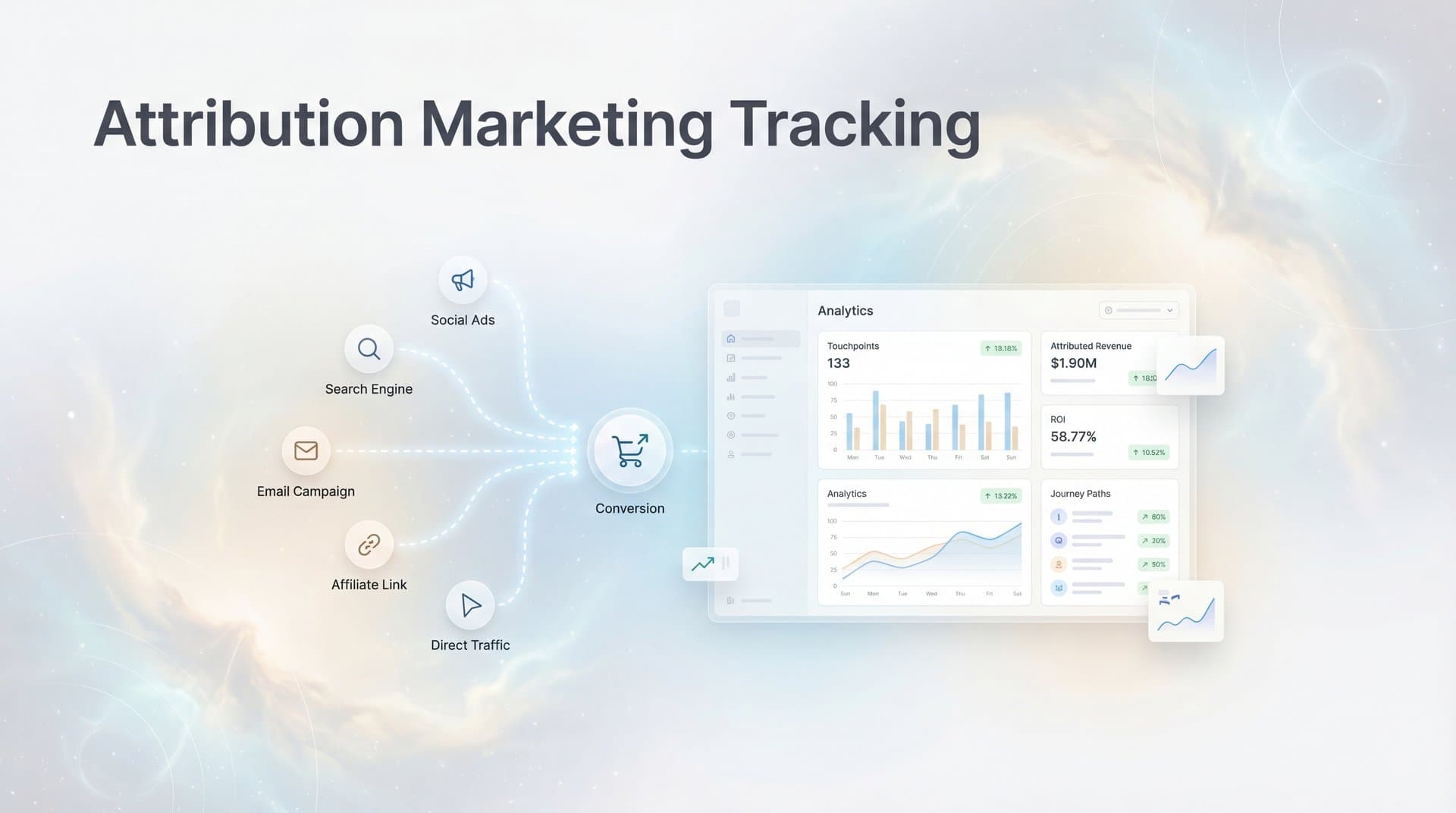
When someone converts, they rarely do so on their first interaction. They might see your Facebook ad on Monday, visit your website directly on Wednesday, click a Google ad on Friday, and finally convert through an email link on Sunday. Attribution tracking captures all four of those touchpoints and helps you understand their relative importance.
The technology behind attribution tracking relies on several interconnected mechanisms working together. Tracking pixels—small pieces of code embedded on your website—fire when visitors take specific actions, sending data back to your analytics platform. These pixels can track page views, form submissions, purchases, and any other meaningful event you define.
UTM parameters add another layer of intelligence. These are tags appended to your URLs that identify the source, medium, and campaign for each click. When someone clicks a link with UTM parameters, your analytics platform knows exactly which ad, email, or social post drove that visit. This turns generic traffic into attributed traffic with a clear origin story.
Cookies have traditionally been the glue holding attribution together. When someone first visits your site, a cookie gets stored in their browser with a unique identifier. Every subsequent visit, that cookie tells your tracking system "this is the same person who visited last week." This enables the multi-session tracking that makes attribution possible.
But cookies have limitations, which is where server-side tracking enters the picture. Instead of relying on browser-based cookies that users can block or delete, server-side tracking sends conversion data directly from your servers to your analytics platform and ad platforms. This method is more reliable, privacy-compliant, and accurate—especially as browsers increasingly restrict third-party cookies.
The customer journey concept is central to understanding why attribution matters. Picture a B2B software buyer. They might discover you through a LinkedIn ad, read three blog posts over two weeks, attend a webinar, download a whitepaper, request a demo, and finally sign a contract 45 days after that first LinkedIn impression. That's seven touchpoints across six weeks. Which one deserves credit for the sale?
Traditional analytics would give all the credit to whichever touchpoint happened last—probably the demo request. But attribution tracking recognizes that the LinkedIn ad created awareness, the blog posts built trust, the webinar demonstrated expertise, and the whitepaper captured intent. Each played a role in the conversion.
This is why attribution tracking has become essential rather than optional. Without it, you're making budget decisions based on incomplete information. You might cut the LinkedIn budget because it doesn't show many "last-click conversions," not realizing it's your primary source of new prospect discovery. Or you might pour money into retargeting because it shows high conversion rates, not recognizing it only works because other channels did the heavy lifting earlier in the journey.
Attribution Models Explained: Choosing Your Lens on the Data
Attribution models are the rules that determine how credit gets distributed across the touchpoints in a customer journey. Think of them as different lenses for viewing the same data—each one highlights different aspects of your marketing performance.
First-touch attribution gives 100% of the credit to the initial touchpoint that introduced someone to your brand. If a prospect first discovered you through a Facebook ad, that Facebook ad gets full credit for the eventual conversion, regardless of what happened afterward. This model is valuable when you want to understand which channels are best at generating new awareness and bringing fresh prospects into your ecosystem.
First-touch works well for businesses with short sales cycles or when you're specifically trying to optimize top-of-funnel performance. If you run an e-commerce store where most people convert within a day or two of discovery, first-touch attribution gives you clear insight into which channels introduce buyers to your products.
Last-touch attribution does the opposite—it awards 100% of the credit to the final touchpoint before conversion. This is the default model in many analytics platforms because it's simple and focuses on the action that directly preceded the sale. If someone converts after clicking a Google search ad, that ad gets full credit.
Last-touch makes sense when you have a very short consideration period or when you're primarily focused on optimizing conversion efficiency. It answers the question: "What's the last thing we did that convinced them to buy?" But it completely ignores the awareness and consideration work that happened earlier in the journey.
Linear attribution distributes credit equally across all touchpoints. If a customer journey involved five interactions, each one receives 20% of the credit. This model acknowledges that multiple touchpoints contributed to the conversion without trying to weight their relative importance.
Linear attribution is useful when you believe every touchpoint in the journey matters roughly equally, or when you want a balanced view that doesn't over-emphasize any particular stage. It's often a good starting point for businesses new to attribution because it's straightforward and doesn't require assumptions about which touchpoints matter most. For a deeper dive into this approach, explore linear model marketing attribution software options.
Time-decay attribution gives more credit to touchpoints closer to the conversion. The last touchpoint might get 40% of the credit, the second-to-last gets 30%, the third-to-last gets 20%, and earlier touchpoints split the remaining 10%. This model operates on the assumption that recent interactions have more influence on the purchase decision.
Time-decay works well for businesses with moderate sales cycles where you want to emphasize bottom-funnel optimization without completely ignoring top-funnel efforts. It acknowledges that the webinar someone attended yesterday probably influenced their decision more than the blog post they read three weeks ago.
Position-based attribution (also called U-shaped attribution) assigns 40% of the credit to the first touchpoint, 40% to the last touchpoint, and distributes the remaining 20% among the middle touchpoints. This model recognizes that discovery and conversion are both critical moments while still acknowledging the role of nurturing touchpoints in between.
Position-based attribution is popular among B2B companies with longer sales cycles. It helps you understand both which channels are bringing in new prospects and which channels are closing deals, without completely dismissing the middle-of-funnel content and touchpoints that keep prospects engaged.
Data-driven attribution represents the current industry standard for sophisticated marketers. Instead of using predetermined rules, data-driven models analyze your actual conversion patterns and algorithmically determine how much credit each touchpoint type deserves based on how it correlates with successful conversions.
If your data shows that prospects who attend webinars convert at 3x the rate of those who don't, the data-driven model will assign more weight to webinar touchpoints. If email sequences consistently appear in high-value customer journeys, they'll receive more credit. The model continuously learns from your data and adjusts attribution weights accordingly.
Data-driven attribution requires substantial conversion volume to work effectively—typically at least a few hundred conversions per month. But when you have sufficient data, it provides the most accurate picture of what's actually driving results in your specific business context.
Choosing the right attribution model depends on your sales cycle length, marketing strategy, and what questions you're trying to answer. Short sales cycles often work well with first-touch or last-touch models. Longer B2B sales cycles typically benefit from position-based or data-driven approaches. Understanding the types of marketing attribution models helps you select the right framework for your business.
Why Traditional Tracking Falls Short in 2026
The attribution tracking methods that worked perfectly well in 2020 are increasingly unreliable in 2026. Three major shifts have fundamentally changed how tracking works: privacy regulations, platform limitations, and cross-device complexity.
Apple's App Tracking Transparency framework, introduced with iOS 14 and strengthened in subsequent updates, requires apps to ask permission before tracking users across other companies' apps and websites. The result? Most users decline tracking. For Facebook and other platforms that relied heavily on tracking iOS users across the web, this created massive blind spots in their conversion data.
When platforms can't track conversions accurately, their reported numbers become increasingly unreliable. You might run a Facebook campaign that genuinely drives 100 conversions, but Facebook can only confirm 60 of them due to iOS tracking limitations. Their dashboard shows 60 conversions, so you assume the campaign is underperforming. In reality, you're making decisions based on incomplete data.
Cookie deprecation compounds this problem. Chrome has been phasing out third-party cookies, following Safari and Firefox who blocked them years ago. Third-party cookies were the backbone of cross-site tracking—they allowed platforms to follow users from your website to other sites and back again. Without them, attribution becomes significantly harder.
First-party cookies still work, but they only track behavior on your own domain. If someone visits your site, leaves, clicks a Facebook ad, and returns, traditional first-party cookie tracking might not connect those two sessions as the same person. You lose visibility into the multi-touchpoint journey.
Platform-native analytics create another challenge: overlapping attribution windows. Facebook might use a 28-day click attribution window, meaning any conversion within 28 days of clicking a Facebook ad gets credited to Facebook. Google Ads might use a 30-day window. LinkedIn might use 90 days. When the same customer clicks ads on all three platforms before converting, all three platforms claim credit.
This leads to the conversion inflation problem. You check Facebook: 50 conversions. Google: 45 conversions. LinkedIn: 30 conversions. Add them up: 125 conversions. Check your actual sales: 75 customers. You're not measuring reality—you're measuring overlapping claims from platforms that don't talk to each other. These attribution challenges in marketing analytics require modern solutions to overcome.
Cross-device tracking remains one of the most difficult attribution challenges. Someone might see your ad on their phone during their morning commute, research your product on their work laptop during lunch, and convert on their home tablet that evening. Traditional cookie-based tracking sees three different people. You can't connect the journey, so you can't properly attribute the conversion.
Some platforms attempt to solve this through logged-in user matching—if someone is logged into Facebook on all three devices, Facebook can theoretically connect them. But this only works within walled gardens. You can't easily connect a Facebook interaction on mobile with a Google search on desktop with a direct website visit on tablet.
Server-side tracking has emerged as the solution to many of these challenges. Instead of relying on browser-based pixels that can be blocked or deleted, server-side tracking sends conversion data directly from your servers to your analytics platform and back to ad platforms. When a conversion happens, your server notifies Facebook, Google, and your attribution platform simultaneously with consistent data.
This approach is more accurate because it doesn't depend on cookies surviving in browsers. It's more privacy-compliant because you control what data gets sent and can anonymize or hash personal information. And it's more reliable because server-to-server communication doesn't get disrupted by ad blockers, browser privacy settings, or iOS restrictions.
The tracking landscape has fundamentally changed, and marketers who haven't adapted their attribution infrastructure are operating with increasingly unreliable data. The platforms you're using for campaign reporting aren't lying—they're just giving you their limited perspective on a customer journey they can no longer fully see.
Building Your Attribution Tracking Stack
Implementing effective attribution marketing tracking requires three interconnected components working together: tracking implementation, data integration, and analytics infrastructure. Think of it as building a nervous system for your marketing—sensors that capture data, pathways that connect systems, and a brain that processes everything into insights.
Tracking implementation starts with proper instrumentation of your website and conversion events. You need tracking pixels or server-side tracking code that fires when meaningful events occur: page views, form submissions, button clicks, purchases, demo requests, or any other action that indicates progress toward conversion.
The key is defining your conversion events before you start tracking. What actions actually matter to your business? An e-commerce company might track product views, add-to-cart events, checkout initiations, and completed purchases. A B2B SaaS company might track whitepaper downloads, demo requests, trial signups, and paid conversions. Be specific about what you're measuring.
UTM parameter discipline is essential for tracking implementation. Every marketing link you create—in ads, emails, social posts, or anywhere else—should include consistent UTM parameters that identify the source, medium, campaign, and specific creative. This turns anonymous traffic into attributed traffic with clear origin stories. A marketing campaign tracking spreadsheet can help maintain consistency across your team.
Server-side tracking implementation involves setting up conversion APIs that send data from your servers directly to ad platforms and your analytics system. When someone converts, your server sends a conversion event to Facebook's Conversions API, Google's offline conversion tracking, and your attribution platform simultaneously. This creates a unified record of the conversion across all systems.
Data integration is where attribution tracking becomes powerful. Your tracking implementation captures events, but those events need to connect to your business systems to become truly valuable. This means integrating your attribution platform with your CRM, payment processor, and ad platforms.
CRM integration allows you to track the full customer journey from first click to closed revenue. When someone fills out a form on your website, that lead gets created in your CRM with attribution data attached. When your sales team closes that lead 30 days later, the attribution platform can connect the revenue back to the original marketing touchpoints. You're no longer tracking just conversions—you're tracking actual ROI.
Payment processor integration ensures accurate revenue tracking for e-commerce and subscription businesses. When someone completes a purchase, the transaction data flows into your attribution system with the exact revenue amount and order details. This enables revenue-based attribution rather than simple conversion counting. Platforms focused on marketing attribution with revenue tracking make this integration seamless.
Ad platform integration creates a feedback loop that improves campaign performance. When your attribution system identifies a high-quality conversion—someone who became a paying customer, not just a lead—it can send that enriched conversion data back to Facebook, Google, and other ad platforms. This helps their algorithms understand what "good" looks like and optimize toward higher-quality conversions.
This feedback mechanism is crucial for modern advertising success. Ad platforms use machine learning to optimize campaigns, but they can only optimize toward the signals you give them. If you only send basic conversion events, they optimize for any conversion. If you send enriched events that distinguish between tire-kickers and serious buyers, they can optimize for quality.
The analytics dashboard brings everything together into a unified view of marketing performance. This is where you see the complete customer journey, compare attribution models, analyze channel performance, and identify optimization opportunities. A good attribution dashboard should answer questions like: Which channels drive the highest-value customers? How do different attribution models change your performance assessment? Which campaigns are underperforming when you account for assisted conversions?
Your analytics infrastructure should support flexible reporting that lets you slice data by channel, campaign, time period, attribution model, and customer segment. You need the ability to drill down from high-level channel performance into specific campaigns, ad sets, and individual ads. Surface-level reporting isn't enough—you need granular visibility into what's working and what's not.
Real-time data processing has become increasingly important for attribution tracking. When you can see conversion data in real time rather than waiting days for reports to update, you can make faster optimization decisions. If a campaign is driving high-quality conversions today, you can increase its budget today rather than waiting until next week's performance review.
Building this stack requires technical implementation work upfront, but the payoff is dramatic. You move from guessing which marketing works to knowing with confidence. You stop making budget decisions based on platform-reported metrics that don't align with reality. You gain a single source of truth about marketing performance that everyone in your organization can trust.
Turning Attribution Data Into Actionable Decisions
Attribution tracking is only valuable if you actually use the insights to make better marketing decisions. The data itself doesn't improve your ROI—acting on what the data reveals does. Here's how to translate attribution insights into concrete optimizations that drive better results.
Start by identifying underperforming channels based on true ROI rather than vanity metrics. Your Facebook ads might show a high conversion rate in Facebook's dashboard, but when you look at your attribution data, you discover those conversions have a 30% lower average order value than conversions from Google. That's actionable intelligence. You might reduce Facebook budget and shift it to Google, or you might adjust your Facebook targeting to attract higher-value customers.
Attribution data reveals which channels work best at different stages of the customer journey. You might discover that LinkedIn drives expensive clicks but introduces high-quality prospects who eventually convert at 3x the rate of other channels. Meanwhile, retargeting shows cheap clicks and high conversion rates but only works because LinkedIn did the initial discovery work. This insight changes how you allocate budget—you invest in LinkedIn for prospecting and retargeting for conversion, understanding they work together rather than competing.
Look for assisted conversion patterns that traditional last-click reporting misses completely. A channel might show few direct conversions but appear frequently in the paths of high-value customers. Your blog content might rarely get credit for last-click conversions, but attribution data shows that customers who read three or more blog posts convert at twice the rate and have 50% higher lifetime value. That's a signal to invest more in content, even though it won't show immediate ROI in last-click reports.
Creative and messaging optimization becomes more precise with attribution insights. When you can see which specific ads, landing pages, and offers drive not just conversions but high-quality conversions, you can double down on what works. You might discover that ads emphasizing cost savings drive high conversion volume but low average order value, while ads emphasizing premium features drive fewer conversions but much higher revenue. That insight shapes your entire creative strategy.
Audience analysis through an attribution lens reveals which customer segments deliver the best ROI. You might find that certain demographic segments, geographic regions, or interest categories consistently appear in high-value customer journeys. This allows you to shift budget toward acquiring more of your best customers rather than treating all conversions as equally valuable.
Budget reallocation decisions should be based on incremental contribution rather than absolute performance. A channel might drive fewer total conversions than another channel but have more room to scale profitably. Attribution data helps you identify these opportunities by showing which channels are saturated (increasing spend doesn't drive proportional results) versus which channels have headroom (you could profitably increase investment). Understanding cross-channel attribution and marketing ROI is essential for these decisions.
AI-powered analysis takes attribution optimization to the next level by surfacing patterns you might miss manually. Modern attribution platforms can analyze thousands of customer journeys simultaneously and identify statistically significant patterns: which combinations of touchpoints drive the highest conversion rates, which sequences of content consumption predict high-value customers, which time gaps between touchpoints indicate strong purchase intent.
These AI insights might reveal that prospects who visit your pricing page within 48 hours of first discovery convert at 5x the rate of those who wait longer. That's an actionable insight—you can create campaigns specifically designed to drive quick pricing page visits for new prospects. Or you might discover that customers who interact with both video content and written content convert at higher rates than those who engage with only one format. That shapes your content strategy. Learn more about how machine learning can be used in marketing attribution to unlock these capabilities.
The key to turning attribution data into action is establishing a regular optimization cadence. Weekly or bi-weekly reviews of attribution reports, looking for emerging patterns, testing hypotheses about what drives performance, and making incremental adjustments based on what you learn. Attribution isn't a set-it-and-forget-it system—it's an ongoing feedback loop that continuously improves your marketing effectiveness.
Common Attribution Pitfalls and How to Avoid Them
Even with proper attribution tracking in place, marketers frequently make mistakes that undermine the value of their data. Understanding these pitfalls helps you avoid wasting time and money on attribution approaches that don't actually improve decision-making.
The most common mistake is relying solely on platform-reported metrics without independent verification. Facebook tells you they drove 100 conversions. Google says they drove 80. You trust both numbers and celebrate 180 conversions. Then you check your actual sales and find only 110 customers. This happens because platforms use overlapping attribution windows and don't communicate with each other. Always compare platform-reported conversions against a single source of truth—your attribution platform or CRM—to understand the real numbers.
Switching attribution models mid-campaign destroys data continuity and makes performance analysis nearly impossible. If you start with last-click attribution, then switch to first-click halfway through the quarter, you can't meaningfully compare performance before and after the switch. The data shows different things because you changed the measurement methodology, not because performance actually changed. Pick an attribution model and stick with it long enough to gather meaningful insights.
That said, you should compare multiple attribution models to understand your data from different angles. The mistake is constantly switching your primary model, not looking at alternative perspectives. Run reports using different models to see how your assessment changes, but maintain consistency in your primary decision-making framework. When comparing marketing attribution software features, look for platforms that support multiple model views.
Implementing attribution tracking after you've already scaled spend is like trying to install a speedometer while driving 100 mph. You need proper tracking infrastructure before you aggressively scale campaigns. Otherwise, you're making scaling decisions based on incomplete data, which often leads to wasted budget on channels that looked good in limited testing but don't actually drive profitable growth at scale.
Many marketers also make the mistake of treating all conversions as equally valuable. A lead is not the same as a customer. A $50 purchase is not the same as a $5,000 purchase. Your attribution system should track not just conversion volume but conversion value—revenue, customer lifetime value, or whatever metric actually matters to your business. Optimizing for conversion volume without considering value leads to acquiring cheap, low-quality customers while missing higher-value opportunities.
Ignoring the time lag between touchpoints and conversions creates unrealistic expectations about campaign performance. If your average sales cycle is 45 days, you can't evaluate a campaign's true performance after just one week. Attribution data needs time to mature. Early results might look promising or disappointing, but you need to wait until enough time has passed for full customer journeys to complete before making definitive judgments.
Over-complicating your attribution setup is another common pitfall. Some marketers implement incredibly complex tracking with dozens of custom events and intricate conversion funnels, then find the data overwhelming and difficult to act on. Start simple—track the essential conversion events that matter to your business, get that working reliably, then add complexity only when you have specific questions that require more granular data.
Finally, many marketers fail to account for offline conversions in their attribution tracking. If you're a B2B company where deals close through sales calls, or a retail business with both online and in-store sales, you need to connect offline conversions back to their online marketing origins. Otherwise, your attribution data only shows part of the picture, and you might undervalue channels that drive offline results.
Your Path to Attribution Clarity
Attribution marketing tracking has evolved from a nice-to-have analytics feature to an essential infrastructure for any marketer who wants to scale profitably. The days of trusting platform-reported metrics and hoping for the best are over. In 2026, successful marketers operate with clear visibility into what drives results and confidence in their budget allocation decisions.
The path forward starts with understanding that attribution isn't just about technology—it's about establishing a single source of truth for marketing performance. You need tracking infrastructure that survives privacy restrictions, attribution models that match your business reality, and integration between your marketing platforms and business systems. Most importantly, you need the discipline to actually use attribution insights to make better decisions rather than just generating reports that sit unread.
Start by auditing your current tracking setup. Are you properly capturing all meaningful conversion events? Do you have UTM parameter discipline across all your marketing channels? Can you connect marketing touchpoints to actual revenue in your CRM? If the answer to any of these questions is no, that's your starting point.
Choose an attribution model that makes sense for your sales cycle and stick with it long enough to gather meaningful insights. Compare it against alternative models to understand different perspectives on your data, but maintain consistency in your primary decision-making framework. Remember that no single model is perfect—they're different lenses for viewing the same reality.
Implement server-side tracking to maintain data accuracy as privacy restrictions continue to tighten. The tracking methods that worked five years ago are increasingly unreliable, and waiting to upgrade your infrastructure only makes the eventual transition more painful. Future-proof your attribution tracking now rather than waiting for a crisis. Explore the best software for tracking marketing attribution in 2026 to find the right solution for your needs.
Most importantly, establish a regular cadence of reviewing attribution data and acting on what you learn. Weekly or bi-weekly optimization sessions where you analyze performance, identify patterns, and make incremental improvements. Attribution tracking doesn't magically improve your marketing—it gives you the insights to make better decisions, but you still have to make those decisions.
The marketers who master attribution tracking gain a fundamental competitive advantage. While competitors guess which channels work and make budget decisions based on incomplete platform data, you'll know with confidence where your revenue actually comes from. You'll identify optimization opportunities others miss. You'll scale profitably while others waste budget on channels that look good in isolation but don't actually drive business results.
Ready to elevate your marketing game with precision and confidence? Discover how Cometly's AI-driven recommendations can transform your ad strategy—Get your free demo today and start capturing every touchpoint to maximize your conversions.