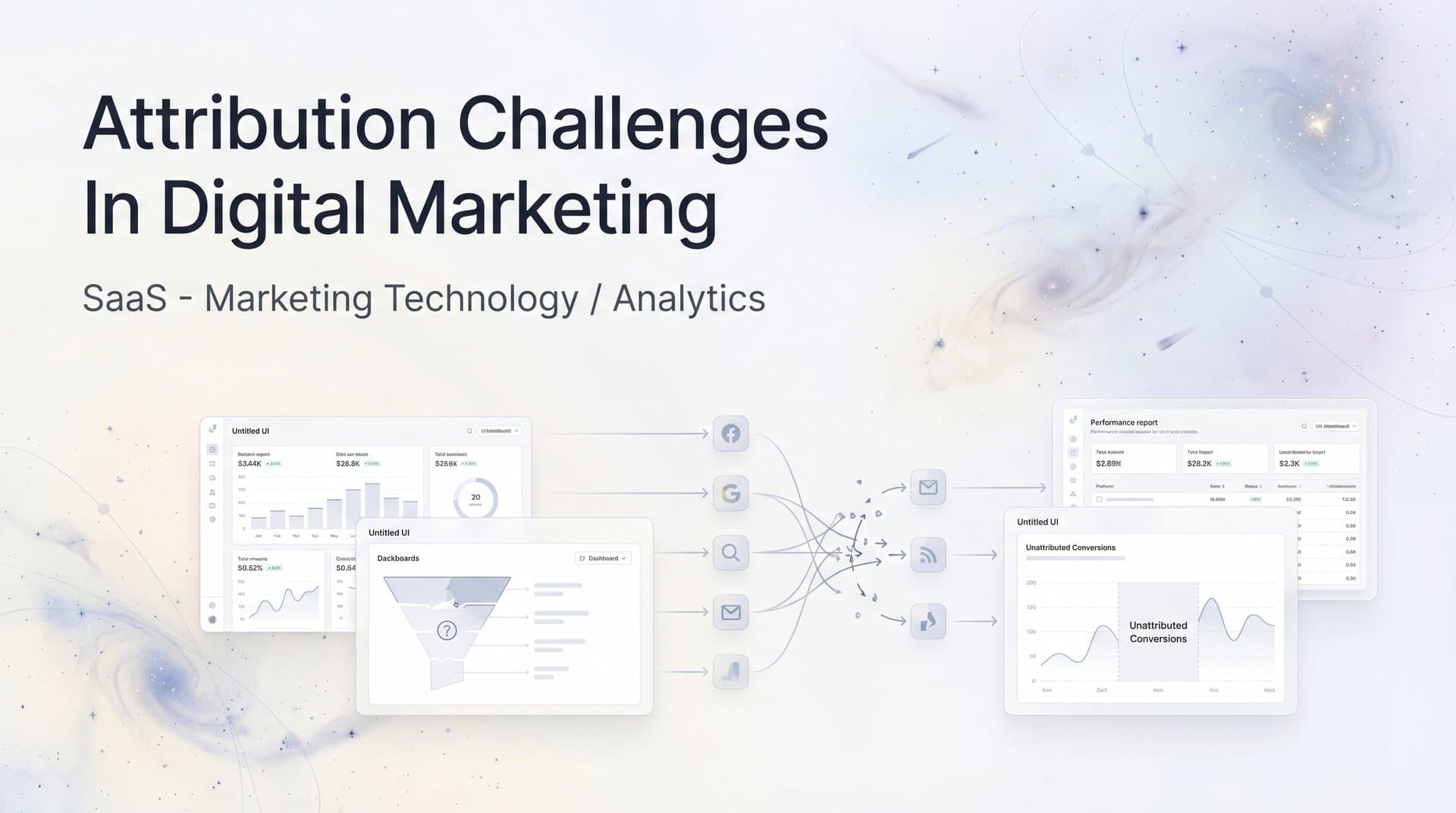
Your Meta Ads Manager shows 847 conversions this month. Google Analytics claims 612. Your Google Ads dashboard reports 723. And when you add them all up? The total is somehow 400 conversions more than you actually made in sales.
This isn't a glitch in the matrix. It's the attribution crisis that's quietly draining marketing budgets across every industry.
Attribution challenges in digital marketing have evolved from minor tracking annoyances into fundamental obstacles that actively mislead decision-making. When every platform claims credit for the same conversions using different measurement rules, marketers end up confidently investing in channels that don't actually drive results—while accidentally starving their genuine revenue generators.
The stakes are higher than most realize. A 20% error in attribution doesn't just mean slightly off reporting. It means potentially misallocating hundreds of thousands in ad spend, scaling campaigns that look profitable but aren't, and cutting budgets from channels that are actually carrying your growth.
Here's what actually broke, why it matters, and how to build an attribution system that tells you the truth.
The Perfect Storm: Why Attribution Broke in the 2020s
Attribution didn't gradually decline—it hit a wall. Three seismic shifts converged to shatter the tracking infrastructure that digital marketing relied on for over a decade.
The first earthquake was Apple's iOS 14.5 update in April 2021, which introduced App Tracking Transparency. This seemingly simple privacy feature fundamentally changed how data flows from users to advertisers. Before iOS 14.5, apps could track users across other apps and websites by default. After the update, they had to ask permission first.
The result? Most users opted out. When given a clear choice between "Allow Tracking" and "Ask App Not to Track," the majority chose privacy. This created massive blind spots in customer journeys—particularly problematic because mobile devices now account for the majority of digital interactions. A prospect might see your ad on Instagram, research your product on Safari, and convert three days later on desktop. Without iOS tracking, that entire mobile journey vanishes from your attribution data.
The second shift is the slow death of third-party cookies. Google originally planned to phase them out in Chrome by 2022, then pushed to 2024, and has since delayed again—but the direction is clear. Third-party cookies enabled cross-site tracking, allowing advertisers to follow users across different websites and connect their browsing behavior to conversions. When someone visited your site after seeing your ad on a publisher's site, cookies made that connection visible.
As third-party cookies disappear, that connective tissue dissolves. The customer journey fragments into disconnected events that can't be stitched together. You see someone visited your site, but you don't know which ad campaign brought them there. You see a conversion, but you can't trace it back to the touchpoint that started the journey.
The third force is the expanding web of privacy regulations. GDPR in Europe, CCPA in California, and a growing list of state-level privacy laws require explicit user consent for data collection. These regulations are necessary and important—but they create another layer of data fragmentation. Users in different jurisdictions see different consent prompts, make different choices, and generate different levels of tracking data.
Together, these changes created a perfect storm. The tracking infrastructure that attribution models depended on—cross-app tracking, third-party cookies, and permissionless data collection—has been systematically dismantled. What remains is a fractured data landscape where marketers see only partial customer journeys, making accurate attribution nearly impossible with traditional methods. Understanding these common attribution challenges in marketing is the first step toward solving them.
The Self-Reporting Trap: When Every Platform Claims Credit
Here's where attribution gets truly messy: every advertising platform has its own scoreboard, and they're all designed to make that platform look good.
Meta's Ads Manager uses a default attribution window of 7 days after a click and 1 day after a view. Google Ads defaults to 30 days for search clicks. TikTok offers various attribution windows but emphasizes view-through conversions. LinkedIn uses its own methodology. Each platform is measuring the same conversions using completely different rules.
Think about what this means in practice. A customer sees your TikTok ad on Monday (doesn't click), searches your brand on Google Tuesday (clicks through), reads your blog Wednesday, and converts on Thursday. TikTok's view-through window claims credit because the conversion happened within their attribution window. Google's last-click model claims credit because they were the final ad click before conversion. If you're running retargeting on Meta and the customer saw (but didn't click) a retargeting ad Wednesday, Meta might claim credit too under their view-through window.
For a deeper dive into this space, see our AI UGC ad generator guide.
Same conversion. Three platforms claiming credit. When you add up the conversions each platform reports, you get totals that can exceed your actual sales by 200% or more.
This isn't accidental. Ad platforms are businesses optimizing for their own success. Their dashboards are designed to demonstrate value to advertisers. They use attribution methodologies that—while not technically inaccurate—tend to present their platform in the most favorable light possible. A view-through conversion that happened 23 hours after someone scrolled past your ad is technically within the attribution window, even if that view had zero influence on the eventual purchase.
The real problem emerges when you make budget decisions based on these self-reported numbers. You see Meta claiming 60% of conversions and Google claiming 55%, and you think "both channels are crushing it—let's increase spend on both." In reality, they're both claiming credit for largely the same conversions. You're not seeing two successful channels; you're seeing one successful customer journey that two platforms are both taking credit for.
Without a unified source of truth that sits outside these self-interested reporting systems, you're making critical budget allocation decisions based on fundamentally flawed data. It's like asking two competing salespeople to report their own performance and expecting objective truth. This is why cross channel attribution has become essential for measuring true marketing ROI.
The Multi-Touch Reality: Customers Don't Convert in Straight Lines
The attribution crisis deepens because modern customer journeys are inherently complex—and most attribution models pretend they're simple.
Consider a typical B2B software purchase. A prospect sees a LinkedIn ad introducing your product (Touchpoint 1). They don't click, but they remember the name. Two days later, they Google your category and find your SEO content (Touchpoint 2). They read three blog posts but don't convert. A week later, they see a retargeting ad on Meta and click through to your pricing page (Touchpoint 3). They leave without converting. Your sales team calls them after they fill out a contact form from a Google search ad (Touchpoint 4). After two sales calls and a demo, they convert three weeks after that initial LinkedIn impression (Touchpoint 5).
Which touchpoint "caused" the conversion? The honest answer is all of them played a role. But most attribution models don't handle this reality well.
Last-click attribution—still the default in Google Analytics and many platforms—gives 100% of the credit to that final Google search ad. This systematically undervalues all the awareness and consideration touchpoints that made the prospect ready to search for your brand and convert. Your top-of-funnel campaigns look like they're failing because they don't get credit for the conversions they influenced.
First-click attribution makes the opposite mistake. It gives all credit to that initial LinkedIn ad, ignoring everything that happened afterward. This overvalues discovery channels while giving zero credit to the nurturing, retargeting, and sales touchpoints that actually closed the deal. Understanding the different types of marketing attribution models helps you choose the right approach for your business.
The fundamental issue is that customers don't experience marketing in isolated channels. They experience an integrated journey across devices, platforms, and time. They might discover you on mobile, research on desktop, discuss with colleagues in person, and convert on a different device entirely. They interact with organic content, paid ads, email campaigns, and direct outreach—often in non-linear sequences with days or weeks between touchpoints.
For a deeper dive into this space, see our AI UGC content generator guide.
Single-touch attribution models try to force this complex reality into a simple story with one hero. But marketing doesn't work that way. The LinkedIn ad that created awareness enabled the Google search to happen. The blog content that built trust made the retargeting ad effective. The sales call that addressed objections converted the lead that advertising generated.
When your attribution model can't capture this multi-touch reality, you make decisions based on fiction. You might cut spending on awareness campaigns because they don't show last-click conversions—not realizing they're the foundation that makes everything else work. This is precisely why multi-touch marketing attribution software has become critical for modern marketers.
Data Gaps That Drain Your Budget
Even if you solved every challenge mentioned so far, you'd still face attribution gaps that hide some of your most valuable conversions.
The offline conversion problem hits particularly hard. A prospect sees your Facebook ad, visits your website, and calls your sales team directly using the phone number on your site. That phone call converts into a $50,000 deal. But because the conversion happened offline, your Facebook pixel never fires. Facebook's dashboard shows zero conversions from that ad campaign. Without a system to connect offline conversions back to their digital origins, that campaign looks like a failure when it actually drove significant revenue.
The same issue affects in-store purchases, sales team closes, and any conversion that doesn't happen through a trackable online form. For many businesses, these offline conversions represent the majority of actual revenue—yet they're completely invisible in standard attribution reporting. Implementing marketing attribution platforms with revenue tracking capabilities solves this visibility problem.
Cross-device tracking failures create another layer of invisibility. Modern customers constantly switch devices. They might discover your product on their phone during a commute, research on their work laptop, discuss with a colleague on a tablet, and finally convert on their personal desktop at home. Unless you have a system that recognizes this is the same person across four different devices, it looks like four different prospects in various stages—none of whom converted.
Traditional cookie-based tracking can't bridge these device gaps. A cookie on someone's iPhone tells you nothing about their desktop behavior. When they convert on desktop, you don't know about the mobile touchpoints that started their journey. This systematically undervalues mobile advertising because conversions often happen on different devices than initial discovery.
Long sales cycles amplify every attribution challenge. In B2B, enterprise software, and other complex sales, the time between first touch and closed deal can stretch across months. A prospect might see your LinkedIn ad in January, engage with your content throughout February and March, request a demo in April, go through a two-month evaluation process, and finally sign a contract in July.
Most attribution windows don't extend six months. Google's default 30-day window misses conversions that happen 31+ days after the click. Even extended windows struggle with sales cycles that span quarters. The touchpoint that actually influenced the deal—that January LinkedIn ad—falls outside the attribution window entirely. The conversion gets attributed to whatever happened most recently, even if that final touchpoint was just the last step in a journey that started months earlier.
These data gaps aren't edge cases. They're systematic blind spots that cause marketers to consistently undervalue certain channels and strategies. Top-of-funnel awareness campaigns look ineffective because their conversions happen too far in the future. Mobile campaigns look weak because conversions happen on desktop. Brand building looks unmeasurable because its impact is distributed across every subsequent touchpoint.
Building an Attribution System That Actually Works
Solving attribution in a privacy-first world requires rebuilding your tracking infrastructure from the ground up. The browser-based, cookie-dependent systems of the past can't handle modern challenges. Here's what actually works now.
Server-side tracking represents the most significant shift in how data gets collected. Instead of relying on browser pixels that can be blocked by ad blockers, deleted by privacy settings, or broken by tracking prevention, server-side tracking captures data directly from your own systems. When someone converts on your website, your server sends that conversion data directly to advertising platforms—no browser involvement required.
This approach bypasses most of the limitations that broke traditional tracking. Ad blockers can't block your server from communicating with Meta's or Google's servers. iOS tracking restrictions don't affect server-to-server data transmission. Cookie deletion doesn't matter because you're not relying on cookies to maintain the connection.
The key is that server-side tracking requires first-party data collection. You need to identify users through your own systems—typically through account creation, email capture, or CRM integration. When someone fills out a form on your site, you capture their email and can track their subsequent behavior through your own database rather than through third-party cookies. When they convert, you know exactly who they are and can trace their entire journey through your first-party data.
CRM integration connects the final piece of the puzzle. Your CRM holds the ultimate truth about conversions—actual closed deals, revenue amounts, customer lifetime value. When you integrate your CRM with your attribution system, you can connect every conversion back through the customer journey to the original touchpoints that started it. That $50,000 deal that closed through a phone call? Your CRM knows about it, and with proper integration, you can attribute it back to the Facebook ad that generated the initial lead. Learning how to setup a datalake for marketing attribution can help centralize this data effectively.
This is where offline conversions become visible. Sales team closes, phone conversions, in-store purchases—if they're recorded in your CRM, they can be attributed back to their digital origins. You're no longer limited to tracking only conversions that happen through web forms.
Multi-touch attribution models distribute credit across the customer journey based on actual influence rather than arbitrary rules. Instead of giving 100% credit to the last click or first click, these models recognize that multiple touchpoints contributed to the conversion and assign fractional credit to each based on their role.
The most sophisticated approaches use data-driven attribution that analyzes patterns across thousands of customer journeys to determine which touchpoints actually influence conversions. If prospects who see a particular LinkedIn ad are 40% more likely to convert than those who don't, that ad gets credit proportional to its influence. If a specific blog post consistently appears in converting journeys, it receives attribution credit even though it's not a paid channel. Discover how machine learning can be used in marketing attribution to automate these insights.
The technical implementation matters less than the principle: you need a system that captures data from your own infrastructure, connects it to your CRM's conversion truth, and distributes credit across touchpoints based on their actual contribution to revenue. This requires moving beyond platform-specific dashboards to a unified attribution system that sits above individual channels and reports objective truth.
Turning Better Attribution Into Better Results
Accurate attribution isn't valuable because it makes prettier reports. It's valuable because it fundamentally changes which decisions you make—and those decisions determine whether your marketing budget grows revenue or burns cash.
The first leverage point is feeding enriched conversion data back to advertising platforms. Meta's algorithm, Google's Smart Bidding, TikTok's optimization—they all learn from the conversion data you send them. When you're only sending browser-based conversion events that miss half your actual conversions, these algorithms optimize toward incomplete data. They think certain audiences and creatives are underperforming when they're actually driving conversions you're not tracking.
For a deeper dive into this space, see our AI advertising generator guide.
Server-side tracking with CRM integration lets you send complete conversion data back to ad platforms. You can tell Meta about the phone call conversion that happened three days after the ad click. You can tell Google about the $50,000 deal that closed six weeks after the initial search. You can send revenue values, not just conversion counts, so platforms optimize for high-value customers rather than just any conversion.
Better data in means better targeting out. When ad platforms see your complete conversion picture, their algorithms make smarter decisions about who to target, which creatives to show, and how to allocate budget across campaigns. This isn't theoretical—advertisers consistently see improved ROAS when they implement comprehensive conversion tracking that captures events platforms were previously blind to. Leveraging data analytics for digital marketing amplifies these optimization opportunities.
The second leverage point is confident scaling. Right now, most marketers are scared to aggressively scale campaigns because they're not sure which ones are actually working. When your Meta dashboard shows strong performance but you're not sure how much it's double-counting Google's conversions, you hesitate to increase spend. That hesitation costs you growth.
Accurate attribution removes the uncertainty. When you can see which campaigns genuinely drive incremental revenue—accounting for multi-touch journeys and removing double-counting—you can scale those campaigns with confidence. You're not guessing which channels deserve more budget. You're making decisions based on clear data about what actually produces revenue.
The third leverage point is stopping the budget waste cycle. Most marketing budgets contain significant waste that's invisible because of attribution problems. You're spending on channels that claim conversions they didn't actually influence. You're running campaigns that look profitable in isolation but are just claiming credit for conversions other channels drove.
Accurate attribution exposes this waste. When you can see that a particular retargeting campaign isn't actually influencing conversions—it's just showing ads to people who were already going to convert—you can cut that spend and reallocate it to channels that drive genuine incremental results. The same budget produces more revenue simply because you're investing it in the right places.
This reallocation effect compounds over time. Every month, you're learning which strategies actually work and shifting budget toward them. Your competitors are still operating on flawed data, scaling campaigns that look good but don't drive real results. The gap in marketing efficiency widens with every budget cycle.
Your Competitive Edge in a Privacy-First World
Attribution challenges aren't getting easier. Privacy regulations will continue expanding. Third-party data will keep disappearing. Ad platforms will maintain their self-interested reporting. The marketers who figure out attribution in this new environment gain a significant competitive advantage over those who don't.
The solution isn't about achieving perfect tracking—that's impossible in a privacy-first world, and honestly, it always was. The goal is building systems that capture enough of the customer journey to make confident decisions. You don't need to track every single touchpoint; you need to track enough touchpoints to understand which channels drive genuine incremental revenue versus which ones just claim credit for conversions that would have happened anyway.
This requires moving beyond the free tools and default setups that most marketers rely on. Platform-specific dashboards will always optimize for platform-specific interests. Cookie-based tracking will continue degrading. The infrastructure that worked five years ago can't handle today's privacy landscape—and it definitely can't handle where things are heading. Exploring the best marketing attribution tools available today is essential for staying competitive.
The marketers who invest in proper attribution infrastructure now—server-side tracking, CRM integration, unified measurement systems—are building a moat around their competitive position. They're making smarter budget decisions while competitors operate on flawed data. They're scaling winners while competitors accidentally scale losers. They're feeding better data to ad platform algorithms while competitors send incomplete conversion signals.
The attribution crisis is real, but it's also an opportunity. While most marketers struggle with conflicting dashboards and unexplainable conversion totals, those who solve attribution gain clarity that translates directly into better marketing performance. The question isn't whether attribution is hard—it is. The question is whether you're going to solve it before your competitors do.
Ready to elevate your marketing game with precision and confidence? Discover how Cometly's AI-driven recommendations can transform your ad strategy—Get your free demo today and start capturing every touchpoint to maximize your conversions.