You're spending $10,000 a month on Facebook ads, another $8,000 on Google, and $5,000 on LinkedIn. Your ad platforms are showing hundreds of conversions. Your analytics dashboard is filled with colorful charts. Everything looks great—until you talk to your sales team.
They closed 47 deals last month. But when you add up the conversions reported across all your ad platforms, you're seeing 312 conversions. The math doesn't work. Which ads actually drove those 47 sales? Which platforms are taking credit for conversions they didn't influence? And most importantly: where should you actually be spending your budget?
This is the reality for most marketers running multi-channel campaigns. You're making decisions based on incomplete, often contradictory data. Marketing attribution software exists to solve exactly this problem—connecting your ad spend to actual revenue, not just clicks or platform-reported conversions. It tracks the complete customer journey from first ad interaction through final purchase, giving you the clarity to scale what genuinely works and cut what doesn't.
Why Your Ad Platform Data Doesn't Match Your Revenue Reality
Here's what's happening behind the scenes: every ad platform wants to prove its value, so each one counts conversions in ways that make their performance look as strong as possible. Facebook sees someone view your ad, then later that person converts—Facebook counts it. Google shows them a search ad they click—Google counts it. LinkedIn displays a sponsored post they scroll past—LinkedIn might count that too if they convert within the view-through window.
The same customer, the same purchase, counted three times across three platforms. Your total reported conversions balloon to numbers that bear no resemblance to your actual sales data.
This isn't malicious—it's just how platform attribution works. Each platform only sees its own slice of the customer journey. Facebook doesn't know the customer also clicked a Google ad. Google doesn't know they engaged with your LinkedIn content first. They're each telling a partial truth, but when you add those partial truths together, you get a completely distorted picture.
Then there's the view-through conversion problem. Platforms count conversions when someone simply saw your ad, even if they never clicked it. While view-through attribution has some validity for brand awareness campaigns, it dramatically inflates conversion numbers. That customer who scrolled past your Facebook ad three weeks ago and then converted after clicking a Google search ad? Facebook might claim that conversion based on the view-through, even though the search ad clearly drove the action.
Privacy changes have made this data gap even worse. iOS App Tracking Transparency means a significant portion of your mobile traffic now can't be tracked through traditional pixels. Cookie deprecation in browsers is limiting what you can track on desktop. The result? Your pixel-based tracking is capturing maybe 60-70% of actual conversions, and what it does capture is often attributed incorrectly across platforms.
When your data is this disconnected from reality, you make expensive mistakes. You scale campaigns that look profitable in the ad platform but actually lose money when you factor in the full customer acquisition cost. You cut campaigns that appear underperforming but are actually your best first-touch channels. You allocate budget based on fiction rather than facts.
How Attribution Software Maps the Complete Path to Purchase
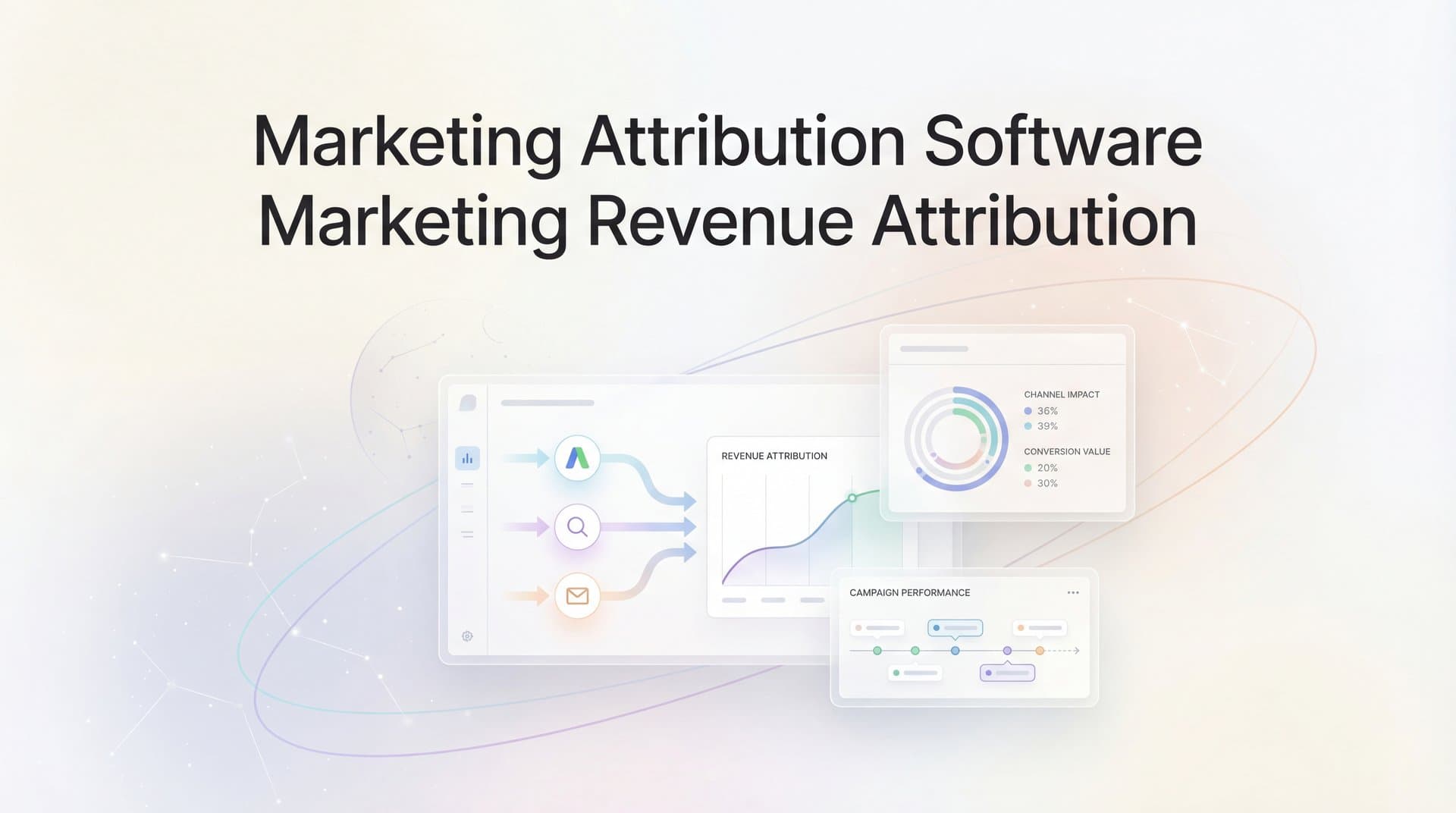
Marketing attribution software works fundamentally differently than ad platform pixels. Instead of each platform tracking in isolation, attribution software sits above all your marketing channels and tracks the entire customer journey from a unified perspective.
Here's how it works: when someone clicks your Facebook ad, the attribution software captures that interaction along with a unique identifier for that visitor. When they later visit your site through a Google search ad, it recognizes this is the same person and logs that second touchpoint. When they fill out a form, make a purchase, or become a qualified lead in your CRM, the attribution software connects that revenue event back to all the marketing interactions that preceded it.
This creates a complete timeline: Facebook ad click on January 5th, Google search ad click on January 8th, email click on January 12th, direct visit and purchase on January 15th. Now you can see the actual sequence of events that led to revenue, not just isolated platform claims.
The tracking mechanism matters enormously. Traditional pixel-based tracking places code on your website that runs in the visitor's browser. This approach has become increasingly unreliable as browsers block third-party cookies and users enable tracking prevention. Server-side tracking solves this by sending conversion data directly from your server to the attribution platform, bypassing browser limitations entirely.
Think of it this way: pixel tracking is like asking each customer to carry a tracker that reports their movements, but many customers refuse or disable the tracker. Server-side tracking is like your business keeping its own record of every transaction, which can't be blocked or disabled by browser settings.
The integration depth determines how complete your attribution picture becomes. Surface-level integrations might only capture ad clicks and website conversions. Deep integrations pull in data from your CRM, showing which leads became qualified opportunities and which closed as customers. They connect to your analytics platform, your email marketing system, even offline conversion data from sales calls.
This unified data layer transforms how you understand your marketing. Instead of asking "which platform reported the most conversions?" you can ask "which sequence of touchpoints most reliably leads to high-value customers?" That's a fundamentally different—and far more valuable—question.
The real-time aspect changes the game too. You're not waiting until the end of the month to reconcile data across systems. You can see which campaigns are driving qualified leads today, this hour. When something's working, you know immediately. When something's not, you can pivot before wasting more budget. Understanding how attribution platforms track revenue is essential for maximizing this real-time visibility.
Choosing the Right Attribution Model for Your Business
Once you have complete journey data, you need to decide how to distribute credit across touchpoints. This is where attribution models come in—different frameworks for assigning value to each interaction in the path to conversion.
First-touch attribution gives all credit to the initial interaction. If someone clicked a Facebook ad, then later clicked Google and LinkedIn ads before converting, Facebook gets 100% credit. This model answers the question: "What's making people aware of us?" It's particularly valuable for top-of-funnel analysis and understanding which channels are best at introducing new prospects to your brand. Use first-touch when you're trying to build awareness or enter new markets.
Last-touch attribution does the opposite—all credit goes to the final interaction before conversion. In that same journey, LinkedIn would get 100% credit as the last touchpoint. This model tells you: "What's closing deals?" It's useful when you have a short sales cycle or want to understand which channels are best at converting already-aware prospects. Many marketers default to last-touch because it's simple and aligns with how sales teams think about attribution.
Linear attribution distributes credit equally across all touchpoints. Facebook, Google, and LinkedIn each get 33.3% credit in our example. This model assumes every interaction contributed equally to the conversion. It's a balanced approach that works well when you genuinely believe each touchpoint in your typical customer journey adds similar value. The downside? It might undervalue particularly influential touchpoints. For a deeper dive into this approach, explore linear model marketing attribution and when it makes sense for your business.
Time-decay attribution gives more credit to interactions closer to the conversion. Recent touchpoints get weighted more heavily than older ones. In our example, LinkedIn might get 50% credit, Google 30%, and Facebook 20%. This model reflects the reality that recent interactions often have more influence on the final decision. It's particularly useful for longer sales cycles where early touchpoints might have less impact than later nurturing efforts.
Data-driven attribution uses machine learning to analyze thousands of conversion paths and determine which touchpoints actually correlate with higher conversion rates. Instead of applying a predetermined formula, it learns from your specific data. If your data shows that people who interact with both Facebook and LinkedIn convert at 3x the rate of those who only see Facebook, the model adjusts credit accordingly. Learn more about how machine learning can be used in marketing attribution to unlock these advanced insights.
Here's the strategic insight most marketers miss: you shouldn't pick one model and stick with it forever. The most sophisticated approach is comparing multiple models side-by-side for the same campaigns. When a channel performs well in first-touch but poorly in last-touch, you know it's great for awareness but weak at closing. When a channel shows strong performance across all models, you've found a genuine winner worth scaling.
Let's say your Google search campaigns show mediocre results in first-touch attribution but excel in last-touch. This tells you something important: people aren't discovering you through Google, but when they're ready to buy, they're searching for you and clicking your ads. That's not a campaign to cut—it's a campaign to protect because it's capturing high-intent traffic at the decision stage.
Conversely, if your Facebook campaigns dominate first-touch but barely register in last-touch, they're introducing prospects who then convert through other channels. You might be tempted to cut Facebook based on last-touch data alone, but you'd be eliminating your primary awareness engine. Understanding the types of marketing attribution models helps you avoid these costly mistakes.
Turning Attribution Insights Into Profitable Budget Decisions
Data without action is just expensive record-keeping. The real value of attribution software emerges when you use the insights to make smarter spending decisions that directly improve profitability.
Start by identifying the campaigns and channels that consistently appear in high-value conversion paths. You're not just looking at which campaigns generate the most conversions—you're looking at which ones generate conversions that actually turn into revenue. There's a massive difference between a campaign that drives 100 leads worth $50,000 in closed revenue and one that drives 200 leads worth $20,000 in closed revenue. The second campaign looks better in your ad platform, but the first campaign is actually twice as profitable.
Attribution software reveals these quality differences. You can segment by revenue value, customer lifetime value, or whatever metric matters most to your business. Maybe you discover that LinkedIn campaigns generate fewer conversions but those conversions are enterprise customers worth 10x more than leads from other channels. That insight completely changes how you should allocate budget.
The reallocation process becomes systematic rather than guesswork. You're not making decisions based on cost per click or even cost per conversion—you're making decisions based on cost per dollar of revenue or cost per customer acquired. If Channel A costs $200 per conversion but those customers are worth $2,000, while Channel B costs $100 per conversion but those customers are worth $500, Channel A is actually the better investment despite the higher cost per conversion.
Here's where it gets even more powerful: feeding this conversion data back to the ad platforms themselves. When you send accurate, revenue-qualified conversion data to Facebook, Google, and other platforms, their machine learning algorithms get dramatically better at optimization. Instead of optimizing for any conversion, they start optimizing for the conversions that actually matter to your business.
This creates a virtuous cycle. Better conversion data leads to better ad targeting, which leads to higher-quality traffic, which leads to more valuable conversions. The platforms' algorithms learn to find people who look like your actual customers, not just people who look like anyone who ever filled out a form on your site.
The budget scaling decisions become clearer too. When you see a campaign consistently driving profitable conversions across multiple attribution models, you have the confidence to increase spend aggressively. When a campaign shows strong performance in platform data but weak performance in revenue attribution, you know to be cautious about scaling despite the tempting metrics.
You also start making smarter decisions about campaign structure. If attribution data shows that people who interact with both search and social convert at higher rates than those who only see one channel, you might create coordinated campaigns designed to hit prospects across both channels rather than treating them as separate initiatives competing for budget. This is where cross channel marketing attribution software becomes invaluable for understanding these multi-platform dynamics.
Essential Capabilities Your Attribution Platform Must Have
Not all attribution software is created equal. The difference between a basic attribution tool and a sophisticated platform can mean the difference between surface-level insights and transformative business intelligence.
Real-time tracking and reporting isn't a luxury—it's a necessity for modern marketing. You need to see which campaigns are performing within hours, not days or weeks. When you're spending thousands per day on ads, waiting until month-end to see what worked means you've potentially wasted weeks of budget on underperforming campaigns. Real-time visibility lets you capitalize on what's working and cut what isn't before the damage compounds.
Integration depth determines how complete your attribution picture becomes. Surface-level integrations might connect to your ad platforms but not your CRM, leaving you blind to which leads actually converted to customers. Deep integrations pull data from everywhere: ad platforms, analytics tools, CRM systems, email marketing, even offline conversion data from sales calls or in-person events. The more data sources you can unify, the more accurate your attribution becomes.
Look for platforms that offer native integrations rather than requiring complex custom development. You want to be tracking accurately within days, not months. The setup process should be straightforward: connect your accounts, configure your conversion events, and start seeing unified data flow in. When evaluating options, a thorough marketing attribution software comparison can help you identify which platforms offer the integration depth you need.
AI-powered recommendations represent the next evolution beyond basic reporting. Instead of presenting you with dashboards full of data that you have to interpret yourself, advanced platforms analyze patterns across all your campaigns and surface specific, actionable recommendations. They might identify that campaigns targeting a specific geographic region are converting at 2x your average rate, or that ads with certain creative elements consistently outperform others.
This AI layer processes far more data than any human could analyze manually. It can spot patterns across thousands of conversion paths, identify correlations between touchpoint sequences and conversion rates, and flag anomalies that might indicate tracking issues or sudden performance changes. The result is faster, more confident decision-making based on comprehensive data analysis.
The platform should also make it easy to test hypotheses and answer specific questions. Can you quickly compare the performance of different audience segments? Can you analyze how seasonal changes affect your attribution patterns? Can you model what would happen if you reallocated budget from Channel A to Channel B? These analytical capabilities turn attribution from a reporting tool into a strategic planning system. Understanding key attribution software features helps you prioritize what matters most for your specific use case.
Implementing Revenue Attribution as a Continuous Process
The biggest mistake marketers make with attribution software is treating it like a one-time setup project. You implement the tracking, look at the initial reports, maybe make a few budget adjustments, then move on. That approach captures maybe 10% of the potential value.
Start by defining the specific revenue questions you need answered. Don't just implement attribution because everyone says you should—implement it to solve particular problems. Are you struggling to justify budget allocation across channels? Do you need to prove marketing's revenue contribution to leadership? Are you trying to identify which campaigns drive your highest-value customers? Your implementation should be designed around answering your most pressing questions.
Build the tracking foundation before you scale spending. There's no point dumping more money into campaigns when you can't accurately measure what's working. Get your tracking infrastructure solid: server-side implementation if possible, proper conversion event configuration, CRM integration tested and verified. Spend a few weeks validating that the data you're seeing matches reality. Compare attribution reports to your actual sales data and reconcile any discrepancies.
This foundation-building phase feels slow, but it prevents expensive mistakes. Better to spend two weeks ensuring your tracking is accurate than to make six months of budget decisions based on faulty data.
Once you're tracking accurately, make attribution review a regular part of your optimization process. Set a weekly time to analyze attribution data and make tactical adjustments. Look at which campaigns moved up or down in performance. Identify any new patterns in high-converting customer journeys. Check whether recent budget reallocations are producing the expected results. A well-structured marketing attribution report makes this weekly review process far more efficient.
Monthly, do deeper analysis. Compare attribution models to understand how different perspectives change your performance assessment. Look at longer-term trends rather than week-to-week fluctuations. Evaluate whether your overall channel mix is shifting in productive directions.
Quarterly, step back for strategic review. Are there channels you should be testing that you're not currently using? Are there customer segments that show particularly strong attribution patterns you could target more aggressively? Has your attribution data revealed insights that should change your overall marketing strategy?
The continuous process also means regularly updating your conversion event definitions as your business evolves. When you launch new products, add new conversion events. When you change your sales process, update how you're tracking qualified leads versus closed customers. Your attribution system should grow and adapt with your business, not remain static. For SaaS companies specifically, marketing attribution software for SaaS addresses the unique challenges of subscription-based revenue models.
Making the Shift to Data-Driven Revenue Decisions
Marketing attribution software fundamentally transforms how you approach paid advertising. Instead of making budget decisions based on platform-reported metrics that often contradict each other and rarely align with actual revenue, you're making decisions based on complete customer journey data tied directly to business outcomes.
The shift isn't just about better reporting—it's about confidence. When you can see exactly which campaigns and channels are driving profitable customers, you can scale aggressively without the nagging worry that you're wasting budget. When you can identify underperformers based on actual revenue data rather than vanity metrics, you can cut spending without second-guessing whether you're making a mistake.
This confidence compounds over time. Every optimization you make based on accurate attribution data improves your overall marketing efficiency. Better data fed back to ad platforms improves their targeting algorithms. Smarter budget allocation means more money flowing to your best-performing channels. The quality of your traffic improves, which often means better conversion rates even beyond what attribution directly influences.
The marketers who win in this environment are those who treat attribution as a core capability, not an optional nice-to-have. They build their entire paid marketing operation around accurate revenue attribution. They make it impossible to approve new campaigns without clear tracking in place. They review attribution data as religiously as they check their ad platform dashboards.
Ready to elevate your marketing game with precision and confidence? Discover how Cometly's AI-driven recommendations can transform your ad strategy—Get your free demo today and start capturing every touchpoint to maximize your conversions. From first ad click through final purchase, see exactly which campaigns drive real revenue and scale what actually works.