You've spent months nurturing a deal. Your content team published whitepapers. Your ads team ran targeted campaigns. Your SDRs made calls. Your marketing automation sent dozens of emails. Then the deal closes, and your CRM credits "organic search" as the source. Sound familiar?
This is the reality for most B2B software marketers. You know your marketing influenced that $50,000 annual contract, but you can't prove which efforts actually mattered. Was it the webinar three months ago? The retargeting ads? The case study they downloaded? The LinkedIn post that started the conversation?
B2B software marketing attribution solves this problem by connecting every marketing touchpoint to revenue outcomes. It's the difference between guessing which channels deserve more budget and knowing with confidence where your next customer will come from. In this guide, you'll learn how attribution works in complex B2B environments, which models fit different business needs, and how to implement attribution that actually improves your marketing decisions.
Why B2B Marketing Attribution Differs From Everything Else
Let's start with the uncomfortable truth: B2B buying journeys break every assumption that traditional attribution models make.
When someone buys a pair of shoes online, the journey is straightforward. They see an ad, click through, maybe browse a few pages, and purchase. The entire cycle happens in minutes or hours. One person makes the decision. One device tracks the journey. Simple.
B2B software purchases operate in a completely different universe. Your typical deal takes six to twelve months to close. The buying committee includes six to ten people—end users, managers, IT teams, procurement, and executives. Each person researches independently, on different devices, across multiple channels. Some engage with your content at work, others from home. Some never fill out a form but influence the decision heavily.
This is where traditional last-click attribution falls apart spectacularly. It credits the final touchpoint before conversion—often a direct website visit or branded search—while ignoring the webinar that educated the team three months earlier, the case study that convinced the VP, and the nurture campaign that kept your brand top-of-mind during budget approval.
The real challenge goes deeper than multiple touchpoints. B2B attribution must track accounts, not just individuals. When a marketing manager downloads your whitepaper, a product manager attends your demo, and a CFO reads your ROI calculator, you're not tracking three separate leads. You're tracking one account with three stakeholders, all moving toward a single purchasing decision.
Traditional analytics tools track individual sessions and conversions. They can tell you someone visited your pricing page, but they can't tell you that this visitor is part of an account where five other people have already engaged with your content. This account-based reality requires attribution systems that connect individual touchpoints to company-level outcomes.
Think of it like this: if you're only tracking the last click, you're essentially giving all credit to the closer on a sales team while ignoring everyone who qualified the lead, ran discovery calls, and built the proposal. No sales team would accept that logic, yet many B2B marketers still rely on last-click attribution to measure their efforts.
The stakes are high. B2B software deals often represent tens or hundreds of thousands in annual contract value. Misattributing success to the wrong channels doesn't just hurt your reporting—it leads to budget decisions that starve your best-performing campaigns and feed underperforming ones.
Attribution Models That Actually Work for B2B Software Sales
Not all attribution models are created equal, and choosing the wrong one can be worse than having no attribution at all. Let's break down your options and when each makes sense.
First-Touch Attribution: This model gives all credit to the first known interaction—typically the channel that brought someone to your website initially. It answers the question: "What made them aware of us?" For early-stage startups focused purely on awareness, first-touch can be useful. But it completely ignores everything that happened between that initial visit and the closed deal. The webinars, the demos, the content that actually convinced them to buy? None of that gets credit.
Last-Touch Attribution: The opposite approach—all credit goes to the final touchpoint before conversion. This is what most default analytics setups use. It answers: "What was the final push?" The problem for B2B? That final push is often a branded search or direct visit that happened because all your earlier marketing worked. You're measuring the symptom, not the cause.
Here's when single-touch models actually work: when your sales cycle is very short (under 30 days), you have a simple product with few stakeholders, or you're specifically trying to answer narrow questions about awareness or conversion points. For everyone else, single-touch attribution is leaving money on the table.
Linear Multi-Touch Attribution: This model spreads credit equally across all touchpoints in the buyer journey. If someone had ten interactions before converting, each gets 10% credit. The beauty of linear attribution is its simplicity and fairness. Every marketing effort that touched the account gets recognized. The downside? It assumes all touchpoints are equally valuable, which rarely reflects reality. The whitepaper they downloaded eight months ago probably didn't influence the decision as much as the ROI calculator they used last week.
Time-Decay Attribution: This model gives more credit to recent touchpoints, assuming that interactions closer to the purchase decision mattered more. It's particularly useful for B2B software with long sales cycles where early touchpoints might have less influence than late-stage content. The challenge is determining the right decay rate—too aggressive and you're back to last-touch problems, too gentle and you're essentially running linear attribution.
Position-Based (U-Shaped) Attribution: This model typically assigns 40% credit to the first touch, 40% to the lead-creation touch (often a form fill or demo request), and splits the remaining 20% among middle touchpoints. It recognizes that awareness and conversion moments are critical while still acknowledging the nurture journey. Many B2B marketers find this model strikes a good balance between simplicity and accuracy.
Data-Driven Attribution: This is where things get sophisticated. Data-driven models use machine learning to analyze your actual conversion patterns and assign credit based on which touchpoints statistically correlate with closed deals. If accounts that attend your webinars close at twice the rate of those that don't, the model weights webinar attendance accordingly. This approach requires significant data volume—you need hundreds of conversions for the model to find meaningful patterns—but it can reveal insights that preset models miss.
So which model should you choose? Start by asking what questions you need answered. If you're trying to understand brand awareness impact, first-touch matters. If you're optimizing late-stage conversion, position-based or time-decay makes sense. If you have the data volume and want to remove guesswork, data-driven attribution is your goal.
Most B2B software companies benefit from starting with position-based attribution and evolving toward data-driven models as they collect more journey data. The key is choosing a model you can actually implement with your current data infrastructure and that your team will trust enough to make budget decisions. For a deeper dive into model selection, explore our guide on marketing attribution modeling software.
Building Your Attribution Foundation: The Technical Stack
Attribution models are only as good as the data feeding them. Without the right technical foundation, you're building on sand. Let's talk about what you actually need to connect.
Your attribution system needs to pull data from every place your prospects interact with your brand. That means integrating your ad platforms (Google Ads, LinkedIn, Facebook), your website analytics, your marketing automation platform (HubSpot, Marketo, Pardot), and your CRM (Salesforce, HubSpot CRM). Each system captures different pieces of the puzzle.
Ad platforms know which campaigns drove clicks and impressions. Your website analytics tracks behavior and engagement. Marketing automation connects anonymous visitors to known leads. Your CRM holds the ultimate truth: which accounts became customers and how much revenue they generated. Attribution happens when you connect all four layers into a unified view of the buyer journey.
Here's where most implementations hit their first wall: data doesn't flow cleanly between systems. Your ad platforms use click IDs. Your website uses cookies. Your marketing automation uses email addresses. Your CRM uses account and contact records. Building the bridge between these different identifiers is the technical challenge that makes or breaks attribution.
This is where server-side tracking becomes critical. Traditional browser-based tracking relies on cookies that expire, get blocked by privacy tools, or fail to persist across devices. When your sales cycle runs six months but browser cookies expire in 30 days, you've lost the connection between early touchpoints and final conversions.
Server-side tracking solves this by capturing data directly on your servers rather than relying on browser cookies. When someone clicks your ad, the click data gets sent to your server, matched to a visitor ID in your database, and connected to their known identity once they fill out a form. This approach survives cookie deletions, ad blockers, and cross-device journeys.
Think of it like this: browser-based tracking is like leaving breadcrumbs that birds might eat. Server-side tracking is like writing in permanent ink. You're capturing the same information, but with far greater reliability.
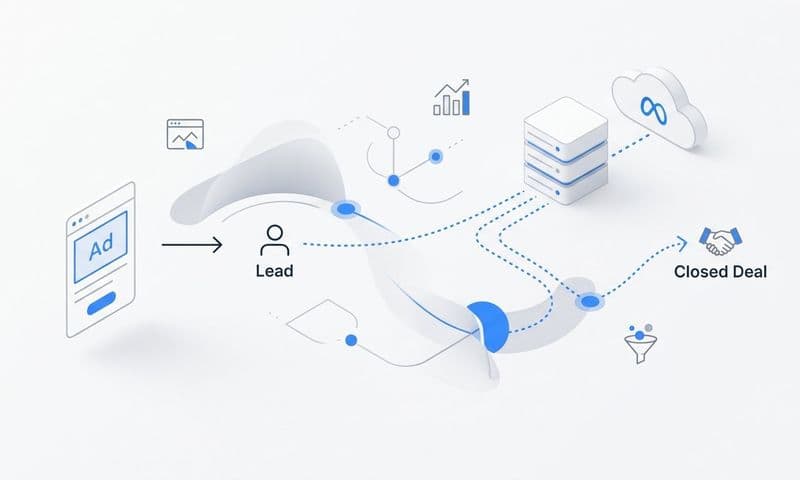
The data pipeline looks like this: Someone clicks your LinkedIn ad. The click data flows to your attribution platform via server-side tracking. They browse your website, and page views get logged. They download a whitepaper, becoming a known lead in your marketing automation system. That lead gets synced to your CRM. Over the next few months, they attend a webinar, request a demo, and engage with nurture emails—all captured as touchpoints. Finally, they become a customer, and the deal closes in your CRM.
Your attribution system now has the complete story: ad click → website visits → content downloads → webinar attendance → demo request → closed deal. Each touchpoint is connected to the same account record, allowing you to see the full journey and assign credit appropriately. Understanding how to leverage marketing campaign tracking software is essential for building this foundation.
The technical challenge isn't just collecting this data—it's maintaining data quality as it flows between systems. Lead records need to merge cleanly. Duplicate contacts need to resolve to single accounts. Offline touchpoints like trade show visits need manual capture and integration. This is why attribution isn't a "set it and forget it" implementation. It requires ongoing data hygiene and quality checks.
Measuring What Matters: Key Metrics for B2B Attribution
Once your attribution system is tracking touchpoints, you need to know which metrics actually matter. Spoiler: it's not the ones most marketers obsess over.
Forget vanity metrics like impressions, clicks, and even leads. Those numbers make nice charts, but they don't tell you what's driving revenue. B2B attribution should answer one fundamental question: which marketing efforts contribute to closed deals and how much?
Pipeline Contribution by Channel: This metric shows how much qualified pipeline each marketing channel generates. If your content marketing efforts influenced $2M in pipeline this quarter while paid search influenced $500K, you know where your leverage is. This metric matters more than lead volume because it connects marketing to revenue outcomes, not just activity.
Influenced Revenue: This takes pipeline contribution one step further by tracking which marketing touchpoints influenced deals that actually closed. A channel might generate lots of pipeline that never converts, while another generates less pipeline but higher close rates. Influenced revenue reveals which channels attract your best-fit customers. Platforms focused on revenue tracking make this measurement significantly easier.
Customer Acquisition Cost by Channel: When you know how much revenue each channel influences and how much you spend on that channel, you can calculate true CAC. This is where attribution justifies its existence—you can finally answer whether spending more on LinkedIn ads or content marketing gives you better ROI. Many marketers discover their assumed best channels are actually their most expensive once you account for the full buyer journey.
Time-to-Conversion by Touchpoint: Different channels perform different roles in the buyer journey. Webinars might accelerate deals by 30 days on average, while whitepapers start relationships that take longer to mature. Understanding time-to-conversion helps you set realistic expectations and optimize your nurture sequences.
Touchpoint Velocity: This metric tracks how quickly prospects move from one stage to the next based on which touchpoints they engage with. If accounts that attend your demo close 2x faster than those that don't, you've identified a velocity accelerator worth promoting.
The key is building dashboards that drive action, not just reporting. Your attribution dashboard should answer questions like: Where should I spend my next $10K? Which campaigns should I pause? Which content assets deserve more promotion? What's working that we should do more of?
This means moving beyond static reports to dynamic analysis. Compare attribution across different time periods to spot trends. Segment by deal size, industry, or customer profile to find patterns. Look at the touchpoint sequences that lead to your best customers and try to replicate those journeys. Investing in robust marketing data analytics software helps you build these actionable dashboards.
One practical approach: create a monthly attribution review where marketing and sales leadership examine pipeline contribution by channel, identify surprises (channels performing better or worse than expected), and make budget reallocation decisions based on the data. This turns attribution from a reporting exercise into a strategic planning tool.
Common Attribution Pitfalls and How to Avoid Them
Even with the right technical setup and metrics, attribution implementations fail in predictable ways. Here's how to avoid the most common traps.
The Offline Touchpoint Gap: Your attribution system tracks digital interactions beautifully, but what about the trade show booth conversation? The sales call that changed the prospect's mind? The executive dinner that sealed the deal? These offline touchpoints often matter more than digital ones, but they're invisible to your tracking. The solution isn't perfect—it requires manual data entry. Train your sales team to log meaningful touchpoints in your CRM. Create custom fields for event attendance, call outcomes, and in-person meetings. Yes, it's more work, but ignoring offline touchpoints means your attribution story is incomplete.
Data Quality Issues: Attribution is only as good as your data hygiene. Duplicate contact records, incomplete CRM data, and misaligned lead sources create attribution chaos. If the same person exists as three different contacts in your system, their journey looks like three separate buyers. If your sales team doesn't update lead sources consistently, your attribution breaks down. The fix requires ongoing data governance: regular deduplication, required fields for critical data, and clear processes for how information flows between systems.
Analysis Paralysis: It's tempting to build increasingly complex attribution models that account for every variable. But complexity doesn't equal insight. Many marketers spend so much time perfecting their attribution model that they never actually use the data to make decisions. Start simple. Use a position-based or linear model that you can implement quickly and that your team understands. Make some budget decisions based on the insights. Refine your model over time as you learn what matters.
The "Not Enough Data" Problem: Data-driven attribution models need volume to work—typically hundreds of conversions. If you're a small B2B software company closing ten deals per month, you don't have enough data for machine learning models to find meaningful patterns. Don't force sophistication you can't support. Stick with simpler models until your data volume justifies complexity.
Ignoring Statistical Significance: Just because your attribution report says Channel X drove more revenue than Channel Y doesn't mean it's true. Small sample sizes create noise. A few large deals can skew your data dramatically. Before making major budget shifts, ask: is this pattern statistically significant or just random variation? Look at trends over multiple months, not single data points. Understanding these attribution challenges in marketing analytics helps you interpret your data more accurately.
The Perfect Attribution Trap: Some marketers refuse to implement attribution until they can track everything perfectly. This is a mistake. Imperfect attribution that captures 80% of your touchpoints and helps you make better decisions beats perfect attribution that you never actually implement. Start with what you can track today and improve over time.
Putting Attribution Insights Into Action
Attribution data is worthless unless it changes your behavior. Here's how to turn insights into outcomes.
Budget Reallocation Strategy: Start with a quarterly attribution review. Compare pipeline contribution and influenced revenue across all channels. Identify your top three performers and your bottom three. The goal isn't to eliminate underperforming channels immediately—it's to test reallocation. Take 10-20% of budget from your worst performers and shift it to your best. Run this for a quarter and measure the impact on pipeline quality and volume. This iterative approach reduces risk while letting you optimize based on real data.
Here's what this looks like in practice: Your attribution data shows that LinkedIn ads drive fewer leads than Google Ads, but those leads close at 3x the rate and generate 2x the deal size. Your CAC on LinkedIn is actually lower when you account for deal quality. You shift $5K monthly from Google to LinkedIn and watch qualified pipeline increase. This is attribution driving strategy.
Feeding Better Data Back to Ad Platforms: Modern ad platforms like Meta and Google use machine learning to optimize campaigns. But they can only optimize based on the conversion data you send them. If you're only sending form fills as conversions, their algorithms optimize for form fills—not qualified pipeline or revenue.
This is where conversion sync matters. By sending qualified opportunity data and closed-won revenue back to your ad platforms, you teach their algorithms what good actually looks like. Instead of optimizing for any lead, they optimize for leads that become customers. This creates a powerful feedback loop where your attribution insights improve your ad targeting automatically.
Building a Culture of Attribution: The biggest barrier to attribution success isn't technical—it's organizational. Sales teams often distrust marketing attribution. Leadership wants simple answers to complex questions. Marketing teams resist accountability.
Breaking through requires shared metrics and regular collaboration. Create a monthly attribution review where sales and marketing leadership examine the data together. Focus on pipeline quality, not just quantity. Celebrate wins when attribution reveals successful campaigns. Use attribution to defend marketing budget, not just report on it.
When sales sees that marketing-influenced deals close faster and larger, they become attribution advocates. When leadership sees clear ROI from marketing spend, they fund expansion. When marketing can prove impact on revenue, they earn strategic influence.
One practical approach: tie marketing compensation partially to attributed pipeline and revenue, not just lead volume. This aligns incentives and forces the team to care about quality over quantity. It also makes attribution data mission-critical rather than nice-to-have reporting. Exploring attribution modeling for marketing can help you structure these compensation frameworks effectively.
Continuous Optimization: Attribution isn't a one-time project—it's an ongoing practice. As you collect more data, your insights improve. As your business evolves, your attribution model needs to evolve with it. Schedule quarterly reviews of your attribution setup. Are you capturing all relevant touchpoints? Is your model still answering the right questions? Are there new channels or tactics you need to incorporate?
The companies that win with attribution treat it as a competitive advantage, not a reporting requirement. They use attribution data to make faster, smarter decisions about where to invest. They test new channels with confidence because they can measure true impact. They optimize campaigns based on revenue outcomes, not vanity metrics. For SaaS companies specifically, marketing attribution software for SaaS offers tailored solutions for these unique challenges.
Moving Forward With Confidence
B2B software marketing attribution isn't about achieving perfect measurement. It's about making better decisions with better data. Every dollar you spend on marketing should drive measurable pipeline and revenue—attribution is how you prove it.
The competitive advantage goes to companies that understand which marketing efforts truly drive revenue. While your competitors guess which channels deserve more budget, you'll know. While they optimize for leads that never convert, you'll optimize for customers and revenue. While they justify marketing spend with activity metrics, you'll justify it with ROI.
Start with the foundation: connect your ad platforms, website, marketing automation, and CRM into a unified attribution system. Choose an attribution model that fits your sales cycle and data volume. Focus on metrics that matter—pipeline contribution, influenced revenue, and customer acquisition cost by channel. Then use those insights to reallocate budget, improve targeting, and drive revenue growth.
The technical implementation takes work. The organizational change takes persistence. But the payoff is marketing that's accountable, scalable, and directly connected to business outcomes. That's the promise of B2B software marketing attribution—and it's worth the effort.
Ready to elevate your marketing game with precision and confidence? Discover how Cometly's AI-driven recommendations can transform your ad strategy—Get your free demo today and start capturing every touchpoint to maximize your conversions.