
You're running ads on Meta, Google, TikTok, and maybe a few other platforms. The spend is adding up—thousands, maybe tens of thousands each month. Your dashboards show clicks, impressions, and conversions. But when your CFO asks which campaigns actually drove last quarter's revenue, you're stuck toggling between platforms, trying to reconcile numbers that don't add up.
Here's the uncomfortable truth: you can't identify which ads drive sales because your tracking setup isn't built for today's reality. iOS privacy changes broke traditional pixel tracking. Customers bounce between devices before buying. And every ad platform takes credit for the same conversion, inflating your reported ROAS and leaving you guessing where to spend next.
This isn't a skills problem. It's a tracking problem. And it's solvable. This article will walk you through why your current attribution setup is failing, what's actually happening behind the scenes, and how to build a tracking foundation that connects every ad touchpoint to real revenue.
Why Your Current Tracking Setup Is Leaving You in the Dark
Traditional pixel-based tracking used to be straightforward. You'd drop a snippet of code on your site, and when someone clicked an ad and converted, the pixel fired. The ad platform logged the conversion. Everyone was happy.
Then iOS 14.5 arrived in 2021 with App Tracking Transparency. Apple required apps to ask users for permission to track them across other apps and websites. Most users said no. Suddenly, mobile conversions that used to be tracked vanished from your Meta and Google dashboards. The pixels were still there, but they couldn't see what they used to see.
Browser-based tracking faced similar headwinds. Safari's Intelligent Tracking Prevention and Firefox's Enhanced Tracking Protection started blocking third-party cookies by default. Chrome announced plans to phase out third-party cookies entirely. Privacy-focused browsers like Brave block tracking scripts outright. Your pixel might load, but it's operating with one hand tied behind its back.
The result? Ad platforms now report fewer conversions than actually happened. Your Facebook Ads Manager might show 50 conversions when your CRM logged 80 sales from the same campaign. The gap between what platforms see and what actually converts keeps growing. Understanding why Facebook ads aren't attributing sales properly is the first step toward fixing this.
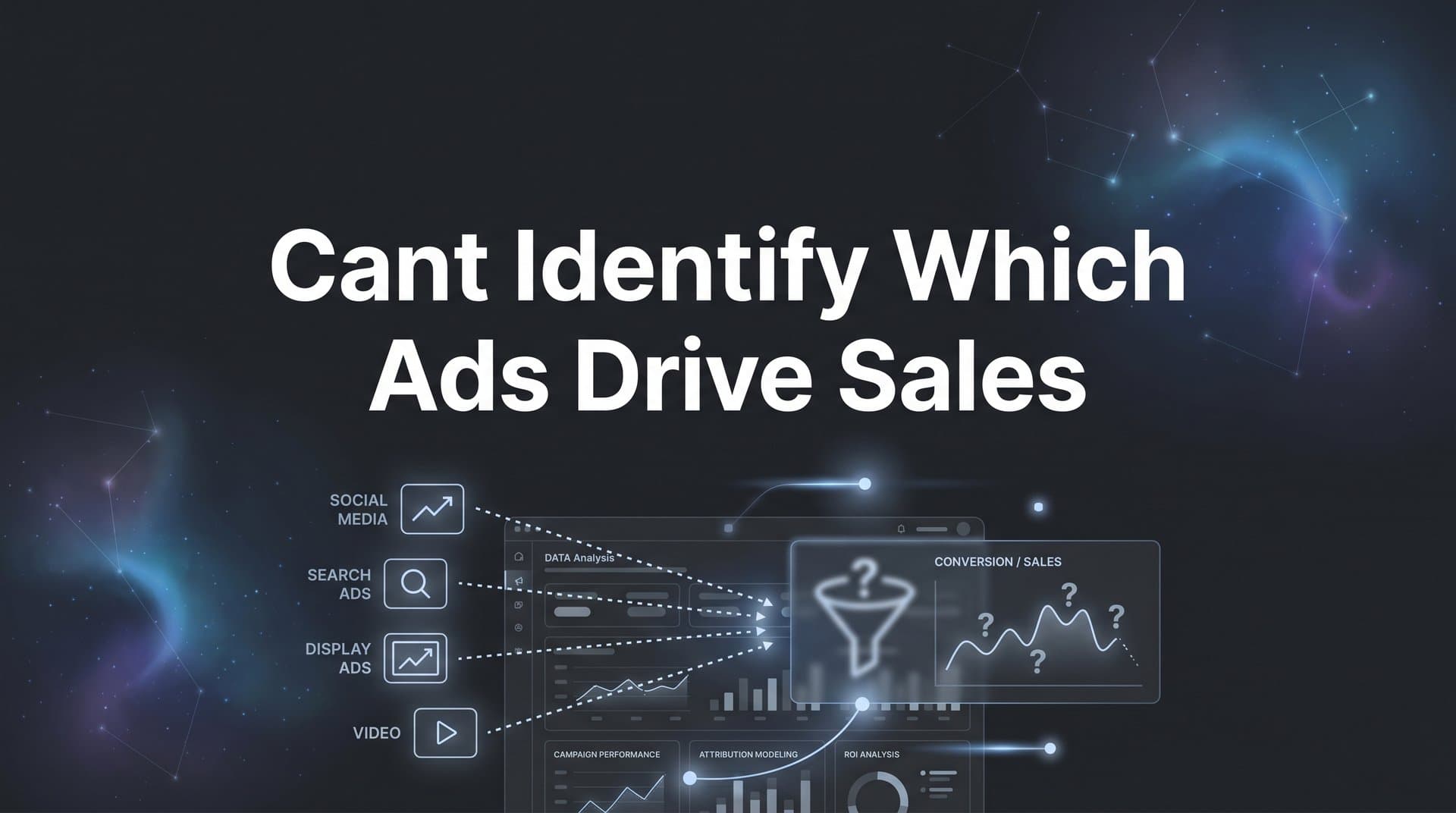
But tracking limitations are only part of the problem. Customer journeys have become longer and more complex. Someone might see your Instagram ad on Monday, click a Google search ad on Wednesday, receive a retargeting email on Friday, and finally convert on Saturday after clicking a different Google ad. That's four touchpoints across three platforms and a week of consideration.
Each platform only sees its own slice. Meta thinks the Instagram ad drove the sale. Google thinks the search ad deserves credit. Your email platform reports a conversion. They're all technically right—each touchpoint played a role. But when you add up the conversions each platform claims, you get 300% ROAS on paper while your actual revenue stays flat.
This is attribution inflation, and it makes every budget decision unreliable. You can't confidently scale what's working because you don't actually know what's working. You're flying blind, making million-dollar decisions based on incomplete data from platforms that are financially incentivized to overreport their own impact.
The Hidden Cost of Attribution Guesswork
When you can't identify which ads drive sales, you start making decisions based on vanity metrics instead of revenue. A campaign with a stellar click-through rate and low cost-per-click looks like a winner in your dashboard. So you increase the budget. Three months later, you realize it's generating awareness but rarely converting. You've just spent tens of thousands on a channel that felt right but wasn't.
This happens constantly. Marketers over-invest in channels that report impressive metrics but underperform in reality. They cut budgets from campaigns that look expensive but actually drive high-value customers. Without accurate attribution connecting ad spend to actual revenue, optimization becomes guesswork dressed up in analytics dashboards. Learning how to prove which ads drive sales changes everything.
The misalignment between sales and marketing gets worse. Your CRM shows 200 new customers this month. Your ad platforms collectively claim credit for 400 conversions. Sales leadership questions whether marketing's numbers are real. Marketing can't prove which campaigns deserve credit for closed deals. Instead of collaborating on what's driving growth, teams waste time in meetings arguing about whose data is correct.
Trust erodes. When the VP of Sales asks which campaigns brought in your top 10 accounts, you can't answer with confidence. When leadership wants to know if that expensive conference sponsorship actually led to pipeline, you're stuck guessing based on timing and gut feel. Attribution guesswork doesn't just hurt campaign performance; it undermines your credibility.
Scaling becomes a risk instead of an opportunity. You know some of your campaigns are profitable, but you're not sure which ones. Doubling your ad spend might double your revenue, or it might just double your spend on channels that don't actually convert. So you stay cautious, testing incrementally, never fully committing to growth because you can't confidently identify what's working.
Meanwhile, competitors who solved attribution are scaling aggressively. They know exactly which campaigns drive revenue. They can reallocate budget in real time. They're feeding better data back to ad platforms, improving algorithmic optimization. They're growing faster not because they're smarter marketers, but because they have better visibility into what's actually driving results.
The opportunity cost of attribution guesswork compounds over time. Every month you operate without clear visibility is a month of suboptimal budget allocation, missed scaling opportunities, and decisions based on incomplete information. The hidden cost isn't just wasted ad spend; it's the growth you're leaving on the table.
Server-Side Tracking: The Foundation for Accurate Attribution
Browser-based pixels are fighting a losing battle against privacy restrictions. Server-side tracking takes a different approach: instead of relying on a user's browser to report conversions, your server sends conversion data directly to ad platforms. This bypasses browser limitations entirely.
Here's how it works. When someone converts on your site or in your CRM, that event triggers on your backend. Your server then sends that conversion data to Meta, Google, and other ad platforms through their server-to-server APIs. No browser required. No pixels that can be blocked. No reliance on cookies that might be deleted.
The advantages are immediate. You capture conversions that browser-based tracking misses—iOS users who opted out of tracking, people using privacy-focused browsers, customers who cleared their cookies before converting. Events that used to vanish from your reports now get properly attributed. The gap between platform-reported conversions and actual CRM sales shrinks dramatically. This is essential for improving Facebook ads tracking accuracy.
But server-side tracking does more than just capture missing data. It provides richer, more accurate information to ad platform algorithms. Instead of sending just "someone converted," you can send "John Smith purchased $500 of Product X, this is his third order, and his lifetime value is $1,200." That enriched data helps Meta and Google's machine learning systems understand what a valuable customer looks like.
This is where conversion sync becomes powerful. Ad platforms optimize for the signals you send them. If you only send basic conversion events, they optimize for anyone who converts. But if you send enriched events that include customer value, purchase history, and CRM status, they optimize for your best customers. The algorithm learns to find more people like your high-value buyers, not just anyone willing to click.
Implementation connects three layers: your website tracking, your backend systems, and your ad platforms. The website layer captures user behavior and intent. The backend layer processes actual conversions and enriches them with CRM data. The ad platform layer receives clean, complete conversion data that feeds back into optimization algorithms.
This isn't a replacement for pixel-based tracking; it's a complement. Pixels still capture browsing behavior and enable retargeting. But server-side tracking ensures that when conversions happen, they're accurately reported and properly attributed. Together, they create a more complete picture than either approach alone.
The technical lift varies depending on your stack, but the core concept remains consistent: move conversion reporting from the browser to your server, enrich it with CRM data, and send it back to ad platforms in a format their algorithms can use to improve targeting and optimization.
Multi-Touch Attribution: Seeing the Full Customer Journey
Server-side tracking captures conversions accurately. Multi-touch attribution tells you which touchpoints along the customer journey deserve credit. This distinction matters because not all interactions contribute equally to a sale.
Think about your own buying behavior. You might discover a product through a social media ad, research it via Google search, read reviews on a third-party site, receive a retargeting email, and finally convert after clicking another search ad. Five touchpoints, but which one "drove" the sale?
Last-touch attribution gives 100% credit to the final interaction before conversion. In this model, that last search ad gets all the glory. Last-touch is simple and shows which channels close deals, but it ignores everything that happened earlier in the journey. The social ad that created initial awareness? Invisible. The email that brought you back? Doesn't count.
First-touch attribution does the opposite: it credits the initial touchpoint that started the journey. This model highlights top-of-funnel channels that generate awareness and introduce prospects to your brand. It's valuable for understanding what brings people into your ecosystem, but it ignores the nurturing and closing touchpoints that actually converted them.
Linear attribution distributes credit equally across all touchpoints. Every interaction gets the same weight, which feels fair but doesn't reflect reality. The casual Instagram scroll that exposed someone to your brand probably didn't contribute as much as the comparison shopping search that happened right before purchase. When your marketing team can't agree on an attribution model, comparing multiple models side-by-side often resolves the debate.
Time-decay attribution weights recent interactions more heavily than earlier ones. Touchpoints closer to conversion get more credit, while early awareness moments get less. This model acknowledges that not all interactions are equal and that closing touchpoints often matter more, but it still gives some credit to the entire journey.
Here's the key insight: there's no single "correct" attribution model. Each one tells a different story about your marketing. Last-touch reveals your closing channels. First-touch shows your awareness drivers. Linear highlights your most consistent performers. Time-decay balances recency with journey completeness.
The power comes from comparing models side-by-side. When you analyze the same campaigns through multiple attribution lenses, patterns emerge. You might discover that TikTok ads excel at first-touch attribution but rarely appear in last-touch reports—they're great for awareness but don't close deals. Meanwhile, branded search ads dominate last-touch attribution but barely register in first-touch—they capture existing demand but don't create new interest.
This multi-model view transforms how you allocate budget. Instead of asking "which channel is best," you ask "which channels serve which purpose in my funnel?" You stop expecting every channel to do everything and start building a marketing mix where each channel plays to its strengths.
Real-time attribution takes this further. Instead of waiting for end-of-month reports to see what worked, you can monitor attribution data daily or even hourly. When a campaign's attributed revenue drops, you can investigate and adjust immediately. When a new creative starts driving conversions, you can scale it while it's hot. Real-time visibility turns attribution from a retrospective analysis tool into an active optimization lever.
Turning Attribution Data Into Actionable Decisions
Accurate attribution is only valuable if you use it to make better decisions. The goal isn't prettier dashboards; it's smarter budget allocation, improved campaign performance, and faster growth.
Start with budget reallocation. When you know which campaigns actually drive revenue, you can shift spend from underperformers to proven winners. This isn't about killing everything that doesn't work—some channels play important supporting roles even if they don't get last-touch credit. But it does mean you can confidently scale campaigns that consistently show up in your attribution data as revenue drivers. Understanding which marketing channel drives revenue is the foundation of smart budget decisions.
Many marketers discover that their budget allocation is inverted. They're spending heavily on awareness channels that generate impressive vanity metrics but rarely convert, while underfunding conversion-focused channels that don't look as exciting in platform dashboards. Attribution data reveals this misalignment and gives you the evidence to fix it.
Feeding enriched conversion data back to ad platforms creates a compounding advantage. When Meta and Google know which conversions came from high-value customers, their algorithms optimize for quality, not just quantity. You stop getting clicks from people who'll never buy and start getting clicks from people who match your best customer profiles.
This is conversion sync in action. Instead of letting ad platforms guess what a valuable conversion looks like, you tell them explicitly. You can send customer lifetime value, average order value, product categories purchased, or any other signal that distinguishes your best customers from casual browsers. The more specific your signals, the better the algorithmic optimization. Discover how ad tracking tools can help you scale ads using this accurate data.
Reporting transforms from defensive to strategic. When leadership asks about marketing ROI, you're not scrambling to justify your budget or explaining why platform numbers don't match CRM numbers. You show clear, accurate reports that connect ad spend directly to revenue, broken down by campaign, channel, and attribution model. The conversation shifts from "prove marketing works" to "where should we invest more?"
Attribution data also improves creative and messaging decisions. When you know which campaigns drive revenue, you can analyze what makes them work. Is it the offer? The creative angle? The audience targeting? You can double down on what's proven and test variations that build on successful patterns rather than guessing blindly.
The compounding effect matters most. Better attribution leads to smarter budget allocation. Smarter allocation improves campaign performance. Better performance generates more revenue. More revenue creates budget for further testing and scaling. Each cycle reinforces the next, creating momentum that separates high-growth companies from stagnant competitors.
Getting Started: Your Path to Clear Ad Attribution
You don't need to fix everything at once. Start with an honest audit of your current tracking setup. Compare conversion numbers in your ad platforms to actual sales in your CRM. The gap between these numbers reveals how much visibility you're missing.
Look at your highest-spend channels first. If you're spending $50,000/month on Meta ads but can only confidently attribute 60% of reported conversions to actual CRM sales, that's where you start. Fixing attribution on your biggest channels delivers the fastest impact on decision-making and budget optimization. A marketing tracking spreadsheet can help you document and compare these numbers systematically.
Establish baseline metrics before implementing new tracking. Document your current cost per acquisition, return on ad spend, and conversion rates by channel. When you improve attribution accuracy, these baselines let you measure the impact. Many marketers find that their true CPA is higher than platform-reported numbers suggested, but their ROAS is also more reliable because it's based on real data.
Prioritize server-side tracking implementation for conversion events that matter most to your business. If you're B2B, that might be demo requests and closed deals. If you're e-commerce, it's purchases and high-value orders. Don't try to track everything perfectly from day one; focus on the events that directly impact revenue.
Start comparing attribution models once you have clean data flowing. Look at the same campaigns through last-touch, first-touch, and time-decay lenses. The differences will reveal which channels initiate interest versus which channels close deals. Use these insights to set appropriate expectations and goals for each channel.
Build reporting that leadership actually wants to see. Most executives don't care about click-through rates or cost-per-click. They care about revenue, customer acquisition cost, and return on investment. When your attribution data can answer "which campaigns drove revenue" clearly and accurately, you earn trust and budget for growth.
Putting It All Together
The inability to identify which ads drive sales isn't permanent. It's a tracking problem with a clear solution. Marketers who implement proper attribution—combining server-side tracking with multi-touch attribution models—gain visibility that transforms how they optimize and scale.
You stop guessing which campaigns work and start knowing. You stop over-investing in channels that look good but underperform and start scaling proven winners. You stop fighting with sales about whose numbers are right and start collaborating on growth. The competitive advantage isn't subtle; it's the difference between cautious testing and confident scaling.
Every month you operate without clear attribution is a month of suboptimal decisions, missed opportunities, and budget allocated based on incomplete data. The marketers winning in today's landscape aren't necessarily more creative or strategic—they just have better visibility into what's actually driving results.
Building this visibility requires connecting your website, CRM, and ad platforms into a unified system that captures every touchpoint and ties it to revenue. It requires moving beyond browser-based pixels to server-side tracking that bypasses privacy restrictions. It requires comparing attribution models to understand which channels serve which purpose in your funnel.
But once you have it, everything changes. Budget decisions become obvious. Scaling becomes confident. Reporting becomes strategic. You're no longer stuck in meetings trying to explain why your numbers don't match. You're focused on growth because you know exactly what's working.
Ready to elevate your marketing game with precision and confidence? Discover how Cometly's AI-driven recommendations can transform your ad strategy—Get your free demo today and start capturing every touchpoint to maximize your conversions.