You're running Meta ads that generate awareness. Google campaigns that capture search intent. Email sequences that nurture leads. Organic content that builds trust. But when someone finally converts, which channel actually drove that decision?
Without a clear cross channel attribution strategy, you're making budget decisions based on incomplete data. Your Facebook Ads Manager shows one conversion number. Google Analytics shows another. Your CRM tells a third story. And none of them agree.
This disconnect isn't just confusing—it's expensive. You might be killing campaigns that are actually driving revenue in ways you can't see. Or doubling down on channels that look great in their own dashboards but aren't really moving the needle.
The problem isn't your marketing. It's that each platform only sees its own piece of the puzzle. Meta doesn't know about your Google clicks. Google doesn't know about your email opens. And your CRM sits disconnected from both.
The strategies in this guide will help you connect these dots. You'll learn how to build an attribution approach that tracks the complete customer journey—from first touchpoint to closed deal—so you can finally make confident decisions about where your marketing dollars actually belong.
1. Unify Your Data Sources Before Choosing Attribution Models
The Challenge It Solves
Attribution models are only as good as the data they're built on. If your ad platforms, website analytics, and CRM are operating in silos, no attribution model will give you accurate insights. You'll end up comparing incomplete datasets and making decisions based on partial truths.
The iOS 14+ privacy changes made this challenge even more acute. Browser-based tracking now misses significant portions of your customer journey, leaving gaps that traditional analytics tools can't fill.
The Strategy Explained
Data unification means connecting every source of customer interaction into a single, cohesive view. This requires moving beyond browser-based tracking to server-side tracking that captures data directly from your servers to ad platforms and analytics tools.
Server-side tracking bypasses browser limitations and ad blockers, ensuring you capture the complete picture of customer interactions. When someone clicks your Meta ad, visits your site via Google search, and later converts through an email link, all three touchpoints get recorded in one unified system.
Think of it like building a central nervous system for your marketing data. Instead of each platform maintaining its own isolated records, everything flows into one source of truth that all your tools can access.
Implementation Steps
1. Audit your current data sources—list every platform where customer interactions happen (ad platforms, website, CRM, email, offline channels).
2. Implement server-side tracking to capture events that browser-based tracking misses, especially post-iOS 14 mobile traffic.
3. Connect your CRM to your ad platforms and analytics tools so revenue data flows back to where customer journeys begin.
4. Establish a unique customer identifier that persists across all platforms, allowing you to track individual journeys from first touch to conversion.
Pro Tips
Start with your highest-value conversion events. Don't try to track everything at once—focus on the conversions that actually drive revenue. Once those are flowing accurately, expand to secondary events. Also, test your tracking by completing a conversion yourself and verifying it appears correctly across all platforms.
2. Map the Complete Customer Journey Across All Touchpoints
The Challenge It Solves
Most marketers only see the digital interactions their analytics tools capture. But customer journeys often include touchpoints that never show up in your dashboards—sales calls, in-person demos, partner referrals, offline events, or extended research periods where customers go dark before converting.
These invisible touchpoints create attribution blind spots. You might credit a final Google search for a conversion that was actually driven by a discovery call two weeks earlier.
The Strategy Explained
Journey mapping means documenting every possible interaction point between awareness and conversion. This includes both digital and offline touchpoints, with special attention to the gaps where customers disappear from your tracking before re-emerging to convert.
The goal isn't just to list touchpoints—it's to understand the sequence and timing of interactions that lead to conversions. Do customers typically see three ads before clicking? Do they visit your pricing page multiple times? Does a demo call always happen before enterprise deals close?
These patterns reveal which touchpoints are actually influencing decisions versus which ones just happen to be present in the journey.
Implementation Steps
1. Interview your sales team to identify offline touchpoints that happen before conversions—calls, demos, proposals, in-person meetings.
2. Pull conversion data from your CRM and work backward to identify every recorded touchpoint that preceded each deal.
3. Look for patterns in high-value customer journeys—which channels appear most frequently, what's the typical time between first touch and conversion, how many interactions usually happen.
4. Document the gaps where customers go silent between touchpoints, as these often represent research periods or competitive evaluations.
5. Create a visual map showing typical journey paths for different customer segments or deal sizes.
Pro Tips
Pay special attention to the touchpoints that appear in your highest-value deals. These patterns often differ significantly from smaller conversions and deserve different attribution weight. Also, don't assume digital-first journeys—many B2B customers research extensively before their first trackable interaction.
3. Implement Multi-Touch Attribution Instead of Last-Click Defaults
The Challenge It Solves
Last-click attribution gives 100% credit to the final touchpoint before conversion. This systematically undervalues upper-funnel channels that create awareness and consideration. Your brand awareness campaigns might be doing the heavy lifting while your retargeting ads get all the credit.
When you optimize based on last-click data, you end up starving the channels that actually start customer journeys and over-investing in channels that simply close deals already in progress.
The Strategy Explained
Multi-touch attribution distributes conversion credit across multiple touchpoints in the customer journey. Different models distribute this credit differently based on what you want to understand about your marketing mix.
Linear attribution gives equal credit to every touchpoint—useful when you want to value all interactions equally. Time-decay attribution gives more credit to recent interactions—helpful when recency matters more than early awareness. Position-based attribution typically credits 40% to the first touch, 40% to the last touch, and distributes the remaining 20% among middle interactions—valuable when you want to emphasize both awareness and conversion moments.
The right model depends on your sales cycle length and which questions you're trying to answer about your marketing effectiveness.
Implementation Steps
1. Choose an attribution model that matches your sales cycle—shorter cycles often work well with time-decay, longer cycles benefit from position-based models.
2. Apply your chosen model to historical conversion data to see how credit redistribution changes your understanding of channel performance.
3. Identify channels that gain credit under multi-touch attribution versus last-click—these are likely being undervalued in your current budget allocation.
4. Set up reporting that shows both last-click and multi-touch attribution side by side so you can compare perspectives.
Pro Tips
Don't abandon last-click attribution entirely—it still tells you which channels are effective at closing deals. Instead, use multi-touch attribution alongside last-click to get a complete picture. If a channel performs well in multi-touch but poorly in last-click, it's probably an effective awareness channel that needs different optimization metrics.
4. Feed Enriched Conversion Data Back to Ad Platforms
The Challenge It Solves
Ad platform algorithms optimize based on the conversion data they receive. But if you're only sending basic conversion events, the algorithms are optimizing for quantity rather than quality. They can't tell the difference between a $50 customer and a $5,000 customer.
This limitation becomes especially problematic when your CRM reveals that certain traffic sources or campaigns drive dramatically different customer lifetime values. The ad platforms need this information to improve their targeting and optimization.
The Strategy Explained
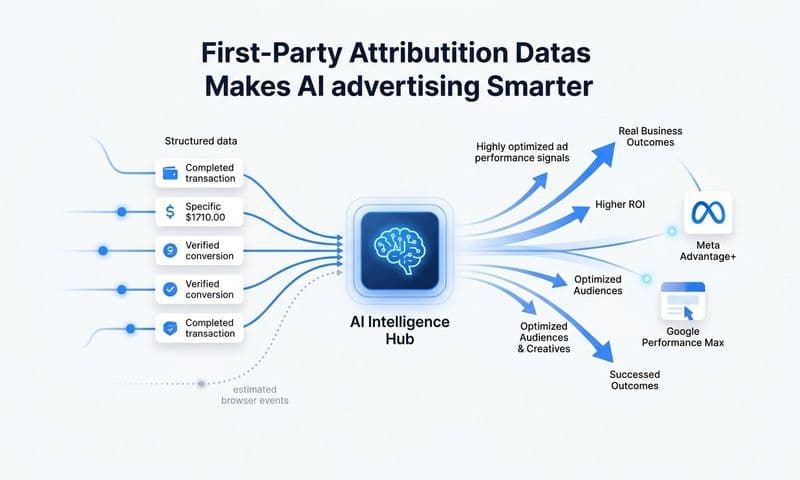
Conversion APIs allow you to send enriched conversion data from your CRM back to ad platforms like Meta and Google. Instead of just reporting "conversion happened," you can send actual revenue values, customer lifetime value predictions, lead quality scores, or deal closure data.
When ad platforms receive this enriched data, their algorithms can optimize for the conversions that actually matter to your business. Meta's algorithm learns which audience segments drive high-value customers. Google's Smart Bidding adjusts bids based on predicted customer value rather than just conversion likelihood.
This feedback loop transforms your ad platforms from conversion-counting machines into revenue-optimization engines.
Implementation Steps
1. Identify which conversion events in your CRM represent true business value—closed deals, high-value purchases, qualified leads.
2. Set up server-side conversion tracking through Conversion APIs for Meta, Google, and other platforms you use.
3. Configure your CRM to send conversion events back to ad platforms when deals close or when you can confirm conversion quality.
4. Include revenue values or custom parameters in your conversion events so algorithms can optimize for value, not just volume.
5. Monitor how campaign performance changes as algorithms receive better data—you should see improved efficiency over 2-4 weeks as machine learning adapts.
Pro Tips
Start by sending closed deal data for your highest-value conversions. Even if you can't track every micro-conversion perfectly, feeding actual revenue data back to ad platforms creates immediate optimization improvements. Also, maintain consistent event naming between your CRM and ad platforms to ensure proper matching.
5. Compare Attribution Models Side-by-Side for Better Insights
The Challenge It Solves
No single attribution model tells the complete story. Last-click overvalues bottom-funnel channels. First-click overvalues awareness channels. Linear attribution treats all touchpoints equally even when they clearly have different impacts. Each model reveals different truths about your marketing effectiveness.
Relying on one model means you're making decisions based on a single perspective when you need multiple angles to understand the full picture.
The Strategy Explained
Model comparison means running multiple attribution models simultaneously on the same conversion data. By viewing your marketing performance through different lenses, you can identify which channels are being systematically under or overvalued by your current attribution approach.
If you're evaluating vendors, our marketing dashboard software comparison breakdown can help.
When a channel performs well across multiple models, you can be confident it's genuinely driving results. When a channel's performance varies dramatically between models, that variance tells you something important about its role in the customer journey.
For example, if a channel gets high credit in first-touch attribution but low credit in last-click, it's probably an effective awareness driver that rarely closes deals directly. That's not a weakness—it's valuable information about how that channel fits into your marketing mix.
Implementation Steps
1. Set up reporting that shows the same conversion data through at least three different attribution models—typically last-click, first-click, and one multi-touch model.
2. Create a comparison view that shows how conversion credit shifts between models for each marketing channel.
3. Identify channels with high variance between models—these are the ones where attribution choice significantly impacts your understanding of performance.
4. Look for channels that perform consistently well across models—these are your most reliable performers that deserve stable investment.
5. Use model comparison to inform budget decisions rather than relying on any single model as the "truth."
Pro Tips
Pay attention to which models your executive team and finance department trust most. Even if you prefer a sophisticated multi-touch model, if leadership makes decisions based on last-click data, you need to speak that language while educating them on other perspectives. Build internal alignment on which models to use for which decisions.
6. Establish Cross-Channel Incrementality Testing
The Challenge It Solves
Attribution models show correlation—which touchpoints were present before conversions. But correlation doesn't prove causation. Just because customers saw your ad before converting doesn't mean the ad caused the conversion. They might have converted anyway.
Without incrementality testing, you can't distinguish between channels that genuinely drive new conversions versus channels that simply reach customers who were already going to convert. This leads to over-investment in channels that look good in attribution reports but aren't actually moving the needle.
The Strategy Explained
Incrementality testing uses holdout experiments to measure true lift from marketing channels. You create test and control groups, expose the test group to your marketing while withholding it from the control group, then measure the difference in conversion rates between groups.
The conversion rate difference represents true incremental impact—the conversions that wouldn't have happened without your marketing. This provides causal evidence that attribution models can't deliver.
Think of it like a clinical trial for your marketing. Attribution tells you what happened. Incrementality testing tells you what you caused to happen.
Implementation Steps
1. Choose one marketing channel to test initially—start with a channel where you suspect attribution might be overstating impact.
2. Design a holdout test by randomly splitting a portion of your target audience into test and control groups (typically 90% test, 10% control).
3. Run your marketing normally to the test group while completely withholding it from the control group for 2-4 weeks.
4. Measure conversion rates for both groups and calculate the lift percentage—this is your true incremental impact.
5. Compare incrementality results to what attribution models showed for the same channel to identify gaps between correlation and causation.
Pro Tips
Run incrementality tests during stable periods, not during major promotions or seasonal spikes. You want to measure the channel's normal impact without confounding variables. Also, accept that incrementality testing requires pausing marketing to some users—the insights gained are worth the short-term opportunity cost.
7. Build Real-Time Dashboards That Connect Spend to Revenue
The Challenge It Solves
Most marketing dashboards show metrics that don't directly connect to business outcomes. You can see impressions, clicks, and even conversions, but translating those into actual revenue impact requires manual analysis across multiple tools. By the time you've connected the dots, the opportunity to optimize has passed.
Decision-making speed matters. When you can see which campaigns are driving revenue in real-time, you can shift budget immediately rather than waiting for end-of-month reports to reveal what's working.
The Strategy Explained
Revenue-connected dashboards unify spend data from ad platforms with conversion and revenue data from your CRM in a single view. Instead of looking at cost-per-click in one tool and revenue in another, you see cost-per-acquisition and return on ad spend for every campaign, ad set, and creative in real-time.
Modern platforms add AI-powered recommendations on top of this unified data. The system doesn't just show you performance—it identifies underperforming campaigns that should be paused, high-performing campaigns ready to scale, and budget reallocation opportunities that will improve overall efficiency.
This transforms reporting from a retrospective exercise into an active optimization tool that guides daily decisions.
Implementation Steps
1. Connect your ad platform spend data and CRM revenue data into a unified analytics platform that can join them on customer identifiers.
2. Build dashboard views that show revenue metrics alongside spend metrics—ROAS, customer acquisition cost, revenue per campaign, lifetime value by source.
3. Set up automated alerts for significant performance changes—campaigns that suddenly improve or decline, budget pacing issues, or anomalies in conversion rates.
4. Configure AI-powered recommendations based on your business rules—minimum ROAS thresholds, budget allocation preferences, scaling criteria.
5. Establish a daily optimization routine where you review recommendations and make budget adjustments based on revenue performance.
Pro Tips
Don't try to track every possible metric in your dashboard. Focus on the 3-5 metrics that actually drive business decisions—typically ROAS, CAC, conversion rate, and revenue by channel. Too many metrics create analysis paralysis. Also, give your team clear decision-making authority based on dashboard insights so optimization happens quickly without approval bottlenecks.
Putting It All Together
Building a cross channel attribution strategy isn't a one-time project—it's an ongoing commitment to understanding what actually drives your revenue. The marketers who win aren't those with the biggest budgets. They're the ones who know exactly which dollars are working and which aren't.
Start with data unification as your foundation. Until your ad platforms, website, and CRM are speaking the same language, no attribution model will give you accurate insights. Server-side tracking solves the iOS 14+ limitations that make browser-based tracking increasingly unreliable.
Then layer in multi-touch attribution models that match your sales cycle. Compare multiple models side-by-side to build confidence in your understanding of channel performance. Use incrementality testing to prove causation beyond correlation for your most important channels.
Begin by auditing your current data sources this week. Pull a recent conversion and try to trace its complete journey across all your platforms. The gaps you find—where data doesn't connect or where touchpoints disappear—represent the opportunity cost of flying blind.
Those gaps are where budget gets misallocated. Where effective campaigns get killed because their impact isn't visible. Where underperforming campaigns keep running because they look good in their own isolated dashboards.
With unified tracking, proper attribution models, and conversion data flowing back to your ad platforms, you'll finally have the clarity to scale what works and cut what doesn't. Your ad algorithms will optimize for actual revenue instead of proxy metrics. Your budget decisions will be based on complete customer journeys instead of last-click snapshots.
The difference between guessing and knowing is a cross channel attribution strategy that connects every touchpoint to actual revenue. Ready to elevate your marketing game with precision and confidence? Discover how Cometly's AI-driven recommendations can transform your ad strategy—Get your free demo today and start capturing every touchpoint to maximize your conversions.