

Picture this: A potential customer scrolls through Instagram on their phone during their morning commute and sees your ad for the first time. Intrigued, they click through to learn more but don't convert. Later that afternoon, they're at their desk researching solutions on their work laptop and find your brand again through a Google search. That evening, relaxing on the couch with their tablet, they finally decide to make the purchase.
From your perspective as a marketer, this should be a clear win for that Instagram ad. But here's the problem: without proper cross device tracking, your analytics platform sees three completely different anonymous users across three separate sessions. The Instagram ad gets zero credit. The Google search claims the conversion. And you're left making budget decisions based on incomplete, misleading data.
This isn't a hypothetical scenario. It's the daily reality for marketers trying to measure performance in a world where customers seamlessly move between phones, tablets, laptops, and desktops throughout their journey. The attribution gap this creates doesn't just skew your reporting. It actively undermines your ability to scale what's working and cut what isn't.
In this guide, we'll demystify how cross device tracking actually works, explain why traditional tracking methods are failing in today's privacy-first landscape, and show you how to implement tracking that captures the complete customer journey across every screen. By the end, you'll understand exactly what it takes to connect the dots between touchpoints and make confident marketing decisions based on accurate data.
The Multi-Screen Reality of Modern Customer Journeys
Cross device tracking is the ability to recognize and connect a single user's activity across multiple devices. When someone interacts with your brand on their smartphone, continues their research on a laptop, and converts on a tablet, cross device tracking identifies all three sessions as belonging to the same person and stitches them together into one coherent journey.
This capability matters because fragmented data creates a distorted view of marketing performance. When you can't connect devices, you're essentially flying blind. That Facebook ad that introduced someone to your brand? It looks like it generated zero value. The retargeting campaign that nudged them closer to a decision? Invisible. The direct visit where they finally converted? That gets 100% of the credit, even though it was the culmination of multiple touchpoints across different devices.
The stakes are high. When attribution is wrong, everything downstream suffers. You might cut budget from channels that are actually driving awareness and consideration. You might pour more money into bottom-funnel tactics that only capture demand created elsewhere. Your ROAS calculations become meaningless because you're measuring the wrong inputs.
Think back to the early days of digital marketing, when most people accessed the internet primarily from a single desktop computer. Attribution was simpler because the customer journey happened in one place. A user clicked an ad, browsed your site, and either converted or didn't. All on the same device. All captured in a single session or through simple cookie-based tracking.
Today's reality is fundamentally different. Consumers move fluidly between devices throughout the day. They discover brands on mobile during micro-moments of downtime. They do deeper research on larger screens when they have more time and attention. They complete purchases on whatever device is most convenient in that moment.
This multi-screen behavior isn't an edge case. It's the norm. Your customers aren't thinking about devices when they interact with your brand. They're thinking about solving a problem or fulfilling a need. The device is just a tool, and they'll use whichever one is at hand. But from a tracking perspective, each device switch creates a potential break in the data chain.
Without cross device tracking, you're not measuring customer journeys. You're measuring device journeys. And those are two very different things. A customer journey might involve five touchpoints across three devices over two weeks. But if you can't connect those devices, your analytics show three separate users with fragmented, incomplete journeys. The insights you extract from that data will be fundamentally flawed.
The question isn't whether cross device tracking matters. It's whether you can afford to make marketing decisions without it. Every budget allocation, every creative test, every channel experiment relies on accurate attribution. When your tracking can't follow users across devices, you're optimizing based on partial information at best and completely wrong conclusions at worst.
Deterministic vs. Probabilistic: Two Approaches to Connecting Devices
There are two fundamentally different ways to connect user activity across devices: deterministic tracking and probabilistic tracking. Understanding the difference is crucial because each method has distinct strengths, limitations, and implications for accuracy.
Deterministic tracking relies on authenticated data to definitively link devices to the same person. The most common identifier is an email address or user account. When someone logs into your website or app on their phone and then logs in again on their laptop, you know with certainty that both devices belong to the same user. There's no guessing involved. The login credentials provide an exact match.
Other deterministic identifiers include phone numbers, customer IDs from your CRM, or hashed email addresses shared through data partnerships. The key characteristic is that these identifiers are unique to an individual and persist across devices. When you can match them, you have a direct, verifiable connection.
The accuracy of deterministic tracking is its biggest advantage. When you know someone's email address from a form submission or account creation, and you see that same email used across multiple devices, you can confidently attribute all of that activity to a single person. There's no statistical inference or probability calculation. It's a one-to-one match.
But deterministic tracking has a significant limitation: it only works when users authenticate. If someone browses your site anonymously on three different devices and never logs in or submits a form with their email, you have no deterministic way to connect those sessions. You're tracking three separate anonymous users, even though they're actually one person.
This is where probabilistic tracking comes in. Instead of requiring authenticated identifiers, probabilistic methods use patterns and signals to statistically infer which devices likely belong to the same user. These signals include IP addresses, device types and operating systems, browser fingerprints, geographic location data, browsing behavior patterns, and timing of activity.
For example, if you see an iPhone user in Chicago visit your site at 8 AM from a residential IP address, and then 30 minutes later see a MacBook user in Chicago visit from the same IP address, probabilistic algorithms can infer with reasonable confidence that these are the same person switching from their phone to their laptop at home.
The more signals that align, the higher the confidence level. If the timing, location, device ecosystem, and behavioral patterns all match, the probability of a correct connection increases. But it's still an educated guess, not a definitive match. There's always some margin of error. For a deeper dive into these approaches, explore our guide on cross device user tracking methods.
Probabilistic tracking's advantage is coverage. It can attempt to connect devices even when users never authenticate, capturing a broader view of anonymous browsing behavior. This is valuable for understanding the full scope of your audience and their cross-device patterns.
The tradeoff is accuracy. Probabilistic methods will inevitably produce some false positives (incorrectly linking devices that belong to different people) and false negatives (failing to link devices that do belong to the same person). Shared IP addresses in households or offices, VPN usage, and similar device configurations can all confuse probabilistic algorithms.
From a privacy perspective, deterministic tracking is generally more transparent. Users actively provide their email or create an account, understanding that this information will be used to recognize them. Probabilistic tracking, on the other hand, operates behind the scenes using signals that users may not be aware are being collected and analyzed.
In practice, the most effective cross device tracking strategies use a hybrid approach. Deterministic matching provides the foundation of high-confidence connections for authenticated users. Probabilistic methods fill in gaps for anonymous traffic, with appropriate confidence thresholds to minimize false connections. And as anonymous users eventually authenticate by logging in or converting, those probabilistic connections can be validated or corrected with deterministic data.
The key is understanding what each method can and cannot do. Deterministic tracking gives you certainty but requires user authentication. Probabilistic tracking gives you coverage but involves statistical inference. Neither is perfect on its own, but together they provide a more complete picture of cross device behavior than either could alone.
Why Traditional Tracking Falls Short in a Privacy-First World
The tracking landscape has fundamentally changed over the past few years, and traditional methods that marketers relied on for cross device attribution are increasingly unreliable. Two major shifts have created significant blind spots in how we measure customer journeys: mobile operating system restrictions and the deprecation of third-party cookies.
Apple's App Tracking Transparency framework, introduced with iOS 14.5 in April 2021, requires apps to explicitly ask users for permission before tracking their activity across other companies' apps and websites. This seemingly small change had massive implications. When given the choice, the majority of users opt out of tracking. Suddenly, a huge portion of mobile traffic became much harder to identify and connect across devices.
Before ATT, mobile apps could access the Identifier for Advertisers, a unique device-level ID that enabled cross-app and cross-device tracking. After ATT, that identifier is only available if users explicitly grant permission. For most apps, opt-in rates are low. This means that a significant percentage of iOS users are now effectively anonymous from a tracking perspective, even when using apps where they're logged in.
The impact extends beyond just iOS devices. When you can't reliably track mobile activity, you lose visibility into a critical part of the customer journey. Mobile is often where discovery happens. Users see ads, click links, and start their research on phones. If you can't connect that mobile activity to the eventual desktop conversion, you're missing the top of the funnel entirely. These cross device tracking challenges for marketers continue to grow more complex.
Third-party cookie deprecation compounds the problem. Third-party cookies have long been the backbone of cross-site tracking in web browsers. They allowed advertisers and analytics platforms to recognize users as they moved between different websites, enabling retargeting, audience building, and cross-domain attribution.
Safari and Firefox have already blocked third-party cookies by default for years. Google Chrome, which still commands the largest browser market share, has announced plans to phase them out, though the timeline has shifted multiple times as the industry grapples with alternative solutions. Regardless of the exact timing, the direction is clear: third-party cookies are going away.
When third-party cookies disappear, so does much of the traditional infrastructure for cross-device tracking. Ad platforms and analytics tools that relied on cookie-based identification suddenly have much less visibility. Users who browse on multiple devices without logging in become impossible to connect through cookies alone.
These changes create attribution blind spots that distort your understanding of marketing performance. When you can't track mobile activity or connect anonymous cross-device journeys, certain channels appear more or less effective than they actually are. Mobile ads might look like they generate awareness but no conversions, simply because you can't see when that mobile user converts later on desktop. Direct traffic and branded search might get inflated credit because they're often the last trackable touchpoint before a conversion, even though earlier untrackable interactions did the heavy lifting.
The result is a growing gap between what's actually happening in customer journeys and what your analytics platforms can measure. This isn't just an academic problem. It affects every budget decision you make. When attribution is broken, you're flying blind. You might be scaling channels that aren't actually driving results or cutting channels that are your most efficient customer acquisition sources.
The old playbook of relying on pixel-based tracking and third-party cookies simply doesn't work anymore. Privacy regulations and platform restrictions have fundamentally changed what's possible. Marketers who continue using traditional tracking methods are working with increasingly incomplete data, and that incomplete data leads to increasingly poor decisions.
The solution isn't to give up on cross device tracking. It's to adapt to the new reality by building tracking infrastructure that works within privacy constraints rather than trying to circumvent them. That means shifting from browser-based tracking to server-side data collection, prioritizing first-party data relationships with customers, and using authenticated identifiers wherever possible.
Server-Side Tracking: The Foundation for Accurate Cross Device Attribution
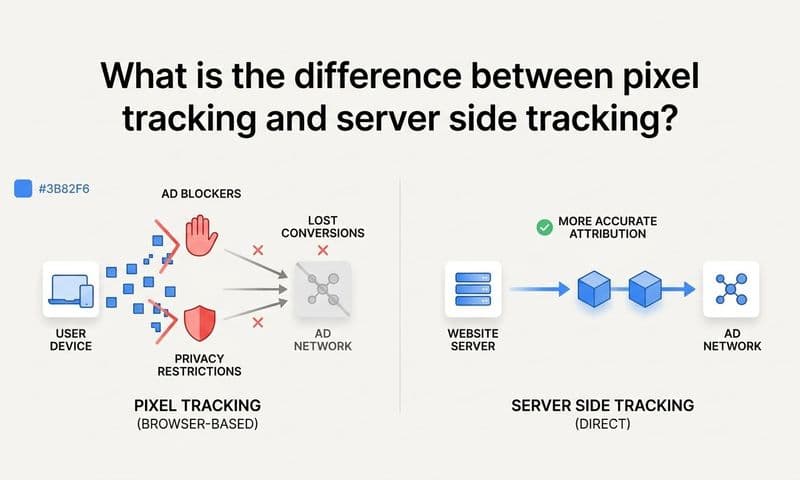
As browser-based tracking becomes less reliable, server-side tracking has emerged as the most robust foundation for accurate cross device attribution. Instead of relying on cookies and pixels that execute in the user's browser, server-side tracking collects data directly at the server level, where it's not subject to the same limitations and restrictions.
Here's how it works: when a user takes an action on your website or app, that event is sent to your server first, rather than directly to third-party analytics or advertising platforms. Your server then processes the event, enriches it with additional context, and forwards it to the appropriate platforms. This server-to-server communication happens behind the scenes, independent of browser settings, cookie blockers, or operating system restrictions.
The key advantage is reliability. Browser-based pixels can be blocked by ad blockers, disabled by privacy settings, or limited by browser restrictions. Server-side tracking bypasses all of these obstacles. The data flows from your server to the destination platform through a direct connection that users can't block and browsers can't restrict. Understanding the server side tracking benefits is essential for modern marketers.
This reliability is crucial for cross device tracking because it ensures you're capturing every touchpoint, regardless of device or browser configuration. When someone visits your site on their phone with tracking protection enabled, a browser-based pixel might fail to fire. But server-side tracking still captures that visit because the data is collected server-side before any browser restrictions come into play.
Server-side tracking also enables more sophisticated data enrichment. Because events pass through your server before being sent to analytics platforms, you can append additional context that wouldn't be available in a browser environment. This might include customer lifetime value from your database, subscription status from your CRM, or product inventory information from your backend systems.
For cross device attribution specifically, the real power comes from combining server-side tracking with first-party data collection. First-party data is information that users voluntarily provide directly to you, such as email addresses, phone numbers, or account credentials. When you collect this data through forms, account creation, or authentication, you create deterministic identifiers that can reliably connect activity across devices.
Here's where it all comes together: A user visits your site anonymously on their phone. Server-side tracking captures this visit and assigns a temporary anonymous identifier. Later, they return on their laptop and sign up for your email list. Server-side tracking captures the email address and associates it with that laptop session. Now you have a deterministic identifier.
But the real magic happens when you integrate your CRM or customer database. When that user eventually converts, your CRM records their email address along with the conversion. Your server-side tracking system can now retroactively connect all of their previous anonymous sessions across both devices to their known customer profile. The mobile visit, the laptop signup, and the final conversion all get stitched together into one complete journey, attributed to a single customer.
This CRM integration is critical because it turns anonymous touchpoints into known customer interactions after the fact. You don't need to identify users in real-time on every device. You just need to collect enough data server-side and then connect the dots once they authenticate or convert and become a known entity in your system.
The technical implementation typically involves setting up a server-side tagging container or using conversion APIs provided by major advertising platforms. Facebook's Conversions API, Google's Enhanced Conversions, and TikTok's Events API all enable server-side event tracking. These tools allow you to send conversion data directly from your server to the ad platform, including customer information like email addresses that can be used for matching across devices.
Server-side tracking also improves data privacy compliance. Because you control the data collection and processing on your own server, you have more granular control over what data is collected, how it's used, and where it's sent. You can implement consent management more effectively and ensure that data handling aligns with regulations like GDPR and CCPA.
The shift to server-side tracking represents a fundamental change in how marketing measurement works. Instead of relying on browser-based tools that are increasingly restricted, you're building your own data infrastructure that gives you direct control over collection, processing, and attribution. It's more complex to set up initially, but it provides far more reliable and complete data in return.
Implementing Cross Device Tracking for Better Marketing Decisions
Understanding the theory behind cross device tracking is one thing. Actually implementing it in a way that improves your marketing decisions is another. The key is building a unified customer identity system that connects touchpoints across devices and feeds accurate data back into your optimization processes.
At the foundation is unified customer identity: using consistent identifiers like email addresses, phone numbers, or customer IDs as the connective tissue that links all touchpoints to a single person. Every time a user provides identifying information, whether through a form submission, account creation, or purchase, you capture that identifier and use it to recognize them across future interactions.
This requires thinking beyond individual sessions or devices. Instead of treating each visit as an isolated event, you're building a persistent profile for each customer that accumulates data over time and across contexts. When someone browses anonymously on their phone, that activity gets logged. When they later sign in on their laptop, all of their previous anonymous activity gets attributed to their known profile. When they convert on their tablet, the entire journey across all three devices is visible in one place. This is the essence of customer journey tracking across devices.
The technical implementation typically involves a customer data platform or a marketing attribution system that can ingest data from multiple sources and resolve identities across devices. These systems use a combination of deterministic matching on authenticated identifiers and probabilistic inference for anonymous sessions, with rules for how aggressively to link devices based on your accuracy requirements.
Once you have unified identity tracking in place, the next critical piece is using multi-touch attribution models that account for cross device journeys. Single-touch attribution models like last-click or first-click fundamentally break down in a multi-device world because they assign all credit to one touchpoint, which might have happened on a completely different device than the initial discovery or the final conversion.
Multi-touch attribution distributes credit across all touchpoints in the customer journey based on their actual contribution. A user might discover your brand through a Facebook ad on their phone, research your product through organic search on their laptop, receive a retargeting ad on their tablet, and finally convert through a direct visit on their desktop. Multi-touch attribution recognizes that all four touchpoints played a role, across all four devices, and allocates credit accordingly. Learn more about cross device attribution tracking to implement this effectively.
Different multi-touch models weight touchpoints differently. Linear attribution gives equal credit to every touchpoint. Time decay gives more credit to touchpoints closer to the conversion. Position-based models emphasize the first and last touchpoints while still crediting middle interactions. The specific model you choose matters less than the fact that you're accounting for the full cross-device journey rather than arbitrarily crediting a single touchpoint.
The real value of accurate cross device tracking and multi-touch attribution shows up in your optimization decisions. When you know which channels and campaigns are actually driving conversions across devices, you can allocate budget more effectively. That Facebook ad campaign that looked like it had terrible ROAS based on last-click attribution might actually be your most efficient top-of-funnel acquisition channel once you see its full cross-device impact.
Beyond internal reporting, feeding accurate conversion data back to advertising platforms improves their optimization algorithms. Facebook, Google, and other ad platforms use machine learning to automatically optimize campaign delivery toward users most likely to convert. But their algorithms are only as good as the conversion data they receive.
When you send incomplete conversion data that only captures single-device journeys, the ad platforms optimize toward the wrong signals. They might show ads to users who are likely to convert on the same device they see the ad, while missing users who convert cross-device. This creates a systematic bias in your targeting that compounds over time.
Server-side conversion tracking and enhanced conversion features allow you to send more complete, accurate conversion data back to ad platforms. By including customer identifiers like email addresses, you enable the platforms to match conversions across devices and feed that signal back into their optimization models. The result is better targeting, more efficient delivery, and ultimately lower customer acquisition costs.
The implementation process requires coordination across your marketing stack. Your website or app needs to capture user identifiers and send events server-side. Your CRM needs to share customer data with your attribution system. Your attribution system needs to connect touchpoints across devices and calculate multi-touch credit. And your advertising integrations need to send enriched conversion data back to ad platforms.
It's more complex than dropping a pixel on your site and calling it done. But the payoff is marketing measurement that actually reflects reality. You see which channels drive revenue, not just which channels get the last click. You optimize toward true customer acquisition efficiency, not distorted single-device metrics. And you make budget decisions based on complete data rather than partial visibility.
Putting It All Together: Building a Complete View of Your Customer Journey
Cross device tracking isn't a single feature or tool. It's a comprehensive approach to marketing measurement that combines multiple components into a cohesive system. The core elements are deterministic identification through authenticated user data, server-side data collection that bypasses browser limitations, and unified attribution that connects every touchpoint across devices into complete customer journeys.
When these pieces work together, you get something that's been increasingly rare in digital marketing: confidence in your data. You know that when your analytics show a conversion attributed to a specific ad, that attribution is based on the actual customer journey, not just the last trackable click. You know that your ROAS calculations reflect true performance, not artifacts of tracking limitations. You know that your budget allocations are optimizing toward real business outcomes.
The business impact extends beyond just better reporting. Accurate cross device tracking changes how you think about channel strategy. You stop obsessing over last-click metrics and start evaluating channels based on their role in the complete journey. You might discover that channels you thought were underperforming are actually critical for awareness and consideration, even if they don't get credit in last-click attribution. You might find that channels you thought were driving growth are actually just capturing demand created elsewhere.
This shift in perspective leads to fundamentally different marketing decisions. Instead of cutting budget from top-of-funnel channels because they don't show immediate conversions, you recognize their value in starting journeys that convert across devices days or weeks later. Instead of pouring more money into bottom-funnel tactics that get last-click credit, you balance your spend across the full funnel based on actual contribution to revenue.
The optimization feedback loop improves as well. When you feed accurate cross device conversion data back to advertising platforms, their algorithms get smarter. They learn to identify and target users who are likely to convert even if that conversion happens on a different device. They optimize delivery toward the full spectrum of valuable users, not just the subset whose journeys happen to be trackable with traditional methods.
Cross device tracking is no longer optional for marketers who want accurate attribution. The days of relying on single-device journeys and last-click metrics are over. Consumer behavior has evolved. Privacy regulations have evolved. The tracking infrastructure has evolved. Your measurement approach needs to evolve too.
This is exactly what Cometly was built to solve. Our platform captures every touchpoint across devices and connects them to real revenue, giving you a complete view of the customer journey that traditional analytics tools simply can't provide. From ad clicks to CRM events, Cometly tracks it all, providing AI-powered insights that show you which sources actually drive conversions across every device.
We use server-side tracking to ensure reliable data collection that isn't subject to browser restrictions or ad blockers. We integrate with your CRM to connect anonymous touchpoints to known customers. We apply multi-touch attribution models that account for cross device journeys. And we send enriched conversion data back to your ad platforms to improve their optimization algorithms.
The result is marketing measurement you can actually trust. You see which ads and channels drive leads and revenue across the complete customer journey. You make budget decisions based on accurate attribution rather than distorted single-device metrics. And you scale your campaigns with confidence, knowing your data reflects reality.
Ready to elevate your marketing game with precision and confidence? Discover how Cometly's AI-driven recommendations can transform your ad strategy. Get your free demo today and start capturing every touchpoint to maximize your conversions.