

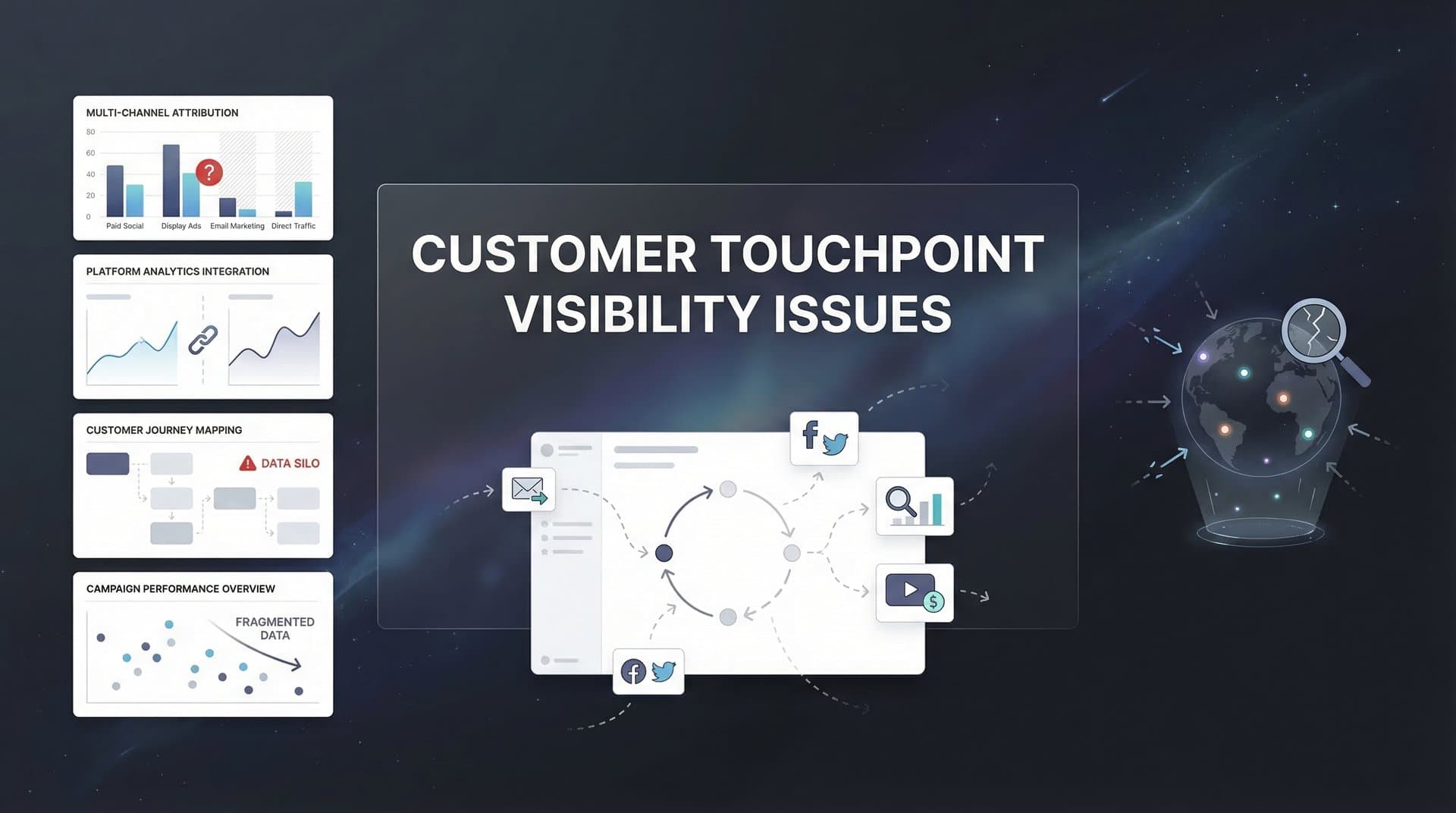
Your marketing dashboard shows a winning campaign. Facebook Ads reports 200 conversions. Google Analytics confirms strong traffic. The team celebrates another successful quarter. Then finance sends over the revenue report—and the numbers don't match. Not even close.
What happened? The conversions you attributed to that last Facebook click actually started with an organic search three weeks earlier, followed by a LinkedIn ad, two email opens, and a webinar signup. But your tracking only saw the final touchpoint. You've been flying blind, making million-dollar decisions based on incomplete data.
This is the reality of customer touchpoint visibility issues—the hidden problem undermining marketing decisions across every industry. When you can't see the complete customer journey, you can't optimize it. You waste budget on channels that look good in isolation but don't actually drive conversions. You underfund the touchpoints that truly matter. And you wonder why campaigns that tested well suddenly fail when you scale them.
The stakes have never been higher. Modern buyers interact with brands across 10-15 touchpoints before converting. Privacy regulations have made tracking harder than ever. And ad platforms are competing for credit without showing you the full picture. If you're still making decisions based on fragmented data, you're not just missing opportunities—you're actively burning money.
Here's what you need to know about why touchpoint visibility breaks down, how to spot the warning signs, and most importantly, how to fix it before it costs you another quarter of growth.
The Hidden Cost of Marketing Blind Spots
Customer touchpoint visibility issues occur when you can't track and understand the complete customer journey from first interaction to final conversion. It's the gap between what actually influenced a buyer's decision and what your analytics tools are telling you happened.
Think of it like watching a movie with half the scenes missing. You see the opening and the ending, but everything that happened in between—the character development, the plot twists, the moments that actually made the story work—is invisible to you. You're trying to understand the narrative with incomplete information.
This problem has exploded in complexity over the past few years. Buyers now research across multiple devices, switch between channels constantly, and take weeks or months to convert. A typical B2B customer might start with a Google search on their phone, click a LinkedIn ad on their laptop, read your blog posts over several weeks, attend a webinar, download a guide, and finally convert after receiving a retargeting email. That's six touchpoints across four platforms and two devices—and most attribution systems will only credit the last one.
The business impact is devastating and often invisible until you dig deeper. You're wasting ad spend on channels that appear to drive conversions but are actually just getting last-click credit for journeys that started elsewhere. That "high-performing" Facebook campaign might be capturing demand created by your content marketing, not generating new interest.
Meanwhile, you're underfunding channels that actually create demand because they rarely get credit for the final click. Your podcast sponsorships, webinar series, and educational content might be starting customer journeys that convert weeks later through different channels—but your dashboard shows them as having zero ROI.
The optimization problem compounds everything. When you can't see which touchpoints actually contribute to conversions, you can't improve them. You're making budget allocation decisions based on fiction, scaling campaigns that don't work and cutting ones that do. You're feeding incomplete conversion data back to ad platform algorithms, teaching them to optimize for the wrong signals.
And here's the part that keeps CMOs up at night: your competitors who solve this problem first will outspend you everywhere. They'll know which channels actually drive revenue, which creative resonates at each stage, and how to allocate budget for maximum return. They'll feed better data to Meta and Google, getting better targeting and lower costs. You'll be competing with one hand tied behind your back.
Five Root Causes Behind Touchpoint Tracking Failures
The first culprit is data silos—the fragmented systems that each see only their own piece of the customer journey. Your Facebook Ads Manager knows about clicks and conversions on its platform. Google Analytics tracks website behavior. Your CRM captures lead information and sales activity. Your email platform monitors engagement metrics. But none of them talk to each other in a meaningful way.
This creates a fractured view where each platform claims credit for the same conversion. Facebook says it drove 200 conversions. Google Ads reports 150. Your CRM shows 100 new customers. They're often counting the same people, but you can't see the overlap or understand which touchpoint actually mattered. It's like asking three witnesses to describe the same event—you get three different stories, and the truth is somewhere in between.
The technical reality makes this worse. Most platforms use their own tracking pixels and cookies, creating separate data streams that can't be reconciled. When a customer clicks a Facebook ad, visits your site, leaves, then returns via Google search and converts, both platforms see a conversion but neither sees the full journey. You're left guessing which channel deserves credit and how much budget to allocate to each. Understanding why you're losing visibility on customer journey data is the first step toward fixing these gaps.
Browser and iOS privacy restrictions have accelerated the visibility crisis. Apple's iOS App Tracking Transparency requires explicit user permission before apps can track activity across other companies' apps and websites. Most users decline. Safari's Intelligent Tracking Prevention blocks third-party cookies by default. Firefox and Chrome are following suit with their own restrictions.
The result? Your tracking pixels simply stop working for a growing percentage of your audience. When someone opts out of tracking on iOS, Facebook can't connect their ad click to your website conversion. The conversion still happens—you still get the customer—but your attribution data shows nothing. It's like having security cameras that only record during business hours. The activity is still happening, you just can't see it.
Cookie deprecation compounds the problem. Third-party cookies, the technology that powered cross-site tracking for decades, are being phased out across all major browsers. This means the traditional method of following a user from an ad click through your website and into your CRM is breaking down. The data gaps are growing, and they're not going away.
Then there's the over-reliance on last-click attribution—the default model in most analytics platforms. Last-click gives 100% of the credit to whichever touchpoint happened immediately before the conversion. It's simple, easy to implement, and fundamentally misleading for any business with a multi-touch customer journey.
Research consistently shows that B2B buyers interact with 5-15 touchpoints before converting. Consumer purchases often involve 3-7 touchpoints. But last-click attribution ignores all of them except the final one. That means the blog post that introduced someone to your brand gets zero credit. The webinar that convinced them you were credible gets ignored. The retargeting ad that reminded them to come back is invisible. Only the final Google search before purchase gets recognized.
This creates perverse incentives. Marketers optimize for channels that capture existing demand rather than channels that create new demand. Brand awareness campaigns look like they have terrible ROI because they rarely get last-click credit. Bottom-of-funnel tactics appear incredibly efficient because they're harvesting interest created elsewhere. You end up starving the top of your funnel while overspending on the bottom, wondering why your pipeline is shrinking.
Warning Signs Your Attribution Data Is Incomplete
The first red flag is when conversion numbers don't match between platforms and your CRM. Facebook reports 300 conversions this month. Google Analytics shows 280. But your CRM only logged 200 new customers. The discrepancy isn't just a rounding error—it's a signal that different systems are counting different things, using different attribution windows, or tracking different events as conversions.
This mismatch reveals that you're making decisions based on inconsistent data. When your CFO asks for ROI by channel and each platform tells a different story, you can't answer with confidence. You might be over-reporting success to stakeholders or under-reporting the true impact of certain channels. Either way, you're operating on unreliable intelligence. These attribution reporting issues with paid ads are more common than most marketers realize.
The second warning sign is unexplained direct traffic spikes that don't correlate with brand awareness efforts. Direct traffic in Google Analytics means someone typed your URL directly into their browser or clicked a link that didn't pass referral information. Some direct traffic is legitimate—people who know your brand and navigate to you intentionally. But sudden spikes usually indicate tracking failures, not brand awareness breakthroughs.
What's really happening? Users are clicking ads or links, but privacy restrictions and tracking limitations are stripping the referral data before they land on your site. Google Analytics sees them arrive with no source information and categorizes them as "direct." You see a spike in direct conversions and think your brand is growing organically. In reality, you're paying for those clicks but can't see which campaigns are driving them.
This creates a dangerous blind spot. You might cut budget from the campaigns actually generating that "direct" traffic because they appear to have poor conversion rates. Meanwhile, you celebrate your growing direct traffic without realizing it's about to disappear when you pause those hidden drivers. You're making decisions based on a categorization error, not reality.
The third warning sign is the most expensive: campaigns that worked in testing but fail when you scale them. You run a small test campaign, see promising results, and increase the budget 5x. Suddenly the performance collapses. Cost per acquisition skyrockets. The conversion rate drops. The campaign that looked like a winner at $100/day is losing money at $500/day.
This often indicates you were optimizing on incomplete data during the test phase. Maybe your test captured conversions that happened within 24 hours, but when you scaled, you attracted customers with longer consideration cycles. Maybe the test period coincided with other marketing activities that created demand, and your scaled campaign is trying to generate that demand alone. Maybe tracking limitations meant you only saw a fraction of the true performance during testing, and scaling revealed the real economics.
When this pattern repeats across multiple campaigns, it's a strong signal that your attribution data is fundamentally incomplete. You're making scaling decisions based on a sample that doesn't represent the full picture. The campaigns aren't failing because the creative stopped working—they're failing because you never had accurate data about what made them work in the first place.
Building Complete Journey Visibility: A Practical Framework
Server-side tracking has emerged as the foundation for solving touchpoint visibility issues because it bypasses browser-based limitations entirely. Instead of relying on pixels and cookies that can be blocked by privacy settings, server-side tracking sends data directly from your server to ad platforms and analytics tools. The user's browser never gets involved, which means tracking prevention features can't interfere.
Here's how it works in practice. When someone converts on your website, your server captures that event along with all the relevant data—what they purchased, how much they spent, and any identifying information they provided. Your server then sends this conversion data directly to Facebook, Google, and your other platforms through their server-side APIs. Because the data transmission happens between servers, not through the user's browser, it can't be blocked by cookie restrictions or tracking prevention.
The accuracy improvement is substantial. Browser-based tracking typically misses 20-40% of conversions due to privacy settings, ad blockers, and cookie restrictions. Server-side tracking captures nearly 100% of conversions because it doesn't depend on browser cooperation. You're suddenly seeing the full picture instead of a fraction of your actual performance. Learning how to capture every customer touchpoint becomes essential for accurate measurement.
Implementation requires technical setup but delivers immediate benefits. You need to configure your server to capture conversion events, set up API connections to your ad platforms, and ensure you're sending the data in the format each platform expects. The initial lift is worth it—you'll start feeding complete conversion data to ad platform algorithms, improving their targeting and optimization capabilities while gaining visibility into previously invisible conversions.
Connecting ad platforms to CRM systems creates the unified view that makes multi-touch attribution possible. Your ad platforms know about clicks and impressions. Your CRM knows about leads, opportunities, and closed revenue. Connecting them means you can finally see which ad clicks turned into qualified leads and which leads came from which campaigns.
This connection reveals patterns invisible when data stays siloed. You might discover that LinkedIn ads generate fewer leads than Facebook, but LinkedIn leads close at 3x the rate and generate 5x the revenue. Your Facebook campaigns look more efficient on a cost-per-lead basis, but LinkedIn is actually driving more profitable growth. Without CRM integration, you'd never see this—you'd keep optimizing for lead volume instead of revenue quality.
The technical implementation varies by platform but follows a common pattern. You're typically using API connections or native integrations to pass lead data from your ad platforms into your CRM, then sending conversion and revenue data back from your CRM to your ad platforms. This bidirectional flow ensures both systems have complete information about the customer journey from first click to closed deal.
Multi-touch attribution models provide alternatives to last-click that better reflect how modern customer journeys actually work. Linear attribution gives equal credit to every touchpoint in the conversion path. Time-decay attribution gives more credit to recent touchpoints but still acknowledges earlier ones. Position-based attribution emphasizes the first and last touchpoints while giving some credit to everything in between. Mastering multi-touchpoint marketing attribution is critical for understanding true campaign performance.
Each model tells a different story about which channels matter. Linear attribution might reveal that your content marketing consistently appears early in high-value customer journeys, even though it rarely gets last-click credit. Time-decay could show that your retargeting campaigns are more effective than last-click suggests because they're the final nudge in journeys that started elsewhere. Position-based attribution helps you understand which channels are best at starting conversations versus which ones are best at closing them.
The goal isn't to find the "right" attribution model—it's to use multiple models to understand the full picture. Compare how different models credit your channels. Look for patterns across models rather than fixating on a single view. Use these insights to make smarter budget allocation decisions that account for the entire customer journey, not just the final click.
Turning Visibility Into Action: Optimizing With Complete Data
Using enriched conversion data to improve ad platform algorithms starts with sending more than just "conversion happened" signals. When you feed platforms complete information—conversion value, customer lifetime value predictions, lead quality scores, and revenue attribution—their machine learning systems can optimize for outcomes that actually matter to your business instead of just conversion volume.
Meta's algorithm, for example, performs dramatically better when it receives conversion value data rather than just conversion counts. If you send revenue information with each conversion, Meta can optimize to find customers who spend more, not just customers who convert. If you send lead quality scores from your CRM, it can learn to target people who become qualified opportunities, not just people who fill out forms.
This creates a compounding advantage. Better conversion data leads to better targeting. Better targeting leads to more high-value conversions. Those conversions provide even better data to train the algorithm. Within weeks, you're attracting fundamentally different customers than competitors who are still sending basic conversion signals. You're playing a different game because you're giving the platform better information to work with.
The implementation requires connecting your CRM data back to your ad platforms through conversion APIs or server-side tracking. When someone becomes a qualified lead in your CRM, that signal goes back to Meta or Google. When they close as a customer, the revenue value gets sent back. The platforms can now see which clicks led to valuable outcomes, not just which clicks led to any outcome.
Identifying which channels actually drive revenue versus which just generate clicks requires looking beyond surface-level metrics. A channel might have a high click-through rate and low cost-per-click but generate leads that never convert to customers. Another channel might look expensive on a cost-per-lead basis but consistently produce customers who spend more and stay longer.
This is where connecting ad data to CRM revenue becomes transformative. You can calculate true customer acquisition cost by channel—not just cost per lead, but cost per paying customer. You can measure lifetime value by acquisition source. You can identify which campaigns attract customers who churn quickly versus customers who become long-term advocates.
The insights often surprise marketing teams. The channels that look most efficient at generating leads frequently underperform at generating revenue. The expensive channels that get questioned in budget reviews sometimes deliver the highest-quality customers. Without complete visibility into the journey from click to revenue, you'd never discover these patterns. You'd keep optimizing for the wrong metrics and wondering why revenue doesn't scale with lead volume.
Making confident budget allocation decisions based on full-funnel attribution means moving beyond channel-level optimization to journey-level thinking. Instead of asking "which channel has the best ROI," you ask "which combination of touchpoints creates the highest-value customers most efficiently."
You might discover that customers who interact with both content marketing and paid search before converting have 2x higher lifetime value than customers who only touch one channel. This insight changes your strategy—instead of competing for budget between content and paid search, you invest in both and measure how they work together. You're optimizing the system, not just the individual components. Understanding the multiple touchpoints before conversion helps you design more effective marketing sequences.
This approach reveals opportunities invisible in traditional channel reporting. You might find that webinars don't directly drive many conversions but customers who attend webinars convert at much higher rates when they later see retargeting ads. The webinar isn't a conversion driver in isolation—it's a conversion multiplier that makes other channels more effective. Cut the webinar budget based on last-click data, and your retargeting performance collapses. Understand the full journey, and you invest in both strategically.
Budget allocation becomes a strategic exercise in journey design rather than a reactive response to channel performance reports. You're asking which touchpoints to add to customer journeys, which sequences work best, and how to guide prospects through the path that maximizes both conversion rate and customer value. You're building a marketing system that compounds over time instead of a collection of campaigns competing for credit.
The Path Forward: From Blind Spots to Clear Vision
Customer touchpoint visibility issues aren't just a technical inconvenience or a data quality problem to fix when you have time. They're actively costing you money every day. Every budget decision made on incomplete data. Every campaign scaled based on misleading attribution. Every high-performing channel underfunded because it doesn't get last-click credit. The cost compounds over time as competitors with better visibility outspend you in the channels that actually drive growth.
The solution requires three foundational elements working together. Server-side tracking to capture complete conversion data despite privacy restrictions. Connected systems that link ad platforms to CRM revenue so you can see the full journey from click to customer. And multi-touch attribution models that reveal which combinations of touchpoints create the highest-value customers most efficiently.
None of these pieces solve the problem alone. Server-side tracking without CRM integration still leaves you blind to which conversions turn into revenue. CRM integration without multi-touch attribution still credits only the last touchpoint. Multi-touch attribution without complete data just distributes credit across an incomplete picture. You need all three to see clearly and optimize effectively.
The good news? Fixing touchpoint visibility unlocks immediate improvements across your entire marketing operation. Ad platform algorithms perform better when fed complete conversion data. Budget allocation becomes strategic instead of reactive. You stop wasting money on channels that look good in isolation but don't drive real growth. You start investing confidently in the touchpoints that actually matter.
Start by assessing your current visibility gaps. Compare conversion counts between your ad platforms and CRM. Look for unexplained direct traffic spikes. Identify campaigns that performed well in testing but failed when scaled. These patterns reveal where your data is incomplete and where you're making decisions based on fiction rather than fact.
Ready to elevate your marketing game with precision and confidence? Discover how Cometly's AI-driven recommendations can transform your ad strategy—Get your free demo today and start capturing every touchpoint to maximize your conversions.



