Your competitor just scaled their ad spend 300% last quarter. Meanwhile, you're still in weekly meetings debating whether Facebook or Google deserves more budget. They're confidently pouring money into campaigns that clearly work. You're making educated guesses based on conflicting platform reports and gut feelings about what "seems" to be performing.
This isn't a story about better creative or smarter targeting. It's about data.
Most marketing teams operate like pilots flying through storm clouds without instruments. They can see bits and pieces—clicks here, impressions there, some conversions showing up in Google Analytics. But they can't see the complete picture of how customers actually find them, evaluate them, and eventually buy from them. They're making million-dollar decisions based on incomplete, misleading, or fragmented information.
The result? Systematic budget waste. Successful campaigns get paused because they don't show immediate last-click conversions. Ineffective channels get scaled because they happen to be the last touchpoint before purchase. Top-of-funnel awareness efforts that drive 60% of your pipeline get starved of budget because traditional attribution can't connect them to revenue.
Here's what makes this particularly dangerous: bad marketing data doesn't just prevent optimization. It actively misleads you into doubling down on the wrong strategies. Every decision compounds the problem. Your team develops expertise around tactics that don't actually drive business results. Your creative strategy evolves based on engagement metrics that have zero correlation with revenue. Your audience targeting gets refined toward people who click but never convert.
Meanwhile, companies with proper attribution infrastructure are playing a completely different game. They know exactly which campaigns drive customer acquisition at profitable rates. They can confidently scale what works and kill what doesn't. Their AI algorithms optimize in real-time based on actual revenue data, not platform-reported conversions that conflict by 40%.
This article breaks down exactly why marketing data has become mission-critical for competitive survival. You'll understand what complete marketing data actually encompasses beyond vanity metrics. We'll quantify the real costs of operating without proper attribution—not just wasted budget, but compound strategic mistakes that worsen over time. You'll learn which specific data types every growth team needs, how to navigate modern challenges like iOS tracking limitations, and how to build a data foundation that turns marketing from a cost center into a predictable revenue driver.
By the end, you'll see why the gap between data-rich and data-poor companies is becoming a permanent competitive moat that's increasingly difficult to overcome. More importantly, you'll know exactly what to do about it.
Decoding Marketing Data: Beyond Vanity Metrics to Revenue Intelligence
Marketing data isn't just numbers in a dashboard. It's the complete record of every interaction between your brand and potential customers—from the first ad impression to the final purchase and beyond. But here's what most marketers miss: not all data actually tells you what's working.
The difference between surface-level metrics and revenue intelligence is the difference between feeling busy and driving growth. Vanity metrics like impressions, clicks, and engagement rates feel productive to track. They go up, you feel good. They go down, you panic. But they rarely reveal which marketing efforts actually generate profitable customers.
True marketing data connects every touchpoint to business outcomes. It tracks the customer who sees your Facebook ad on Monday, clicks to your website but doesn't convert, returns via Google search on Wednesday, subscribes to your email list, and finally purchases on Friday after clicking an email link. Each of those interactions generates data. The question is whether your systems can connect them into a coherent story about what drove that conversion.
This is where most marketing measurement falls apart. Your Facebook Ads Manager shows 50 conversions. Google Analytics reports 75. Your CRM says 60 customers came from paid channels. Which number is right? None of them, because they're each measuring different fragments of the customer journey using different attribution windows and tracking methodologies.
The marketing data ecosystem breaks down into three critical layers. First-party data includes everything that happens on your owned properties—website behavior, email engagement, purchase history, customer support interactions. This is your most valuable data because you control it completely and it's not subject to platform reporting conflicts or privacy restrictions.
Third-party data comes from external platforms—ad network metrics, social media insights, market research, competitive intelligence. This data provides context about performance relative to benchmarks and helps you understand broader market dynamics. But it's limited by what platforms choose to share and how they choose to measure success.
Attribution data sits at the intersection of these two layers. It's the connective tissue that reveals which marketing touchpoints actually influence conversions. This is where the real intelligence lives—understanding that customers who watch your product video on mobile but purchase on desktop have different lifetime values than those who convert immediately. Or discovering that your podcast sponsorships don't generate direct conversions but increase branded search volume by 40%, which then drives high-value customers.
Traditional metrics miss this nuance entirely. A campaign with a 0.5% click-through rate looks like a failure until you realize those clicks generate customers with 3x higher lifetime value than your 2% CTR campaign. Last-click attribution credits Google Ads for conversions that Facebook actually initiated weeks earlier. Platform-reported ROI calculations ignore post-purchase behavior, customer retention, and true lifetime value.
For marketers transitioning from surface-level metrics to revenue-focused analysis, understanding marketing data at a deeper level requires systematic frameworks for interpretation. The goal isn't to track more metrics—it's to track the right ones and connect them to actual business outcomes.
Revenue attribution requires following customers across devices, platforms, and time periods. It means tracking that someone saw your LinkedIn ad at work, researched your product on their phone during lunch, compared you to competitors on their home laptop, and finally converted on their tablet a week later. Each of those touchpoints deserves some credit for the conversion, but traditional analytics platforms can't connect these dots across different devices and sessions.
The Complete Marketing Data Ecosystem
Marketing data isn't just numbers in a dashboard. It's every measurable interaction between your brand and potential customers across their entire journey—from the first moment they discover you exist to the purchase decision and beyond.
Think of it as a comprehensive map of human behavior. Every click, scroll, form submission, email open, ad impression, and purchase creates a data point. But here's what most marketers miss: these individual data points only become valuable when you can connect them into complete customer stories.
The ecosystem breaks down into three critical layers, each serving a distinct purpose in understanding what actually drives your business results.
First-Party Data: Your Direct Relationship Intelligence
This is information you collect directly from customer interactions with your properties. Website behavior tracking shows which pages visitors view, how long they stay, and where they drop off. Email engagement data reveals which messages drive opens, clicks, and conversions. Purchase history connects individual customers to actual revenue and lifetime value.
First-party data is your most valuable asset because it's accurate, compliant with privacy regulations, and unique to your business. When someone fills out a form on your website, subscribes to your newsletter, or makes a purchase, you're capturing behavioral signals that no competitor can access.
Third-Party Data: Market Context and Platform Performance
This layer includes metrics from advertising platforms, social media insights, and market research. Facebook tells you how many people saw your ad and what percentage clicked. Google Analytics shows traffic sources and on-site behavior. LinkedIn provides demographic information about your audience.
Third-party data provides essential context about campaign performance and market dynamics. But it comes with a critical limitation: each platform reports through its own attribution lens, often taking credit for the same conversion. This creates the conflicts that make budget allocation so challenging.
Attribution Data: The Connection Layer That Changes Everything
This is where marketing data becomes truly powerful. Attribution data connects all those individual touchpoints into complete customer journeys, revealing which marketing efforts actually influence purchase decisions.
Consider a typical path: A customer sees your Facebook ad while browsing on their phone. They click through to your website but leave without converting. Three days later, they search your brand name on Google and return to your site on their laptop. They browse several pages, then leave again. A week later, they receive your email newsletter, click a link, and finally make a purchase.
Without attribution data, you might credit that entire conversion to email because it was the last click. But Facebook generated the initial awareness. Google search indicated growing intent. The email provided the final nudge. Each touchpoint played a role, and proper attribution data reveals the true contribution of each channel.
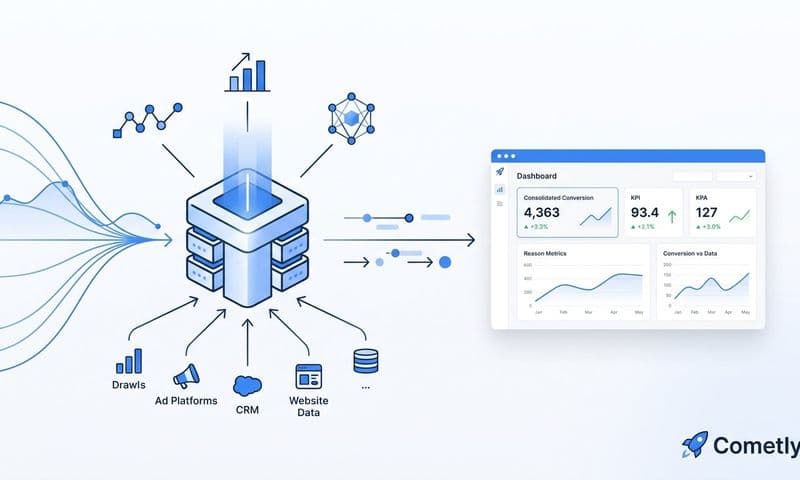
This is the fundamental shift from tracking isolated metrics to understanding complete customer behavior. Implementing comprehensive marketing data solutions enables businesses to connect these disparate data sources into unified customer journey insights. True marketing data doesn't just tell you what happened—it reveals why customers convert and which marketing investments actually drive business outcomes.
Why Traditional Metrics Miss the Mark
Here's the uncomfortable truth: most marketing dashboards are designed to make you feel good, not make better decisions.
Click-through rates look impressive in Monday morning meetings. Impression counts create the illusion of reach. Engagement metrics suggest your audience cares. But none of these vanity metrics answer the question that actually matters: which marketing efforts are driving profitable customer acquisition?
A campaign with a 5% click-through rate sounds successful until you realize those clicks generated zero revenue. Meanwhile, a campaign with a 0.8% CTR might be quietly building your customer base with high-lifetime-value buyers who convert three weeks later through a completely different channel. Traditional metrics can't tell you this because they measure activity, not outcomes.
The problem compounds when you look at platform-reported conversions. Facebook claims 150 conversions this month. Google Ads reports 200. Your analytics platform shows 180. They're all measuring the same customers, but using different attribution windows, tracking methodologies, and conversion definitions. Which number do you trust when deciding where to allocate next quarter's budget?
This isn't just a reporting inconvenience. It's a systematic failure that leads to catastrophic budget misallocation. Last-click attribution—still the default in most platforms—gives 100% credit to whatever touchpoint happened right before purchase. Your Facebook awareness campaign that introduced 60% of your customers to your brand? Zero credit. The podcast sponsorship that built trust over weeks? Invisible. The retargeting ad that happened to be the last thing someone saw? Full credit, even though it was just reminding an already-convinced buyer to complete their purchase.
Revenue attribution requires connecting multiple touchpoints across devices and time periods. A customer sees your Instagram ad on mobile during their morning commute. They Google your brand name on their work computer that afternoon. They read comparison articles on their tablet that evening. Three days later, they receive your email newsletter and click through on their phone. A week after that, they finally purchase on their desktop after searching your brand name again.
Traditional metrics see this as six separate, unrelated events. Proper attribution sees it as one customer journey with multiple influential touchpoints that all deserve credit for the eventual conversion.
For marketers seeking to master these complex measurement challenges, enrolling in a comprehensive marketing analytics course provides the foundational knowledge needed to implement proper attribution frameworks. The metrics that actually matter—customer acquisition cost, lifetime value, and true revenue attribution—require infrastructure that most marketing teams don't have. They need tracking that follows customers across devices. They need attribution models that distribute credit intelligently across touchpoints. They need integration between ad platforms, analytics tools, and CRM systems to connect marketing spend to actual revenue.
Without this foundation, you're optimizing for the wrong goals. Your team gets better at generating clicks that don't convert. Your creative strategy evolves around engagement metrics that have zero correlation with revenue. Your budget flows toward channels that happen to be the last touchpoint, not the ones actually driving customer acquisition.
This is why companies with proper attribution infrastructure operate in a completely different reality. They know which campaigns generate customers at profitable rates. They can confidently scale what works because they're measuring actual business outcomes, not proxy metrics that might correlate with success. They make decisions based on revenue data, not vanity metrics that create the illusion of progress.
The Hidden Costs of Flying Blind: What Marketing Without Data Really Costs
Let's talk about what's actually happening to your marketing budget right now. Not the optimistic projections in your quarterly review deck. The real numbers.
Without proper attribution data, you're systematically rewarding the wrong marketing activities. Every day. Every campaign. Every budget decision compounds the problem.
Budget Hemorrhaging: Where Money Disappears Without Proper Attribution
Here's the mechanism: Last-click attribution credits whichever channel happened to be the final touchpoint before conversion. Google Ads gets the glory because someone searched your brand name right before purchasing. Meanwhile, the Facebook campaign that introduced them to your product three weeks ago gets zero credit.
So what happens? You scale Google brand search campaigns while cutting the Facebook prospecting budget that's actually filling your pipeline. Implementing proper performance marketing analytics solves these attribution conflicts by providing unified measurement across all marketing channels and touchpoints.
The math is brutal. If 60% of your customers discover you through top-of-funnel channels but your attribution system only sees the bottom-funnel click, you're starving the channels that drive awareness while over-investing in channels that simply capture existing demand.
Platform reporting conflicts make this worse. Facebook claims 150 conversions. Google says 200. Your analytics shows 180. Which number guides your budget decisions? Without unified attribution, you're essentially guessing which platform deserves credit, and that guesswork directly determines where millions of dollars flow.
The compound effect is devastating. Month one, you cut awareness spend by 20% because it doesn't show direct conversions. Month two, your pipeline shrinks but you don't notice yet because you're still converting leads from previous awareness campaigns. Month three, conversion rates drop. Month four, you're in crisis mode wondering why your previously successful campaigns stopped working. They didn't stop working—you systematically defunded the top of your funnel based on incomplete data.
Strategic Drift: How Bad Data Compounds Over Time
Budget misallocation is just the beginning. The deeper cost is strategic drift—the gradual evolution of your entire marketing approach around metrics that don't correlate with business outcomes.
Your team optimizes for engagement because that's what they can measure. Creative decisions get made based on click-through rates. Audience targeting evolves toward people who interact frequently but rarely convert. Over months and years, your entire marketing operation becomes expertly calibrated to drive the wrong results.
This creates institutional knowledge that's actively harmful. Your best-performing campaign manager is the one who's best at gaming vanity metrics. Your creative team develops expertise in generating engagement that doesn't drive revenue. Your audience insights are based on behavioral patterns of people who click but don't buy.
Meanwhile, your competitors with proper data analysis marketing capabilities are developing completely different institutional knowledge. They know which creative angles drive high-value customers. Their audience targeting evolves toward profitable segments. Their campaign managers get promoted based on revenue contribution, not click-through rates.
The gap widens every quarter. You're getting better at the wrong game while they're mastering the right one. By the time you realize the problem, they've built a multi-year competitive advantage that's nearly impossible to overcome without completely rebuilding your measurement infrastructure and retraining your entire team.
Opportunity Cost: What You Could Build With Accurate Data
Here's what keeps executives up at night: it's not just the wasted budget or strategic drift. It's the opportunity cost of what you could have built with accurate data.
Companies with proper attribution infrastructure don't just avoid mistakes. They actively compound advantages. They identify profitable customer segments earlier. They scale winning campaigns faster. They kill losing initiatives before they drain significant resources. Every decision is based on actual business outcomes, creating a compounding advantage that accelerates over time.
Consider two companies with identical products and $1M monthly ad budgets. Company A operates with last-click attribution and platform-reported metrics. Company B has unified attribution connecting all touchpoints to revenue. After one year, Company B has identified which campaigns drive customers with 3x higher lifetime value. They've reallocated budget toward these high-value segments, improving overall CAC by 40% while increasing customer quality. Company A is still debating whether Facebook or Google deserves more budget based on conflicting platform reports.
The math compounds brutally. Year two, Company B's improved customer acquisition efficiency allows them to scale spend profitably while Company A hits diminishing returns. Year three, Company B has built predictive models that identify high-value customers at first touch, allowing them to bid more aggressively for the right audiences. Company A is still trying to figure out which campaigns actually work.
This isn't hypothetical. This is the current reality separating data-rich companies from data-poor competitors. The gap isn't just about having better dashboards. It's about building fundamentally different capabilities that compound over time into permanent competitive advantages.
Ready to elevate your marketing game with precision and confidence? Discover how Cometly's AI-driven recommendations can transform your ad strategy—**Get your free demo** today and start capturing every touchpoint to maximize your conversions.