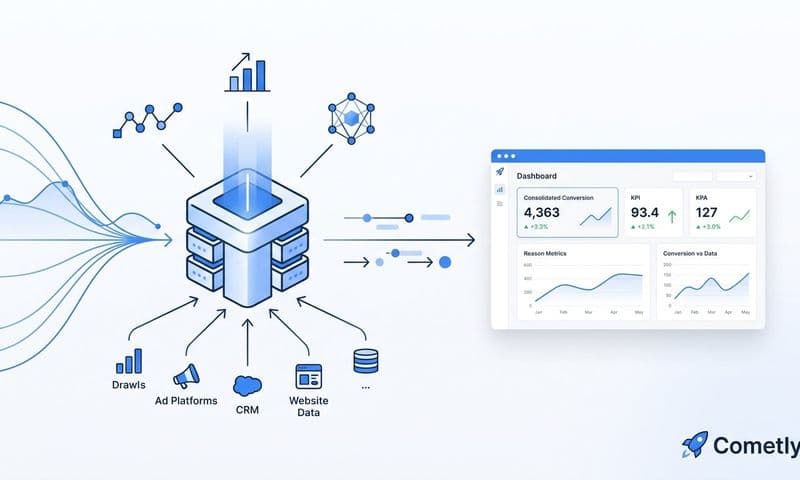
At its core, a digital marketing report is a document that takes all the key numbers from your marketing efforts and organizes them into a story. It translates raw data from channels like SEO, social media, and paid ads to show what happened over a specific period—highlighting what worked, what flopped, and where you can grow.
Why Digital Marketing Reports Are Your Growth Compass
 How To Utilize Digital Marketing Reports For Measuring Growth
Stop trying to navigate your marketing strategy in the dark. It’s far too easy to see digital marketing reports as just another tedious spreadsheet filled with numbers. But their real job is to act as a compass for your business, guiding every decision with objective, hard data.
Think of your raw marketing data as a sky full of disconnected stars—confusing and overwhelming on its own. A well-built report is the telescope that organizes those stars into clear constellations, revealing the patterns that point you toward your goals. This shift in perspective is what separates businesses that scale from those that stagnate.
From Data Overload to Strategic Clarity
In a world where digital ad spend just keeps climbing, understanding your performance is non-negotiable. Worldwide ad spending has already hit approximately US$1.1 trillion, with digital advertising alone growing by 10.3 percent year-over-year. That kind of money flowing through the system means businesses have to measure their return on investment with absolute precision.
Without a solid reporting process, you're just guessing where your budget is going. A clean report cuts through the noise and helps you answer the big questions:
- Which marketing channels are actually bringing in valuable customers?
- Where are we losing potential leads in our sales funnel?
- Is our ad spend generating a positive return, or are we burning cash?
A great report doesn’t just spit back numbers—it turns marketing data into a story about progress, outcomes, and opportunities. It’s the bridge between what you do and what you achieve.
Moving Beyond Vanity Metrics
The real goal here is to translate complex metrics into a clear narrative about what’s working, what isn’t, and where your biggest opportunities are hiding. This means getting past surface-level "vanity metrics" like social media likes or page views and digging into the data that directly impacts your bottom line.
It’s all about connecting your marketing spend to tangible business outcomes, making every single dollar accountable. By turning raw numbers into actionable data, you can make smarter, faster decisions that fuel real, sustainable growth. This guide will show you how to build reports that not only track performance but also light up the path forward, tying every marketing initiative to real business impact.
The Four Essential Types of Marketing Reports
Not all digital marketing reports are created equal. If you're trying to cram every single metric into one massive document, you're doing it wrong. That's like using a sledgehammer to hang a picture frame—it’s clumsy, inefficient, and you’ll probably miss the point entirely.
To get a true 360-degree view of your marketing performance, you need four distinct types of reports. Each one is designed to answer a specific set of questions.
Think of these reports as different camera lenses. Some give you that wide, panoramic view of the entire landscape, while others zoom in to capture the tiny details on a single flower. When you master all four, you gain the clarity to connect high-level strategy with your day-to-day execution. Nothing gets overlooked.
1. The Channel Report: Your Performance Review
First up is the Channel Report. This report is your high-level performance review for each marketing platform—think SEO, Pay-Per-Click (PPC), social media, and email. Its main job is to answer one big question: "Which of our channels are actually driving the most value?"
For example, your channel report might reveal that your SEO efforts are bringing in a steady stream of high-converting organic traffic, but your social media ads have a dismal Return On Ad Spend (ROAS). This is the kind of insight that lets you diagnose problems and shift your budget. You might decide to double down on content for SEO or pause those underperforming ad campaigns to rethink your targeting.
2. The Campaign Report: Your Project Deep-Dive
While a channel report gives you the big picture, a Campaign Report zooms in on a specific initiative. Think of it as a project-specific deep-dive, built to evaluate whether a particular marketing push—like a product launch, a holiday sale, or a lead generation campaign—actually hit its goals.
This report cuts through the noise of broad channel metrics to focus on campaign-specific KPIs. Did your Black Friday email sequence hit its sales target? Did that new Google Ads campaign for a specific service generate enough qualified leads within budget? By isolating the performance of individual campaigns, you can figure out what works and repeat that success again and again.
You can check out a bunch of different templates in our guide to marketing report examples to see how these are built.
The Campaign Report is your accountability tool. It cuts through the noise of daily metrics to deliver a clear verdict on whether a specific investment of time, money, and effort paid off.
3. The Funnel Report: Your Customer Journey Map
Next is the Funnel Report, which maps out the entire customer journey from the moment someone first hears about you to the final conversion. Its purpose is to find the leaks in your marketing and sales process. Imagine your funnel is a series of pipes; this report helps you find exactly where the pressure drops and potential customers are falling out.
A funnel report visualizes those critical transition points, answering questions like:
- How many website visitors actually started the checkout process?
- Of those, how many followed through and completed their purchase?
- At what specific stage are leads from our webinar dropping off before booking a demo?
By pinpointing these drop-offs, you can take immediate action. For example, if you see a huge number of users abandoning their carts, you might roll out an abandoned cart email sequence or simplify your checkout flow.
4. The Attribution Report: Connecting the Dots to Revenue
Finally, we have the Attribution Report. This is arguably the most advanced and insightful report of the bunch. It connects the dots between every single marketing touchpoint and the final sale, answering the ultimate question: "Which efforts truly influenced this conversion?"
This report goes way beyond simplistic "last-click" thinking, which incorrectly gives all the credit to whatever the customer clicked right before buying.
Instead, a proper attribution report shows how different channels work together as a team. It might reveal that a customer first found your brand through a blog post (SEO), later saw a retargeting ad on social media, and finally converted after clicking a link in an email. Understanding this complete journey ensures you don't mistakenly cut the budget for channels that play a crucial "assist" role, giving you a far more accurate picture of your true marketing ROI.
To make these concepts even clearer, here's a quick breakdown of the four report types.
Quick Guide to Marketing Report Types
Report Type | Primary Purpose | Key Question Answered |
|---|---|---|
Channel Report | High-level performance review | "Which channels are driving the most value?" |
Campaign Report | Project-specific deep-dive | "Did this specific initiative hit its targets?" |
Funnel Report | Customer journey analysis | "Where are we losing potential customers?" |
Attribution Report | Revenue impact analysis | "Which touchpoints truly influenced this sale?" |
By using these four reports together, you move from just collecting data to generating real, actionable insights that drive growth.
Choosing KPIs That Actually Drive Business Results
A report is only as good as the data inside it. A classic mistake I see all the time is marketers flooding their digital marketing reports with dozens of metrics, creating a ton of noise but zero clarity. Powerful reporting isn't about tracking everything; it's about tracking the right things. That means picking Key Performance Indicators (KPIs) that connect directly to your business goals.
Think of it like a pilot flying a plane. The cockpit is covered in hundreds of dials and gauges, but to get to the destination safely, the pilot focuses on just a handful of critical instruments—altitude, speed, and fuel. Your KPIs are your primary flight instruments. Everything else is just supporting data.
To pick the right ones, you first need to understand the difference between metrics that just look good and metrics that actually help you make decisions.
Ditching Vanity Metrics for Actionable Insights
Vanity metrics are the numbers that look great on a slide deck but don't actually tell you anything about your revenue or business health. They feel good to share, but they offer little strategic value.
- Page Likes: A big follower count is nice, but it says nothing about whether those people are actually buying from you.
- Impressions: Knowing how many times your ad was seen doesn't tell you if it resonated or made someone take action.
- Total Pageviews: High traffic is awesome, but if those visitors aren't converting, it’s just empty volume.
Actionable metrics, on the other hand, are tied directly to business outcomes. They give you clear signals that help you make smart calls on your budget, your strategy, and what to do next. These are the numbers that really matter.
A vanity metric tells you what happened, but an actionable metric tells you why it happened and what to do next. Focusing on the latter is what separates busy marketers from effective ones.
Aligning KPIs with Your Marketing Funnel
The best way to select the right KPIs is to map them to your business goals and the customer’s journey through your marketing funnel. Each stage of the funnel has a different job, so you need different metrics to measure its success.
Top-of-Funnel KPIs for Awareness and Reach
At the top of the funnel (TOFU), your goal is simple: attract a broad audience and get your brand on their radar. You're casting a wide net to introduce people to what you do.
Key metrics here include:
- Click-Through Rate (CTR): This tells you how compelling your ad or content is. A high CTR means your message is hitting the mark with your target audience.
- Cost Per Mille (CPM): This shows how much it costs to get your ad in front of 1,000 people, helping you measure the efficiency of your awareness spend.
Middle-of-Funnel KPIs for Engagement and Consideration
In the middle of the funnel (MOFU), the focus shifts to nurturing the interest you've generated. This is where you build relationships and encourage people to seriously consider your solution.
Essential metrics for this stage are:
- Conversion Rate: The percentage of visitors who take a desired action, like signing up for a newsletter or downloading a guide. It's a direct measure of how well you're turning casual visitors into real leads.
- Cost Per Lead (CPL): This calculates what you spend to acquire one new lead, which is absolutely critical for managing your lead generation budget effectively.
Bottom-of-Funnel KPIs for Conversion and Revenue
At the bottom of the funnel (BOFU), it's all about turning leads into paying customers. This is where your marketing efforts translate directly into dollars and cents.
The most important metrics here are:
- Customer Acquisition Cost (CAC): The total sales and marketing cost required to land a single new customer. It’s one of the most vital metrics for understanding if your marketing is actually profitable.
- Return On Ad Spend (ROAS): This measures the gross revenue you generate for every dollar you put into advertising. A high ROAS is a clear sign of a winning ad campaign.
- Customer Lifetime Value (CLV): This projects the total revenue you can expect from a single customer over their entire relationship with your business. Comparing CLV to CAC is how you figure out the long-term health and profitability of your entire customer base.
By choosing KPIs that map to each stage of the funnel, your digital marketing reports start to tell a complete story, from the first impression to the final sale. If you want to dive deeper, you can explore a broader list by checking out these powerful marketing KPI examples. This approach ensures you’re measuring what truly moves the needle for your business, not just tracking numbers for the sake of it.
Building Your Step-by-Step Reporting Process
Building accurate digital marketing reports from scratch feels like a huge undertaking. But with a solid process, it’s a lot less intimidating than you think. It's like building with LEGOs—you don’t just start snapping bricks together and hope for the best. You follow a plan, start with a strong foundation, and add pieces logically until the final structure comes together.
This checklist will walk you through building a reliable reporting system your team can actually trust. The goal here is to get you out of messy spreadsheets for good and into a streamlined process that delivers real, actionable insights every time.
1. Define Your Objectives and Key Questions
Before you even think about touching data, you have to know what you’re trying to accomplish. A report without a clear goal is just a pile of numbers. So, start by asking the big business questions.
Are you trying to:
- Get more qualified leads for your sales team?
- Improve your Return On Ad Spend (ROAS)?
- Boost brand awareness in a new market?
- Lower your Customer Acquisition Cost (CAC)?
Each of these goals demands a different set of metrics. A ROAS-focused report will zero in on ad spend and revenue, while a lead generation report is all about conversion rates and Cost Per Lead. Nail down your core questions first—it keeps your report focused and relevant.
This infographic breaks down how to match KPIs to the different stages of your marketing funnel.
 How To Utilize Digital Marketing Reports For Measuring Growth
This visual is a great cheat sheet for figuring out which metrics matter most, depending on whether your goal is awareness, engagement, or closing deals.
2. Select and Centralize Your Data Sources
Next up, you need to figure out where all your data lives. Most marketers pull information from a dozen different places, creating a mess of disconnected data silos. Your job is to wrangle them all into one spot.
Your data is likely scattered across platforms like:
- Website Analytics: Google Analytics 4 is your go-to for tracking user behavior, traffic sources, and on-site conversions.
- Ad Platforms: Google Ads, Meta Ads (Facebook/Instagram), and LinkedIn Ads hold all your critical spend and performance data.
- CRM Systems: Tools like HubSpot or Salesforce track lead quality and tell you what happens after the initial conversion.
- Email Marketing Platforms: Mailchimp or Klaviyo give you the scoop on open rates, click-throughs, and campaign engagement.
The real challenge isn’t just getting access to these sources; it’s unifying them. Without a central hub, you'll be stuck exporting CSVs for hours, which is a recipe for errors and wasted time. This is where a powerful data analysis dashboard becomes your single source of truth.
3. Clean and Visualize Your Data
Let’s be honest: raw data is almost always messy. Before you build anything, you have to "clean" it. That means fixing errors, getting rid of duplicates, and making sure your naming conventions are consistent across every platform. If you skip this step, your reports will be unreliable. Period.
Once your data is clean, it's time to make it understandable. This is where visualization comes in. Tools like Google Data Studio (now Looker Studio) or Tableau are great for turning raw numbers into charts and graphs that actually make sense.
A well-designed visual report tells a story at a glance. It should guide the viewer's eye to the most important insights, highlighting trends and performance without needing a paragraph of explanation.
To make your life easier and keep things consistent, consider using effective PPC reporting templates designed for platforms like Google Ads. These pre-built frameworks save a ton of time and ensure you’re presenting data in a clean, professional way.
4. Set a Consistent Reporting Schedule
Finally, reliability comes from consistency. A one-off report is helpful, but a recurring one becomes a strategic weapon. You need to establish a reporting cadence that lines up with what your team and stakeholders need to see.
- Weekly reports are perfect for fast-moving paid campaigns where you need to make quick adjustments.
- Monthly reports work well for tracking slower burns like SEO and content marketing progress.
- Quarterly reports give you that high-level overview for big-picture planning and budget talks.
Automate the delivery whenever you can. Scheduling reports to land in your team’s inbox every Monday morning or on the first of the month creates a rhythm. It builds accountability and keeps everyone on the same page about performance.
Mastering Marketing Attribution and Avoiding Common Traps
Attribution is the single biggest place where beautiful-looking digital marketing reports completely fall apart, often leading to disastrous budget decisions. It’s how you give credit to the marketing touchpoints that convince a customer to convert, and if you get it wrong, you’re basically flying blind.
The most common mistake? Relying on the default model baked into most ad platforms: last-click attribution. This model gives 100% of the credit for a sale to the very last thing a customer clicked before buying.
Think about a soccer team. Last-click is like giving all the praise—and the entire bonus—to the player who scored the goal. It completely ignores the midfielders who skillfully passed the ball up the field and the defenders who stopped the other team from ever getting a shot. It tells a dangerously incomplete story. The goal scorer is vital, but they sure didn't win the game alone.
Moving Beyond Last-Click Thinking
To build reports that tell the whole story, you have to look at more sophisticated attribution models. These models are designed to distribute credit more fairly across the entire customer journey, acknowledging that it often takes multiple touchpoints working together to close a deal.
Each model offers a slightly different lens for what "credit" means:
- Linear Model: This one’s the ultimate team player. It spreads credit out evenly to every single touchpoint along the customer’s path. It’s fantastic for getting a broad overview of the entire journey but can sometimes undervalue the most influential moments.
- Time-Decay Model: This model is all about momentum. It gives more credit to the touchpoints that happened closer to the final conversion, operating on the idea that the last few interactions were the most persuasive. This works well for businesses with shorter sales cycles.
- Data-Driven Model: This is the smartest kid in the class. It uses your actual account data and a bit of machine learning to analyze both converting and non-converting paths. It then assigns credit based on which touchpoints were statistically most likely to drive a conversion.
Choosing the right attribution model is like switching from a blurry, black-and-white photo to a high-definition color video. You suddenly see the entire sequence of events with clarity, allowing you to value every "assist" that led to the final "goal."
Avoiding Common Attribution Pitfalls
Getting attribution right isn't just about picking a better model; it's also about sidestepping the common traps that can completely torpedo your digital marketing reports. These errors create massive blind spots, hiding how your campaigns are really performing.
Two of the most frequent pitfalls are:
- Ignoring Offline Touchpoints: Many businesses have customer interactions that happen in the real world—think phone calls, in-store visits, or conversations at a trade show. If your reports only track what happens online, you're missing huge pieces of the puzzle. You might end up cutting the budget for a campaign that's actually driving a ton of valuable offline actions.
- Failing to Track the Cross-Device Journey: Your customers don't live on a single device. They might see your ad on their phone during their morning commute, research your product on their work laptop, and finally pull the trigger on their tablet at home. If you can't connect these dots, you’ll see three different "users" instead of one person's cohesive journey.
By actively working to avoid these traps, you can build a far more accurate and holistic view of your marketing performance. This allows you to put your budget where it will have the most impact and optimize every touchpoint effectively. For a deeper look into this topic, our guide on marketing attribution provides more advanced strategies and examples.
The goal is to create reports that tell the full, unvarnished story of your customer's path to purchase.
Automating Your Reporting with Modern Tools
 How To Utilize Digital Marketing Reports For Measuring Growth
Let's be honest: manual reporting is a soul-crushing waste of time. Pulling data from a dozen different platforms, wrestling with clunky spreadsheets, and spending hours just to get a basic performance snapshot is a massive drain on your team. It’s not just slow; it’s dangerously prone to human error, which means you could be making big decisions based on bad data.
Modern attribution tools completely flip this script. Instead of treating reporting like a tedious, backward-looking chore, they turn it into a streamlined, strategic advantage. By automating the grunt work of data collection and analysis, these platforms free you up to focus on what actually matters—finding insights and taking action.
Unifying Your Data Sources
The first hurdle automation clears is the mess of scattered data. Tools like Cometly plug directly into all your marketing channels—from ad platforms like Meta and Google to your CRM and payment processors. This means no more manually exporting CSVs and trying to stitch them together. You get a single, reliable source of truth for your digital marketing reports.
Having this unified view ensures every touchpoint is captured in one place. It gives you a complete picture of performance without the gaps and inconsistencies that always pop up with manual reporting.
The screenshot from Cometly below shows just how powerful this is. A centralized dashboard brings together key metrics from all your sources, giving you a clear, at-a-glance overview of what’s really happening.
How To Utilize Digital Marketing Reports For Measuring Growth
You can instantly see how different campaigns contribute to revenue, directly linking your ad spend to profit and ROAS in real time. No more guesswork.
Achieving Accuracy with Server-Side Tracking
With all the privacy updates and ad blockers out there, browser-side tracking pixels have become notoriously unreliable. A huge chunk of your conversion data might never even get recorded, leading to inaccurate reports and misattributed sales. It's a massive blind spot.
Modern attribution platforms solve this with server-side tracking. This method sends conversion data directly from your website's server to the ad platforms, completely bypassing browser disruptions. The result is far more accurate data and, in turn, better ad performance.
This ensures your digital marketing reports are built on a rock-solid foundation of complete, trustworthy data. You can finally be confident that the numbers you're looking at are correct.
Streamlining Your Entire Workflow
Beyond just collecting data, automation platforms make the entire reporting process smarter from end to end. They offer powerful features that used to be incredibly complex, making them accessible to any marketing team.
- Multi-Touch Attribution: Instead of being stuck with last-click, advanced tools automatically apply sophisticated attribution models to show you the true customer journey. You can instantly see which channels assist conversions, not just which ones get the final credit.
- One-Click Conversion Syncs: These platforms let you send accurate, server-side conversion data back to ad platforms like Facebook and Google with a single click. This creates a powerful feedback loop that helps their algorithms find more customers just like your best ones, directly improving campaign ROI.
- AI-Powered Insights: Many tools now come with AI features that sift through your data and surface actionable recommendations. They can flag underperforming ads or suggest new audiences to target, turning raw numbers into strategic advice.
By embracing automation, you're not just saving time. You're building a more accurate, insightful, and effective marketing operation.
Frequently Asked Questions About Digital marketing reports
Even with a solid game plan, you're bound to run into a few practical questions when you start building digital marketing reports. Here are some quick answers to the most common hurdles people face.
How Often Should I Create Marketing Reports?
There's no single right answer—it all comes down to your goals.
For fast-moving paid ad campaigns where you're watching budgets like a hawk, daily or weekly reports are your best friend. They let you see what's happening in near real-time and make quick adjustments.
But for longer-term plays like SEO or content marketing, a monthly report usually makes more sense. It gives you enough data to spot meaningful trends without getting lost in daily noise. And for the big picture stuff—high-level planning, annual goal reviews, and setting future strategy—quarterly and annual reports are essential.
What Is the Difference Between a Dashboard and a Report?
It's a classic question, and the easiest way to think about it is with a road trip analogy.
A dashboard is your car's speedometer. It’s a live, interactive tool that gives you a quick glance at what’s happening right now. How fast are you going? How much gas is left? It’s all about immediate, real-time monitoring.
A report, on the other hand, is like the photo album from your trip. It’s a static snapshot of performance over a specific time, telling the story of your journey. It provides deeper context and analysis, explaining the "why" behind the numbers.
The dashboard shows the 'what,' while the report explains the 'why.' Both are crucial for a complete picture of your marketing performance, but they serve very different purposes in your decision-making.
How Can I Start Improving My Company Reports Today?
The key is to start small and stay focused. Don't try to boil the ocean.
First, pick one clear business objective you want to measure. For example, maybe you want to increase qualified leads by 15% this quarter.
Next, identify just 3-5 key performance indicators (KPIs) that directly track your progress toward that goal. Make sure your analytics tools are set up to capture this data cleanly, then build a simple report that shows only those essential metrics.
Avoid the temptation to add clutter. Prove the value with this one focused report, and then you can expand from there.
For more deep dives, case studies, and strategic insights on digital marketing reports, the Branditok Digital Marketing Blog is an excellent resource to check out.
Ready to stop guessing and start knowing exactly what drives your revenue? Cometly unifies your tracking, masters multi-touch attribution, and gives you the clear, accurate reports you need to scale with confidence. See how Cometly transforms your marketing data today.