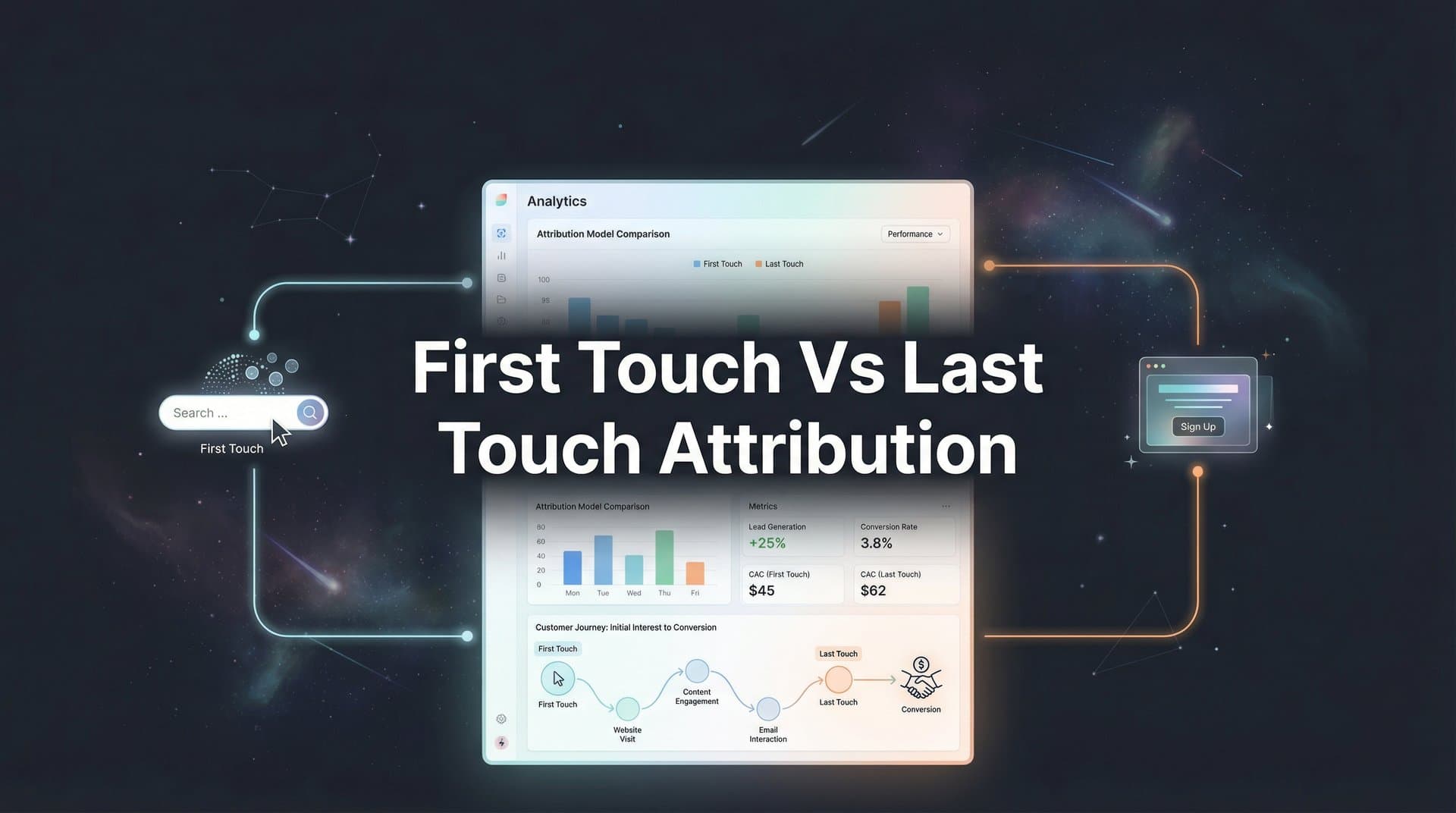
Every marketing dollar tells a story—but which chapter matters most? When a customer finally converts after seeing your Facebook ad, clicking a Google search result, and opening three emails, which touchpoint deserves the credit? This is the fundamental question behind first touch vs last touch attribution.
First touch attribution credits the initial interaction that introduced a prospect to your brand, while last touch gives all credit to the final touchpoint before conversion. Neither approach is inherently right or wrong—the best choice depends on your business model, sales cycle, and marketing objectives.
This guide walks you through seven practical strategies to help you decide when to use each model, how to implement them effectively, and when to consider moving beyond single-touch attribution altogether.
1. Match Your Attribution Model to Your Sales Cycle Length
The Challenge It Solves
Your sales cycle length fundamentally shapes how customers interact with your brand before converting. A three-day e-commerce purchase journey looks completely different from a six-month B2B software evaluation. Using the wrong attribution model for your sales cycle creates blind spots that distort your understanding of what's actually driving conversions.
When you apply a model that doesn't match your customer journey complexity, you end up optimizing for the wrong touchpoints and misallocating budget across channels.
The Strategy Explained
Start by calculating your average time-to-conversion across all customers. For short sales cycles (under two weeks), last touch attribution often provides actionable insights because the gap between discovery and conversion is minimal. Customers typically convert close to their initial awareness, making the closing touchpoint highly relevant.
For longer sales cycles (over one month), first touch attribution becomes more valuable for understanding what initiates qualified interest. These prospects engage with multiple touchpoints over extended periods, so knowing which channels introduce high-quality leads helps you invest in effective discovery mechanisms.
Mid-length cycles (two to four weeks) present the trickiest scenario. This is where single-touch models start showing their limitations most clearly, and you'll want to consider running both models in parallel.
Implementation Steps
1. Pull conversion data from your CRM or analytics platform and calculate the median time between first touchpoint and conversion for the past 90 days.
2. Segment this data by product line or customer type if you have distinct buyer personas with different journey lengths.
3. Apply first touch attribution for segments with sales cycles exceeding 30 days, and last touch for segments converting within 14 days.
4. For mid-range cycles, set up parallel reporting that shows both models side by side so you can identify which channels excel at discovery versus conversion.
Pro Tips
Don't just look at averages. Check the distribution of your sales cycle lengths. If you have high variance (some customers convert in days while others take months), you'll need segment-specific attribution strategies rather than a one-size-fits-all approach.
2. Align Attribution Choice with Your Primary Marketing Goal
The Challenge It Solves
Marketing teams juggle multiple objectives simultaneously: building brand awareness, generating qualified leads, nurturing prospects, and driving conversions. When you try to measure all these goals with a single attribution model, you end up with metrics that don't align with what you're actually trying to achieve in each campaign.
This misalignment leads to frustrating situations where successful awareness campaigns appear to underperform because you're measuring them with conversion-focused attribution.
The Strategy Explained
Think of attribution models as measurement tools designed for specific jobs. First touch attribution excels at answering "Which channels introduce new prospects to our brand?" This makes it ideal for measuring awareness campaigns, content marketing initiatives, and top-of-funnel activities where the goal is discovery.
Last touch attribution answers "Which touchpoints close deals?" Use this model when evaluating retargeting campaigns, promotional emails, limited-time offers, and other conversion-focused tactics where the primary objective is moving ready prospects to purchase.
The key is matching your measurement approach to your campaign intent. A brand awareness campaign measured by last touch attribution will always look ineffective because you're using the wrong lens.
Implementation Steps
1. List all your active marketing campaigns and categorize them by primary objective: awareness, consideration, or conversion.
2. Apply first touch attribution to awareness-focused campaigns and track metrics like new prospect acquisition and pipeline contribution.
3. Use last touch attribution for conversion-focused campaigns and measure direct revenue impact and conversion rates.
4. Create separate dashboards for each objective category so stakeholders understand which metrics matter for which campaign types.
Pro Tips
Set clear expectations with leadership about what each campaign type should accomplish. When everyone understands that your podcast sponsorship aims to drive discovery rather than immediate conversions, first touch metrics become the natural success measure.
3. Use First Touch to Optimize Top-of-Funnel Discovery Channels
The Challenge It Solves
Your discovery channels—the places where prospects first encounter your brand—often appear undervalued in last touch models. Content marketing, social media, podcast ads, and PR efforts introduce prospects who may not convert for weeks or months. If you only measure these channels by their last-touch contribution, you'll systematically underinvest in the activities that fill your pipeline.
This creates a dangerous cycle where you cut budget from effective awareness channels because they don't show direct conversion attribution.
The Strategy Explained
First touch attribution reveals which channels excel at introducing qualified prospects to your brand. When you analyze first touch data, you're essentially asking "Where do our best customers first hear about us?" This insight is invaluable for budget allocation decisions around awareness investments.
Look for patterns in your first touch data. Which channels introduce prospects who eventually convert at high rates, even if they don't close immediately? These are your pipeline-building channels that deserve sustained investment even when last touch data suggests otherwise.
Pay particular attention to the quality of first touch traffic, not just quantity. A channel that introduces 100 prospects who never convert is less valuable than one that introduces 20 prospects where 10 eventually become customers.
Implementation Steps
1. Set up first touch tracking in your attribution platform to capture the initial source for every prospect in your database.
2. Create a report showing first touch source alongside eventual conversion status and customer lifetime value.
3. Calculate the conversion rate and average deal size for prospects introduced by each discovery channel.
4. Identify your top three first touch channels based on both volume and conversion quality, then ensure these channels maintain adequate budget even if last touch data shows lower direct attribution.
Pro Tips
Track the time lag between first touch and conversion by channel. Some discovery channels introduce prospects who convert quickly, while others build long-term pipeline. Understanding these patterns helps you set realistic expectations for campaign performance timelines.
4. Deploy Last Touch to Refine Your Closing Channels
The Challenge It Solves
You've built awareness and filled your pipeline with qualified prospects. Now you need to understand which touchpoints actually convert ready buyers into customers. Last touch attribution reveals the final triggers that push prospects over the conversion line, helping you optimize the closing phase of your funnel.
Without clear last touch data, you can't distinguish between channels that introduce prospects and channels that close deals—leading to inefficient investment in conversion tactics.
The Strategy Explained
Last touch attribution shows you which touchpoints prospects interact with immediately before converting. This is particularly valuable for optimizing retargeting campaigns, email nurture sequences, demo requests, free trial experiences, and promotional offers designed to drive immediate action.
When analyzing last touch data, look for channels that appear frequently as the final touchpoint before conversion. These are your closing channels—the tactics that excel at converting warm prospects into customers. They may not deserve credit for initial discovery, but they're essential for conversion optimization.
Pay attention to how last touch patterns differ across customer segments. Enterprise buyers might convert after a sales demo, while self-service customers might convert after reading comparison content or seeing a limited-time discount.
Implementation Steps
1. Configure your analytics platform to track the last touchpoint before each conversion event.
2. Build a report showing last touch source distribution across all conversions for the past 90 days.
3. Identify channels that appear disproportionately often as the last touch compared to their overall traffic contribution.
4. Increase investment in high-performing last touch channels, particularly for retargeting and conversion-focused campaigns targeting prospects already familiar with your brand.
Pro Tips
Don't confuse high last touch attribution with channel effectiveness in isolation. Direct traffic often shows high last touch attribution, but this usually reflects prospects typing your URL after being influenced by other channels. Look for patterns across the full journey, not just the final click.
5. Run Parallel Models to Uncover Hidden Insights
The Challenge It Solves
Choosing between first touch vs last touch attribution creates a false dilemma. Each model reveals different aspects of your customer journey, and viewing only one perspective leaves you with an incomplete picture. Channels that appear successful in one model might seem ineffective in another, creating confusion about where to allocate budget.
Running a single attribution model forces you to make decisions based on partial data, potentially leading to strategic missteps.
The Strategy Explained
The most sophisticated approach involves running first touch and last touch attribution simultaneously, then analyzing the gaps between them. When a channel shows strong first touch attribution but weak last touch attribution, you've identified an excellent awareness channel that needs support from closing tactics. When the pattern reverses, you've found a conversion channel that depends on other channels for initial discovery.
These discrepancies are where the real insights live. A channel that ranks third in first touch but eighth in last touch tells you something important about its role in your customer journey. This nuanced understanding helps you build more effective channel strategies.
Think of parallel attribution models as stereo sound versus mono. Each model is like a single speaker—useful, but limited. Together, they create depth and dimension that reveals the full picture.
Implementation Steps
1. Set up dashboard views that display first touch and last touch attribution side by side for the same time period and conversion events.
2. Create a spreadsheet comparing each channel's rank in first touch versus last touch attribution.
3. Calculate the attribution gap for each channel by subtracting its last touch percentage from its first touch percentage.
4. Categorize channels into three groups: discovery channels (high first touch, low last touch), closing channels (low first touch, high last touch), and balanced channels (similar performance in both models).
5. Adjust your channel strategy based on these roles—invest in discovery channels for pipeline building and closing channels for conversion optimization.
Pro Tips
Present parallel attribution data to stakeholders when making budget requests. Showing both perspectives builds stronger cases for investment in awareness channels that might look weak in last touch reports but are actually essential for pipeline generation.
6. Transition to Multi-Touch Attribution When Single-Touch Falls Short
The Challenge It Solves
As your marketing sophistication grows and your customer journeys become more complex, single-touch attribution models start creating more questions than answers. When prospects interact with 8-12 touchpoints before converting, giving all credit to either the first or last touchpoint ignores the contribution of everything in between.
This oversimplification leads to budget decisions that don't reflect the true value of each channel in your marketing mix.
The Strategy Explained
Multi-touch attribution models distribute conversion credit across multiple touchpoints in the customer journey. Linear attribution splits credit equally across all touchpoints. Time-decay attribution gives more credit to recent interactions. Position-based attribution emphasizes first and last touch while acknowledging middle touchpoints. Data-driven attribution uses algorithms to assign credit based on actual conversion patterns.
The transition to multi-touch attribution makes sense when you notice significant discrepancies between first and last touch models, when your sales cycle involves numerous touchpoints, or when single-touch models can't explain the performance you're seeing in your campaigns.
Start with simpler multi-touch models like linear or position-based attribution before advancing to algorithmic approaches. These foundational models are easier to understand and explain to stakeholders while still providing more nuanced insights than single-touch alternatives.
Implementation Steps
1. Audit your current data infrastructure to ensure you're capturing all touchpoints across the customer journey, not just first and last interactions.
2. Select a multi-touch attribution model that aligns with your business context—position-based works well for most B2B companies, while time-decay suits businesses with clear recency effects.
3. Run your chosen multi-touch model alongside your existing single-touch models for at least 60 days to understand how attribution shifts.
4. Analyze which channels gain or lose attribution credit under the multi-touch model compared to single-touch models.
5. Gradually shift budget allocation decisions toward multi-touch insights while maintaining single-touch models for specific campaign evaluation.
Pro Tips
Don't expect multi-touch attribution to provide definitive answers. It's a more sophisticated approximation, not absolute truth. The goal is better decision-making inputs, not perfect attribution certainty. Use multi-touch models to inform strategy while maintaining healthy skepticism about any attribution model's completeness.
7. Build a Data Foundation That Supports Any Attribution Model
The Challenge It Solves
Attribution models are only as accurate as the data they analyze. Browser-based tracking faces increasing limitations from privacy features, ad blockers, and cookie restrictions. When you're missing 30-40% of your actual touchpoints due to tracking gaps, even the most sophisticated attribution model will lead you to incorrect conclusions.
Poor data infrastructure undermines every attribution decision, regardless of which model you choose.
The Strategy Explained
Server-side tracking captures conversion events directly from your servers rather than relying on browser-based pixels and cookies. This approach bypasses many tracking limitations created by iOS updates, browser privacy features, and ad blockers. When your tracking infrastructure captures complete customer journey data, you can confidently implement any attribution model.
The foundation includes connecting your ad platforms, website analytics, CRM, and other marketing tools so customer touchpoints flow into a unified system. This integration ensures you're not missing critical interactions that influence conversion decisions.
Think of attribution models as analysis tools and your data infrastructure as the raw material they analyze. You can have the best analysis tools in the world, but they're useless if your raw material is incomplete or inaccurate.
Implementation Steps
1. Implement server-side tracking to capture conversion events that browser-based tracking misses due to privacy restrictions.
2. Connect your ad platforms, CRM, email marketing tools, and analytics platforms so customer touchpoints sync into a central attribution system.
3. Set up conversion tracking that captures both online and offline events, including phone calls, in-person meetings, and CRM status changes.
4. Establish data quality checks to identify tracking gaps, duplicate events, or attribution errors before they distort your analysis.
5. Test your tracking infrastructure by following a test conversion through your entire funnel to verify that all touchpoints are captured correctly.
Pro Tips
Invest in your data foundation before investing in sophisticated attribution models. A simple attribution model with complete data beats a complex model with incomplete data every time. Focus on capturing every touchpoint accurately, then layer on attribution sophistication as your infrastructure matures.
Your Attribution Strategy Roadmap
Choosing between first touch vs last touch attribution isn't about finding the "correct" answer. It's about selecting the model that aligns with your current marketing priorities and business context.
Start by auditing your sales cycle length and primary campaign objectives. For brand-building initiatives, lean toward first touch to understand discovery channels. For conversion optimization, last touch provides clarity on closing performance.
The most sophisticated marketers run both models in parallel and eventually graduate to multi-touch attribution as their data infrastructure matures. This progression isn't about complexity for its own sake—it's about gaining progressively clearer insights into what actually drives conversions across your entire customer journey.
Whatever model you choose, accurate data collection is the foundation. Without complete touchpoint tracking, even the best attribution model will lead you astray. Server-side tracking and connected marketing infrastructure ensure you're working with reliable data regardless of which attribution lens you apply.
Ready to see your full customer journey and compare attribution models side by side? Cometly connects every touchpoint to revenue so you can analyze first touch, last touch, and multi-touch attribution in one platform. With AI-powered insights and server-side tracking that captures what browser-based analytics miss, you'll make confident, data-driven decisions about where to invest your marketing budget. Get your free demo today and start capturing every touchpoint to maximize your conversions.