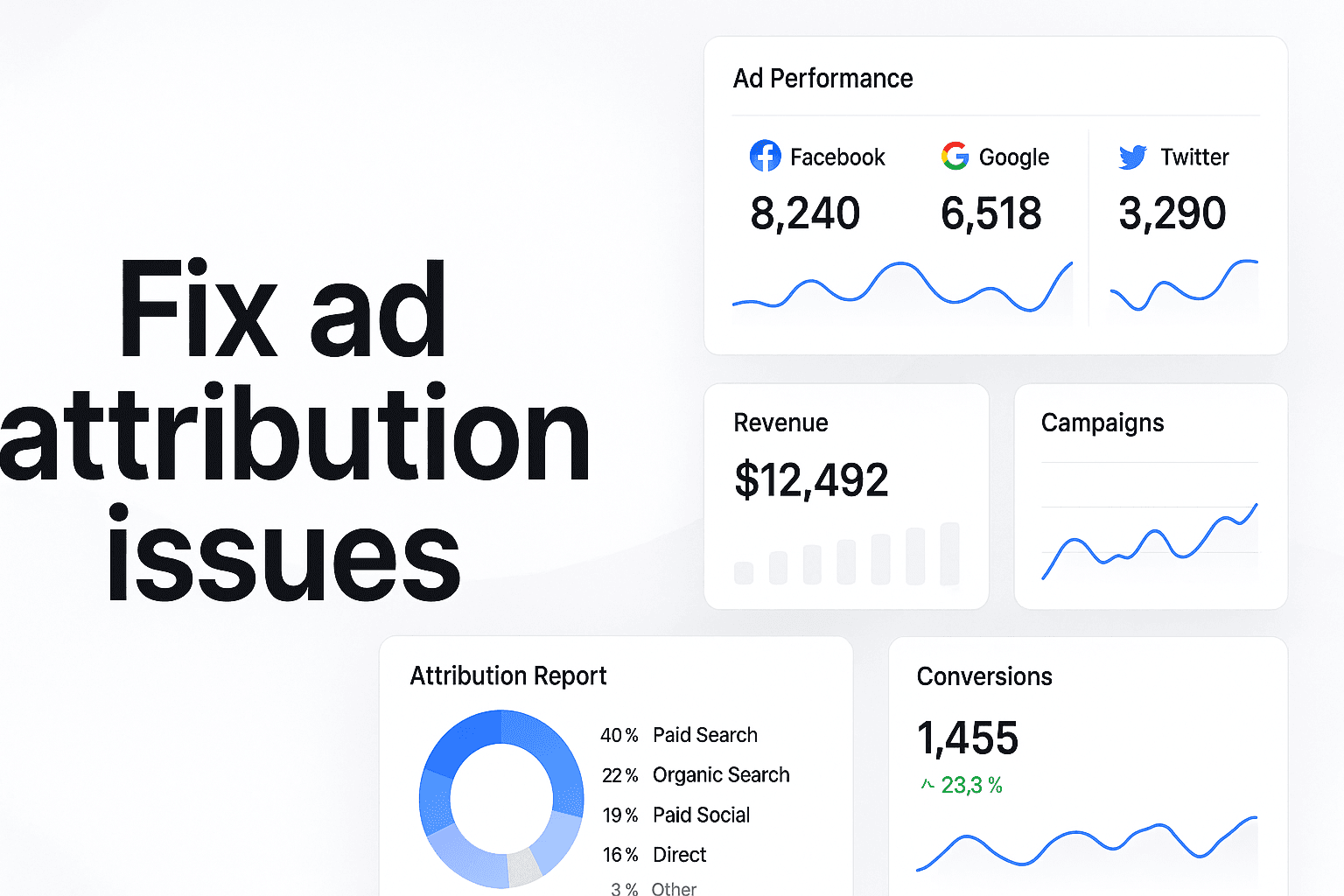
You're reviewing last month's ad performance, and something doesn't add up. Facebook Ads Manager shows 847 conversions with $127,000 in attributed revenue. Google Ads claims 612 conversions worth $98,000. Your analytics platform reports 523 total conversions. And your actual revenue? $142,000.
The math is impossible. These platforms are claiming credit for more conversions than actually happened, and the attributed revenue exceeds your real sales. This isn't a minor reporting quirk—it's attribution chaos that makes every optimization decision a gamble.
Attribution issues compound quickly. When you can't trust which campaigns drive real results, you waste budget on underperformers while starving your best channels. Your team debates which platform to believe. Budget allocation becomes guesswork. And scaling what works feels like navigating in the dark.
The root cause isn't mysterious. Modern attribution breaks down because each platform operates independently, using different attribution windows and methodologies. Add browser tracking limitations, cross-device customer journeys, and overlapping touchpoints, and you get systematic attribution failure.
But here's the critical insight: attribution problems are systematic, which means they respond to systematic solutions. You don't need to accept conflicting data or choose which platform to trust. You need a methodical approach to diagnose the specific issues in your attribution setup and implement technical fixes that restore accuracy.
This guide walks you through exactly that process. You'll learn how to audit your current attribution infrastructure, identify where tracking breaks down, implement server-side tracking that bypasses browser limitations, configure multi-touch attribution models that reveal true campaign impact, and unify data across platforms to eliminate duplication.
By the end, you'll have a clear roadmap to fix your attribution issues and build a system that shows exactly which marketing activities drive real revenue. No more impossible math. No more conflicting reports. Just accurate attribution that makes optimization decisions obvious.
Let's walk through how to fix this step-by-step.
Step 1: Audit Your Current Attribution Setup
Before fixing attribution issues, you need to understand exactly where your tracking breaks down. Most marketers skip this diagnostic phase and jump straight to implementing new tools, which compounds problems rather than solving them.
Start by documenting every tracking mechanism currently active in your marketing stack. This includes pixel implementations, conversion API setups, analytics platforms, CRM integrations, and any third-party attribution tools. Create a spreadsheet listing each tracking method, which platform it reports to, what events it captures, and what attribution window it uses.
The goal isn't just inventory—it's identifying conflicts. When Facebook's pixel and Google's tag both fire on the same conversion, both platforms claim credit. When your analytics platform uses a 7-day attribution window while your ad platforms use 28 days, you get systematically different conversion counts. These conflicts create the impossible math you're experiencing.
Next, run a controlled test to measure tracking accuracy. Place a test order or complete a test conversion while monitoring which tracking systems fire. Check whether the conversion appears in each platform, how long it takes to appear, and what attribution each platform assigns. This reveals which tracking mechanisms work reliably and which fail under real conditions.
Pay special attention to cross-device and cross-browser scenarios. Complete a conversion on mobile after clicking an ad on desktop. Use incognito mode. Clear cookies mid-funnel. These real-world user behaviors break most tracking setups, and understanding where your system fails helps prioritize fixes.
Document discrepancies systematically. If Facebook reports 847 conversions but your analytics shows 523, that's a 62% inflation rate. If Google Ads claims $98,000 in revenue but actual revenue is $142,000, you're missing 31% of conversions. These specific numbers guide your optimization priorities—fix the biggest gaps first.
Finally, map your customer journey to identify tracking blind spots. Where do customers typically enter your funnel? What devices do they use? How long is the consideration period? If your B2B customers research on mobile but convert on desktop three weeks later, and your tracking doesn't connect these touchpoints, you'll systematically misattribute conversions. Understanding these patterns through b 2 b marketing attribution helps you design tracking that matches reality.
Step 2: Implement Server-Side Tracking
Browser-based tracking is fundamentally broken. Ad blockers, privacy settings, cookie restrictions, and browser updates systematically prevent client-side pixels from firing. This isn't a minor issue—it's the primary cause of attribution failure for most advertisers.
Server-side tracking solves this by moving conversion tracking from the user's browser to your server. Instead of relying on JavaScript pixels that users can block, your server sends conversion data directly to ad platforms via their APIs. This approach bypasses browser limitations entirely and dramatically improves tracking accuracy.
Start by implementing Facebook's Conversion API (CAPI). This requires server-side code that sends conversion events to Facebook when they occur on your website or in your CRM. The technical implementation varies by platform, but the concept is consistent: when a conversion happens, your server makes an API call to Facebook with the conversion details and user identifiers.
The critical component is user matching. For server-side tracking to work, you need to send Facebook enough information to match the conversion to the user who clicked your ad. This typically includes hashed email addresses, phone numbers, IP addresses, and user agent strings. The more matching parameters you send, the higher your match rate and attribution accuracy.
Implement similar server-side tracking for Google Ads using Enhanced Conversions. This works similarly to Facebook's CAPI—your server sends conversion data with user identifiers directly to Google, bypassing browser-based tracking limitations. The implementation requires adding conversion tracking code to your server that fires when conversions occur.
For e-commerce businesses, integrate server-side tracking with your order confirmation process. When an order completes, your server should immediately send conversion events to all relevant ad platforms with complete transaction details. This ensures every conversion is tracked regardless of browser settings or ad blockers, which is essential for accurate marketing attribution for e-commerce.
Don't disable your existing pixel-based tracking when you implement server-side tracking. Run both in parallel. Pixels still capture some conversions that server-side tracking might miss, and platforms use data from both sources to improve attribution. The combination provides redundancy and maximizes tracking coverage.
Test your server-side implementation thoroughly before relying on it. Send test conversions and verify they appear in each platform's reporting. Check that user matching works correctly and that conversion values are accurate. Monitor match rates—if they're below 70%, you need to send additional user identifiers to improve matching.
Step 3: Configure Multi-Touch Attribution Models
Last-click attribution is a lie. When a customer clicks five different ads across three platforms before converting, giving 100% credit to the final click systematically misrepresents which marketing activities actually drove the sale. This creates the attribution conflicts you're experiencing.
Multi-touch attribution distributes conversion credit across all touchpoints in the customer journey based on their actual contribution. Instead of impossible math where multiple platforms each claim 100% credit for the same conversion, you get a realistic view of how different channels work together to drive results.
Start by selecting an attribution model that matches your business reality. Linear attribution gives equal credit to all touchpoints—useful for long consideration cycles where every interaction matters. Time-decay attribution gives more credit to recent touchpoints—appropriate when the final interactions are most influential. Position-based attribution emphasizes first and last touch—effective when awareness and conversion moments are most critical.
The choice matters less than consistency. Pick one model and apply it across all your reporting. When every platform uses different attribution models, you get systematically different results that can't be reconciled. Standardizing on one model eliminates this source of discrepancy.
Implement your chosen model in a centralized attribution platform that can track the complete customer journey across all channels. This requires a system that can identify the same user across different touchpoints and platforms, then apply your attribution model to distribute conversion credit appropriately. Tools like multi touch attribution platforms handle this complexity automatically.
Configure proper lookback windows that match your actual sales cycle. If customers typically convert within 7 days, a 28-day attribution window inflates your conversion counts by including conversions that would have happened anyway. If your B2B sales cycle is 90 days, a 7-day window misses most of your actual customer journey. Match your attribution window to your business reality.
Pay special attention to view-through attribution. When someone sees your ad but doesn't click, then converts later, should that ad get credit? The answer depends on your business. For brand awareness campaigns, view-through attribution captures real value. For direct response campaigns, it often inflates results. Configure view-through windows conservatively—1 day for most businesses, 7 days maximum for brand campaigns.
Regularly compare your multi-touch attribution results to last-click attribution to understand the difference. If multi-touch attribution shows your upper-funnel campaigns driving 40% more value than last-click suggests, that's critical information for budget allocation. Understanding these differences helps you make better optimization decisions and improve overall marketing performance improvement.
Step 4: Unify Data Across Platforms
Attribution issues fundamentally stem from data fragmentation. Each platform tracks conversions independently, uses different user identifiers, applies different attribution models, and reports in different formats. Unifying this data into a single source of truth eliminates the impossible math and conflicting reports.
Start by establishing a central data warehouse where all conversion data flows. This could be a dedicated analytics platform, a data warehouse like BigQuery or Snowflake, or a specialized attribution tool. The key requirement is that it receives conversion data from all sources—ad platforms, analytics, CRM, and your transaction system.
Implement user identity resolution to connect the same customer across different platforms and touchpoints. This requires a consistent user identifier that persists across your entire marketing stack. For logged-in users, this might be a customer ID. For anonymous users, you'll need to use probabilistic matching based on device fingerprints, IP addresses, and user agent strings.
The technical implementation typically involves creating a user ID mapping table that connects different platform identifiers to a single canonical user ID. When Facebook identifies a user as "fbuser12345" and Google identifies the same user as "gaclient67890", your mapping table connects both to "customerid999". This allows you to track the complete customer journey across platforms.
Configure data pipelines that automatically sync conversion data from each platform to your central warehouse. This should happen in near real-time so your unified reporting stays current. Most platforms offer APIs that allow automated data extraction—use these to pull conversion data, campaign performance, and cost information into your central system.
Implement deduplication logic to handle conversions that multiple platforms report. When both Facebook and Google claim credit for the same conversion, your unified system should identify the duplicate and apply your chosen attribution model to distribute credit appropriately. This eliminates the impossible math where attributed conversions exceed actual conversions.
Create unified reporting dashboards that show true marketing performance across all channels. Instead of logging into five different platforms and trying to reconcile conflicting numbers, you have one dashboard showing accurate, deduplicated conversion data with consistent attribution. This makes optimization decisions obvious and eliminates the confusion that attribution issues create.
For businesses that need to track digital marketing across complex customer journeys, this unified approach is essential. Without it, you're making decisions based on incomplete and conflicting data, which systematically leads to poor budget allocation and missed opportunities.
Step 5: Validate and Optimize Your Attribution System
Implementation is only half the battle. Attribution systems drift over time as platforms update their tracking, browsers change privacy settings, and your marketing mix evolves. Regular validation ensures your attribution remains accurate and your optimization decisions stay grounded in reality.
Start by establishing a validation cadence—monthly at minimum, weekly for high-spend accounts. Each validation cycle should compare attributed conversions to actual conversions from your transaction system. If your attribution platform reports 847 conversions but your database shows 823 actual orders, you have a 2.9% inflation rate. Track this metric over time to catch degradation early.
Implement conversion value validation alongside conversion count validation. Attribution systems often track conversions accurately but misreport revenue due to currency formatting issues, tax inclusion inconsistencies, or refund handling problems. Compare attributed revenue to actual revenue from your accounting system to identify these discrepancies.
Run regular holdout tests to measure incrementality. Randomly exclude a small percentage of users from seeing your ads, then compare their conversion rate to users who saw ads. The difference represents your true incremental impact—the conversions that actually resulted from your advertising rather than conversions that would have happened anyway. If your attribution shows 100 conversions but your holdout test shows only 60 incremental conversions, your attribution is inflating results by 67%.
Monitor platform-specific attribution changes closely. When Facebook updates its attribution methodology or Google changes how it handles cross-device conversions, your attribution accuracy can shift dramatically. Subscribe to platform update notifications and re-validate your attribution whenever major changes occur.
Pay attention to match rates for server-side tracking. If your Facebook CAPI match rate drops from 85% to 60%, you're losing attribution accuracy. Investigate what changed—did you stop collecting a user identifier? Did a technical issue break your hashing implementation? Maintaining high match rates is critical for accurate attribution.
Optimize your attribution model based on business results. If your current model systematically over-credits or under-credits certain channels compared to holdout test results, adjust the model. Attribution isn't about perfect theoretical accuracy—it's about creating a system that guides you toward better marketing decisions. Understanding different types of marketing attribution models helps you choose the approach that best matches your business reality.
Document everything. Maintain a changelog of attribution system updates, model changes, and validation results. When you make a budget allocation decision based on attribution data, you need to know exactly how that data was calculated and what assumptions it includes. This documentation becomes critical when results don't match expectations and you need to diagnose what went wrong.
Common Attribution Issues and How to Fix Them
Even with proper implementation, specific attribution problems require targeted solutions. Understanding these common issues and their fixes helps you troubleshoot problems quickly when they arise.
Issue: Attributed conversions exceed actual conversions
This happens when multiple platforms claim credit for the same conversion without deduplication. The fix is implementing a central attribution system that receives conversion data from all platforms and applies deduplication logic. Each conversion should be counted exactly once, with credit distributed according to your chosen attribution model.
Issue: Attributed revenue doesn't match actual revenue
Revenue discrepancies typically stem from timing differences, refund handling, or currency formatting. Ensure your attribution system receives conversion data at the same point in your order flow as your transaction system. Implement consistent refund handling—either include refunds in both systems or exclude them from both. Standardize currency formatting to eliminate rounding errors.
Issue: Mobile conversions are under-attributed
Mobile attribution fails when users click ads on mobile but convert on desktop, or when app-to-web journeys aren't tracked. Implement cross-device tracking using logged-in user identifiers when possible. For anonymous users, use probabilistic device matching. Ensure your attribution platform can connect app events to web conversions for businesses with both app and web presence.
Issue: Attribution breaks after iOS 14.5 updates
iOS privacy changes limit browser tracking and require user consent for tracking. The solution is server-side tracking via Conversion API, which bypasses browser limitations. Implement CAPI for Facebook and Enhanced Conversions for Google. Use first-party data from your CRM to improve user matching when browser identifiers aren't available.
Issue: Long sales cycles aren't captured properly
Default attribution windows (typically 7-28 days) miss conversions in longer B2B sales cycles. Extend your attribution window to match your actual sales cycle—90 days or more for complex B2B sales. Implement CRM integration so your attribution system can track conversions that happen weeks or months after the initial ad click.
Issue: Offline conversions aren't attributed to online marketing
When customers research online but purchase in-store or via phone, standard attribution misses these conversions. Implement offline conversion tracking by uploading transaction data from your CRM or point-of-sale system to your ad platforms. Match offline purchases to online ad clicks using email addresses, phone numbers, or customer IDs.
Issue: Different platforms show completely different results
Platform reporting discrepancies stem from different attribution models, windows, and counting methodologies. The fix is choosing one source of truth—typically a centralized attribution platform—and using it for all optimization decisions. Understand why platforms differ by comparing their specific attribution modeling vs marketing mix modeling approaches, but don't try to reconcile them. Pick one system and optimize based on its data consistently.
Building a Sustainable Attribution System
Fixing attribution issues isn't a one-time project—it's an ongoing process of measurement, validation, and optimization. The goal is building a system that maintains accuracy as your marketing evolves and platforms change their tracking methodologies.
Start by establishing clear ownership of attribution within your organization. Someone needs to be responsible for monitoring attribution accuracy, investigating discrepancies, and implementing fixes when problems arise. Without clear ownership, attribution systems degrade over time as small issues compound into major problems.
Create standard operating procedures for attribution validation. Document exactly how to compare attributed conversions to actual conversions, what discrepancy thresholds trigger investigation, and how to diagnose common problems. This ensures attribution maintenance happens consistently even as team members change.
Implement automated monitoring that alerts you when attribution accuracy degrades. Set up alerts for when attributed conversions deviate more than 10% from actual conversions, when match rates drop below acceptable thresholds, or when platform reporting shows unusual discrepancies. Catching problems early prevents them from affecting optimization decisions.
Invest in proper attribution infrastructure rather than trying to piece together free tools. Dedicated attribution platforms handle the technical complexity of server-side tracking, user identity resolution, multi-touch attribution, and data unification. The cost is minimal compared to the budget waste that attribution issues cause.
Train your team on attribution fundamentals so everyone understands how conversions are tracked and attributed. When marketers understand that Facebook's "attributed conversions" include view-throughs and use a 28-day window, they interpret the data more accurately. When they know your attribution system uses time-decay modeling, they optimize differently than if it used last-click attribution.
Regularly review and update your attribution model as your business evolves. The model that worked when you ran only Facebook ads might not work when you expand to Google, TikTok, and LinkedIn. The attribution window appropriate for impulse purchases doesn't work for considered purchases. Revisit your attribution configuration quarterly to ensure it still matches your business reality.
Document your attribution methodology clearly so stakeholders understand what the numbers mean. When you report "847 attributed conversions," specify that this uses time-decay attribution with a 28-day window including view-throughs. This context prevents misinterpretation and ensures everyone makes decisions based on the same understanding of the data.
Conclusion
Attribution issues aren't inevitable—they're systematic problems that respond to systematic solutions. The impossible math, conflicting reports, and optimization paralysis you're experiencing stem from specific technical failures in how conversions are tracked, attributed, and reported.
By auditing your current attribution setup, implementing server-side tracking, configuring multi-touch attribution models, unifying data across platforms, and establishing ongoing validation processes, you can build an attribution system that shows exactly which marketing activities drive real revenue.
The result isn't just cleaner reporting—it's better marketing decisions. When you know which campaigns actually drive conversions, budget allocation becomes obvious. When you can trust your attribution data, scaling what works is straightforward. When your team operates from a single source of truth, optimization debates disappear.
Start with the audit. Document your current tracking setup, identify where it breaks down, and prioritize the biggest gaps. Then implement the technical fixes systematically, validating accuracy at each step. Within weeks, you'll have attribution you can trust and marketing performance that reflects reality.
The impossible math ends when you build attribution infrastructure that matches how customers actually buy. Stop accepting conflicting data and start measuring what matters.
Ready to elevate your marketing game with precision and confidence? Discover how Cometly's AI-driven recommendations can transform your ad strategy—**Get your free demo** today and start capturing every touchpoint to maximize your conversions.