
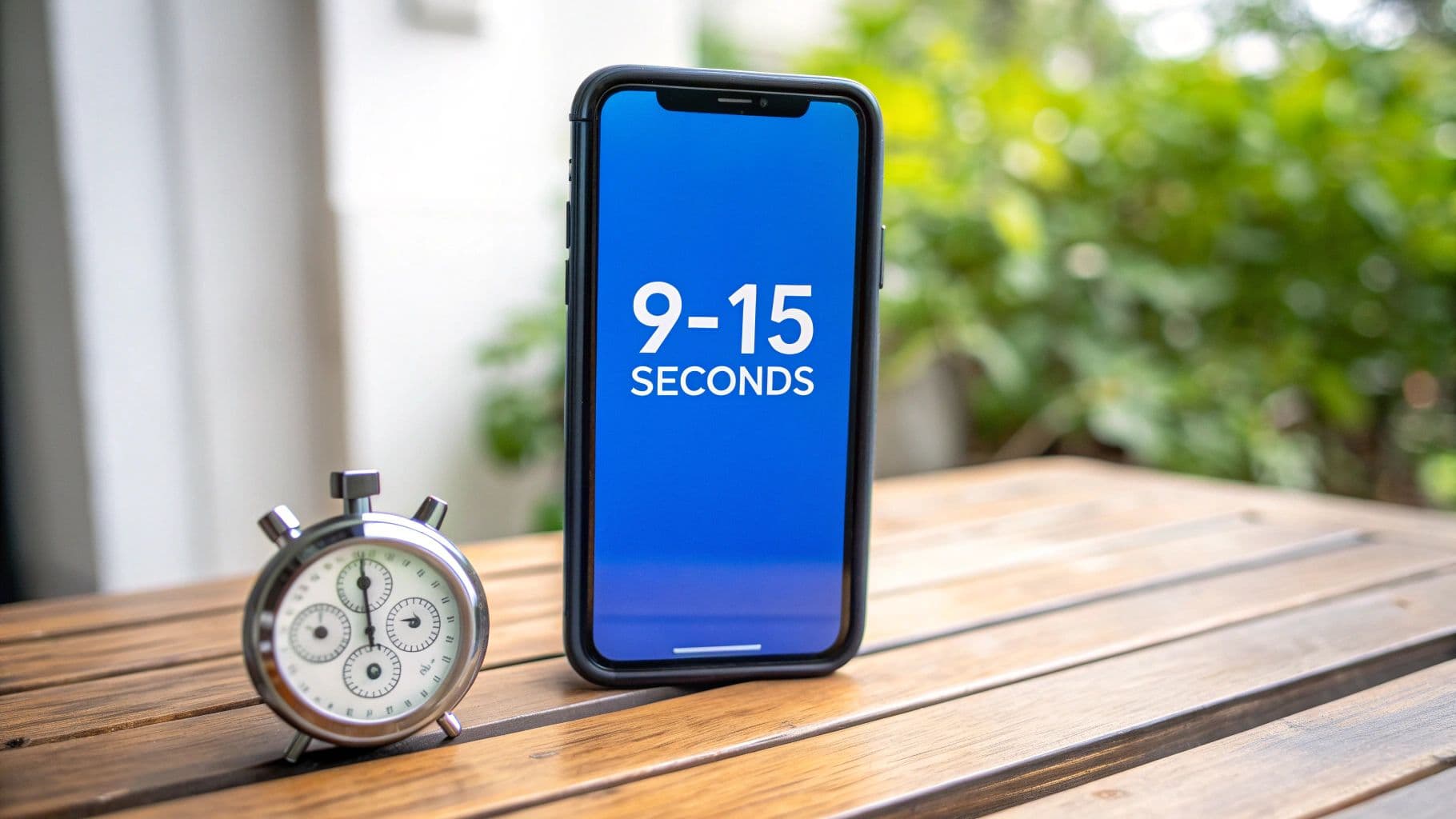
For most TikTok ads, the sweet spot—where the magic really happens—is between 9 and 15 seconds.
This is your best window to grab someone's attention, get your point across, and push them to act before they swipe away. Think of it like a perfect elevator pitch; you’ve got just a moment to make a real impact.
The 9 To 15 Second Sweet Spot For TikTok Ads
In the blink-and-you'll-miss-it world of TikTok, attention is everything. Users are flying through content at a dizzying pace, and this is exactly why the 9 to 15-second ad has become the gold standard for most campaigns. It’s a length that just feels right for the platform, hitting that perfect balance between being informative and respecting the user's time.
An ad in this range is long enough to tell a quick story and drop a clear call-to-action, but short enough to keep those completion rates high. And that’s a metric the TikTok algorithm absolutely loves. When users watch your ad all the way through, it signals that your content is engaging, which often leads to better delivery and lower costs.
Why This Timeframe Is So Effective
The 9 to 15-second window isn't just a hunch; it's backed by a mountain of performance data. TikTok's own ad specs and countless industry deep-dives all point to this range for in-feed ads, which make up the bulk of most advertising efforts.
Time and time again, we see these shorter clips hitting the highest completion rates—often over 70%—while longer ads suffer a steep drop-off. One analysis even found that shorter ads can convert up to 25% better and slash acquisition costs by 15-20%.
This flowchart breaks down the strategy, showing how different ad lengths map to different goals, with the sweet spot sitting right at the center of a winning approach.
 How Long Should a TikTok Ad Be for Maximum Impact
The visual makes it clear: while you have other options, that 9-15 second range is where you'll get the most bang for your buck on nearly any campaign goal.
It all comes down to a simple rule: match the message to the medium. On a platform built for speed, your ad has to deliver its punch almost instantly. If you can't hook a viewer and show your value in under 15 seconds, you've already lost them.
While this guide is focused on paid ads, it helps to understand what is the optimal length for a TikTok video in general. The principles of grabbing attention fast apply to both organic and paid content.
Ultimately, mastering this short-form format is the key to unlocking conversions. To dig deeper into the metrics that matter, check out our detailed guide on what are 10-second video views.
Aligning Ad Length with Your Campaign Goals
Figuring out the perfect length for a TikTok ad isn't about finding one magic number. Instead, your campaign goal is the compass that should guide every creative decision you make, especially how long your video runs. A one-size-fits-all approach just doesn't work here; what drives quick sales will almost certainly fail at building long-term brand loyalty.
Think of it like a conversation. If you’re meeting someone for the first time, you might take a little longer to tell your story and make a connection. But if you’re asking for a direct sale, you need to be sharp, persuasive, and get straight to the point. That same logic applies directly to your TikTok ads.
 How Long Should a TikTok Ad Be for Maximum Impact
Lengths for Awareness and Connection
If your main goal is brand awareness, you’ve got a bit more breathing room. Ads in the 21-34 second range can be incredibly effective for building an emotional connection and telling a story that sticks. This gives you enough time to introduce a problem, show off your brand’s personality, and leave a lasting impression without feeling rushed. The focus isn't on an immediate click, but on planting a seed for later.
Lengths for Driving Conversions and Sales
On the flip side, when your objective is conversions—whether that’s driving sales, generating leads, or getting app installs—short and sweet is the name of the game. For these direct-response goals, the 9-15 second window is king. This tight timeframe forces you to be ruthless with your messaging. You have to get straight to the value and hit them with a clear, unmissable call-to-action (CTA).
The data from top-performing TikTok ads backs this up. A massive 63% of the best ads get their main message across right at the very beginning. This clarity pays off, with research showing that 92% of users take action after watching an ad that lands in that powerful 5-15 second sweet spot. For a deeper dive into the technical side, you can explore the latest TikTok ad specs on veuno.com.
If you're evaluating vendors, our AI UGC for TikTok breakdown can help.
Key Takeaway: Match your ad’s runtime to its job. For building a brand narrative, a slightly longer, story-driven ad works well. For driving immediate action like a purchase, a short, impactful ad with a crystal-clear CTA is non-negotiable.
Here’s a simple breakdown of how to align ad length with your specific marketing goals:
- To Build Brand Awareness: Aim for 21-34 seconds. Use this time to create a narrative, showcase your brand’s values, and entertain the viewer to build positive sentiment.
- To Generate Leads: Stick to 9-15 seconds. Quickly highlight a pain point, present your solution as the obvious answer, and push users to a lead form with an urgent CTA.
- To Drive Product Sales: A concise 9-15 second ad is your best bet. Focus on showing the product in action, highlighting a key benefit, and making that "Shop Now" button impossible to ignore.
By tailoring the length of your ad to its specific purpose, you make sure your creative isn’t just seen—it’s actually effective at hitting your business goals.
Anatomy of a High-Performing Short Ad
When you're working with less than 15 seconds, you can't just throw information at the wall and hope it sticks. Every single second has a job to do. Think of a high-performing short ad less like a single video and more like a lightning-fast, three-act play designed to stop the scroll, show the value, and drive an action before your viewer even thinks about moving on.
If you're evaluating vendors, our Shopify video ad tool breakdown can help.
Getting this structure right is the key to making short-form ads work for you. It's how you answer the question, "How long should a TikTok ad be for conversions?" by making every moment count. Let's break down the three distinct phases.
 How Long Should a TikTok Ad Be for Maximum Impact
Act 1: The Hook (Seconds 0-3)
You have about three seconds to earn the right to the next three. That’s it. This is your one and only shot to stop someone's thumb mid-scroll. Your hook has to be disruptive, visually arresting, or hit an immediate emotional chord. Forget the slow intros and brand logos—lead with your absolute strongest, most compelling asset.
Think of it as the headline of your ad. It needs to be bold and instant.
- Go for a Surprising Visual: Start with an unexpected image or a jarring cut that completely defies expectations.
- Pose a Relatable Problem: Kick things off with a question that your target audience feels in their bones, like, "Tired of your phone dying by 3 PM?"
- Make a Bold Claim: A statement like "This is the last moisturizer you'll ever need" is powerful because it demands attention.
Understanding what grabs people is everything. Most guides on how to create viral TikTok videos point to this initial moment as the single most critical factor for success.
Act 2: The Value Proposition (Seconds 4-9)
Once you’ve got their attention, you have to deliver the "why." This is where you show, not just tell, how your product or service fixes the problem or delivers on the promise from your hook. This middle section has to be crystal clear, quick, and focused entirely on the benefit.
Don't just list features; demonstrate the outcome. Show the transformation, the relief, or the pure joy your product brings to the table. A few quick cuts of a demo, a solid before-and-after, or a genuine user testimonial work wonders here. You're answering the viewer’s silent question: "What's in it for me?"
Act 3: The Call to Action (Seconds 10-15)
Finally, you have to tell them exactly what to do next. A weak or missing Call-to-Action (CTA) makes the entire ad pointless, no matter how great the hook was. Your instruction needs to be clear, urgent, and incredibly easy to follow.
Pro Tip: Combine a visual text overlay (e.g., "Shop Now," "Learn More") with a verbal command in your voiceover. This one-two punch reinforces the message and has been proven to seriously boost click-through rates.
This final phase is the entire reason your ad exists. Your goal is to turn that initial flicker of interest into a real, measurable action. If you're looking for fresh ideas, exploring different ad creative strategies can give you a ton of inspiration for both your hooks and your CTAs.
To put it all together, here’s a simple blueprint you can follow for your next short-form ad.
Blueprint for a 15-Second Winning Ad
In the first 0–3 seconds, the core component is The Hook, and the goal is to stop the scroll immediately. This is where you grab attention with a surprising visual, ask a painful question like “Hate doing dishes?”, or make a bold promise such as “The secret to perfect skin.”
From 4–9 seconds, the core component is The Value Prop, and the goal is to clearly show the benefit. This can be done by demonstrating the product in action, showing a quick before-and-after, or featuring a user’s genuine reaction, keeping everything fast, visual, and easy to understand.
In the final 10–15 seconds, the core component is The CTA, and the goal is to drive action. Use a clear text overlay and voiceover with direct instructions like “Tap ‘Shop Now’ to get yours!” or “Link in bio to learn more!” and add urgency to push the viewer to take the next step right away.
This simple three-act structure forces you to be disciplined and ensures every second of your ad is working as hard as possible to grab attention and drive conversions.
How Ad Formats Shape Your Video Length
Thinking about the "right" length for a TikTok ad isn't just a creative question—it's a technical one, too. The platform isn't some one-size-fits-all ad machine. It’s a whole ecosystem of different ad formats, and each one has its own rules of engagement and ideal video length. The format you pick is just as critical as your creative because it literally dictates where and how your audience sees your message.
For a deeper dive, see our guide to AI TikTok video ad generator.
Take Brand Takeover and TopView ads, for example. These are the sprinters of the TikTok ad world. They're premium, full-screen placements that show up the second a user opens the app. You get a guaranteed, captive audience, but only for a blink-and-you'll-miss-it moment. Their job is to deliver maximum impact in minimum time, which is why 3-5 seconds is the sweet spot to sear your brand into someone's memory.
Matching Length to Format and Goal
Once you move past those instant-impact formats, the timing strategy completely changes. Collection Ads, built specifically for e-commerce, have a different job to do. Their goal is to turn that initial discovery into a seamless shopping experience, letting users browse a mini-gallery of your products right inside the app.
If you make a Collection Ad too long, you risk overwhelming the viewer. But make it too short, and you don't have enough time to show off your products. This is why they tend to hit their stride around the 10-second mark—just enough time to feature a few key items and get that click without creating any friction.
The strategic purpose of each ad format is everything. A Brand Takeover is like a billboard on a digital highway—it’s designed for a quick glance. A Collection Ad, on the other hand, is a mini-storefront that invites people to hang around for a moment.
If you look at the history of TikTok ads, you'll see a clear trend toward these ultra-short, high-impact formats. The platform has moved on from its early days of experimenting with 15-30 second ads to the 6-15 second powerhouses we see today. That shift was driven by algorithm changes that reward high completion rates.
The platform's own specs back this up, recommending 9-15 seconds for standard video ads but a slightly different 5-16 seconds for dynamic and collection ads. You can find more great insights on how these formats have evolved over at adapty.io.
Ultimately, a winning campaign comes down to aligning your creative's length with both the ad format and your specific conversion goals. You absolutely have to know which format you're running to pick the right length. Nailing this synergy is even more important when you're using advanced tracking to measure what's actually working. You can learn more about connecting your TikTok ads to a powerful attribution platform to see which formats and lengths are truly driving revenue for your business.
Systematically Testing Ad Lengths to Find What Works
Industry benchmarks are a fantastic starting point, but they aren't the final word on what will drive results for your brand. The only real way to find your conversion sweet spot—and answer the "how long should my TikTok ad be?" question for good—is through systematic testing. Think of yourself as a scientist running an experiment. Your hypothesis might be that 12-second ads are best, but only data can prove it.
This means you have to move beyond gut feelings and set up structured A/B tests. The core idea is simple: create a few variations of the same core ad, just at different lengths. For example, you could take your best-performing ad concept and chop it up into three distinct versions.
 How Long Should a TikTok Ad Be for Maximum Impact
Creating Your Test Scenarios
The key here is to isolate one variable: duration. Everything else—the audience targeting, budget, and the creative concept (your hook, value prop, and offer)—needs to stay identical across all test versions.
Here's a common testing structure you can borrow:
- Version A (The Control): A fast, punchy 9-second cut that gets straight to the CTA.
- Version B (The Sweet Spot): A 15-second version that follows the standard best-practice recommendations.
- Version C (The Storyteller): A 25-second edit that gives you a little more room for narrative or product demonstration.
By running these variations at the same time, you let your audience's behavior tell you which length is most effective for your offer. If you want to get reliable data faster, adopting an accelerated testing strategy is the way to go.
Don't just test to test—test to learn. Your goal isn't just to find a winning ad length but to understand why it wins. Does a shorter ad drive more impulse buys? Does a longer ad lead to higher average order values?
Once your tests are live, the real work begins. You have to track the right metrics to make an informed decision. Forget vanity metrics like views or likes. The KPIs that truly matter are the ones that hit your bottom line.
Focus on tracking these three:
- Cost Per Acquisition (CPA): How much are you paying to get one sale or lead from each ad length?
- Return On Ad Spend (ROAS): Which version is generating the most revenue for every dollar you put in?
- Click-Through Rate (CTR): Does a particular length do a better job of actually getting users to click your link?
By digging into this data, you can confidently figure out which ad length delivers the goods, allowing you to scale your budget on a proven winner.
Measuring the True Revenue Impact of Ad Lengths
So, you think you know which ad length is actually driving sales? I’m willing to bet you don't have the full story.
TikTok's built-in analytics are great for a quick glance at surface-level stuff—clicks, views, the usual vanity metrics. But they have a massive blind spot when it comes to the real customer journey. They might tell you someone clicked your 12-second ad, but they have no idea if that same person came back three days later and made a purchase.
This gap is where attribution software becomes a non-negotiable for serious advertisers. Without it, you’re basically guessing which of your creative decisions are actually making you money. You might be busy scaling a 15-second ad that gets tons of clicks, while a quieter 9-second ad is the one secretly driving your most valuable conversions.
Seeing the Full Customer Journey
To get the real picture of what’s working, you need tools that can see the entire customer journey from start to finish, without any platform bias. Advanced attribution platforms with server-side tracking see what the native ad managers miss. They can follow a user from the second they see your TikTok ad all the way to the final purchase on your Shopify store, no matter how much time passes in between.
This is how you move beyond vanity metrics and get down to business. You can finally see exactly how long a TikTok ad should be to not just grab a click, but to actually secure a sale. It’s the kind of insight that reveals which video lengths are quietly delivering your highest Return On Ad Spend (ROAS).
This Cometly dashboard, for instance, shows how you can trace revenue directly back to specific ads and campaigns. It’s this level of clarity that lets you make smart, confident budget decisions.
With this kind of data, you can confidently double down on the creative lengths that fuel your business growth—not just your view counts.
The goal isn't just to find an ad length that gets attention; it's to find the one that generates revenue. True attribution connects your creative choices directly to your bottom line, ending the guesswork for good.
This is all about tying every dollar you spend back to every dollar you earn, which is the heart of any winning ad strategy. If you want to go deeper on this, check out our guide on how to measure advertising effectiveness and start applying these principles to your TikTok campaigns.
When you can link specific ad lengths to cold, hard sales data, you can finally optimize your creative strategy with total confidence. You'll know you're investing in what actually works.
Common Questions About TikTok Ad Length
Let's dig into some of the most common questions advertisers have when trying to nail down their TikTok ad length. Getting these details right is a huge part of building a solid creative strategy that actually performs.
Can My TikTok Ad Be Longer Than 60 Seconds?
Technically, yes and no. For paid in-feed ads, you're capped at 60 seconds. While you can post much longer organic videos on your profile, the paid ad slot has that one-minute hard stop.
But here’s the more important answer: you almost never want to. Performance data shows a massive engagement drop-off after the first 15 seconds. So, while staying under 60 seconds is the rule, aiming for that 9-15 second sweet spot is the strategy that will make your ad budget work harder.
Does The Ideal Ad Length Change For Different Industries?
Absolutely. That 9-15 second window is a killer starting point for almost everyone, but there are definitely some nuances depending on what you're selling.
- E-commerce & DTC: These brands live and breathe in the 9-15 second range. It’s just enough time to show off a product, flash a key benefit, and hit them with a clear call-to-action to drive that impulse buy.
- B2B or SaaS: If you're selling a more complex solution, you might need a little more runway. We often see these brands experimenting in the 20-30 second range. That extra time is crucial for explaining a nuanced problem or quickly demoing a software feature that solves it.
No matter the industry, though, one thing never changes: the first three seconds are everything. If you don't hook them immediately, the rest of the ad doesn't matter.
How Often Should I Test Different Ad Lengths?
You should never really stop. Continuous testing is the name of the game on TikTok. A good rule of thumb is to test new ad length variations any time you launch a big campaign or introduce a totally fresh creative angle.
A great habit to get into is always having new length variations in your back pocket, ready to test against your current winning ads. This keeps you one step ahead of creative fatigue and helps you constantly refine what works for your specific audience and offers.
If an ad is crushing it, let it run. But don't ever stop looking for your next winner.
Ready to stop guessing which ad lengths are driving sales? Cometly provides crystal-clear attribution, showing you exactly which creatives generate revenue so you can scale with confidence. See how it works at Cometly.com.