

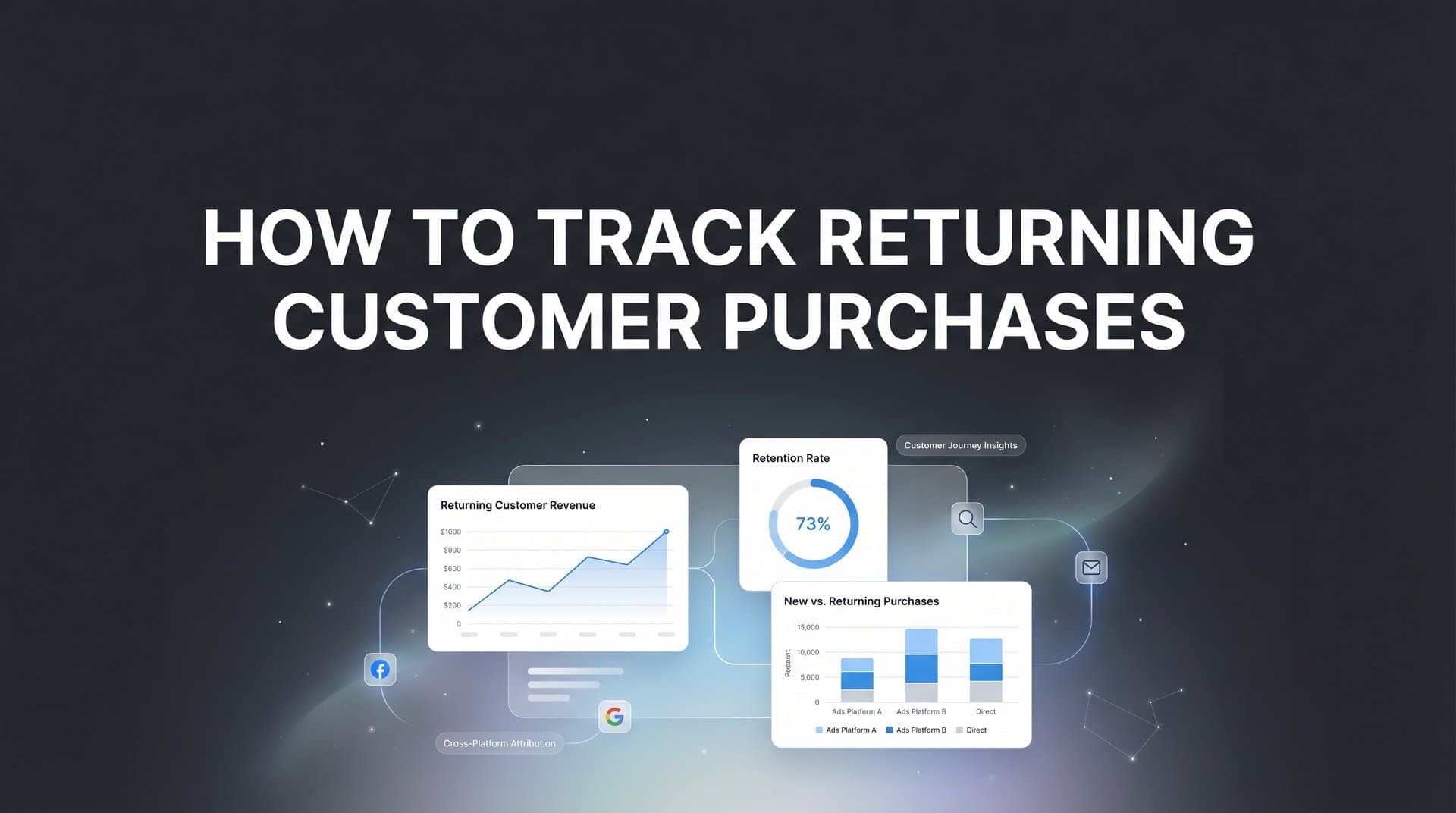
You spend thousands on ads to acquire new customers. Your campaigns convert. Revenue flows in. Success, right? Not quite. Because while you're celebrating those first purchases, you have no idea which of those customers will ever buy again—or which marketing efforts brought them back when they did.
Here's the uncomfortable truth: Most marketers are flying blind when it comes to returning customer purchases. They can tell you exactly how much they spent to acquire Customer A, but they can't tell you which email, retargeting ad, or social post convinced that same customer to make their second, third, or tenth purchase.
This knowledge gap is expensive. You might be pouring budget into channels that attract one-time buyers while starving the campaigns that actually build customer loyalty. You're optimizing for the wrong metrics, celebrating vanity wins, and missing the revenue hiding in your existing customer base.
The solution isn't complicated, but it does require a systematic approach. You need to track the complete customer journey—not just the path to first purchase, but every touchpoint that influences someone to come back and buy again.
This guide walks you through building a complete tracking system for returning customer purchases. You'll learn how to identify customers across devices and sessions, connect your marketing channels to actual repeat purchase behavior, and use that data to make smarter budget decisions. By the end, you'll have a clear framework for understanding which marketing efforts drive customer lifetime value, not just initial conversions.
Let's get started.
Step 1: Define Your Returning Customer Criteria and Goals
Before you track anything, you need to define what you're actually tracking. What qualifies as a "returning customer" for your business? The answer varies dramatically depending on your industry and product.
For an e-commerce store selling consumables, a returning customer might be someone who makes a second purchase within 90 days. For a B2B SaaS company, it might be an account that upgrades or renews. For a high-ticket service business, it could be a client who books again within a year.
Start by establishing your time window. Look at your historical purchase data and identify the typical repurchase cycle. What's the median time between first and second purchase for customers who do come back? This becomes your baseline for tracking.
Next, set specific tracking goals that align with business outcomes. Don't just track "repeat purchases" as a vague concept. Get precise about what you need to know.
Which channels drive repeat purchases? You need to see if the customers acquired through paid social come back at the same rate as those from organic search or email marketing.
What is the time between purchases? Understanding velocity helps you time your retention campaigns and identify when customers are at risk of churning.
What patterns exist in high-value repeat buyers? Customers who purchase three or more times likely have different characteristics and touchpoint patterns than one-time buyers.
Now identify the key metrics you'll track consistently. These should include repeat purchase rate (percentage of customers who make a second purchase), time to second purchase (how long it takes for customers to return), revenue per returning customer (average value of repeat purchases), and customer lifetime value segmented by acquisition channel.
Finally, document your customer journey stages. Map out every touchpoint from initial awareness through multiple purchases. Where do tracking gaps currently exist? Where do customers interact with your brand between purchases? These gaps are where valuable attribution data gets lost.
This foundation work prevents you from building a tracking system that collects data you don't need while missing the insights that actually matter. Get this step right, and everything else becomes easier.
Step 2: Set Up Customer Identification Across Touchpoints
Tracking returning customers only works if you can actually recognize the same person across multiple sessions, devices, and time periods. This is harder than it sounds, especially as browser restrictions and privacy regulations limit traditional tracking methods.
Your first priority is implementing unique customer identifiers that persist across sessions and devices. This typically means creating a customer ID in your database that gets assigned when someone creates an account, makes a purchase, or provides their email address.
This identifier needs to follow the customer everywhere. When they log in on their phone, that ID should be associated with their mobile session. When they click an email link on their laptop, that same ID should connect to their desktop activity. When they return three months later, you need to recognize them immediately.
The key is connecting your CRM data with your website tracking. Most analytics platforms can track anonymous visitors, but they lose that visitor when someone switches devices or clears cookies. By integrating your CRM, you create a bridge between anonymous browsing behavior and known customer identities.
Here's where server-side tracking becomes critical. Browser-based tracking alone struggles with iOS limitations, ad blockers, and cookie restrictions. Server-side tracking captures data directly from your server to your analytics platform, bypassing browser limitations entirely. Learn more about tracking conversions without cookies to future-proof your setup.
When someone makes a purchase, your server knows exactly who they are because they completed checkout. That purchase event gets sent directly to your tracking platform with the customer ID attached. No cookies required. No browser restrictions to worry about. The data flows reliably regardless of the visitor's device or privacy settings.
Configure your tracking so customer IDs flow correctly from ad click to purchase completion. When someone clicks a Meta ad, lands on your site, browses products, creates an account, and completes checkout, that entire sequence should be connected to a single customer identifier.
Test this flow thoroughly. Create a test customer account, make a purchase, then return later from a different device or browser. Can your system recognize this as the same customer? If not, you have a gap that will corrupt your returning customer data.
The technical implementation varies depending on your stack, but the principle remains constant: every customer interaction needs to be tied to a persistent identifier that survives across sessions, devices, and time. Without this foundation, you're just collecting disconnected data points instead of complete customer journeys.
Step 3: Connect Your Ad Platforms and Marketing Channels
Your customer identification system is worthless if it doesn't connect to the marketing channels actually driving those customers. This step bridges the gap between your tracking infrastructure and the platforms where you spend money.
Start by integrating your major ad accounts with your attribution system. This typically means connecting Meta Ads, Google Ads, TikTok Ads, and any other paid channels you use regularly. The integration should be bidirectional—data flows in from the platforms, and enriched conversion data flows back out.
Why bidirectional? Because feeding accurate returning customer data back to ad platforms dramatically improves their optimization algorithms. When Meta knows which customers came back and made repeat purchases, it can find more people who match that high-value profile.
Set up UTM parameters and tracking templates for consistent data capture across all campaigns. Every ad, email, and marketing link should include standardized parameters that identify the source, medium, campaign, and specific creative.
Be systematic about this. Create a UTM naming convention document and enforce it across your team. Inconsistent tagging is one of the most common reasons marketers lose attribution visibility. When one campaign manager uses "facebook" and another uses "meta" as the source parameter, your data becomes fragmented and unreliable.
Now configure conversion events that distinguish first-time purchases from repeat purchases. Your tracking platform needs to recognize these as separate event types because they represent fundamentally different customer behaviors with different values.
A first purchase might be labeled "Purchase_New_Customer" while a repeat purchase becomes "Purchase_Returning_Customer." This separation allows you to analyze performance differently for acquisition versus retention campaigns.
Enable conversion sync to feed your enriched purchase data back to ad platforms. This is where your customer identification work pays dividends. Instead of just telling Meta that a conversion happened, you can send detailed information: this was a returning customer, they previously purchased 45 days ago, their lifetime value is $347, and they came back after seeing a retargeting ad.
That enriched data helps ad platform algorithms optimize for the outcomes you actually care about—not just any conversion, but conversions from customers likely to return and generate long-term value.
Verify that your integration is working correctly by running test campaigns and confirming that conversion data appears in both your attribution platform and your ad accounts. Check that customer type (new versus returning) is being captured accurately. Ensure that UTM parameters are being preserved throughout the customer journey.
This connection between your marketing channels and your tracking infrastructure is what transforms raw data into actionable insights about which campaigns drive valuable, repeat customers.
Step 4: Build Your Attribution Model for Repeat Purchases
Single-touch attribution models fail spectacularly when tracking returning customers. Last-click attribution might credit a retargeting ad for a repeat purchase, completely ignoring the email sequence, organic social engagement, and content marketing that actually nurtured the customer relationship.
You need an attribution model that captures the full journey before repeat purchases. This means implementing multi-touch attribution that assigns value to every touchpoint along the path.
Start by choosing an attribution model that matches your business reality. Linear attribution spreads credit equally across all touchpoints. Time decay attribution gives more weight to recent interactions. Position-based attribution emphasizes first and last touch while acknowledging middle interactions.
For returning customers, time decay or position-based models often work well because they recognize that the touchpoints immediately before purchase matter, but they don't ignore the earlier interactions that kept your brand top of mind.
Configure your multi-touch attribution to see all touchpoints before a repeat purchase. This is where things get interesting. A customer's path to their third purchase might include: retargeting ad view, email open, organic social visit, direct site visit, promotional email click, and finally purchase. Understanding customer touchpoints before purchase is essential for accurate attribution.
Each of those touchpoints played a role in bringing that customer back. Your attribution model should reflect that reality instead of arbitrarily assigning all credit to whichever touchpoint happened to be last.
Set appropriate lookback windows that match your typical repurchase cycle. If your customers typically return within 60 days, a 90-day lookback window captures the relevant touchpoints without including ancient interactions that had no real influence.
Lookback windows that are too short miss important touchpoints. Windows that are too long include noise that dilutes your insights. Use your historical purchase data to determine the right window for your business.
Here's a critical step many marketers skip: compare attribution models to understand how different approaches value returning customer touchpoints. Run the same date range through multiple attribution models and see how the results differ.
You might discover that last-click attribution credits paid search for 60% of repeat purchases, while multi-touch attribution reveals that email marketing and retargeting ads actually drive most of the journey, with paid search just capturing the final click.
This comparison isn't about finding the "right" model—it's about understanding what different models reveal about your customer behavior. Each model tells a different story. The truth usually lives somewhere in the middle.
Document your chosen attribution model and the reasoning behind it. Share this with stakeholders so everyone understands how you're measuring success. When you later recommend shifting budget based on attribution insights, you'll need this foundation to explain why the data supports your recommendation.
Step 5: Create Segments and Reports for Returning Customers
Raw attribution data is overwhelming. You need to organize it into segments and reports that actually answer your business questions. This is where tracking transforms into insight.
Build customer segments based on purchase frequency and recency. Start with basic segments: one-time purchasers, two-time purchasers, three-plus purchasers. Then add recency layers: purchased within 30 days, 31 to 90 days, 91 to 180 days, 180-plus days.
These segments reveal patterns you can't see in aggregate data. You might discover that customers acquired through paid social make repeat purchases faster but at lower average order values, while organic search customers take longer to return but spend more when they do.
Set up dashboards that show returning customer metrics by channel and campaign. Your dashboard should answer these questions at a glance: Which channels have the highest repeat purchase rates? What's the average time to second purchase by acquisition source? How does customer lifetime value differ across channels? A robust customer journey tracking platform makes this analysis straightforward.
Create comparison reports that put new customer acquisition cost versus returning customer value side by side. This is where many marketers have their "aha moment." You might be spending $85 to acquire a customer through paid social who generates $120 in lifetime value, while organic content costs almost nothing to produce and attracts customers worth $340 over time.
These comparisons shift how you think about channel performance. The channel with the lowest cost per acquisition isn't necessarily the best channel—it's the channel that attracts customers with the highest lifetime value.
Configure automated alerts for significant changes in repeat purchase patterns. If your repeat purchase rate drops by more than 15% week-over-week, you want to know immediately. If the time between first and second purchase suddenly increases, that's an early warning sign of declining customer satisfaction or increased competitive pressure.
Automated alerts turn your tracking system into an active monitoring tool instead of just a reporting dashboard. You catch problems early instead of discovering them weeks later when reviewing monthly reports.
Organize your reports by decision-maker. Your CEO needs a high-level view of customer lifetime value trends and overall repeat purchase rates. Your channel managers need granular data about their specific campaigns and audiences. Your finance team needs revenue forecasts based on historical repeat purchase patterns.
Build each report with a specific use case in mind. Don't create reports just because you can—create them because someone needs that specific insight to make a better decision.
Step 6: Analyze and Optimize Based on Your Data
You've built the tracking infrastructure. You've collected the data. You've created the reports. Now comes the part that actually impacts your bottom line: using these insights to optimize your marketing.
Start by identifying which campaigns and channels drive the highest returning customer rates. Sort your acquisition channels by repeat purchase rate, not just by cost per acquisition or initial conversion rate. The results might surprise you.
You may discover that the expensive branded search campaign you've been trying to cut actually attracts customers who purchase three times more often than customers from prospecting campaigns. Or that the content marketing you've been neglecting generates customers with twice the lifetime value of paid social customers.
Calculate true customer lifetime value using your tracked repeat purchase data. Stop using industry benchmarks or educated guesses. You have real data now. Use it. Understanding how to track marketing ROI accurately depends on this foundation.
Segment your LTV calculation by acquisition channel, campaign type, audience, and time period. LTV isn't a single number—it varies dramatically based on how and when customers were acquired.
Customers acquired during a holiday promotion might have different repeat purchase behavior than customers acquired through evergreen campaigns. Customers who came from influencer partnerships might behave differently than those from display ads. Your data will reveal these patterns.
Adjust budget allocation to favor channels that bring back high-value customers. This is where tracking translates directly into ROI improvement. If you discover that email marketing drives 40% of repeat purchases but receives only 10% of your marketing budget, you have a clear optimization opportunity.
Shift budget gradually while monitoring results. Don't make massive changes based on a single week of data. Look for consistent patterns over time, then make measured adjustments and track the impact.
Use AI-powered recommendations to scale campaigns that drive repeat purchases. Modern attribution platforms can analyze your data and identify patterns you might miss manually. They can spot which ad creatives, audiences, and bidding strategies correlate with higher repeat purchase rates.
These recommendations help you scale what's working without the guesswork. Instead of wondering whether to increase budget on Campaign A or Campaign B, you have data showing which one attracts customers who actually come back. Explore how ad tracking tools can help you scale ads using this accurate data.
Review your returning customer data weekly to spot trends and optimization opportunities. Make this a recurring calendar item. Set aside time every week to review key metrics, identify anomalies, and brainstorm optimization tests.
Weekly reviews catch trends early. Monthly reviews miss opportunities. The faster you spot a pattern, the faster you can capitalize on it or fix it.
Document your optimization decisions and their outcomes. When you shift budget based on returning customer data, record what you changed, why you changed it, and what happened as a result. This creates an optimization playbook you can reference and refine over time.
Putting It All Together
Tracking returning customer purchases transforms how you evaluate marketing performance. You're no longer guessing which channels build long-term customer value—you have data that shows exactly which touchpoints bring customers back and drive repeat revenue.
This shift in perspective changes everything. Budget decisions become clearer. Campaign optimization becomes more effective. You stop celebrating vanity metrics and start focusing on the activities that actually grow your business.
Use this checklist to verify your setup is complete and functioning correctly:
Customer identification configured: Unique customer IDs persist across sessions and devices, connecting anonymous browsing to known customer identities.
Ad platforms connected: Your major marketing channels integrate with your attribution system, with bidirectional data flow enabled.
Attribution model selected: You've chosen and documented a multi-touch attribution approach that captures the full returning customer journey.
Segments created: Customer segments based on purchase frequency and recency are built and actively maintained.
Reporting dashboards active: Stakeholders have access to relevant reports that answer their specific business questions.
Review your returning customer data weekly. Look for trends in repeat purchase rates, changes in time between purchases, and shifts in channel performance. These patterns reveal optimization opportunities you can't see in aggregate acquisition metrics.
The most successful marketers don't just acquire customers—they build systems that identify and scale the channels bringing back high-value customers who purchase repeatedly. With accurate tracking in place, you can confidently invest in the marketing activities that drive long-term growth, not just short-term conversions.
Your tracking infrastructure captures every touchpoint from initial click through multiple purchases. Your attribution model assigns appropriate credit across the customer journey. Your reports reveal which channels deserve more investment and which ones look good on paper but fail to drive real customer value.
This is the foundation for sustainable, profitable growth. You're no longer optimizing in the dark. You're making decisions based on complete customer journey data that shows what actually works.
Ready to elevate your marketing game with precision and confidence? Discover how Cometly's AI-driven recommendations can transform your ad strategy—Get your free demo today and start capturing every touchpoint to maximize your conversions.



