

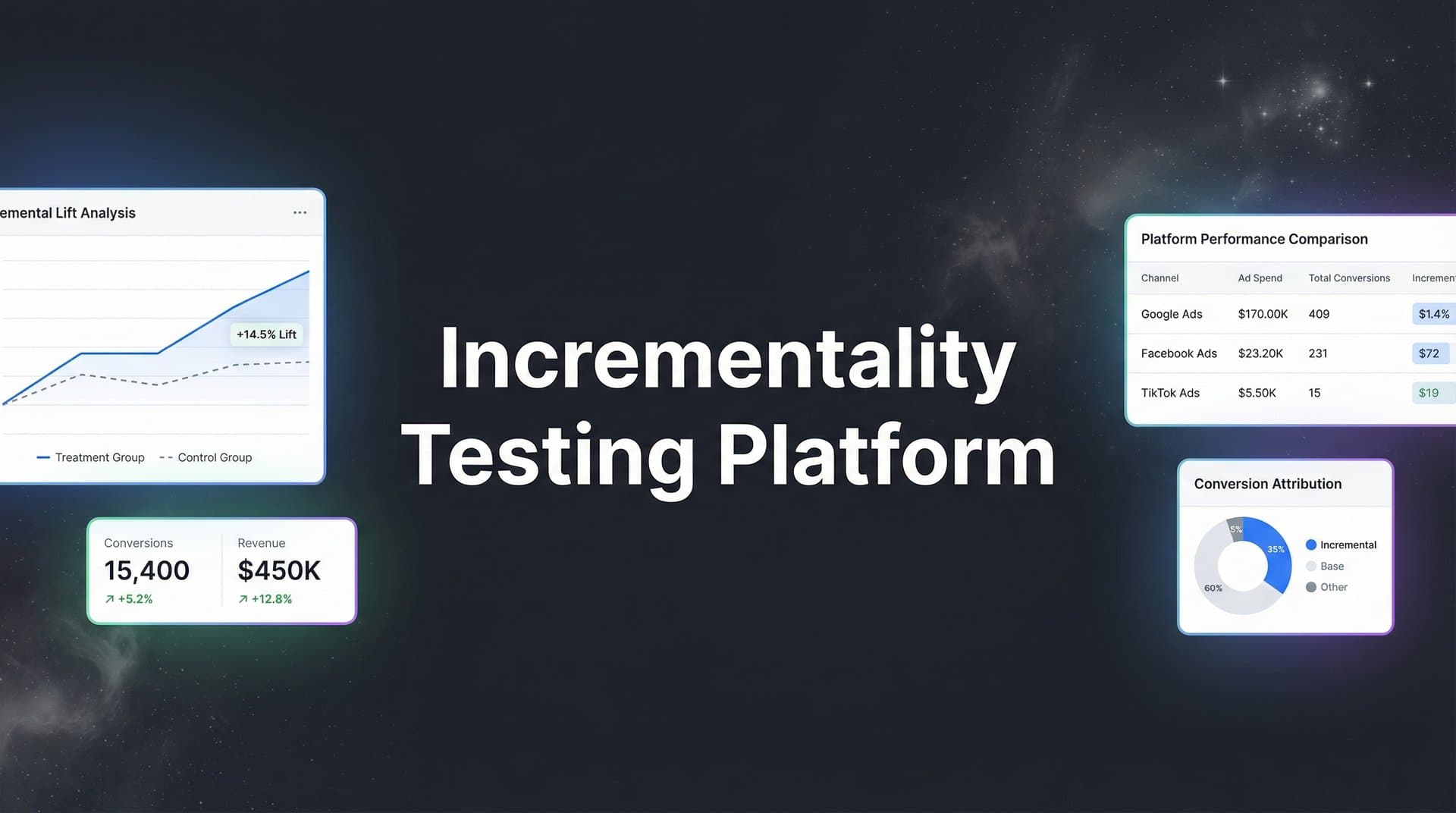
You've just launched a new campaign. The dashboard lights up with conversions. Your ROAS looks strong. Everything points to success. But here's the question that should keep you up at night: how many of those customers would have bought from you anyway, even if they'd never seen your ad?
This is the attribution blind spot that costs marketers millions in wasted spend every year. Traditional tracking tells you what happened after someone saw your ad. It doesn't tell you whether your ad actually caused the conversion or simply got credit for being in the right place at the right time.
Incrementality testing is the solution to this problem. Instead of tracking correlations, it measures causation. Instead of counting touchpoints, it quantifies the actual lift your marketing creates. For marketers who want to move beyond vanity metrics and understand which campaigns truly drive growth, incrementality testing platforms provide the framework to separate signal from noise and invest with confidence.
The Attribution Problem That Keeps Marketers Guessing
Traditional attribution models operate on a simple assumption: if someone saw your ad and later converted, the ad deserves credit. This logic seems reasonable until you realize it's fundamentally flawed.
Consider a customer who's been researching your product for weeks. They've visited your website multiple times. They've read reviews. They're ready to buy. Then they see your retargeting ad and complete the purchase. Your ad platform reports this as a conversion driven by your campaign. But did your ad actually influence the decision, or did it just happen to appear right before a purchase that was already going to happen?
This is the difference between correlation and causation. Correlation means two events happened in sequence. Causation means one event actually caused the other. Traditional attribution measures correlation. Incrementality testing measures causation. Understanding incrementality testing vs attribution helps clarify why this distinction matters for your marketing strategy.
The overcounting problem becomes especially severe with retargeting campaigns and branded search ads. These channels often show impressive platform-reported ROAS because they target people who already know your brand and have high purchase intent. Your ads get credit for conversions that would have occurred organically. The result? You're paying for customers you would have acquired anyway.
Incrementality testing solves this by measuring lift rather than just tracking touchpoints. Instead of asking "did this person see my ad and convert?" it asks "did my ad cause additional conversions that wouldn't have happened otherwise?" This shift from tracking to testing transforms how you evaluate marketing performance.
The methodology is straightforward: create two statistically similar groups. Show ads to one group but not the other. Measure the difference in conversion rates. That difference is your incremental lift. It's the only metric that tells you whether your marketing actually moved the needle or just took credit for momentum that already existed.
For marketers managing significant ad budgets, this distinction matters enormously. A campaign with 5X platform-reported ROAS might deliver only 2X incremental ROAS when you account for baseline conversions. That gap represents wasted spend that could be reallocated to channels delivering genuine growth.
How Incrementality Testing Actually Works
At its core, incrementality testing uses the scientific method to measure marketing impact. You create a hypothesis, design an experiment with control and test groups, measure outcomes, and analyze the difference. The simplicity of this approach is what makes it so powerful.
The fundamental setup involves two groups that are as similar as possible in every way except one: ad exposure. The test group sees your ads. The control group doesn't. After a defined period, you compare conversion rates between the groups. The difference represents your incremental lift.
Geo-based holdout tests are one of the most common methodologies. You select geographic regions that are similar in demographics, market size, and historical performance. Some regions continue seeing your ads normally. Others have advertising paused or reduced. By comparing conversion rates across these regions, you can measure the true impact of your advertising spend. A comprehensive guide to incrementality testing methodology can help you select the right approach for your campaigns.
This approach works particularly well for channels with broad geographic reach like TV, radio, or display advertising. If you normally advertise across 50 markets, you might select 10 comparable markets as holdouts. The conversion rate difference between advertised and non-advertised markets reveals your incremental impact.
PSA tests offer another methodology, especially useful for digital channels. Instead of showing your actual ads to the control group, you show public service announcements or placeholder ads. This maintains the same ad placement and frequency while removing your marketing message. The conversion rate difference between groups exposed to your real ads versus PSAs measures true advertising impact.
Ghost ads take a similar approach but use completely blank ad units. This method is particularly effective for testing specific creative elements or messaging strategies. By comparing performance between your actual ads and blank placeholders, you isolate the impact of your creative execution.
Intent-to-treat analysis adds statistical rigor by measuring based on ad eligibility rather than actual exposure. Not everyone in your test group will see every ad due to delivery variations, frequency caps, or user behavior. Intent-to-treat methodology accounts for this by analyzing all users who were eligible to see ads, regardless of whether they actually saw them. This provides a more conservative and accurate measure of real-world impact.
The metrics that matter in incrementality testing differ from traditional attribution metrics. Incremental lift measures the percentage increase in conversions caused by your advertising. If your control group converts at 2% and your test group converts at 2.5%, your incremental lift is 25%.
Incremental ROAS calculates return on ad spend using only the additional conversions your ads created, not the total conversions. This metric often looks less impressive than platform-reported ROAS but provides a far more accurate picture of true marketing efficiency.
Cost per incremental conversion tells you what you're actually paying to generate new customers rather than what you're paying to reach people who would have converted anyway. This metric becomes the foundation for intelligent budget allocation decisions.
What to Look for in an Incrementality Testing Platform
The right incrementality testing platform transforms complex statistical methodology into actionable marketing intelligence. Not all platforms are created equal, and the capabilities you prioritize should align with your testing sophistication and business needs.
Audience segmentation capabilities sit at the foundation of effective incrementality testing. Your platform needs to create statistically valid control and test groups that are truly comparable. This means matching on demographics, purchase history, engagement levels, and any other factors that might influence conversion likelihood. Poor segmentation undermines the entire experiment.
Statistical significance calculation should be automated and transparent. Your platform needs to tell you whether observed differences between groups are meaningful or just random variation. It should calculate required sample sizes before you start testing and confidence intervals for your results. Without proper statistical rigor, you risk making budget decisions based on noise rather than signal.
Cross-channel measurement capability separates enterprise-grade platforms from single-channel solutions. Customer journeys span multiple touchpoints across paid search, social media, display advertising, email, and offline channels. Your incrementality platform needs to measure lift across all these channels simultaneously to provide a complete picture of marketing impact. A robust cross-platform analytics tool becomes essential for this comprehensive view.
Integration requirements matter enormously because incrementality testing depends on comprehensive data. Your platform needs to connect with ad platforms like Meta, Google Ads, and TikTok to control ad delivery and measure exposure. It needs CRM integration to track conversions that happen offline or in sales systems. It needs website analytics integration to capture online behavior and conversion events.
Server-side tracking has become increasingly critical as browser-based tracking faces limitations from privacy changes and cookie restrictions. Platforms that rely solely on client-side tracking will miss conversions and undercount your incremental impact. Look for solutions that offer robust server-side tracking to maintain data accuracy.
Automation features determine whether you can run continuous testing at scale or only occasional one-off experiments. Manual test setup is time-consuming and prone to errors. Platforms with automated test design, audience selection, and statistical analysis enable you to run multiple concurrent tests across different channels and campaigns.
Real-time reporting capabilities let you monitor tests as they run rather than waiting weeks for results. Early indicators of test direction help you make faster decisions. The ability to stop underperforming tests early or extend promising ones maximizes learning while minimizing risk.
Customization flexibility matters because different channels and business models require different testing approaches. A platform that only supports one testing methodology limits your ability to measure impact across your full marketing mix. Look for solutions that offer multiple testing frameworks and let you customize test parameters to match your specific needs.
Running Your First Incrementality Test: A Step-by-Step Approach
Your first incrementality test sets the foundation for a more sophisticated measurement approach. Start with a channel or campaign where you suspect attribution might be overstated and where you have sufficient volume to achieve statistical significance.
Defining your hypothesis comes first. What specific question are you trying to answer? "Does our retargeting campaign drive incremental conversions or just claim credit for organic purchases?" is a clear, testable hypothesis. "Is our marketing working?" is too vague to design an effective test around.
Channel selection should prioritize areas with the biggest budget or the most uncertainty about true impact. Retargeting campaigns, branded search, and display advertising are often good starting points because they tend to show high platform-reported ROAS but may have lower incrementality. Testing these channels first can unlock significant budget optimization opportunities. Understanding incrementality testing for paid advertising specifically helps you design more effective experiments.
Sample size calculation determines whether your test will produce meaningful results. You need enough users in both control and test groups to detect a statistically significant difference. The required sample size depends on your baseline conversion rate, expected lift, and desired confidence level. Many platforms calculate this automatically, but understanding the principle helps you design better tests.
As a general rule, lower baseline conversion rates require larger sample sizes. If your conversion rate is 0.5%, you'll need far more users than if it's 5%. Similarly, detecting small lift amounts requires larger samples than detecting large lift. Plan for sample sizes that give you at least 80% statistical power to detect the minimum lift that would change your budget decisions.
Control and test group creation requires careful attention to comparability. Random assignment works well for digital channels where you can precisely control who sees ads. For geo-based tests, select markets that are similar in size, demographics, seasonality, and historical performance. The more similar your groups at the start, the more confident you can be that observed differences reflect true advertising impact.
Test duration needs to balance statistical validity with business urgency. Too short, and you won't capture full customer journey timelines or account for day-of-week variations. Too long, and you delay decisions and risk external factors contaminating results. Most digital campaigns benefit from two to four week test periods. Longer consideration cycles may require extended testing.
Avoiding contamination means preventing control group users from being exposed to your ads through other channels. If you're testing Facebook ads but control group users see your Google ads, your results will be muddied. Either test one channel at a time or use sophisticated cross-channel holdout strategies that maintain consistency across all platforms. Addressing multiple ad platforms tracking issues becomes critical for maintaining test integrity.
Seasonality bias can skew results if your test period includes unusual events. Running a test that spans Black Friday or a product launch will produce results that don't reflect normal conditions. Either avoid testing during anomalous periods or ensure your control and test groups experience the same seasonal factors.
Monitoring during the test helps you catch issues early. Check that your control group is truly seeing no ads. Verify that delivery volumes match expectations. Look for unusual patterns that might indicate technical problems. Early detection of setup errors saves you from wasting weeks on invalid results.
Turning Incrementality Insights Into Budget Decisions
Incrementality test results only create value when you act on them. The goal isn't just to measure lift but to reallocate budgets toward channels that deliver genuine incremental growth and away from those claiming credit for organic conversions.
Interpreting results starts with understanding the difference between statistical significance and business significance. A test might show that your ads create a statistically significant 5% lift in conversions. But if that lift costs more than the incremental revenue it generates, it's not worth continuing. Always evaluate incrementality in the context of profitability and business goals.
Identifying true incremental value means comparing incremental ROAS across channels rather than platform-reported ROAS. You might discover that your retargeting campaign shows 8X platform ROAS but only 2X incremental ROAS because most of those customers would have converted anyway. Meanwhile, your prospecting campaign shows 3X platform ROAS but 2.5X incremental ROAS because it reaches genuinely new audiences.
This insight transforms budget allocation. The retargeting campaign looks more efficient on the surface but delivers less true value. Shifting budget from retargeting to prospecting might lower your platform-reported ROAS while increasing actual revenue growth. This is the power of measuring incrementality rather than just tracking attribution.
Channel-level decisions become clearer when you understand incremental impact. Branded search often shows high conversion rates and strong ROAS because people searching for your brand name already intend to buy. But incrementality testing frequently reveals that pausing branded search has minimal impact on overall conversions. Those customers find you anyway through organic search or direct navigation. Recognizing ad platform attribution bias helps explain why platform-reported metrics often overstate true performance.
Budget reallocation should be gradual and tested. Don't immediately slash spending on channels with low incremental lift. Instead, run controlled experiments where you reduce spend incrementally and measure the impact on total conversions. This approach lets you find the optimal spend level for each channel rather than making binary on-off decisions.
Combining incrementality data with multi-touch attribution creates a complete measurement framework. Attribution shows you the customer journey and which touchpoints appear in converting paths. Incrementality validates which of those touchpoints actually influenced outcomes. Together, they answer both "what happened?" and "did it matter?" A multi-touch marketing attribution platform provides the foundation for this integrated approach.
This combined approach helps you understand channel roles beyond simple last-click or first-click attribution. A channel might rarely get last-click credit but show strong incremental lift, indicating it plays an important early-journey role. Another channel might appear frequently in attribution reports but show weak incrementality, suggesting it claims credit without driving decisions.
Continuous testing at scale transforms incrementality from a one-time exercise into an ongoing measurement discipline. As markets change, customer behavior shifts, and competitive dynamics evolve, yesterday's incrementality insights become less relevant. Platforms that enable automated, continuous testing help you maintain accurate understanding of what's working as conditions change.
Moving From Vanity Metrics to True Marketing Measurement
The shift from traditional attribution to incrementality-informed measurement represents a fundamental evolution in marketing sophistication. It's the difference between tracking what happened and understanding what you caused. Between counting conversions and measuring growth. Between optimizing for reported metrics and optimizing for actual business impact.
Incrementality testing doesn't replace attribution. It complements it. Attribution provides the customer journey map. Incrementality validates which parts of that journey you actually influenced. Together, they give you both the complete picture of how customers convert and the clear understanding of where your marketing dollars drive genuine growth.
For marketers managing significant budgets, this measurement approach transforms decision-making. You stop arguing about attribution models and start measuring actual lift. You stop crediting every channel in the customer journey and start identifying which investments create incremental value. You stop optimizing for platform metrics and start optimizing for real revenue growth.
The platform you choose matters because it determines whether incrementality testing becomes a core capability or remains an occasional experiment. Look for solutions that integrate with your full marketing stack, automate the statistical complexity, and enable continuous testing at scale. The right platform turns incrementality insights into a competitive advantage.
Ready to elevate your marketing game with precision and confidence? Discover how Cometly's AI-driven recommendations can transform your ad strategy. Our platform connects every touchpoint across your marketing channels, validates which campaigns deliver true incremental value, and provides the attribution accuracy you need to make confident budget decisions. Get your free demo today and start capturing every touchpoint to maximize your conversions.


