Imagine you had a marketing assistant who could learn from every single customer interaction, predict what they’ll do next, and automatically tweak your ad campaigns in real time. That, in a nutshell, is the power of machine learning for ads. It turns advertising from a manual guessing game into a data-driven science, predicting outcomes with a level of precision we’ve never had before.
Why Machine Learning Is the New Advertising Powerhouse
 Machine Learning for Ads Your Complete Guide to Boosting ROI
For decades, marketers ran on experience, intuition, and basic demographic targeting. We’d build customer profiles, set our bids manually, and cross our fingers hoping the message landed. This approach was always reactive; we were constantly analyzing past performance to slowly, painfully refine future strategies.
Machine learning completely flips that model on its head.
Instead of just reacting to what already happened, it proactively predicts what will happen next. Think of it as the difference between looking in your car's rearview mirror and having a GPS that forecasts traffic, suggests the fastest route, and reroutes you on the fly.
From Manual Guesswork to Automated Precision
At its core, machine learning (ML) uses algorithms to chew through enormous datasets, uncovering hidden patterns and making predictions without needing to be explicitly programmed for every little task. For advertisers, this means the system learns from thousands—or millions—of data points like clicks, purchases, and user behaviors to make smarter decisions.
This shift lets us move beyond simple, rule-based optimization. We’re no longer stuck with “if a user is in this demographic, show them this ad.” Machine learning operates on a much deeper, more nuanced level. You can explore a broader overview of the impact of artificial intelligence on transforming marketing strategies to see how this fits into the bigger picture.
It starts answering the critical questions with data-backed confidence:
- Which specific user is most likely to convert in the next 24 hours?
- What’s the absolute optimal bid for this individual ad impression?
- Which mix of headline, image, and call-to-action will crush it for this particular audience segment?
By processing vast amounts of information, machine learning models can identify subtle correlations that no human analyst could ever spot. For instance, an algorithm might discover that users who visit a specific blog post on a Tuesday are 3x more likely to purchase a high-ticket item on a Friday.
The Core Job of Machine Learning in Ads
Ultimately, machine learning in advertising is all about automation and efficiency at a massive scale. It crushes the tasks that are too complex, too big, or too fast for any human to manage. The main goal? Maximize your return on ad spend (ROAS) by making the smartest decision at every possible opportunity.
Instead of setting one bid for an entire audience, predictive bidding models can set a unique price for every single impression in a programmatic auction. This happens millions of times a day, with each bid tailored to the predicted value of that specific user, seeing that specific ad, at that exact moment.
This is the kind of granular, predictive power that gives modern advertisers a true competitive edge. It’s no longer a nice-to-have; it’s essential.
The Core Models Powering Modern Ad Campaigns
While "machine learning for ads" might sound like something cooked up in a lab, it really just boils down to a few core models running the show behind the scenes. These are the specialized engines that automate the most critical decisions in your campaigns, turning mountains of raw data into profitable actions.
Think of them less as a single, all-knowing AI and more like a team of experts, each with a very specific job. Getting to know what each one does is the key to actually making them work for you. Let's break down the four foundational models that are driving the most successful ad campaigns today.
Predictive Bidding: The Master Auctioneer
Imagine trying to win an auction for every single person who might see your ad. That’s pretty much what programmatic advertising is—billions of ad slots being bought and sold every single second. Predictive bidding models act as your automated, expert auctioneer, deciding the perfect price to pay for each individual impression.
This model crunches hundreds of signals in real-time—like a user's behavior, the time of day, their device, and past conversion data—to predict how likely they are to convert. It then calculates a precise bid that maximizes your chance of winning that impression without overpaying. It’s the difference between shouting one price for the entire room and whispering a custom bid for every single person.
This is where machine learning really shines. Programmatic advertising, powered by these ML models, now makes up roughly 80% of all digital display ad spend globally. These systems optimize for cost per acquisition (CPA) far faster than any human could, with some industry estimates pointing to ROI improvements in the 15–20% range.
Customer Lifetime Value (LTV) Modeling: The Futurist
While predictive bidding is all about the immediate win, Customer Lifetime Value (LTV) modeling is playing the long game. This model is like a financial forecaster for your customer base, predicting the total revenue a new customer is likely to generate over their entire relationship with your brand.
It answers the most important question in customer acquisition: how much can you really afford to spend to get a customer today based on what they'll be worth tomorrow? By analyzing patterns from your existing customers—like how often they come back, their average order value, and churn rates—the model assigns a predicted LTV to new leads.
This lets you bid more aggressively for users who look like your future VIPs, even if their first purchase is small. It also keeps you from overspending on one-time buyers who will probably never return, fundamentally shifting your strategy from short-term CPA to long-term profitability.
A classic mistake is optimizing only for the first sale. An LTV model might show that customers from a specific channel have a 50% higher long-term value, which completely justifies a higher initial acquisition cost for that channel.
Lookalike Audience Generation: The Expert Matchmaker
Once you’ve figured out who your best customers are, the next logical step is to find more people just like them. That's where Lookalike Audience Generation comes in. These models act as your expert matchmaker, scanning massive user pools on platforms like Facebook and Google to find new prospects who share key traits with your most valuable customers.
For a deeper dive into this space, see our AI ad maker guide.
This goes way beyond basic demographic matching. The model digs deep, identifying thousands of subtle behavioral signals, interests, and online patterns that your top customers have in common. It then builds a brand new, much larger audience of "lookalikes" who have a statistically high probability of converting.
This is one of the most powerful ways to use machine learning for ads because it automates market expansion. It gives you the confidence to scale your campaigns, reaching a qualified and receptive audience without months of painful trial and error. To really nail this, you need a solid grasp of how AI ads optimization works in practice.
We compare the leading options in our AI ad graphic generator roundup.
Dynamic Creative Optimization: The Personal Stylist
Finally, what good is the perfect audience if your ad creative falls flat? Dynamic Creative Optimization (DCO) is like a personal stylist for your ads, automatically putting together the most effective ad variation for each individual viewer.
We compare the leading options in our AI ad variation generator roundup.
Instead of creating dozens of static, one-size-fits-all ads, you just give the DCO system a library of components:
- Multiple headlines
- Different images or videos
- Various calls-to-action (CTAs)
- Product descriptions
The model then mixes and matches these elements on the fly, learning which combinations perform best for different audience segments. The impact of machine learning is amplified even further by real-time AI in visual creative work, which allows for instant adjustments. A user who browsed a specific product might see an ad with that exact item, while another person sees a broader brand message—all from the same campaign.
Here's a quick look at how these models come together:
Common Machine Learning Models in Advertising
Machine learning models play a critical role in modern advertising by optimizing performance across different stages of the funnel. Predictive bidding models automatically determine the optimal bid for each ad impression in real time, helping advertisers spend more efficiently. By adjusting bids based on the likelihood of conversion, these models directly impact key metrics such as Cost Per Acquisition (CPA) and Return on Ad Spend (ROAS).
Lifetime value (LTV) modeling focuses on predicting the long-term revenue a new customer is expected to generate rather than just their initial purchase. This allows marketers to make smarter acquisition decisions by understanding how much they can afford to spend to acquire a customer. As a result, LTV modeling strongly influences Customer Lifetime Value (LTV) itself as well as Customer Acquisition Cost (CAC).
Lookalike audience models analyze your highest-value customers and identify new prospects who share similar characteristics and behaviors. This enables advertisers to scale campaigns more effectively while maintaining performance. These models typically improve Conversion Rate (CVR) and expand reach without sacrificing efficiency.
Dynamic creative models automatically assemble, test, and optimize ad creative combinations based on each viewer’s attributes and behavior. By personalizing elements such as headlines, images, and calls to action in real time, these models increase relevance and engagement, leading to higher Click-Through Rate (CTR) and overall ad engagement.
Together, these models create a powerful, automated system that touches every part of your campaign—from who you target and how much you pay, to what they see.
The Data and Attribution That Fuel Machine Learning
Think of a machine learning model as a high-performance engine. It's incredibly powerful, but it’s completely useless without the right fuel. In advertising, that fuel is data. The quality, accuracy, and completeness of your data are the single most critical factors that will determine whether your machine learning efforts take off or crash and burn.
It’s a simple but unforgiving rule: garbage in, garbage out. If you feed an algorithm incomplete or inaccurate information, you're just teaching it to make bad decisions faster. This is why a solid foundation of data collection and attribution isn't just a "nice-to-have"—it's the entire bedrock of a successful ML-powered ad strategy.
This is how data flows through the core models that power modern ad campaigns, from the initial bid to building high-value audiences.
 Machine Learning for Ads Your Complete Guide to Boosting ROI
As you can see, each model builds on the last, demanding a continuous stream of high-quality data to do its job.
The Problem with Siloed Platform Data
Most advertisers start out by relying on the data handed to them by platforms like Facebook and Google. It’s convenient, sure, but this approach creates a massive blind spot. Each platform only sees what happens within its own little world, leaving your machine learning models with a fractured, incomplete picture of the actual customer journey.
A user might see your ad on Facebook, search for your brand on Google a day later, and finally buy after clicking a link in an email. To Facebook's algorithm, it looks like a simple view-through conversion. To Google's, it's a branded search conversion. Neither one sees the whole story, so neither can learn what really drives results.
Relying solely on platform data is like trying to solve a puzzle with half the pieces missing. Your models can't learn which touchpoints have the most impact, leading to wasted ad spend and misguided optimization efforts.
Why Server-Side Tracking Is Essential
To get the full picture, you need a single source of truth—and that starts with server-side tracking. Unlike the client-side tracking you get from something like the Facebook Pixel, which runs in the user's browser, server-side tracking sends data directly from your server to the ad platforms.
This method is far more reliable and accurate for a few key reasons:
- It Bypasses Ad Blockers: A huge chunk of users run ad blockers that prevent browser-based pixels from ever firing, leaving gaping holes in your data.
- It Overcomes Browser Restrictions: Privacy updates from browsers like Safari (ITP) are constantly limiting cookie tracking, making client-side data less and less dependable.
- It Captures the Full Journey: It ensures every single conversion event is captured and sent back to the platforms, giving their algorithms the clean, comprehensive data they need to learn effectively.
This robust data collection is the first step. The second is making sense of it all. To truly understand the impact of various touchpoints in ad campaigns, a deep dive into Attribution Modeling is essential, a field greatly enhanced by machine learning.
The Role of Multi-Touch Attribution
Once you have accurate data flowing in, multi-touch attribution acts as the GPS for the customer journey. Instead of giving 100% of the credit to the very last click, it distributes that credit across every touchpoint that influenced the final conversion. This gives your ML models a much more nuanced understanding of which channels and campaigns are actually working together to drive sales.
Understanding this is key, and you can learn more about how to connect actions to results in our detailed guide on data-driven attribution. When models can finally see the entire path, they learn to value the top-of-funnel activities that introduce new customers, not just the bottom-funnel ads that happen to close the deal.
Industry analyses show that ML-powered campaigns can deliver conversion rate uplifts of around 14% and ROI improvements of 15–20%, but these benefits are entirely dependent on data fidelity. In fact, while AI use is rising, only 30% of firms have fully integrated it end-to-end, often because incomplete tracking and fragmented data blunt ML performance. Realizing those gains is contingent on having rigorous server-side tracking and multi-touch models in place.
Putting Machine Learning Into Practice
Knowing the theory behind machine learning for ads is one thing. Actually putting it to work without setting your budget on fire is another challenge entirely. Making the leap from a cool concept to a real-world advantage takes a disciplined approach, starting with a crystal-clear goal and a sharp eye for the common traps that sink most ML projects before they even get started.
The whole game hinges on one simple truth: your models are only as smart as the data you feed them. Before you can expect an algorithm to magically optimize your campaigns, you have to teach it what winning looks like. That process begins with defining precise, unambiguous event labels for every single action you want it to track and chase.
Defining Your Objectives with Clear Event Labels
Think of event labels as the instructions you’re giving your model. If the instructions are fuzzy, the results will be a mess. Telling a model to just "get conversions" is like telling a new employee to "do sales"—it's uselessly vague. Does that mean a newsletter signup? An add-to-cart? Or a final purchase?
To train your models to do what you want, you have to get specific. Your event labels need to line up perfectly with your actual business goals.
- Top-of-Funnel Actions: Labels like
ViewContentorLeadtrain models to find people who are just starting to show interest in your brand. - Mid-Funnel Engagement: Events like
AddToCartorInitiateCheckoutare strong buying signals, helping models pinpoint users who are on the verge of converting. - Bottom-of-Funnel Conversions: The holy grail for most advertisers is the
Purchaselabel. This one has to be tracked with near-perfect accuracy, as it’s the ultimate goal.
When you meticulously label each step in the customer's journey, you’re creating the clear, structured roadmap your algorithms need to learn which behaviors actually lead to money in the bank. This clarity is the first, most critical step in aligning your machine learning efforts with real business growth.
Avoiding the Pitfall of Bad Data
The number one reason machine learning projects fail is the classic "garbage in, garbage out" problem. If your models are learning from inaccurate, incomplete, or messy data, they will learn the wrong lessons and start optimizing for the wrong outcomes. This doesn't just fail to help—it actively hurts your performance.
A model trained on flawed data is worse than no model at all. It automates bad decisions at scale, giving you the illusion of optimization while actively burning through your ad budget.
Imagine your tracking misses 30% of your mobile purchases. A machine learning model fed this data would quickly—and incorrectly—conclude that desktop users are exponentially more valuable. It would then start pushing your budget away from mobile, choking off a profitable audience segment simply because of a data collection mistake. Keeping your data clean isn't just a tech chore; it's a strategic imperative.
Steering Clear of Overfitting Your Models
Another huge pitfall you have to dodge is overfitting. This is what happens when a model learns the training data too well—so well that it memorizes all the random noise and statistical quirks instead of the real, underlying patterns of customer behavior.
Think about it like this: you're trying to teach an algorithm to spot your best customers. If your training data happens to include a random sales spike from a single zip code on a rainy Tuesday, an overfitted model might decide that "people in this zip code on rainy Tuesdays" is your golden audience. It’s confusing a fluke correlation with a meaningful signal.
Of course, when that overfitted model gets applied to new, real-world data, it falls flat on its face. It's looking for patterns that were never really there. To prevent this, you need a large volume of high-quality, diverse data and the right validation techniques to make sure your model is learning true signals, not just noise. This is exactly where a robust, unified data source becomes your most valuable asset.
How Cometly Builds the Foundation for ML Success
 Machine Learning for Ads Your Complete Guide to Boosting ROI
Getting machine learning to work for your ads isn’t about flipping a switch; it's about building a solid foundation. Even the most powerful algorithms from Facebook or Google will stumble if you’re feeding them incomplete or inaccurate data. This is the exact problem Cometly was designed to solve.
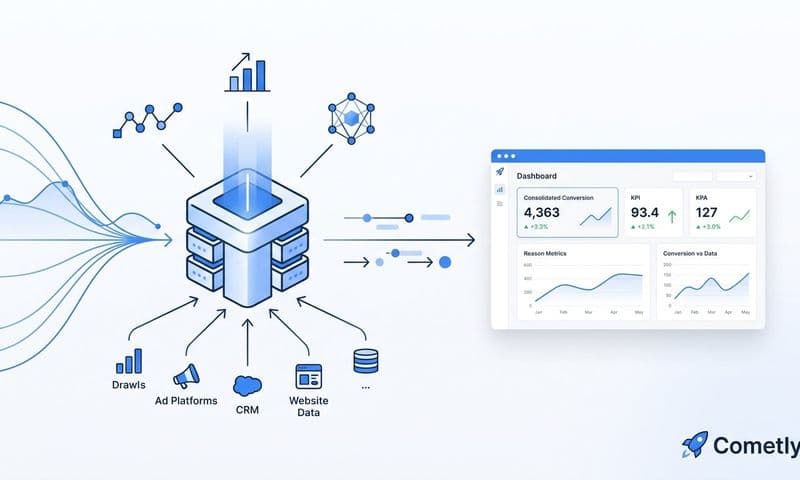
Think of Cometly as the essential data layer that connects your marketing efforts to the ad platforms' learning models. It makes sure the "premium fuel"—clean, complete, and accurate conversion data—is constantly flowing to their algorithms, letting them optimize with real precision.
Delivering the Premium Fuel Ad Platforms Need
The heart of any successful machine learning strategy is a rock-solid stream of conversion data. When ad platforms are starved of good signals because of ad blockers, browser restrictions, or tracking errors, their performance tanks. They start guessing instead of learning.
Cometly cuts through this noise by creating a single source of truth for all your conversion events.
- Server-Side Tracking: It captures every customer action directly from your server, neatly sidestepping the client-side issues that lead to data loss. This guarantees a far more complete and reliable dataset for training your ML models.
- One-Click Conversion Sync: Cometly then feeds this verified, server-side data directly back to the ad platforms. This steady flow of high-quality information is exactly what their algorithms crave to learn faster and make smarter bidding and targeting decisions.
By providing a clean, unified view of what’s actually working, Cometly ensures that your machine learning models aren’t just optimizing for noise. Instead, they’re learning from real, verified customer behavior, which directly translates to a higher return on ad spend.
Turning Complex Data into Actionable Insights
Just collecting perfect data is only half the battle. The real trick is turning that data into clear, actionable strategies you can use to steer your campaigns in the right direction. This is where Cometly's AI-powered features turn raw numbers into a real strategic advantage.
These tools are built to surface the critical insights buried in your attribution data, making it easy to see what your ML models are learning and how you can guide them more effectively. The system doesn't just track results; it helps you make sense of them.
For instance, the platform’s AI can analyze performance across multiple channels, spotting patterns that would be nearly impossible to find manually. You can explore how the Cometly Ads Manager simplifies this process, turning complex attribution data into clear directives for campaign optimization. It lets you fine-tune your strategy based on a complete picture of the customer journey.
At the end of the day, Cometly isn't just another tracking tool. It’s the foundational partner for any business that's serious about making machine learning a core part of its growth engine. It provides the essential infrastructure and intelligent insights needed to move from simply running ads to truly optimizing them with data-driven precision.
Seeing the Real-World Impact of ML in Advertising
Theory is one thing, but seeing machine learning for ads actually deliver tangible results is what it’s all about. This shift from manual dial-turning to automated, predictive optimization isn’t just some passing trend; it’s a fundamental change that’s producing real, measurable gains for businesses everywhere. These success stories move the conversation from abstract ideas to concrete, evidence-based outcomes.
Just look at the real-world applications. E-commerce brands, for instance, are using LTV modeling to justify paying more for customers who are likely to become high-value, long-term shoppers. It’s a strategy that massively boosts their long-term ROAS, taking them way beyond simple first-purchase wins to build sustainable profit.
It's the same story for SaaS companies. They’re using lookalike audiences to find new customers with stunning efficiency. By feeding their ad platforms data on their best enterprise clients, their ML models can pinpoint and target new prospects who share those same valuable traits, cutting customer acquisition costs in a big way.
The Rapidly Growing Market and Its Advantages
This isn't just happening in a few isolated cases; we're talking about a massive market shift. The global machine learning and AI market for commercial use was projected to hit somewhere between $94 billion and $184 billion in 2024-2025, with growth rates topping 30%. This massive investment means the tech behind ML-driven advertising is mature and getting better by the day.
Yet, it’s not so universal that it kills the competitive advantage. While up to 78% of companies say they use AI in some form, many haven't truly operationalized it, leaving a huge window of opportunity for marketers who get it right. You can find more details in these machine learning statistics.
The takeaway is clear: the underlying ecosystem for advanced ad optimization is robust, but a significant gap exists between partial adoption and end-to-end automation. This gap is where a competitive edge is won.
Take Q3 Advisors, for example. They built their strategy on a solid attribution foundation to make smarter, AI-driven decisions. As detailed in a case study on their success, they were able to confidently increase their ad spend by 30%, knowing every dollar was being optimized based on accurate, real-time data. This shows how a strong attribution system like Cometly isn't just a tracking tool—it's the launchpad you need for real-world, ML-powered growth.
Frequently Asked Questions About Machine Learning for Ads
Jumping into machine learning for advertising can feel like learning a new language. You've got questions, and that's a good thing. Let's clear up some of the most common ones so you can move forward with confidence.
What Is the Difference Between AI and Machine Learning in Advertising?
It's easy to use these terms interchangeably, but they aren't the same. Think of it like this: Artificial Intelligence (AI) is the big, overarching goal of making machines smart. It's the whole universe of teaching computers to think, reason, and perform tasks that normally require a human brain.
Machine Learning (ML) is a specific part of that universe. It's the engine that actually gets the job done by teaching computers to find patterns in data and make predictions without being explicitly told what to look for.
In the ad world, it breaks down like this:
- AI might be a high-level concept like a chatbot that answers customer questions on your site.
- Machine Learning is the algorithm behind the scenes, analyzing thousands of past ad campaigns to predict which new creative will get you the most clicks.
So, while you might talk about "AI-powered advertising," it's really the machine learning models doing the heavy lifting.
How Much Data Do I Need to Start Using Machine Learning?
There’s no magic number, but the honest answer is almost always "more than you think." ML models are hungry for data. While you might start to see some basic patterns with a few thousand data points (like purchases or leads), they don't get truly reliable until you're feeding them tens or even hundreds of thousands of conversion events.
But here's the critical part: volume isn't everything.
The real key is data quality and consistency. A clean, accurate dataset of 10,000 conversions is infinitely more valuable than a messy, incomplete dataset of 100,000. This is exactly why getting your attribution foundation right isn't just a suggestion—it's non-negotiable.
Can Machine Learning Completely Replace Human Marketers?
Absolutely not. Machine learning is a phenomenal tool for augmenting what we do, not replacing us. It's brilliant at crunching massive datasets at a speed no human ever could, handling things like real-time bidding or sifting through millions of user profiles to find the perfect audience.
But it’s a tool. It still needs a strategist at the helm.
Human marketers are still essential for:
- Big-picture strategy: Defining the business goals and telling the machine what "success" even looks like.
- Creative genius: Coming up with the ad concepts, the hooks, and the messaging that actually connects with people.
- Human interpretation: Looking at the results and understanding the why. ML can tell you what happened, but a human needs to figure out the story behind it and decide where to pivot next.
Your job isn't going to be taken by AI. But it might be taken by another marketer who knows how to use AI to get better results, faster. Let the machine handle the tactical grunt work so you can focus on the high-level strategy and creative thinking that really moves the needle.
Ready to build the data foundation your machine learning models need to succeed? Cometly provides the accurate, server-side attribution required to train ad platform algorithms effectively. Start your free 14-day trial and see the difference clean data can make.