Running paid ads across Meta, Google, TikTok, and LinkedIn without a solid analytics strategy is like flying blind with your budget. Many marketing teams still rely on platform-reported metrics that often overcount conversions, miss cross-channel interactions, and leave you guessing which campaigns actually generate revenue.
The result? Wasted ad spend, misallocated budgets, and scaling decisions built on incomplete data.
Marketing analytics for paid ads goes far beyond tracking clicks and impressions. It means connecting every touchpoint from the first ad click to the final CRM event so you can see the full picture of what is working and what is draining your budget.
The strategies below are designed for digital marketers and agencies managing multi-platform campaigns who want to move past vanity metrics and start making confident, data-backed decisions. Each strategy builds on the next, taking you from foundational tracking accuracy all the way to AI-powered optimization.
Whether you are spending $5,000 or $500,000 a month on ads, these approaches will help you identify your true top performers, eliminate waste, and scale the campaigns that actually drive revenue.
1. Build a Server-Side Tracking Foundation Before Anything Else
The Challenge It Solves
Browser-based tracking has become increasingly unreliable. Apple's iOS App Tracking Transparency framework, evolving cookie policies, and widespread ad blocker usage mean that a significant portion of your conversions may never get recorded. If your tracking layer has gaps, every decision you make downstream is built on flawed data.
You cannot optimize what you cannot accurately measure, and right now, most browser-based setups are leaving real conversion data on the table.
The Strategy Explained
Server-side tracking sends conversion data directly from your server to the ad platform, completely bypassing the browser. Instead of relying on a pixel firing in someone's browser, the event is captured and transmitted server-to-server. Meta's Conversions API and Google's Enhanced Conversions are both designed around this approach.
This method is far more resilient to privacy restrictions and ad blockers. It gives you a more complete and accurate record of what is actually happening after someone clicks your ad, which is the foundation everything else in your analytics stack depends on. Understanding the challenges of tracking paid ads after iOS updates is critical to appreciating why server-side solutions matter.
Implementation Steps
1. Audit your current tracking setup to identify gaps caused by browser limitations, blocked pixels, or iOS restrictions.
2. Implement server-side event collection using a platform that supports direct API connections to Meta, Google, and other ad networks.
3. Run a parallel period where both browser-based and server-side tracking are active, then compare the data to quantify how many conversions you were previously missing.
4. Transition your primary reporting to server-side data once you have confirmed accuracy and consistency.
Pro Tips
Do not just set it and forget it. Regularly audit your server-side events to confirm they are firing correctly and that your event deduplication logic is working. Duplicate events can inflate conversion counts just as much as missing events deflate them. Tools like Cometly include server-side tracking built directly into the platform, so you get accurate data flowing into your analytics and back to your ad platforms simultaneously.
2. Unify Cross-Platform Data Into a Single Source of Truth
The Challenge It Solves
When you are running campaigns across Meta, Google, TikTok, and LinkedIn at the same time, each platform reports its own attribution. The same customer might click a Meta ad on Monday and a Google ad on Wednesday before converting. Both platforms will claim that conversion. Add up the reported numbers across platforms and your total conversions can look dramatically higher than your actual revenue.
Siloed reporting makes it nearly impossible to understand true cross-channel performance or make intelligent budget decisions. This is one of the core reasons why unreliable marketing performance metrics remain such a persistent problem.
The Strategy Explained
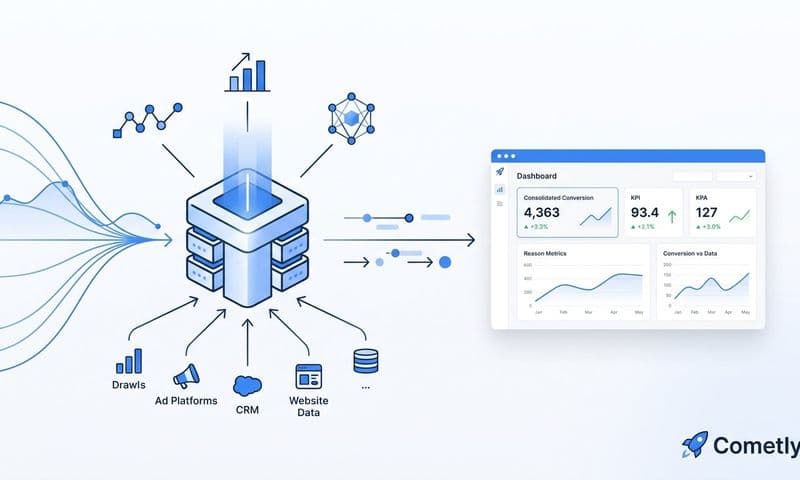
Centralizing your data means pulling every platform's ad data, your website analytics, and your CRM into a single dashboard where you can apply consistent attribution logic across all channels. Instead of comparing apples and oranges across five different platform interfaces, you are working from one unified view.
This is where you can start to see which channels are genuinely driving conversions versus which ones are claiming credit for conversions that originated elsewhere in the funnel.
Implementation Steps
1. Connect all active ad platforms (Meta, Google, TikTok, LinkedIn, etc.) to a centralized analytics platform that pulls data via API.
2. Integrate your CRM so that lead and revenue data flows into the same system alongside your ad data.
3. Apply consistent conversion definitions across all channels so you are comparing like-for-like metrics rather than each platform's proprietary conversion counting.
4. Set up a unified dashboard that shows spend, conversions, cost per acquisition, and revenue across all channels in one view.
Pro Tips
The goal is not just to aggregate data but to eliminate the noise that comes from each platform's self-reported numbers. Platforms like Cometly are built specifically to solve this problem, connecting your ad platforms, CRM, and website so your entire customer journey is visible in one place without the double-counting that inflates platform-native reports.
3. Adopt Multi-Touch Attribution to See the Full Customer Journey
The Challenge It Solves
Last-click attribution gives all the credit to the final touchpoint before a conversion. This model consistently undervalues awareness campaigns, social ads, and any channel that plays a role earlier in the funnel. If your analytics only rewards the last click, you will systematically defund the campaigns that introduce customers to your brand and nurture them toward a decision.
For longer sales cycles with multiple touchpoints, last-click attribution can lead you to cut the very campaigns that are doing the heaviest lifting. Exploring the top attribution tools for paid ads can help you find the right solution for your needs.
The Strategy Explained
Multi-touch attribution distributes conversion credit across every interaction in the customer journey. Depending on the model you choose, you might weight touchpoints equally (linear), give more credit to the first and last interaction (position-based), or use a data-driven model that assigns credit based on actual influence patterns in your data.
The right model depends on your sales cycle length, your channel mix, and how your customers typically discover and evaluate your product or service. The important shift is moving from a binary "this channel gets all the credit" mindset to one that reflects the reality of how customers actually buy.
Implementation Steps
1. Map out your typical customer journey, noting how many touchpoints customers usually have before converting and which channels appear most frequently.
2. Choose an attribution model that aligns with your sales cycle. Longer cycles with many touchpoints often benefit from position-based or data-driven models.
3. Apply your chosen model across your unified data set and compare the results against your current last-click view to see which channels gain or lose credit.
4. Use the new attribution view to inform budget decisions, particularly for upper-funnel channels that may have been undervalued.
Pro Tips
Do not commit to a single attribution model permanently. Run multiple models side by side and look for consistent patterns. When several models agree that a channel is performing well, that is a strong signal. When results vary widely across models, dig deeper into the data before making major budget changes.
4. Feed Enriched Conversion Data Back to Ad Platform Algorithms
The Challenge It Solves
Ad platforms like Meta and Google use machine learning to optimize targeting and bidding. But they can only optimize for the signals you send them. If you are only passing basic pixel events like "Lead" or "Purchase" without revenue values or CRM-verified outcomes, the algorithm is optimizing for surface-level actions that may not correlate with actual business revenue.
The result is that your ad platform AI is working with incomplete information, often driving volume of conversions rather than quality. Understanding why marketing data accuracy matters for growth helps explain the importance of feeding clean signals back to these algorithms.
The Strategy Explained
Closing the loop means syncing enriched conversion data, including verified revenue amounts, lead quality scores, and downstream CRM outcomes, back to your ad platforms. Meta and Google both support offline conversion uploads and API-based event syncing that allows you to pass this richer data back to their algorithms.
When the algorithm knows which clicks actually became paying customers and at what revenue level, it can optimize targeting and bidding toward the audiences and placements most likely to generate real business value, not just clicks or form fills.
Implementation Steps
1. Identify the CRM events that represent genuine business outcomes, such as qualified leads, closed deals, or revenue milestones.
2. Set up a data sync between your CRM and your ad platforms using Meta's Conversions API, Google's offline conversion import, or a platform that handles this automatically.
3. Include revenue values with your conversion events wherever possible so the algorithm can optimize for high-value customers, not just any conversion.
4. Monitor your campaign performance over several weeks after implementation to observe how the algorithm adjusts targeting based on the enriched signals.
Pro Tips
Cometly's Conversion Sync feature is designed exactly for this workflow. It sends enriched, conversion-ready events back to Meta, Google, and other platforms automatically, so your ad platform algorithms are always working from your most accurate and complete data rather than guessing based on incomplete browser signals.
5. Segment Analytics by Audience and Funnel Stage, Not Just Campaign
The Challenge It Solves
Campaign-level reporting tells you how a campaign is performing on average. But averages hide the truth. A campaign might look mediocre overall while containing one audience segment that converts at an exceptional rate and several others that are burning budget. If you only look at the campaign level, you will either scale the whole thing or kill it, and either decision could be wrong.
Hidden winners and losers live inside your campaigns, and you need segment-level visibility to find them.
The Strategy Explained
Segmenting your analytics means breaking performance data down by audience type, funnel stage, device, geography, creative format, and any other dimension that might reveal meaningful differences in behavior. The goal is to identify which specific combinations of audience, message, and context are generating the best outcomes so you can double down on those and pull back from the rest.
This is especially important for multi-platform campaigns where the same audience might behave very differently depending on where they encounter your ad. A unified marketing analytics dashboard makes it far easier to compare these segments across channels in one place.
Implementation Steps
1. Define the key dimensions you want to segment by: audience type (prospecting vs. retargeting), funnel stage (awareness, consideration, conversion), device, and geography at minimum.
2. Ensure your naming conventions and campaign structures are consistent across platforms so you can apply the same segmentation logic everywhere.
3. Build segment-level views in your analytics dashboard that show cost per acquisition and revenue contribution broken down by each dimension.
4. Identify your top-performing segments and create dedicated campaigns or ad sets to give them more budget and creative attention.
Pro Tips
Pay particular attention to device segmentation. Mobile and desktop often show dramatically different conversion rates and cost structures, even for the same audience and creative. If you are not separating these in your analysis, you may be subsidizing poor-performing placements with budget that should be going to your top performers.
6. Use AI-Powered Recommendations to Optimize Budget Allocation
The Challenge It Solves
Managing budget allocation across multiple platforms, campaigns, audiences, and creatives manually is an enormous cognitive load. By the time you have analyzed performance data and made adjustments, the market conditions may have already shifted. Manual optimization at scale is slow, error-prone, and almost always reactive rather than proactive.
The rise of AI marketing analytics is transforming how teams process far more data points simultaneously than any human analyst can, identifying patterns and opportunities that would otherwise go unnoticed.
The Strategy Explained
AI-powered budget optimization uses machine learning to analyze cross-platform performance patterns and surface actionable recommendations for where to shift budget, which campaigns to scale, and which to pause. Rather than waiting for a weekly reporting cycle, these tools can flag opportunities and inefficiencies in near real time.
The key is that AI recommendations are only as good as the data they are trained on. This is why building accurate server-side tracking and a unified data foundation first is so critical. AI working on clean, complete data produces dramatically better recommendations than AI working on fragmented, platform-siloed numbers.
Implementation Steps
1. Ensure your data foundation is solid before relying on AI recommendations. Accurate input data is a prerequisite for meaningful AI output.
2. Implement an analytics platform with built-in AI capabilities that can analyze performance across all your connected channels simultaneously.
3. Review AI recommendations regularly and evaluate them against your own knowledge of campaign context, seasonal factors, and business goals before acting.
4. Track the outcomes of AI-recommended changes so you can build confidence in the recommendations over time and refine how you apply them.
Pro Tips
Cometly's AI Ads Manager and AI Chat features are built for this exact use case. The AI analyzes your cross-platform data and surfaces specific recommendations for budget shifts and bid adjustments, while the chat interface lets you ask natural language questions about your campaign data and get instant answers without building custom reports.
7. Establish a Continuous Testing and Measurement Loop
The Challenge It Solves
Analytics infrastructure is not a one-time setup. Ad platforms update their tracking requirements, privacy regulations evolve, your campaign mix changes, and your customer journey shifts over time. A tracking setup that was accurate six months ago may have silent gaps today. Without a regular audit process, you may not notice data degradation until it has already skewed your decisions for weeks or months.
The marketers who maintain the most reliable data are the ones who treat measurement as an ongoing discipline rather than a project they completed.
The Strategy Explained
A continuous testing and measurement loop means building recurring processes for auditing your tracking accuracy, testing different attribution models against actual revenue, and validating your analytics data against ground-truth business outcomes like CRM records and payment data. Learning more about effective marketing measurement strategies can help you build a more robust framework.
This also includes structured creative and audience testing with proper measurement frameworks so that every test produces learnings you can act on, rather than inconclusive data that just adds noise.
Implementation Steps
1. Schedule monthly tracking audits to verify that all server-side events are firing correctly, deduplication is working, and no new data gaps have appeared.
2. Regularly compare your analytics-reported conversions against your CRM and payment records to identify discrepancies and investigate their source.
3. Run structured A/B tests on creatives, audiences, and landing pages with defined hypotheses, success metrics, and minimum run times before drawing conclusions.
4. Review your attribution model settings quarterly and test alternative models to see if your current choice still reflects how your customers are actually buying.
Pro Tips
Build a simple testing calendar that schedules these audits and reviews in advance. Without a calendar, audits get deprioritized when campaigns are busy, which is exactly when data accuracy matters most. Treat your analytics infrastructure with the same discipline you apply to your creative testing and budget management.
Putting It All Together
These seven strategies do not need to be tackled all at once. The most effective approach is to build from the foundation up.
Start with server-side tracking and unified cross-platform data. These two steps alone will give you a more accurate picture of your paid ad performance than most marketing teams are currently working with. From there, layer in multi-touch attribution to understand which channels are actually contributing to revenue across the full customer journey.
Once your data foundation is solid, set up conversion syncing so your ad platform algorithms are optimizing based on real revenue signals rather than surface-level events. Then move into advanced segmentation to uncover the hidden winners and losers inside your campaigns.
With clean, unified data in place, AI-powered budget recommendations become genuinely powerful. And the continuous testing loop ensures your entire analytics infrastructure stays accurate as platforms, privacy policies, and customer behavior evolve over time.
The marketers and agencies seeing the strongest results from their paid ads treat analytics as an ongoing discipline, not a one-time setup. Every strategy above compounds on the others, and the cumulative effect is a paid media operation that scales with confidence rather than guesswork.
Platforms like Cometly are built specifically for this workflow, connecting your ad platforms, CRM, and website to track every touchpoint, surface AI-driven recommendations, and feed better data back to ad algorithms. It brings together server-side tracking, multi-touch attribution, conversion syncing, and AI-powered analysis in one place so you are not stitching together five different tools to achieve what should be a unified system.
If you are ready to stop guessing and start scaling with confidence, investing in the right marketing analytics infrastructure is the highest-leverage move you can make. Get your free demo today and start capturing every touchpoint to maximize your conversions.