You're staring at your marketing dashboard at 2 AM, trying to figure out why your Facebook ads show a 4x ROAS while Google Analytics claims you're barely breaking even. Meanwhile, your CFO wants proof that the $50K you spent last month actually drove revenue. Sound familiar?
The marketing measurement crisis is real. iOS privacy updates have gutted traditional tracking. Third-party cookies are disappearing. Your customers jump between phones, laptops, and tablets before converting. And every ad platform reports different numbers, each claiming credit for the same conversion.
Here's what's actually happening: most marketers are making million-dollar decisions based on incomplete data. They're scaling campaigns that might be losing money while cutting budgets from their best performers. The old last-click attribution playbook is dead, but most teams haven't adapted.
The good news? While your competitors struggle with attribution chaos, top-performing marketing teams have already cracked the code. They've implemented measurement strategies that cut through the noise, connect every touchpoint to actual revenue, and give them the confidence to scale aggressively.
These seven strategies represent the exact playbook that elite growth teams use to measure what truly drives results. Each addresses a specific measurement challenge with a clear implementation path. Let's dive into the strategies that will transform your marketing measurement from expensive guesswork into a precision growth engine.
1. Establish Unified Customer Identity Resolution
Customer identity resolution is the foundation that makes all other measurement strategies possible. Without it, you're trying to measure marketing performance while treating the same customer as five different people across their laptop, phone, tablet, work computer, and home browser. This fragmentation doesn't just skew your numbers—it makes accurate attribution mathematically impossible.
The core problem: your analytics platform sees anonymous visitor sessions, not actual customers. When someone visits your site on Monday from their phone, clicks an ad on Tuesday from their laptop, and converts on Wednesday from their tablet, most systems count that as three separate users with three disconnected journeys. You can't calculate accurate lifetime value, understand true customer journeys, or attribute conversions correctly when your data treats one customer as multiple entities.
How Identity Resolution Actually Works
Customer identity resolution connects the dots between anonymous sessions and known customer profiles. The strategy involves two complementary approaches working together:
Deterministic Matching: This uses exact identifiers like email addresses, phone numbers, or customer IDs to definitively link sessions. When someone logs into your site or fills out a form, you capture their email and connect all future sessions from that device to their profile. This method is 100% accurate but only works after you've collected an identifier.
Probabilistic Matching: This uses behavioral signals and device characteristics to infer when different sessions likely belong to the same person. Factors like IP address, browser fingerprint, usage patterns, and timing help connect sessions with high confidence even before you know who the user is.
The magic happens when you combine both approaches. You start with probabilistic matching to track anonymous behavior, then use deterministic matching to retroactively connect those anonymous sessions to a known customer profile once they identify themselves.
Building Your Identity Resolution System
Start by implementing progressive profiling to capture customer identifiers early in the journey. Instead of demanding full registration upfront, collect email addresses through valuable content offers, newsletter signups, or account creation for saved preferences. The goal is getting that first identifier as early as possible so you can start building the unified profile.
Configure your analytics platform to use customer identifiers as the primary key for tracking. Most modern platforms support custom user IDs that persist across devices and sessions. When someone logs in or provides their email, you pass that identifier to your analytics tool, which then merges all their previous anonymous sessions into a single customer profile.
Set up cross-device tracking by implementing consistent identifier passing across all your properties. Your website, mobile app, email campaigns, and any other touchpoints should all recognize the same customer and update their unified profile. This requires coordination between your marketing tools, but it's essential for complete journey visibility.
We compare the leading options in our marketing dashboard software comparison roundup.
Create customer journey reports that show the complete cross-device path to conversion. Instead of seeing fragmented sessions, you'll see how customers actually behave—discovering your brand on mobile during their commute, researching on desktop at work, and converting on tablet at home. This complete view reveals optimization opportunities invisible in device-siloed data.
The Measurement Transformation
Identity resolution fundamentally changes what you can measure and optimize. With unified customer profiles, you can calculate accurate lifetime value by connecting all purchases to the same customer, even when they occur across different devices or sessions. This enables value-based optimization where you bid more aggressively for customers likely to generate higher lifetime value.
Your attribution becomes dramatically more accurate because you're measuring actual customer journeys instead of fragmented sessions. That "new customer" who converted from a retargeting ad might actually be someone who first discovered you through organic search three weeks ago on a different device. Identity resolution reveals the true first touchpoint and all the interactions in between.
You can segment and target based on complete behavioral history. Instead of treating mobile and desktop visitors as separate audiences, you recognize them as the same customers with consistent preferences and behaviors. This enables sophisticated targeting strategies that improve campaign performance across all channels.
2. Create Revenue-Based Performance Metrics
Traditional marketing metrics focus on activities—clicks, impressions, conversions—but these numbers don't tell you whether your marketing actually drives profitable growth. You might celebrate a campaign with a 5% conversion rate while ignoring that those customers churn within 30 days. Meanwhile, a seemingly "expensive" campaign with a 2% conversion rate could be attracting customers who stick around for years and refer others.
For a deeper dive into this space, see our marketing dashboard software guide.
The fundamental shift to revenue-based measurement means connecting every marketing activity directly to actual dollars generated, then optimizing for business outcomes rather than marketing department vanity metrics. This approach transforms how you evaluate channel performance, allocate budgets, and make strategic decisions about where to invest your next dollar.
Why Revenue Metrics Change Everything
When you optimize for conversions alone, you're essentially treating all customers as equal. But your business reality tells a different story. Some customers generate 10x more lifetime value than others. Some channels attract high-intent buyers ready to purchase premium products, while others bring bargain hunters who never buy again.
Revenue-based measurement exposes these differences immediately. Instead of celebrating "cheap" conversions, you start asking: Which channels drive customers who actually spend money? Which campaigns attract buyers who stick around? Which audiences generate profitable growth versus just activity?
This shift in perspective often reveals uncomfortable truths. Your highest-converting landing page might attract low-value customers. Your "expensive" prospecting campaigns might be the only thing driving sustainable growth. Your retargeting campaigns might be taking credit for purchases that would have happened anyway.
Building Your Revenue Measurement Framework
Connect Marketing to Revenue Systems: The foundation of revenue-based measurement is integrating your marketing analytics with systems that track actual money. This means connecting your attribution software to your CRM, payment processor, subscription management system, and customer database. You need to see not just who converted, but what they purchased, how much they spent, and whether they're still customers.
Calculate True Customer Lifetime Value: Customer lifetime value (CLV) is the total revenue a customer generates over their entire relationship with your business. For subscription businesses, this includes all monthly payments until churn. For e-commerce, it includes repeat purchases and average order values. For B2B, it includes expansion revenue and contract renewals. Track CLV by acquisition channel to understand which marketing sources drive the most valuable customers.
Implement Profit-Based ROAS Calculations: Return on ad spend (ROAS) typically divides revenue by ad spend, but this ignores your actual profit margins. A 3x ROAS sounds great until you realize your product costs 60% of the sale price, leaving you with negative margins after accounting for customer acquisition costs. Calculate profit-based ROAS using your actual margins: (Revenue × Profit Margin - Ad Spend) / Ad Spend. This shows whether campaigns actually drive profitable growth.
Track Revenue Per Visitor by Channel: This metric reveals channel quality beyond conversion rates. Calculate total revenue generated divided by total visitors from each channel. A channel with a 2% conversion rate but $50 average order value and high repeat purchase rates might generate more revenue per visitor than a channel with a 5% conversion rate but $20 average order value and zero repeat purchases.
Measure Customer Payback Period: How long does it take for a customer to generate enough profit to cover their acquisition cost? This metric is critical for cash flow planning and budget allocation. Channels with 30-day payback periods can be scaled aggressively, while channels with 180-day payback periods require more careful management and sufficient working capital.
Advanced Revenue Optimization Strategies
Once you have revenue data flowing into your attribution system, you can optimize campaigns based on actual business impact rather than proxy metrics. Many platforms now support value-based optimization, where you feed customer lifetime value data back to ad platforms so their algorithms can target users similar to your highest-value customers.
3. Deploy AI-Powered Attribution and Optimization
Modern marketing measurement has evolved beyond simple conversion tracking—you need systems that can automatically analyze complex customer journeys, identify optimization opportunities, and provide actionable recommendations faster than human analysis allows. This is where AI-powered attribution transforms measurement from a reporting exercise into a strategic advantage.
The challenge is straightforward: as your marketing grows more sophisticated, manual analysis becomes impossible. When you're tracking dozens of touchpoints across multiple platforms, analyzing thousands of customer journeys, and trying to identify which combinations drive the best results, human analysis simply can't process the data volume or spot patterns quickly enough to capitalize on opportunities.
How AI Attribution Works
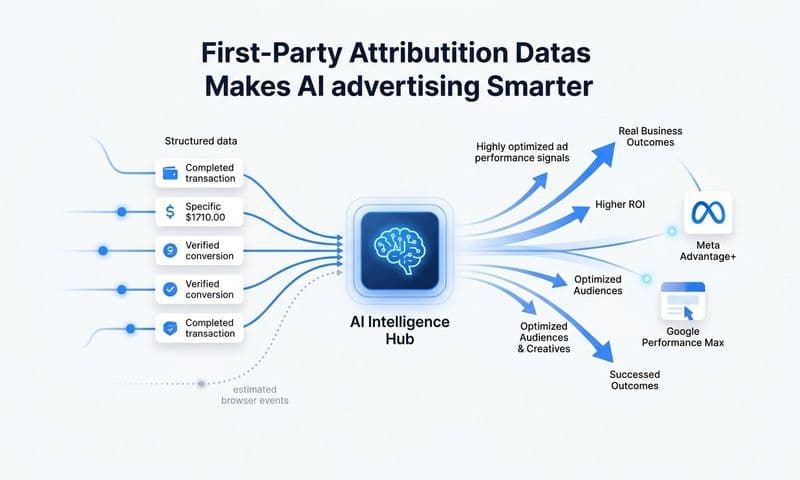
AI-powered attribution uses machine learning algorithms to analyze every customer journey in your database, identifying patterns that predict conversion probability. Unlike traditional rule-based attribution models that apply the same logic to every journey, AI models learn from your actual data to understand which touchpoint sequences drive the highest conversion rates and customer value.
The system processes millions of data points—ad impressions, clicks, website visits, email opens, content downloads, and conversions—to build predictive models. These models then analyze new customer journeys in real-time, scoring touchpoint effectiveness and providing specific optimization recommendations based on what's actually working in your marketing ecosystem.
Modern AI attribution platforms go beyond simple journey analysis. They identify channel synergies, predict which audiences are most likely to convert, recommend budget reallocation opportunities, and even suggest creative or messaging adjustments based on performance patterns across similar customer segments.
Implementation Strategy
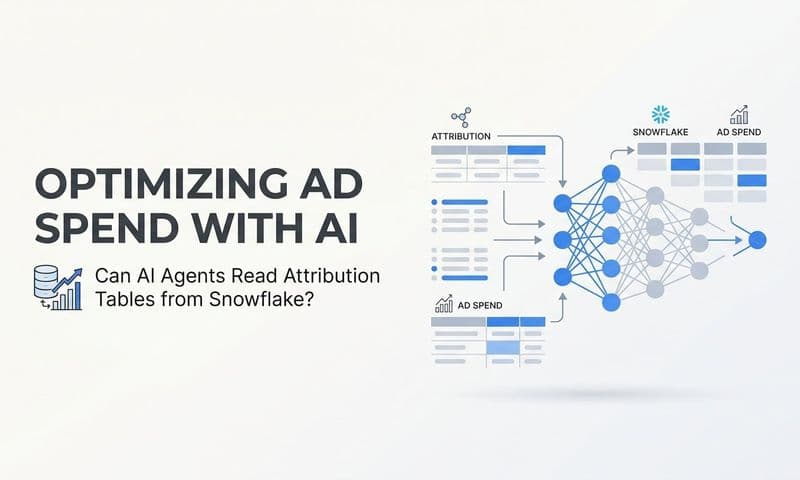
Start by ensuring your AI attribution platform receives complete data from all marketing touchpoints. This means integrating your ad platforms, website analytics, CRM, email marketing tools, and any other customer interaction systems. The AI models need comprehensive journey data to identify meaningful patterns.
Configure your machine learning models to align with your business objectives. If you're optimizing for customer lifetime value rather than just conversions, ensure the AI weighs touchpoints based on their influence on high-value customers. For B2B companies, configure models to recognize the importance of specific content types or sales interactions in the journey.
Set up automated reporting that surfaces AI-generated insights daily or weekly. The goal isn't drowning in data—it's receiving specific, actionable recommendations like "Increase budget 15% on Campaign X based on predicted conversion lift" or "Audience segment Y shows 3x higher conversion rate when exposed to both social and search touchpoints."
Use AI insights as starting points for strategic testing rather than blindly following every recommendation. The most effective approach combines AI pattern recognition with human strategic thinking—let the AI identify opportunities, then validate through controlled testing before making major budget shifts.
Real-World Application
Performance marketing teams using AI attribution often discover unexpected channel synergies that manual analysis would miss. The AI might identify that customers who see your social media ads followed by specific search queries convert at significantly higher rates than those who interact with either channel alone. This insight enables sophisticated cross-channel optimization strategies that maximize the combined impact of your marketing mix.
The predictive capabilities become particularly valuable for audience targeting. AI models can analyze which customer characteristics and behavioral patterns predict high lifetime value, then recommend lookalike audiences or targeting parameters that focus your budget on the most profitable customer segments.
Many teams also use AI attribution to optimize creative and messaging strategies. By analyzing which ad creative combinations perform best for different audience segments and journey stages, the AI can recommend specific creative approaches for different campaigns—insights that would take weeks of manual analysis to uncover.
Critical Success Factors
Data Volume Requirements: AI models need sufficient data to identify reliable patterns. Generally, you need at least 1,000 conversions per month for basic AI attribution, with 5,000+ monthly conversions enabling more sophisticated predictive modeling. Below these thresholds, traditional rule-based attribution models may provide more reliable insights than AI-powered systems.
4. Establish Cross-Platform Data Integration and Reporting
Marketing data accuracy isn't just about having tracking in place—it's about knowing whether that tracking actually captures reality. The gap between what your analytics tools report and what's really happening can cost you thousands in misallocated budget. Browser-based tracking might show 1,000 conversions while your server records 1,400 actual purchases. That 400-conversion blind spot leads to systematically undervaluing your best campaigns.
Testing data accuracy by comparing server-side versus browser-based metrics reveals the truth about your measurement infrastructure. This validation process shows you exactly where tracking breaks down, which customer segments you're missing, and how much data loss you're experiencing across different platforms and devices.
Why Data Accuracy Testing Matters for Attribution
When browser-based tracking misses 30-40% of conversions due to ad blockers, privacy settings, and iOS restrictions, your attribution models work with incomplete data. You're essentially making budget decisions based on a skewed sample that over-represents trackable users while ignoring privacy-conscious customers.
The discrepancy between server-side and browser-based metrics tells you which channels serve customers who use ad blockers or privacy tools. If your Facebook campaigns show dramatically higher conversions in server-side tracking compared to pixel tracking, you're likely reaching a privacy-conscious audience that your browser-based attribution completely misses.
This insight changes everything about how you evaluate channel performance. A campaign that looks mediocre in Google Analytics might be your top performer when measured with complete server-side data.
Setting Up Your Data Accuracy Comparison
Start by implementing parallel tracking systems. Run both browser-based pixels and server-side conversion tracking simultaneously for the same events. This dual-tracking approach lets you directly compare what each system captures.
Configure your server-side tracking to fire conversion events from your backend systems—your CRM, order database, or payment processor. These server-side events represent ground truth because they capture actual business outcomes regardless of browser limitations.
Set up your comparison reporting to show conversion counts from three sources: browser-based tracking (Google Analytics, platform pixels), server-side tracking (Conversion API, server-side tag manager), and your actual business system records (CRM, database). The differences between these numbers reveal your data accuracy gaps.
Analyzing the Discrepancies
Look for patterns in where data loss occurs. Break down your comparison by traffic source, device type, browser, and geographic region. You'll often discover that iOS traffic shows 40-50% more conversions in server-side tracking compared to browser tracking, while desktop traffic shows minimal discrepancy.
Examine conversion timing differences. Browser-based tracking might miss conversions that happen after users close their browser or switch devices. Server-side tracking captures these delayed conversions because it fires based on actual purchase completion rather than page load events.
Calculate your data capture rate by dividing browser-tracked conversions by server-tracked conversions. If you're only capturing 70% of actual conversions through browser tracking, you're making decisions based on incomplete information that systematically undervalues certain channels and customer segments.
Using Accuracy Insights to Improve Attribution
Once you understand your data accuracy gaps, adjust your attribution models to account for systematic undercounting. If server-side tracking shows 30% more conversions than browser tracking, your current attribution likely undervalues all channels proportionally—but especially those serving privacy-conscious users.
Prioritize server-side data as your source of truth for budget allocation decisions. When browser-based and server-side metrics conflict, trust the server-side data because it captures actual business outcomes rather than trackable browser events.
Feed your complete server-side conversion data back to ad platforms through Conversion APIs. This gives platform algorithms access to the full conversion picture, enabling better optimization and audience targeting based on complete data rather than the limited subset that browser tracking captures.
Putting It All Together
These seven strategies aren't just theoretical frameworks—they're the exact measurement infrastructure that separates guessing from knowing. The brands scaling profitably right now have implemented server-side tracking to capture complete data, built multi-touch attribution that reflects actual customer journeys, and deployed AI-powered optimization that spots opportunities human analysis would miss.
Start with the foundation: unified customer identity resolution and server-side tracking give you clean, complete data to work with. Then layer on revenue-based metrics and multi-touch attribution to understand what actually drives profitable growth. Finally, add incrementality testing and AI-powered optimization to continuously improve your measurement accuracy and campaign performance.
The measurement gap between your team and your competitors compounds over time. Every day you operate with incomplete attribution is another day of budget flowing to the wrong campaigns while your best performers stay underfunded. The good news? Modern attribution platforms like Cometly handle the technical complexity of implementing these strategies, connecting your ad platforms, CRM, and analytics into a single source of truth that tracks every touchpoint and ties it directly to revenue.
Ready to stop guessing and start knowing exactly which campaigns drive your growth? Get your free demo and see how Cometly's AI-powered attribution platform implements these seven strategies to give you complete visibility into what's actually working—so you can scale with confidence instead of hope.