Your data warehouse holds millions of customer records. Purchase histories. Behavioral patterns. Lifetime value calculations. Engagement scores. All the insights your marketing team needs to run smarter campaigns.
And none of it can reach your ad platforms.
This is the reality for most marketing teams today. You've invested in building a sophisticated data infrastructure—Snowflake, BigQuery, Redshift—that centralizes everything you know about your customers. Your analytics team can query it. Your data scientists can model it. But when it comes time to actually use those insights in Meta Ads Manager or Google Ads? You're back to manual CSV exports and hoping the data isn't stale by the time it uploads.
This is where reverse ETL changes everything. It's the bridge that finally connects your analytical insights to your execution platforms, transforming your data warehouse from a reporting tool into an activation engine. For marketing teams tired of the gap between what they know and what they can do, reverse ETL represents a fundamental shift in how data powers campaigns.
The Data Activation Gap Every Marketing Team Faces
Traditional ETL (Extract, Transform, Load) has always been a one-way street. It pulls data from various sources—your website, CRM, ad platforms, email tools—and centralizes it in your data warehouse for analysis. This works beautifully for reporting and business intelligence. Your team can run complex queries, build dashboards, and uncover insights about customer behavior.
But here's where the system breaks down: those insights stay trapped in the warehouse.
Let's say your analytics team identifies a segment of customers who made their first purchase six months ago, have an average order value above $200, and haven't returned since. This is exactly the audience you want to target with a win-back campaign. In your warehouse, you can see them clearly. But getting that list into Meta Ads Manager? That requires someone to export a CSV, format it correctly, manually upload it, and hope nothing breaks in the process.
By the time you execute, the data is already outdated. Customers who should be added to the segment aren't included. Customers who should be removed are still there. The whole process needs to be repeated manually whenever you want to refresh the audience.
This is the data activation gap—the frustrating disconnect between analytical capability and operational execution. Your warehouse knows everything about your customers, but your marketing tools remain blind to those insights. Understanding data analytics and marketing integration is essential to bridging this divide.
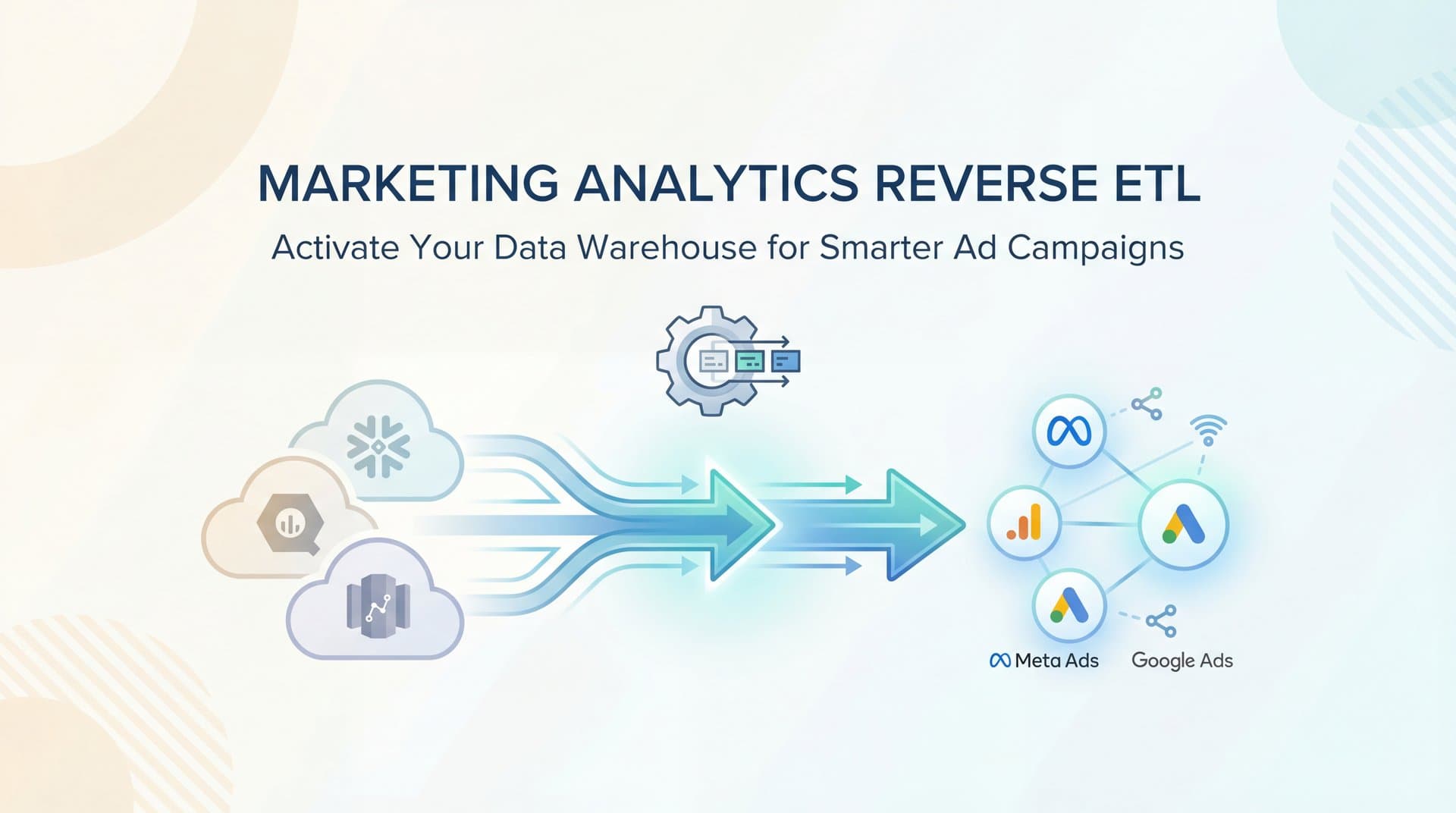
Reverse ETL solves this by creating a two-way street. Instead of data only flowing INTO your warehouse, reverse ETL pushes data OUT to the operational tools where marketing actually happens. It automates the sync process, keeps audiences fresh, and eliminates the manual work that bottlenecks campaign execution.
Think of it as the missing piece that turns your data warehouse from a passive repository into an active participant in your marketing stack. The insights you've been generating? They can now flow directly into campaign targeting, CRM enrichment, and ad platform optimization—automatically and continuously.
How Reverse ETL Actually Works for Marketing Teams
The technical flow of reverse ETL is straightforward, but understanding it helps you see why it's so powerful for marketing operations.
It starts in your data warehouse—Snowflake, BigQuery, Redshift, or whatever system centralizes your customer data. This is where you've already consolidated information from multiple sources: purchase history from your e-commerce platform, engagement data from your website, customer service interactions from your CRM, and campaign performance from your ad platforms.
The reverse ETL tool sits between your warehouse and your destination platforms. You define what data should flow where by writing SQL queries or using visual segment builders. For example, you might create a query that identifies customers who've spent more than $500 in the last 90 days but haven't made a purchase in the last 30 days. This becomes your win-back audience.
Once you've defined your segment or data sync, the reverse ETL tool handles the execution. It runs your query on a schedule—hourly, daily, or in real-time depending on your needs—and automatically syncs the results to your chosen destinations. That win-back audience flows directly into Meta Ads Manager as a custom audience. No CSV exports. No manual uploads. No data engineering required.
The tool also handles the technical complexities of destination APIs. Each marketing platform has its own data format requirements and API specifications. Meta wants data structured one way. Google Ads expects something different. Your CRM has its own field mappings. The reverse ETL tool manages all these transformations automatically, translating your warehouse data into the format each destination expects.
Sync schedules matter more than you might think. Real-time syncing means audiences update as customer behavior changes, keeping your targeting precise. Batch syncing—running updates once or twice daily—works well for audiences that don't need constant refreshing. Many marketing analytics platforms offer real-time conversion capabilities that make this process seamless.
This contrasts sharply with traditional methods. Manual CSV uploads require someone to remember to export data, format it correctly, and upload it to each platform individually. API scripts that your engineering team might build are fragile—they break when platforms change their APIs, require ongoing maintenance, and create dependencies on technical resources that marketing teams often lack.
Reverse ETL automates all of this. It's like having a data engineer on your team whose only job is keeping your marketing tools synchronized with your warehouse insights—except it works 24/7, never makes mistakes, and doesn't require ongoing technical management.
The result? Your marketing team can focus on strategy and creative execution instead of data plumbing. Your audiences stay fresh. Your targeting improves. And the gap between what you know and what you can do finally closes.
Five High-Impact Use Cases for Marketing Analytics
Understanding how reverse ETL works is one thing. Seeing where it creates real marketing value is what matters. Here are the use cases where marketing teams see the biggest impact.
Dynamic Audience Segmentation Based on Purchase Behavior: Your warehouse contains the complete purchase history for every customer—what they bought, when they bought it, how much they spent, and how frequently they return. This data can power sophisticated audience segments that go far beyond what ad platforms can build on their own. You can create segments like "customers who purchased Product A but never Product B" or "high-LTV customers who haven't purchased in 60 days." These audiences sync automatically to your ad platforms, letting you run highly targeted campaigns with messaging tailored to each segment's specific behavior patterns.
Offline Conversion Tracking for Algorithm Optimization: Ad platforms like Meta and Google rely on conversion signals to optimize their algorithms. The more conversion data they receive, the better they can identify which audiences and placements drive results. But many conversions happen offline or in systems the ad platforms can't see directly—phone calls, in-store purchases, CRM deal closures, or subscription renewals. Reverse ETL lets you push these offline conversions back to ad platforms, feeding their optimization algorithms with the complete picture of what's actually driving revenue. Proper marketing attribution analytics ensures these signals are accurate and actionable.
CRM Enrichment with Behavioral Analytics: Your CRM knows basic information about leads and customers—contact details, company name, deal stage. But your warehouse knows how they actually behave—which pages they visit, which content they engage with, how they interact with your product, and what their usage patterns look like. Reverse ETL can enrich CRM records with this behavioral data, giving sales teams context they wouldn't have otherwise. A sales rep can see that a lead has visited your pricing page five times in the last week, or that a customer's product usage has dropped significantly in the last month. This context transforms generic outreach into personalized conversations based on actual behavior.
Suppression Lists to Prevent Wasted Ad Spend: Nothing frustrates customers more than seeing ads for products they already own. And nothing frustrates marketers more than paying to advertise to people who've already converted. Your warehouse knows exactly who your current customers are, which products they own, and which subscriptions they maintain. Reverse ETL can automatically sync suppression lists to your ad platforms, ensuring acquisition campaigns exclude existing customers and product-specific campaigns only target people who don't already own that product. This prevents wasted spend and improves customer experience simultaneously.
Lookalike Audience Creation Based on True Value Metrics: Ad platforms offer lookalike audience features, but they're only as good as the seed audiences you provide. Most marketers use basic signals—website visitors or all purchasers—to build lookalikes. But your warehouse lets you identify your most valuable customers based on actual lifetime value, retention rates, and profitability. You can create seed audiences of your top 5% of customers by LTV, then use reverse ETL to sync these segments to ad platforms for lookalike modeling. The result? Lookalike audiences built on value, not just volume, helping you find more of the customers who actually matter to your business.
Each of these use cases shares a common thread: they leverage the rich, complete customer data in your warehouse to make your marketing execution smarter and more precise. The insights you've been generating finally become actionable across every touchpoint where you reach customers.
Choosing the Right Approach: Build, Buy, or Integrate
Once you understand the value of reverse ETL for marketing, the next question becomes: how do you actually implement it? You have three main options, each with different tradeoffs.
Standalone reverse ETL tools like Census, Hightouch, and Polytomic specialize in data activation. They offer broad destination support, flexible data transformation capabilities, and user-friendly interfaces that let marketing teams manage syncs without constant engineering help. These tools excel when you need to sync data to many different destinations or have complex transformation requirements. The downside? They're another tool in your stack, with its own learning curve, integration requirements, and subscription cost. A thorough marketing analytics platform comparison can help you evaluate these options.
Building your own reverse ETL system is the path some engineering-heavy organizations take. You write custom scripts that query your warehouse and push data to destination APIs on a schedule. This gives you complete control and eliminates vendor costs. But it requires ongoing engineering resources to build, maintain, and troubleshoot. When ad platform APIs change—and they do frequently—your scripts break until someone fixes them. For most marketing teams, this approach creates more problems than it solves.
The third option is increasingly common: using marketing platforms that build data activation capabilities directly into their core functionality. Attribution platforms like Cometly, for example, inherently solve part of the reverse ETL challenge by tracking conversions and syncing that data back to ad platforms through features like Conversion Sync. This approach reduces tool sprawl by combining attribution tracking with data activation in a single platform.
When evaluating your options, consider these key criteria. Sync frequency matters if you need real-time audience updates versus daily batch processing. Destination support is critical—make sure the solution connects to all the platforms you actually use. Data transformation capabilities determine whether you can manipulate data before syncing or need to handle transformations in your warehouse first. Ease of use affects whether your marketing team can manage syncs independently or needs constant engineering support.
Marketing teams often benefit most from solutions that combine attribution with data activation rather than managing separate tools for each function. When your attribution platform can already track the full customer journey and sync conversion data back to ad platforms, you're solving the most critical reverse ETL use case—feeding platforms better signals for optimization—without adding another vendor to your stack. Exploring enterprise marketing data analytics software options can reveal integrated solutions that fit your needs.
The right choice depends on your specific situation. If you need to sync data to dozens of different destinations with complex transformations, a standalone reverse ETL tool might make sense. If your primary goal is improving ad platform optimization with better conversion data, a unified attribution and activation platform eliminates complexity while solving the core problem.
Implementation Roadmap: From Data Warehouse to Campaign Impact
Knowing what reverse ETL can do is different from actually implementing it successfully. Here's how to move from concept to execution without getting overwhelmed.
Start with a Data Audit: Before syncing anything, understand what data you actually have and where it lives. Map out your data sources—which systems feed your warehouse, what customer attributes you're capturing, and how fresh the data is. Identify gaps where important information isn't being collected or isn't making it into your warehouse. You can't activate data you don't have, so this audit reveals both opportunities and limitations.
Identify Your Highest-Impact Use Case: Don't try to implement everything at once. Pick the single use case that will drive the most value for your team right now. If you're struggling with ad platform optimization, start with offline conversion syncing. If audience targeting is your biggest challenge, begin with dynamic segmentation based on purchase behavior. Starting small lets you prove value quickly and learn the system before expanding to more complex use cases.
Define Your Segments and Sync Logic: For your chosen use case, clearly define what data needs to flow where. Write the SQL queries or segment definitions that identify your target audiences. Specify how often syncs should run—real-time, hourly, or daily. Determine what happens when records are added, updated, or removed from your segments. This planning phase prevents issues later when you're trying to troubleshoot why syncs aren't working as expected.
Test with Small Audiences First: Don't immediately sync your entire customer database to production ad campaigns. Create test audiences with a small subset of records to verify that data flows correctly, formats match destination requirements, and syncs complete successfully. Run test campaigns with these audiences to confirm everything works end-to-end before scaling up. This approach catches configuration issues before they impact real campaign performance.
Monitor Data Quality Continuously: Bad data in your warehouse becomes bad data in your marketing tools. Watch for issues like duplicate records, missing required fields, or data that doesn't match destination platform requirements. Set up alerts for sync failures or unusual changes in audience sizes. Data quality problems compound quickly if you're not catching them early. Understanding marketing analytics data best practices helps maintain integrity throughout the process.
Avoid Common Pitfalls: Over-syncing is a frequent mistake—refreshing audiences more often than necessary creates unnecessary processing load and can hit API rate limits. Under-syncing means your audiences get stale and targeting becomes less effective. Find the right balance for each use case. Privacy compliance is another critical consideration. Make sure you have proper consent and legal basis for syncing customer data to third-party platforms, especially when dealing with PII. GDPR and CCPA requirements apply to data activation just as they do to data collection.
Measure Success with Marketing Metrics: Track the actual business impact of your reverse ETL implementation. Are your ROAS and conversion rates improving? Are audience match rates increasing when you sync richer customer data? Are ad platforms showing better performance as they receive more conversion signals? Knowing marketing analytics metrics to monitor ensures you're measuring what matters. If you're not seeing impact, revisit your use cases and segment definitions—you might be syncing the wrong data or targeting the wrong opportunities.
Implementation is iterative. Your first use case teaches you how the system works. Your second use case goes faster. By the third, you're identifying opportunities proactively and building syncs that drive measurable results. The key is starting with focus, learning from each implementation, and expanding strategically based on what creates real marketing value.
Putting It All Together: Your Data-Driven Marketing Stack
Reverse ETL isn't a standalone solution—it's a critical piece of your modern marketing analytics ecosystem. Understanding how it fits alongside other tools helps you build a stack that actually works together instead of creating more silos.
Your data warehouse remains the foundation, centralizing customer data from every source. Attribution platforms track how customers interact with your marketing across all touchpoints. Reverse ETL—whether through standalone tools or built into your attribution platform—activates that data back into operational systems. Your ad platforms, CRM, and marketing automation tools receive the insights they need to execute smarter campaigns.
The teams winning today aren't just collecting data. They're not even just analyzing it. They're activating it across every touchpoint where they reach customers. This creates a flywheel effect: better data leads to better targeting, which generates better results, which creates more data to activate, which improves targeting further. Each cycle compounds the advantage. Learning how to use data analytics in marketing effectively is what separates high-performing teams from the rest.
This is where the competitive gap opens up. Marketing teams stuck in the old model—analyzing data in one place, executing campaigns in another, manually bridging the gap—simply can't move as fast or target as precisely as teams who've closed this loop. The difference shows up in ROAS, customer acquisition costs, and ultimately in business growth.
The good news? You don't need to build this entire infrastructure from scratch. Modern platforms are increasingly solving multiple pieces of this puzzle in integrated ways. When your attribution platform can track the full customer journey, feed conversion data back to ad platforms, and help you understand which touchpoints actually drive revenue, you're solving the core data activation challenge without managing multiple disconnected tools. Exploring the best digital marketing analytics tools can help you identify solutions that combine these capabilities.
The Data Activation Advantage Is Yours to Take
Reverse ETL represents a fundamental shift in how marketing teams leverage their data investments. The days of insights trapped in warehouses while campaigns run blind are ending. The teams who recognize this early and build data activation into their operations are creating advantages that compound over time.
Your warehouse already contains the insights you need to run smarter campaigns. The question is whether you can activate those insights where they matter—in your ad platforms, your CRM, your marketing automation tools. Every day you wait is another day of running campaigns with one hand tied behind your back.
This is exactly why Cometly combines attribution tracking with data activation capabilities. When you can track every touchpoint in the customer journey AND feed that conversion data back to ad platforms through Conversion Sync, you're solving the most critical reverse ETL use case without adding complexity to your stack. You get the attribution insights that show you what's working, plus the activation capabilities that help ad platforms optimize better—all in one platform.
The marketing teams pulling ahead aren't just measuring performance. They're closing the loop between insights and execution, feeding their ad platforms the signals they need to find better customers, and activating their data warehouse insights across every channel. This is how modern marketing operates when data flows freely instead of getting trapped in silos.
Ready to elevate your marketing game with precision and confidence? Discover how Cometly's AI-driven recommendations can transform your ad strategy—Get your free demo today and start capturing every touchpoint to maximize your conversions.