You've spent the last hour navigating vendor websites, filling out contact forms, and dodging vague "contact us for pricing" buttons. All you wanted was a straightforward answer to a simple question: how much does marketing analytics software actually cost? Instead, you're stuck in a cycle of scheduled calls, custom quotes, and pricing tiers that seem designed to confuse rather than clarify.
Getting a marketing analytics software quote doesn't have to feel like pulling teeth. The reality is that pricing varies widely because these platforms solve vastly different problems at different scales. Some marketers need basic dashboard reporting. Others require sophisticated multi-touch attribution across dozens of channels, server-side tracking to overcome iOS limitations, and AI-powered optimization recommendations.
This guide cuts through the confusion. We'll walk you through exactly what drives pricing differences, which features actually matter for your business, the critical questions to ask vendors, and how to evaluate quotes beyond the bottom-line number. By the end, you'll approach vendor conversations with confidence, knowing exactly what you need and what you should expect to pay for it.
What Actually Drives Marketing Analytics Software Pricing
Marketing analytics software pricing isn't arbitrary. Vendors structure costs around specific factors that directly impact the resources required to serve your account. Understanding these drivers helps you make sense of why one platform quotes $500 per month while another starts at $5,000.
Data Volume and Event Tracking: The amount of data you need to process fundamentally shapes pricing. If you're tracking 10,000 monthly website visitors with basic page views, that's a completely different infrastructure requirement than tracking 500,000 visitors with detailed event-level data across multiple touchpoints. Many platforms price based on monthly tracked users (MTUs) or events processed. As your traffic grows, expect costs to scale accordingly.
Number of Connected Platforms: Connecting three ad platforms is straightforward. Connecting fifteen platforms—Meta, Google, TikTok, LinkedIn, Microsoft, Pinterest, plus your CRM, email platform, and analytics tools—requires robust integration infrastructure. Each additional connection adds complexity to data normalization, attribution modeling, and reporting. Platforms that offer unlimited integrations typically charge more upfront but provide better value as your marketing stack expands.
Team Size and User Access: Some tools charge per user seat. If you have a lean team of two marketers, per-user pricing might work in your favor. But if you're running an agency managing multiple client accounts or have a team of ten people who need access, those seat fees add up quickly. Look for platforms that offer role-based access without punitive per-user charges.
Attribution Complexity: Here's where pricing gets interesting. Basic last-click attribution requires minimal computational power. Multi-touch attribution models that analyze every touchpoint across weeks or months of customer journeys? That demands serious processing capabilities and sophisticated algorithms. If you need to compare first-click, linear, time-decay, and position-based models simultaneously, expect to pay for that analytical depth.
Self-Serve Versus Enterprise Solutions: Transparent, self-serve pricing typically indicates standardized features and automated onboarding. You sign up, connect your accounts, and start tracking. Enterprise solutions with custom quotes usually include dedicated implementation support, custom integrations, white-glove onboarding, and features tailored to complex organizational needs. Neither approach is inherently better—it depends on your technical capabilities and support requirements.
The gap between basic analytics and comprehensive attribution platforms can range from a few hundred dollars monthly to five figures. The key is matching your actual requirements to the right pricing tier rather than overpaying for features you'll never use or underpaying for a solution that can't scale with your needs.
Features That Actually Matter Before You Request a Quote
Walking into vendor conversations without clarity on your feature requirements is like grocery shopping while hungry. You'll end up with things you don't need and miss essentials. Let's break down what truly matters versus what sounds impressive but adds little practical value.
Real-Time Tracking and Reporting: Batch processing that updates your data every 24 hours might work for content marketing analysis. But if you're running paid campaigns where ad performance shifts hourly, you need real-time data. This capability affects infrastructure costs, so platforms with genuine real-time marketing analytics typically price higher than those with delayed reporting. Determine whether your decision-making cadence requires instant data or if daily updates suffice.
Server-Side Tracking Capabilities: This is non-negotiable for accurate attribution in today's privacy-first environment. Client-side tracking via browser pixels misses conversions due to ad blockers, cookie restrictions, and iOS limitations. Server-side tracking captures events directly from your server to the analytics platform, bypassing browser restrictions entirely. This technology costs more to implement and maintain, but the data accuracy improvement often justifies the price difference. If a vendor's quote seems unusually low, verify whether they offer true server-side tracking or just pixel-based solutions.
CRM and Marketing Platform Integration: Your analytics software needs to connect where your conversions actually happen. If you're running lead generation campaigns, CRM integration is essential to track which ads drive qualified leads that become customers. For e-commerce, you need direct connections to your platform to attribute revenue accurately. Beyond basic integrations, look for bidirectional data flow—can the platform send conversion data back to your ad platforms to improve their optimization algorithms?
Conversion Sync to Ad Platforms: Speaking of bidirectional data flow, this feature transforms analytics from passive reporting to active optimization. When your attribution platform sends accurate conversion events back to Meta, Google, and other ad platforms, their AI algorithms receive better training data. This improves targeting, bidding strategies, and overall campaign performance. Not all analytics tools offer this capability, and those that do typically charge premium pricing for it.
Multi-Touch Attribution Models: If you're evaluating marketing analytics software, you likely need more than last-click attribution. But do you need five different attribution models or just two? Consider your actual use case. If you run primarily bottom-funnel campaigns, sophisticated multi-touch modeling might be overkill. If you orchestrate complex customer journeys across awareness, consideration, and conversion stages, you need platforms that accurately credit each touchpoint's contribution.
Before requesting quotes, create a simple matrix: must-have features, nice-to-have features, and features you definitely don't need. This clarity helps you evaluate whether a vendor's pricing aligns with the value they're delivering to your specific situation. You're not paying for the most features—you're paying for the right features.
The Questions That Reveal True Costs and Value
Vendor sales calls follow predictable patterns. They'll showcase impressive dashboards, mention big-name clients, and present pricing that seems reasonable at first glance. Your job is to ask questions that uncover what's not immediately visible in the quote.
Implementation and Onboarding Costs: "What's included in implementation, and are there additional setup fees?" Some platforms include white-glove onboarding in their quoted price. Others charge separately for implementation support, custom integration work, or technical setup assistance. Clarify whether you're expected to handle implementation yourself or if the vendor provides hands-on support. Ask about typical implementation timelines—if a platform takes three months to fully deploy, that's three months of paying for software you're not using effectively.
Data Limits and Overage Charges: "What happens when we exceed our monthly tracked user limit?" This question reveals potential hidden costs. Some vendors automatically upgrade you to the next tier when you hit limits. Others charge overage fees that can dramatically increase your effective monthly cost. Understanding the buffer between your current volume and the next pricing tier helps you forecast true costs as your business grows.
Contract Flexibility and Terms: "What's your standard contract length, and what are the terms for scaling up or down?" Annual contracts with upfront payment offer vendors revenue predictability, which often translates to better pricing for you. But if your business is growing rapidly or you're testing a new marketing strategy, locked-in annual pricing might not align with your needs. Ask about mid-contract upgrades, downgrades, and early termination terms.
Support Quality and Availability: "What level of support is included, and how do I access it?" Email-only support with 48-hour response times works differently than dedicated Slack channels with same-day responses. If you're managing significant ad spend and need quick answers when campaigns underperform, support quality directly impacts your ROI. Some platforms include dedicated customer success managers at higher tiers—determine whether that level of support justifies the price difference.
ROI Measurement and Reporting: "How does your platform help us prove the value we're getting?" This question matters because you'll eventually need to justify the software expense to leadership. Ask about built-in ROI reporting, how the platform tracks its own impact on your marketing performance analytics, and whether they provide case studies or benchmarks relevant to your industry. Vendors confident in their value delivery have clear answers to these questions.
Data Accuracy and Attribution Methodology: "How do you handle attribution for users who block cookies or use iOS devices?" This gets to the core of whether the platform can actually deliver on its promises. Vendors should clearly explain their attribution methodology, how they address tracking limitations, and what percentage of conversions they typically capture compared to platform-reported numbers. Vague answers here are a red flag.
Take notes during these conversations. Compare how different vendors answer the same questions. The quality and transparency of their responses often matter more than the initial price point.
Evaluating Quotes Beyond the Monthly Price Tag
You've received three quotes: $799/month, $1,500/month, and $3,200/month. The temptation is to choose the cheapest option and move on. But the real cost of marketing analytics software extends far beyond the subscription fee.
Total Cost of Ownership: Factor in implementation time and internal resources required. A platform with a $799 monthly fee that takes your team 40 hours to set up and another 20 hours monthly to maintain actually costs more than a $1,500 platform that implements in 5 hours and runs itself. Calculate the fully loaded cost including your team's time, training requirements, and ongoing maintenance. Sometimes paying more for the software means paying less overall.
Data Accuracy and Its Financial Impact: Poor attribution doesn't just provide bad reports—it drives bad decisions that waste ad spend. If inaccurate data leads you to kill a profitable campaign or scale an underperforming one, the cost of that mistake dwarfs your software subscription. When comparing quotes, prioritize platforms with proven accuracy, especially for server-side tracking and cross-device attribution. The price difference between an accurate platform and an inaccurate one is negligible compared to the cost of misallocated ad budgets.
Scaling Costs as Your Business Grows: Review each vendor's pricing plans above your current level. If you're processing 50,000 monthly events today but expect to reach 200,000 within a year, what will that growth cost you? Some platforms have gentle scaling curves where doubling your volume increases costs by 30%. Others have steep jumps where crossing a threshold doubles your monthly fee. Project your growth trajectory and calculate what you'll actually pay over the next 12-24 months, not just today.
Contract Terms and Flexibility: A 12-month contract at $1,200/month with quarterly payment terms offers more flexibility than an annual prepayment of $10,800 for a $900/month platform. If your business circumstances change, marketing priorities shift, or the platform doesn't deliver as promised, contract terms determine how easily you can adapt. Sometimes paying slightly more monthly for better terms is the smarter financial decision.
Feature Gaps and Workaround Costs: A cheaper platform missing critical features forces you to patch gaps with additional tools. If the analytics software doesn't sync conversions back to ad platforms, you might need separate optimization tools. If it lacks CRM integration, you'll manually export and match data. These workarounds cost time and often require additional subscriptions. Evaluate whether a more expensive, comprehensive solution actually costs less than a cheaper platform plus supplementary tools.
Create a simple spreadsheet comparing total annual costs including implementation, training, scaling projections, and potential workaround tools. The platform with the lowest monthly quote rarely has the lowest total cost of ownership.
Warning Signs That Should Make You Think Twice
Not all marketing analytics platforms deliver what they promise. Certain red flags during the quoting process signal potential problems down the road. Recognizing these warning signs helps you avoid costly mistakes.
Vague Feature Descriptions: When you ask specific questions about attribution methodology or tracking capabilities and receive generic marketing speak instead of technical details, that's a problem. Phrases like "advanced AI-powered analytics" or "comprehensive tracking solution" without concrete explanations of how the technology actually works suggest the vendor either doesn't understand their own product or is deliberately obscuring limitations. Demand specifics. How does the attribution model work? What tracking methods do they use? How do they handle iOS limitations?
Excessive Contract Lock-Ins: Multi-year contracts with significant early termination penalties should raise questions. While annual commitments are standard, vendors confident in their product's value don't need to trap customers with aggressive contract terms. Be especially wary of contracts that auto-renew without clear opt-out windows or that require 90+ day cancellation notices.
Unclear Data Ownership and Export Terms: Your marketing data belongs to you, period. If a vendor's contract is unclear about data ownership, export capabilities, or what happens to your data if you cancel, that's a significant red flag. You should be able to export your complete dataset at any time in standard formats. Vendors who make data portability difficult are betting you'll stay because switching becomes too painful.
No Conversion Sync Capabilities: In today's marketing landscape, analytics platforms that only report data without feeding insights back to your ad platforms provide limited value. If the vendor can't send conversion events back to Meta, Google, and other platforms to improve their optimization algorithms, you're missing a critical capability. This limitation often indicates outdated technology or infrastructure constraints.
Opaque Attribution Calculations: The platform should clearly explain how it attributes conversions across touchpoints. If the vendor can't articulate their channel attribution methodology or show you how they calculate credit distribution in multi-touch scenarios, you can't trust the data. Transparency in attribution logic is essential—you need to understand why the platform credits certain channels over others.
Pressure Tactics and Artificial Urgency: "This pricing is only available if you sign by Friday" or "We can only offer this discount to the next five customers" are classic high-pressure sales tactics. Legitimate software vendors don't need artificial urgency to close deals. They compete on product quality and value delivery. If you feel pressured to make a quick decision without adequate evaluation time, walk away.
Trust your instincts during vendor interactions. If something feels off or a vendor dodges direct questions, those concerns are valid. The quoting process reveals how vendors will treat you as a customer—pay attention to those signals.
Making Your Decision with Long-Term Confidence
You've gathered quotes, asked tough questions, and evaluated total costs. Now comes the final decision. The right choice balances immediate needs with long-term growth potential.
Value Versus Price: The cheapest option rarely delivers the best value. Instead of optimizing for lowest cost, optimize for highest return on investment. A platform that costs $2,000 monthly but helps you identify and eliminate $10,000 in wasted ad spend delivers exceptional value. A $500 platform that provides inaccurate data leading to poor decisions costs far more than its subscription fee. Frame your decision around business impact, not just software expense.
Request Demos and Trial Periods: Never commit to a marketing analytics platform without testing it with your actual data. Most vendors offer demos or free trial periods—use them. Connect your real ad accounts, run actual campaigns through the platform, and verify that the data matches your expectations. Pay special attention to how the platform handles your specific use cases, whether the interface makes sense to your team, and if the insights genuinely inform better decisions.
Growth Alignment: Choose a platform that scales with your marketing sophistication. If you're currently running basic campaigns but plan to expand into multi-channel attribution and advanced optimization, select a vendor that supports that journey. Starting with a limited platform and migrating later costs time, money, and historical data continuity. Conversely, don't overpay for enterprise features you won't use for years. Find the sweet spot where current capabilities meet your needs while providing room to grow.
Team Adoption and Usability: The most powerful analytics platform delivers zero value if your team doesn't use it. During evaluation, involve the people who will actually use the software daily. Do they find the interface intuitive? Can they quickly answer their most common questions? Does the platform's workflow match how your team operates? User adoption often determines success more than feature completeness.
Take your time with this decision. Switching analytics platforms later disrupts reporting continuity, requires new implementation effort, and often means losing historical data. Getting it right the first time is worth the extra evaluation effort upfront.
Moving Forward with Clarity
Getting a marketing analytics software quote is just the beginning of finding a solution that transforms how you understand and optimize your marketing performance. The right platform doesn't just report what happened—it helps you understand why it happened and what to do next.
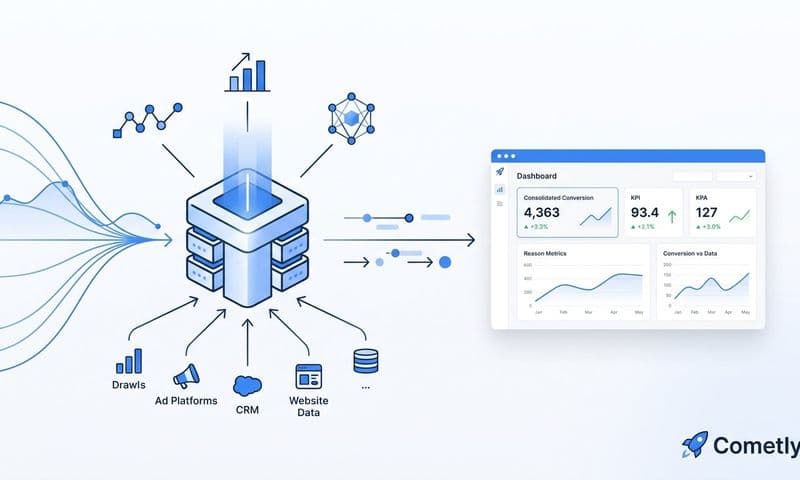
Prioritize solutions that provide accurate attribution across your entire marketing stack, especially those with server-side tracking capabilities that overcome iOS limitations and cookie restrictions. Look for platforms that connect all your data sources—ad platforms, CRM, analytics tools—into a unified view of your customer journey. Most importantly, choose vendors that help you take action on insights, not just collect data.
The quote you receive should reflect genuine value: accurate tracking that captures every touchpoint, intelligent attribution that reveals which channels truly drive revenue, and the ability to feed better data back to your ad platforms for improved optimization. When you find a platform that delivers these capabilities at a price aligned with your budget, you've found a true partner in your marketing success.
Ready to elevate your marketing game with precision and confidence? Discover how Cometly's AI-driven recommendations can transform your ad strategy—Get your free demo today and start capturing every touchpoint to maximize your conversions.