

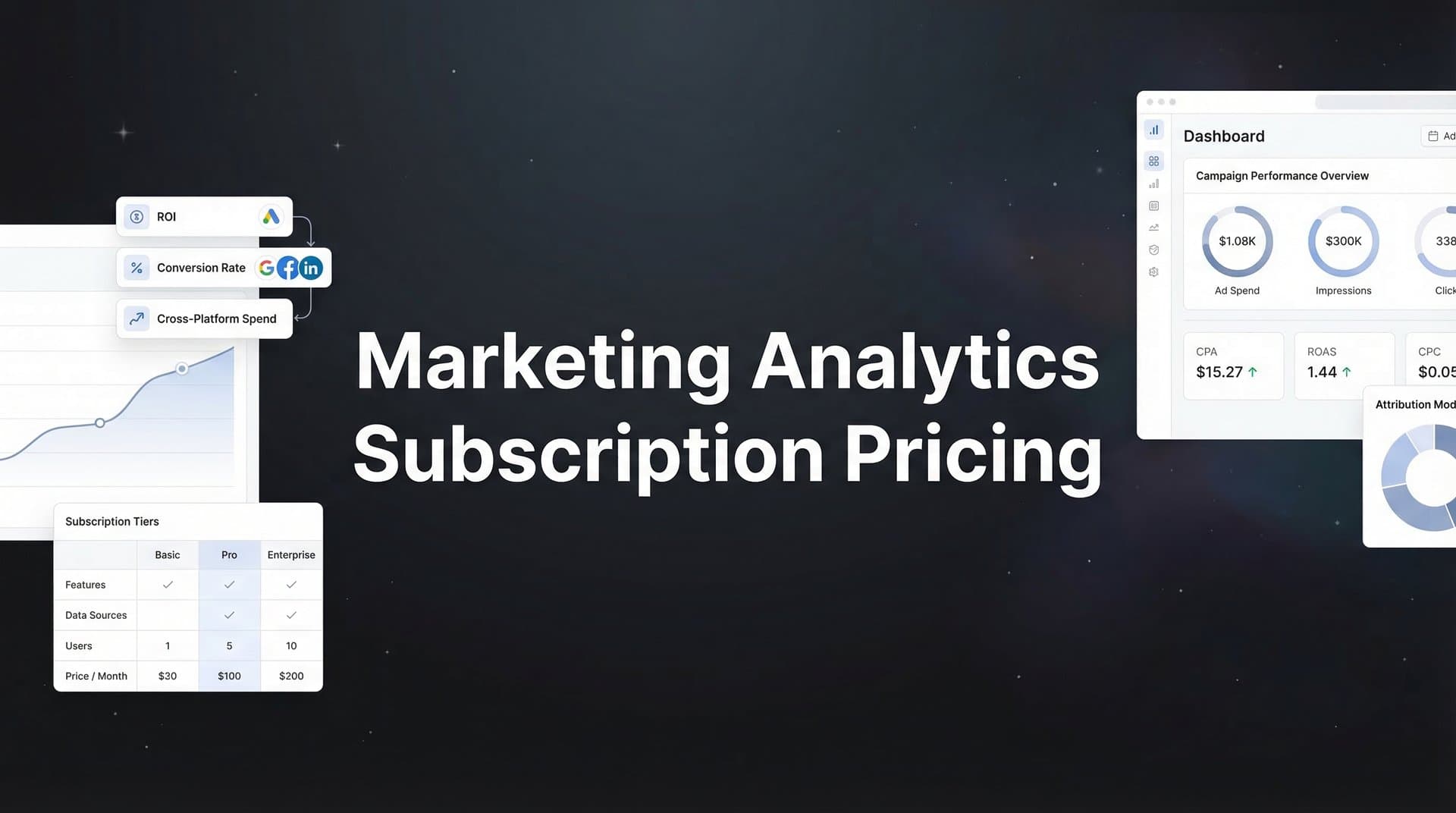
You're sitting in front of three different analytics platforms, each with a pricing page that looks like it was designed to confuse rather than clarify. One charges per "event," another per "seat," and a third has mysterious tier names like "Professional" and "Enterprise" with no actual prices listed. You just want to know: what will this actually cost me, and is it worth it?
This is the reality for most marketers evaluating analytics tools. The pricing landscape isn't just complex—it's deliberately opaque in many cases. Hidden costs lurk behind vague usage limits, implementation fees appear only after you've committed, and what looks like a $200/month subscription can balloon to $800 once you add the integrations and support you actually need.
But here's the thing: understanding subscription pricing models isn't about finding the cheapest option. It's about finding the right value exchange for your specific needs. A platform that costs twice as much but helps you identify which campaigns are wasting budget can pay for itself in a single month. The key is knowing what you're really buying, what you'll actually pay, and how to evaluate whether the investment makes sense for your marketing operation.
Breaking Down How Analytics Platforms Actually Charge You
Marketing analytics platforms structure their pricing in fundamentally different ways, and understanding these models is the first step toward making an apples-to-apples comparison.
Per-seat pricing is the most straightforward model. You pay a fixed amount for each team member who needs access to the platform. This approach works well for small teams with predictable headcount, but it can become expensive as your marketing organization grows. The advantage? You know exactly what you'll pay each month, regardless of how much data you're tracking or how many campaigns you're running.
Usage-based pricing charges you based on consumption—typically measured in tracked events, pageviews, or monthly active users. This model can be attractive for early-stage companies with low traffic, but it creates unpredictable costs as you scale. A successful campaign that drives 10x the normal traffic can suddenly result in a 10x analytics bill. Many platforms combine usage-based pricing with tiered limits, where you pay more as you cross certain volume thresholds.
Tiered feature access is perhaps the most common approach in the analytics space. Basic plans offer standard reporting and limited integrations, while higher tiers unlock advanced capabilities like multi-touch attribution, API access, custom reporting, or dedicated support. The challenge here is that the features you actually need—like server-side tracking or CRM integrations—often sit in the middle or top tier, forcing you to pay for capabilities you don't use just to access the ones you do.
Many platforms use hybrid models that combine these approaches. You might pay a base fee for access, plus additional charges based on usage, plus extra for each additional seat beyond a certain limit. This complexity isn't accidental—it allows vendors to maximize revenue by capturing value from multiple dimensions of your usage.
What's typically included in base subscriptions? Most platforms offer core analytics dashboards, basic integrations with major ad platforms, and some form of email support. What's almost never included? Premium integrations with specialized tools, dedicated customer success managers, custom attribution modeling, extended data retention beyond 90 days, and priority support with guaranteed response times. These add-ons can easily double or triple your effective subscription cost.
Enterprise pricing operates in a different universe entirely. If you have to ask for a quote, expect a sales process involving multiple calls, custom proposals, and negotiation. Enterprise contracts typically include compliance certifications, dedicated support resources, custom integrations, and flexible terms—but they also lock you into longer commitments and higher minimums. The advantage is that nearly everything is negotiable, from pricing to specific features to contract length.
The Costs That Don't Appear on the Pricing Page
The subscription fee is just the beginning. The real cost of implementing a marketing analytics platform includes several hidden expenses that catch many marketers off guard.
Implementation and onboarding fees are the first surprise. While some platforms include basic setup in their subscription, many charge separately for implementation support. This might mean a one-time fee of $2,000-$10,000 for an implementation specialist to help configure tracking, set up integrations, and ensure data accuracy. For complex setups involving multiple domains, custom events, or specialized attribution models, these fees can climb significantly higher.
Even if formal implementation fees aren't charged, there's an opportunity cost. Your team will spend dozens of hours installing tracking codes, configuring integrations, testing data flows, and troubleshooting discrepancies. For a marketing team where time equals money, this hidden cost can exceed the first year's subscription fee.
Overage charges are where usage-based pricing models can spiral unexpectedly. You might sign up for a plan that includes "up to 100,000 tracked events per month" only to discover that a successful campaign or seasonal traffic spike pushes you to 150,000 events. The overage rate—often 2-3x higher than the base rate—can turn a predictable $300 monthly bill into a $600 surprise.
The worst part? Many platforms don't alert you in real-time when you're approaching limits. You discover the overage when the invoice arrives, by which point the data has already been collected and the charges are non-negotiable.
Integration costs deserve special attention. That CRM integration you need might be available—but only on the Professional tier that costs $500 more per month. The Slack notifications your team wants? That's another $50/month add-on. The API access required to push data to your data warehouse? Enterprise tier only, starting at $1,500/month.
Training requirements represent another hidden expense. A platform might be powerful, but if your team needs 20 hours of training to use it effectively, that's a real cost. Some vendors include training in higher-tier plans, while others charge $200+/hour for dedicated training sessions.
The true total cost of ownership includes all of these factors plus ongoing maintenance. Analytics platforms require regular attention—updating tracking codes when you redesign your website, reconfiguring integrations when API versions change, and adjusting attribution models as your marketing mix evolves. Factor in at least 5-10 hours per month of ongoing maintenance, even with a well-implemented system.
The Data Retention Trap
One particularly sneaky hidden cost is data retention limits. Many platforms advertise attractive base prices but limit historical data access to 90 days or 6 months at lower tiers. Need to analyze year-over-year performance or understand long sales cycles? You'll need to upgrade to a higher tier or pay for extended retention.
This becomes especially painful when you're trying to calculate customer lifetime value or analyze attribution across longer buyer journeys. The data you need to make informed decisions is technically in the system—you just can't access it without paying more.
Finding the Right Tier for Your Marketing Operation
Matching your subscription tier to your actual marketing maturity is an art. Too low, and you'll constantly bump against limitations. Too high, and you're paying for capabilities you won't use for years.
Starter and SMB tiers are designed for small teams running straightforward campaigns. These plans typically include basic multi-channel tracking, standard attribution reports, and a handful of integrations with major ad platforms. They work well when you're running campaigns on 2-3 channels, have a small team (1-3 marketers), and need to answer fundamental questions like "which channel drives the most conversions?"
The trap with starter tiers is feature limitations that aren't obvious until you need them. You might discover that custom event tracking isn't available, or that you can only connect two ad accounts, or that API access is restricted. Before committing to a starter tier, map out what you'll need in the next 6-12 months, not just what you need today. Consider exploring budget-friendly marketing analytics tools that offer flexibility without sacrificing essential features.
What you actually need at this stage: reliable tracking across your core channels, clear conversion attribution, and basic reporting that helps you allocate budget intelligently. What you're often paying for but don't need yet: advanced attribution models, extensive integrations, or team collaboration features designed for larger organizations.
Growth-stage considerations become relevant when you're scaling ad spend, expanding to new channels, or building out your marketing team. This is when you typically need to upgrade from starter to mid-tier plans.
Triggers that signal it's time to upgrade include running campaigns across 4+ channels simultaneously, needing to track multiple conversion types with different values, requiring server-side tracking for more accurate data, or having a team of 4+ people who need regular access to analytics. At this stage, the cost of poor attribution—wasting budget on underperforming channels—typically exceeds the cost of upgrading to better analytics.
Mid-tier plans usually unlock multi-touch attribution models, expanded integration options, better data retention, and improved support. The pricing jump can be significant—often 2-3x the starter tier—but the value proposition changes when you're managing $50,000+ in monthly ad spend. A platform that helps you reallocate even 10% of wasted budget pays for itself immediately.
Enterprise requirements emerge when compliance, support SLAs, and custom attribution become non-negotiable. If you're in a regulated industry, you need SOC 2 compliance and data processing agreements. If you're managing millions in ad spend, you need dedicated support with guaranteed response times. If your attribution model needs to account for offline conversions, channel-specific lookback windows, or complex customer journeys, you need customization capabilities that only exist at the enterprise level.
Enterprise pricing typically starts at $2,000-$5,000+ per month, but it includes capabilities that simply aren't available at lower tiers: custom attribution modeling tailored to your specific business model, dedicated customer success managers who understand your industry, priority support with SLAs, compliance certifications, and the ability to negotiate specific features or integrations. For a deeper dive into what's available, review enterprise marketing analytics tools and their capabilities.
The key question at every tier: does this subscription unlock capabilities that will improve our marketing performance by more than it costs? If a $500/month upgrade helps you identify and eliminate $2,000 in wasted ad spend, the ROI is obvious.
The Math That Justifies Your Subscription Investment
Before committing to any analytics subscription, you need a framework for quantifying the value of accurate attribution data. This isn't about abstract benefits—it's about concrete financial impact.
Start with your current ad spend and conversion tracking accuracy. If you're spending $30,000/month on paid advertising but your current tracking only captures 70% of conversions due to cookie limitations or tracking gaps, you're making budget decisions based on incomplete data. How much of that budget is being allocated to channels that look good in your current analytics but aren't actually driving revenue? Understanding unreliable marketing analytics data and its impact is crucial for this assessment.
A conservative estimate suggests that marketers without accurate attribution waste 15-25% of their ad budget on underperforming channels or campaigns. For a company spending $30,000/month, that's $4,500-$7,500 in wasted spend. An analytics platform that costs $500/month but helps you identify and reallocate even half of that waste delivers 5-7x ROI in the first month alone.
The framework for calculating value looks like this: (Monthly Ad Spend) × (Estimated Waste Percentage) × (Improvement from Better Attribution) = Monthly Value Created. If better attribution helps you improve efficiency by even 10%, the math works out favorably for most marketing operations spending more than $10,000/month on advertising.
Compare subscription costs against the specific problems you're trying to solve. If you're currently unable to track conversions from iOS users due to tracking limitations, and iOS represents 40% of your mobile traffic, you're essentially blind to nearly half your mobile performance. A platform with server-side tracking that solves this problem isn't just a nice-to-have—it's filling a critical gap in your decision-making capability.
Questions to ask vendors during evaluation help you understand true value beyond the feature list. Ask: "How quickly do customers typically see ROI from implementing your platform?" This forces vendors to articulate concrete value rather than just listing features. Ask: "What's the most common reason customers upgrade from our target tier?" This reveals limitations you'll likely encounter. Ask: "Can you show me a sample attribution report for a business similar to ours?" This demonstrates whether the platform actually delivers insights or just data.
Also ask about the implementation timeline and what's required from your team. A platform that promises powerful capabilities but requires three months of implementation and ongoing technical maintenance might not be worth it compared to a solution that delivers 80% of the value with 20% of the setup effort.
The most important question: "What specific decisions will we be able to make with your platform that we can't make today?" If the answer is vague or focuses on features rather than outcomes, that's a red flag. The value of analytics is better decision-making, and a vendor should be able to articulate exactly what decisions you'll improve.
Warning Signs and Positive Indicators in Platform Pricing
Not all analytics subscriptions are created equal. Certain pricing structures and contract terms should raise immediate concerns, while others signal a vendor that's aligned with your success.
Red flags to watch for:
Long mandatory contracts that lock you into 12+ months with no flexibility suggest a vendor that's more focused on customer acquisition than customer success. While annual contracts with discounts can make sense, be wary of platforms that require long commitments before you've validated that the solution actually works for your use case. The best platforms offer monthly or quarterly options for new customers, allowing you to prove value before committing long-term.
Opaque usage limits that make it difficult to predict your actual costs are a major warning sign. If a vendor can't clearly explain what counts toward your usage limit, how overages are calculated, or what happens when you exceed thresholds, you're setting yourself up for billing surprises. Transparent platforms provide real-time usage dashboards and proactive alerts when you're approaching limits.
Limited integrations at lower tiers can be a trap. Some platforms advertise extensive integration capabilities but lock most of them behind higher-tier subscriptions. If you need specific integrations with your CRM, ad platforms, or other tools, verify they're included in your target tier before signing up. Having to upgrade just to access basic integrations inflates your true cost significantly. When comparing marketing analytics platforms, always verify integration availability at your target price point.
Vague feature descriptions that don't clearly explain what's included at each tier make comparison difficult. If you can't understand exactly what you're getting without scheduling a sales call, that's often intentional—it allows the vendor to price discriminate and extract maximum value from each customer rather than offering transparent, value-based pricing.
Positive indicators that suggest vendor alignment:
Transparent pricing that clearly shows what's included at each tier, how usage is measured, and what additional costs might apply demonstrates confidence and customer-first thinking. The best platforms publish detailed pricing pages that answer most questions without requiring a sales conversation. This transparency extends to being upfront about limitations—clearly stating what's not included is just as important as highlighting what is.
Flexible scaling options that let you adjust your subscription as your needs change show that a vendor understands businesses grow in fits and starts, not smooth linear progressions. Look for the ability to upgrade or downgrade tiers without penalties, add or remove seats easily, and adjust usage limits without renegotiating your entire contract. Understanding marketing analytics subscription plans in detail helps you identify vendors offering this flexibility.
Included onboarding support signals that a vendor is invested in your success from day one. Platforms that include implementation assistance, training resources, and dedicated onboarding help as part of the subscription rather than charging separately demonstrate confidence that they can deliver value quickly. This is especially important for analytics tools, where improper setup can compromise data accuracy from the start.
Trial periods or money-back guarantees indicate a vendor willing to let the product speak for itself. A 14-day free trial or 30-day money-back guarantee gives you the opportunity to validate that the platform actually solves your problems before committing financially. Be cautious of vendors who won't offer any trial period or require payment upfront before you can evaluate the solution.
The ultimate test of pricing alignment is whether the subscription structure scales naturally with your growth and success. A platform that becomes prohibitively expensive as you succeed—where costs increase faster than the value you're extracting—creates misalignment. The best pricing models grow with you but maintain a favorable value-to-cost ratio as you scale.
Making Your Analytics Investment Work for You
Subscription pricing for marketing analytics platforms isn't just about the monthly number on your credit card statement. It's about the total investment—including implementation time, ongoing maintenance, training, and opportunity costs—measured against the value created through better marketing decisions.
The platforms that deliver the best value are those that align their pricing with your actual needs and growth trajectory. They're transparent about costs, flexible about scaling, and focused on helping you succeed rather than maximizing their revenue through hidden fees and restrictive contracts.
When evaluating options, start with your current marketing operation and specific pain points. What decisions are you making blindly today because you lack accurate data? What's the cost of those blind spots in terms of wasted ad spend or missed opportunities? A platform that helps you answer those questions and make better decisions is worth far more than its subscription cost.
Remember that the cheapest option is rarely the best value. A starter-tier subscription that saves you $200/month but leaves you with incomplete attribution data could cost you thousands in misallocated ad budget. Conversely, an enterprise platform with every possible feature might be overkill if you're running straightforward campaigns across a handful of channels.
The right subscription is the one that gives you the capabilities you need today, can scale as your marketing operation grows, and costs less than the value it creates through improved marketing efficiency. Focus on platforms that make this value equation transparent and sustainable.
Ready to elevate your marketing game with precision and confidence? Discover how Cometly's AI-driven recommendations can transform your ad strategy—Get your free demo today and start capturing every touchpoint to maximize your conversions.


