You're running campaigns across Meta, Google, TikTok, and LinkedIn. Your website gets traffic from organic search, email, and direct visits. Your CRM tracks leads through multiple stages before they convert. And somewhere in that maze of data, you're supposed to figure out which marketing efforts actually drive revenue.
Traditional attribution models try to solve this with simple rules: give all credit to the first touchpoint, or the last one, or split it evenly across everything. But these approaches were built for a simpler era—before customers researched on mobile, clicked ads on desktop, and converted days later after reading an email.
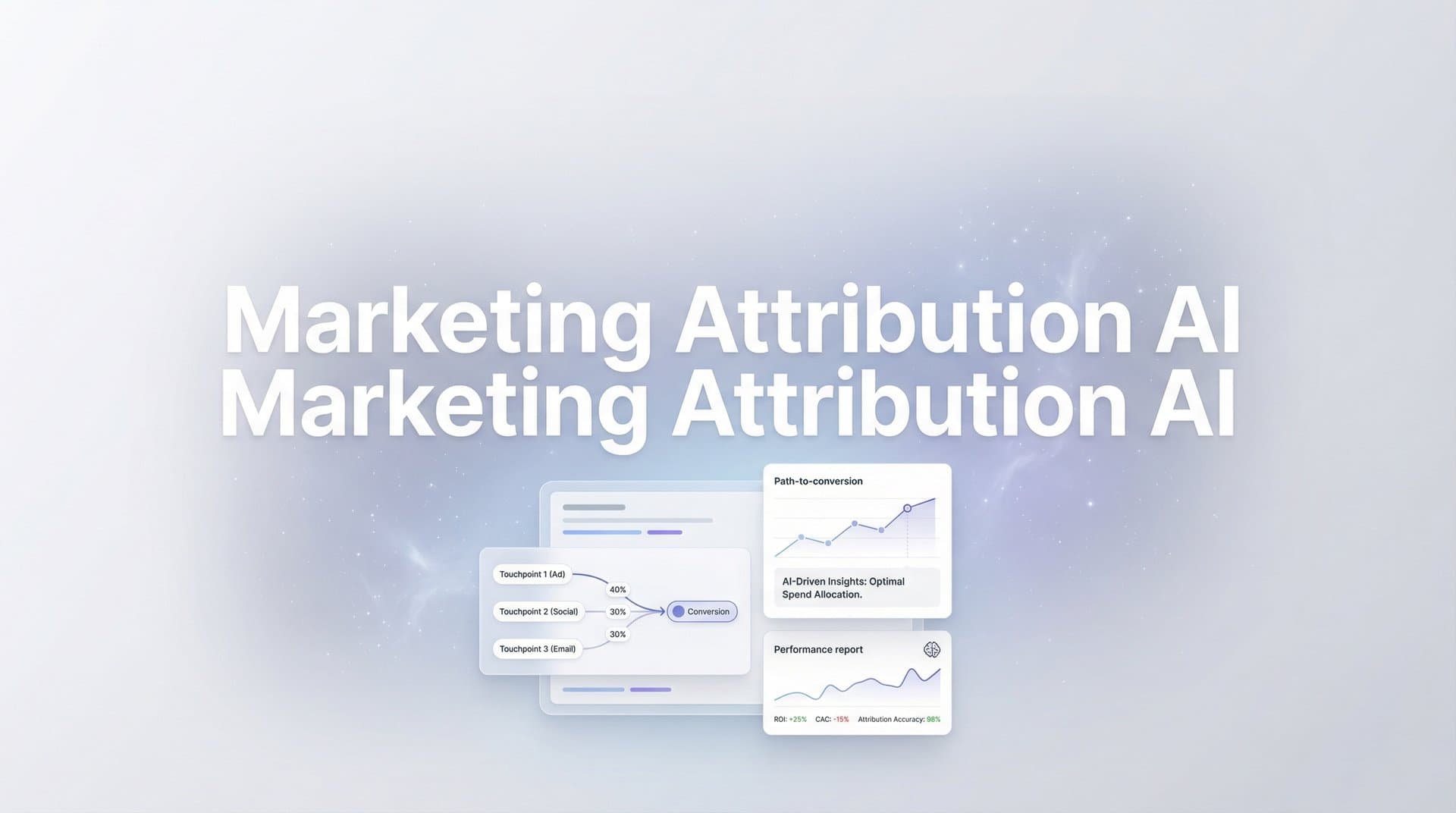
Marketing attribution AI changes the game entirely. Instead of applying fixed formulas to complex customer journeys, machine learning algorithms analyze patterns across millions of touchpoints to reveal what actually drives conversions. It's the difference between guessing based on outdated rules and knowing based on data-driven intelligence.
The Evolution From Rules-Based to AI-Powered Attribution
Traditional attribution models operate on a fundamental assumption: that we can assign conversion credit using predetermined rules. First-touch attribution gives 100% credit to the initial interaction. Last-touch attributes everything to the final click before conversion. Linear models split credit evenly across all touchpoints.
These approaches worked reasonably well when customer journeys were simpler and more linear. But today's reality is far more complex.
Think about your own buying behavior. You might discover a product through a Facebook ad, research it on your phone during lunch, compare options via Google search that evening on your laptop, read review emails over the next few days, and finally convert after clicking a retargeting ad a week later. Which touchpoint deserves credit? The honest answer is that they all played a role, but not an equal one.
Traditional models fail because they can't account for this complexity. They treat every touchpoint the same way regardless of context. A casual scroll-past on social media gets the same weight as a detailed product comparison on your website. An ad view at the beginning of a six-month consideration period counts the same as one shown the day before purchase. Understanding types of marketing attribution models helps clarify why these limitations exist.
Marketing attribution AI takes a fundamentally different approach. Instead of applying fixed rules, machine learning algorithms analyze actual conversion patterns across your entire customer base. They identify which sequences of touchpoints lead to conversions versus drop-offs. They recognize that certain channels work better as awareness drivers while others excel at closing deals. They understand that timing matters—the same touchpoint has different value depending on where it appears in the journey.
The shift goes beyond just assigning credit more accurately. AI-powered attribution transforms from a backward-looking exercise in credit assignment into forward-looking predictive intelligence. Rather than simply telling you what happened, it helps you understand what's likely to happen next and where to focus your efforts for maximum impact.
This evolution matters because modern marketing demands precision. When you're managing significant ad spend across multiple platforms, the difference between knowing and guessing which campaigns drive revenue directly impacts your bottom line. AI attribution gives you that clarity.
How Marketing Attribution AI Actually Works
Understanding the mechanics behind AI attribution helps you evaluate solutions and set realistic expectations. The process starts with comprehensive data collection across every customer touchpoint.
The data collection layer connects your ad platforms, CRM, website analytics, and any other systems that track customer interactions. When someone clicks a Facebook ad, visits your website, opens an email, fills out a form, or converts, each of these events gets captured with detailed context: timestamp, device type, referring source, user identifier, and any other relevant metadata.
This creates a unified view of each customer journey. Instead of seeing isolated events in different platforms, you get the complete story of how someone moved from awareness to conversion. The technical challenge here is identity resolution—connecting the same person across devices and platforms when they're not logged in or using different email addresses.
Once the data flows in, machine learning models go to work analyzing patterns. These algorithms process millions of customer journeys to identify which touchpoint combinations correlate with conversions. They look for sequences that appear more frequently in converting journeys versus non-converting ones. They calculate the incremental impact of each channel and touchpoint type. Learn more about how machine learning can be used in marketing attribution to understand these sophisticated techniques.
The models learn continuously. As new data arrives, they refine their understanding of what drives conversions in your specific business. This matters because what works for one company might not work for another. An e-commerce brand selling impulse purchases has different attribution patterns than a B2B SaaS company with six-month sales cycles.
Modern AI attribution platforms process this analysis in real time. You're not looking at last week's or last month's data—you're seeing current performance as it happens. When a campaign starts outperforming or underperforming, you know immediately rather than discovering it in your next monthly report.
The output goes beyond simple credit assignment. Advanced systems provide predictive insights: which campaigns are likely to drive conversions in the next week, which audience segments show the highest conversion probability, where budget reallocation would have the greatest impact. They identify patterns humans would never spot manually, like the fact that customers who interact with three specific touchpoints in a particular sequence convert at twice the rate of those who don't.
The technical sophistication happens behind the scenes. What you see is actionable intelligence: clear recommendations about where to invest, which campaigns to scale, and which touchpoints matter most for different customer segments. The AI handles the complexity so you can focus on strategy and execution.
Key Capabilities That Set AI Attribution Apart
Several specific capabilities distinguish AI-powered attribution from traditional approaches. These features solve problems that rules-based models simply can't address.
Cross-Platform Journey Stitching: Modern customers don't follow linear paths within single platforms. They discover products on social media, research on search engines, compare options on review sites, and convert through email or direct visits. AI attribution connects these fragmented touchpoints into coherent journeys, even when users switch devices or aren't logged in. The system uses probabilistic matching and behavioral patterns to identify when different interactions likely belong to the same person.
This capability matters because without it, you're essentially blind to how channels work together. You might see that Google Ads drives conversions, but miss that most of those converters first discovered you through Facebook. Or you might undervalue your content marketing because you can't see how blog readers who return weeks later via direct traffic convert at higher rates. Effective cross-channel attribution reveals these hidden relationships.
Automated Anomaly Detection: When performance suddenly changes, you need to know immediately and understand why. AI attribution continuously monitors your campaigns for unusual patterns. If a normally high-performing campaign starts underdelivering, the system flags it and analyzes potential causes. Did audience overlap increase? Did competitors change their bidding strategy? Did a specific ad creative stop resonating?
Rather than manually comparing dashboards and hunting for explanations, you get automated alerts with likely root causes. This transforms how quickly you can respond to performance shifts. Instead of discovering problems days later in your weekly review, you're addressing them within hours.
Predictive Budget Recommendations: Perhaps the most powerful capability is using AI to forecast where additional spend will generate the best returns. The system analyzes which campaigns and channels have headroom for scaling versus which are hitting diminishing returns. It identifies opportunities where increasing budget would likely drive proportional or better results, and warns when campaigns are already at optimal spend levels.
These recommendations get more sophisticated over time. The AI learns your specific business patterns: seasonal fluctuations, day-of-week performance variations, how different customer segments respond to various channels. It factors all of this into its suggestions, giving you confidence that budget reallocations are based on comprehensive analysis rather than gut feeling.
Solving the iOS and Privacy-Era Tracking Challenges
The tracking landscape changed fundamentally with iOS 14.5 and the broader shift toward privacy-first digital experiences. Traditional pixel-based attribution relied on cookies and device identifiers that are increasingly unavailable.
Apple's App Tracking Transparency framework requires apps to ask permission before tracking users across other apps and websites. Most users decline. This created immediate visibility gaps for marketers who relied on pixel tracking to measure campaign performance. Facebook's pixel, Google's conversion tracking, and similar tools suddenly couldn't capture complete data about who clicked ads and what they did afterward.
Cookie deprecation compounds the problem. As browsers phase out third-party cookies, the mechanisms that enabled cross-site tracking disappear. The old approach of dropping a cookie when someone clicks an ad, then recognizing them when they return to convert, no longer works reliably. These represent significant attribution challenges in marketing analytics that teams must address.
AI attribution addresses these challenges through server-side tracking architecture. Instead of relying on browser-based pixels that users can block, server-side tracking captures events directly from your website or app to your attribution platform, then securely shares relevant data with ad platforms. This approach isn't affected by iOS restrictions or cookie blocking because it doesn't depend on client-side tracking mechanisms.
The AI layer becomes even more critical in this privacy-first environment. When direct tracking isn't possible for every user, machine learning models can make intelligent inferences based on aggregate patterns. If the system knows that customers who view certain product pages typically convert within 48 hours, it can probabilistically attribute conversions even when the direct tracking link is broken.
This doesn't mean guessing. The models use statistical techniques to estimate attribution with quantifiable confidence levels. You understand which insights are based on complete data versus modeled estimates. The accuracy remains high because the AI learns from the users you can track fully to make informed predictions about those you can't.
The practical result is that AI-powered attribution maintains accuracy even as tracking becomes more restricted. You're not flying blind just because Apple or browsers limit tracking capabilities. The technology adapts to work within privacy constraints while still delivering the insights you need to optimize campaigns effectively.
Feeding Better Data Back to Ad Platforms
Here's where AI attribution creates a powerful feedback loop that improves campaign performance beyond just measurement. Ad platforms like Meta and Google use machine learning to optimize your campaigns, but they can only work with the data they receive.
The problem is that platform-native tracking often misses conversions or attributes them incorrectly. When someone clicks your Facebook ad, browses on mobile, then converts three days later on desktop, Facebook might not see that conversion. Their algorithm thinks the ad didn't work, so it optimizes away from similar audiences and creative approaches.
This creates a compounding accuracy problem. Incomplete conversion data leads to suboptimal optimization, which reduces campaign performance, which generates even less useful data for the algorithm to learn from. You're stuck in a negative cycle where the platforms can't effectively optimize because they don't have accurate conversion information.
AI attribution solves this through conversion sync—sending enriched, accurate conversion events back to ad platforms. When your attribution system captures a conversion that the platform missed, it securely shares that data with Facebook, Google, or whichever platform drove the initial touchpoint. The platform's algorithm now sees the complete picture of what's actually converting.
The impact extends beyond just correcting missed conversions. AI attribution can send enriched data that includes conversion value, customer lifetime value predictions, and other context that helps platforms optimize more effectively. Instead of just knowing someone converted, the algorithm knows they became a high-value customer, which shifts optimization toward finding similar prospects. This approach to marketing revenue attribution directly improves your bottom line.
This creates a positive feedback loop. Better conversion data improves platform targeting and optimization. Better optimization drives better results. Better results generate more conversions and more data to further refine the algorithms. Over time, campaign performance compounds as both your attribution AI and the ad platform algorithms learn what actually works.
The technical implementation requires secure, privacy-compliant data sharing between your attribution platform and ad platforms. Modern solutions handle this through official APIs and conversion tracking integrations that respect user privacy while ensuring platforms get the data they need to optimize effectively.
Evaluating Marketing Attribution AI Solutions
Not all AI attribution platforms deliver the same capabilities or accuracy. Understanding what to look for helps you choose a solution that actually solves your measurement challenges rather than adding complexity.
Integration Requirements: Start by confirming the platform connects to your essential data sources. At minimum, you need integrations with your major ad platforms (Meta, Google Ads, LinkedIn, TikTok, or whichever you use), your CRM system, and your website analytics. Server-side tracking capability is non-negotiable if you're dealing with iOS traffic or privacy-restricted environments. Ask specifically about how data flows between systems and whether the platform supports real-time or only batch processing.
Data Accuracy and Validation: Request information about how the platform ensures data quality. How does it handle duplicate events? How does it resolve identity conflicts when the same user appears with different identifiers? What's the typical match rate for cross-device tracking? Reputable providers can quantify their accuracy and explain their methodology. Be skeptical of vague claims about "advanced AI" without specifics about how it works.
Model Transparency: You need to understand how the AI reaches its conclusions. Ask whether you can see which factors the model weighs most heavily in attribution decisions. Can you compare different attribution models side by side? Does the platform explain why it's recommending specific budget changes or flagging certain campaigns? Black box systems that provide recommendations without reasoning make it impossible to build confidence in the insights or explain decisions to stakeholders. Reviewing a guide on comparing marketing attribution software features can help you evaluate options systematically.
Time to Value: How long does implementation take? What's required from your team? Some platforms promise plug-and-play setup but require extensive technical work. Others genuinely deliver quick implementation with minimal IT involvement. Understand the realistic timeline from signup to actionable insights. Also ask how long the AI needs to collect data before its recommendations become reliable—most systems need at least a few weeks of data to train effectively.
Red Flags to Watch For: Be wary of solutions that promise instant, dramatic results. AI attribution improves decision-making, but it's not magic that suddenly doubles your ROI overnight. Question providers who can't explain their methodology or claim proprietary algorithms they refuse to discuss. Avoid platforms that lock you into long contracts before you can properly evaluate whether the insights match your needs. And be skeptical of solutions that require you to completely replace your existing tracking infrastructure rather than working alongside it.
Ask about support and ongoing optimization. Does the platform provide guidance on interpreting insights and implementing recommendations? Is there a customer success team that helps you get maximum value, or are you on your own after implementation?
Finally, consider scalability. As your marketing grows more sophisticated, can the platform handle increased data volume and complexity? Will you outgrow its capabilities in a year, or is it built to scale with your business? Exploring the best software for tracking marketing attribution can help you identify solutions built for long-term growth.
Moving Forward With AI-Powered Attribution
Marketing attribution AI represents a fundamental shift from guessing to knowing which efforts drive revenue. The technology moves beyond outdated rules-based models to provide dynamic, data-driven insights about what actually works in your specific business.
The transformation isn't just about better measurement. It's about making confident decisions backed by comprehensive analysis of your customer journeys. It's about optimizing campaigns based on predictive intelligence rather than lagging indicators. It's about feeding better data back to ad platforms so their algorithms can find and convert your best customers more effectively.
What makes this particularly significant is that AI-powered attribution is no longer exclusively for enterprise organizations with dedicated data science teams. Modern platforms make sophisticated attribution accessible to marketing teams of all sizes. The AI handles the technical complexity while you focus on strategy and execution.
The privacy-first future makes AI attribution even more essential. As tracking becomes more restricted, the ability to maintain accurate measurement through server-side tracking and intelligent modeling separates effective marketers from those flying blind. The technology adapts to work within privacy constraints while still delivering the clarity you need.
Ready to elevate your marketing game with precision and confidence? Discover how Cometly's AI-driven recommendations can transform your ad strategy—Get your free demo today and start capturing every touchpoint to maximize your conversions.