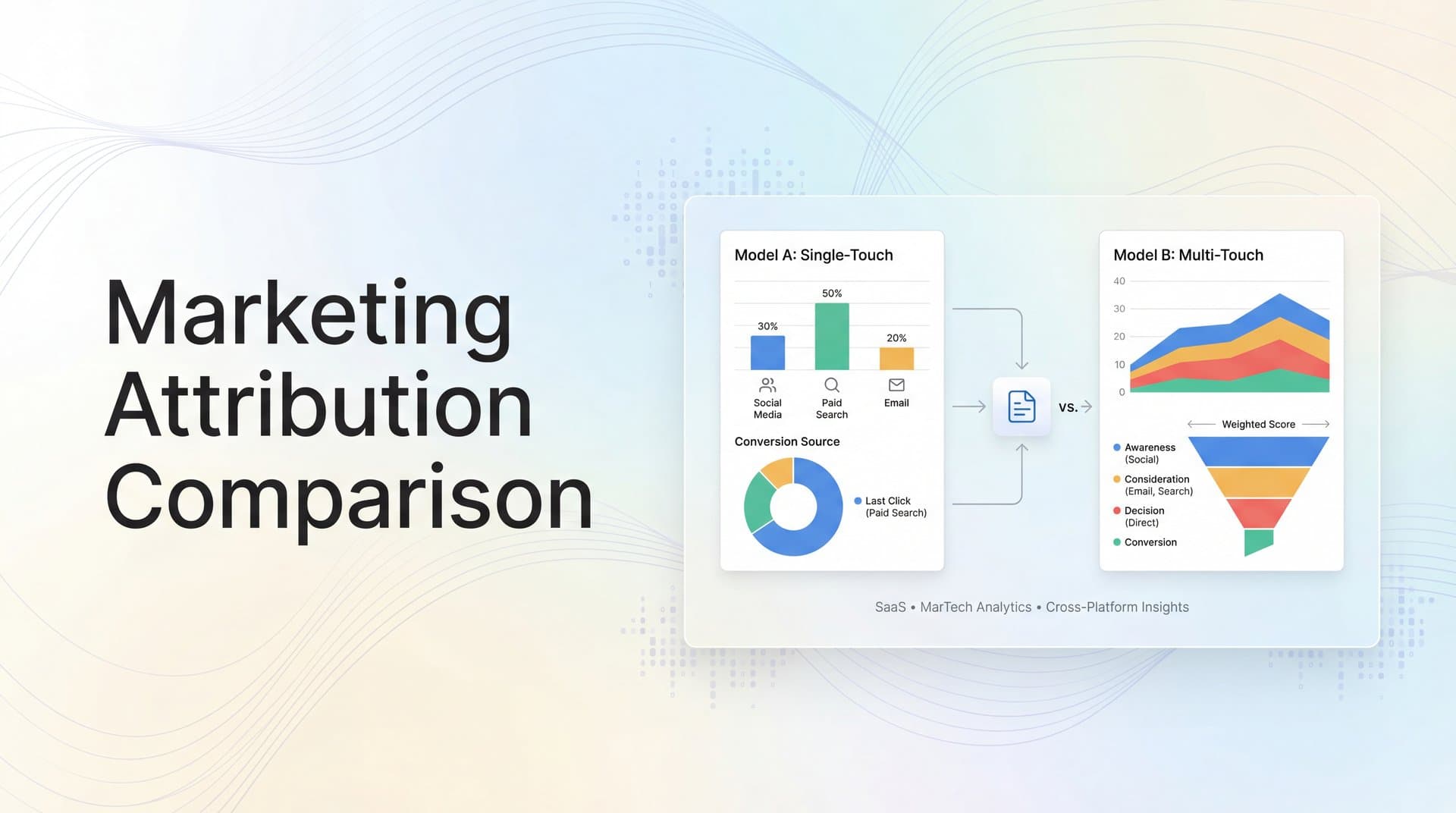
You're running campaigns across Facebook, Google, LinkedIn, and your email platform. A customer converts after seeing your Facebook ad, clicking a Google search ad, opening two emails, and finally returning through direct traffic. Which channel gets credit for the sale?
The answer depends entirely on your attribution model—and different models will give you completely different answers. First-touch credits Facebook. Last-touch credits direct traffic. Linear splits credit across all five touchpoints. Each model tells a different story about where your budget should go.
This isn't just an academic exercise. The attribution model you choose directly influences which campaigns get scaled, which get paused, and where your next dollar goes. Choose wrong, and you'll optimize based on incomplete or misleading data. Choose right, and you'll have confidence that every budget decision is grounded in how customers actually find and buy from you.
The challenge isn't just understanding what each model does. It's knowing how to systematically compare them against your specific business reality—your sales cycle, your customer journey, your actual revenue outcomes. Most marketers know attribution matters. Few know how to conduct meaningful comparisons that lead to better decisions.
These seven strategies will change that. You'll learn how to test models side-by-side, validate them against real revenue, and build an approach that gives your team clarity instead of confusion.
1. Map Your Customer Journey Before Comparing Models
The Challenge It Solves
Jumping straight into attribution model comparison without understanding your actual customer journey is like choosing a car before knowing where you need to drive. Different businesses have fundamentally different buying patterns—some customers convert in hours, others take months. Some interact with three touchpoints, others with fifteen.
Without this baseline understanding, you'll evaluate models in a vacuum. You won't know if a model's assumptions match your reality, and you'll struggle to interpret why different models produce different results.
The Strategy Explained
Start by documenting how customers actually move through your marketing ecosystem before they convert. Pull data from your CRM, analytics platform, and ad accounts to identify common touchpoint sequences. Look for patterns: Do most customers start with paid search or social? How many touchpoints occur before conversion? What's the typical time span from first interaction to purchase?
Create journey segments based on conversion value or customer type. High-ticket B2B sales will look completely different from e-commerce impulse purchases. Your attribution comparison needs to account for these differences.
This mapping exercise establishes your comparison criteria. If your data shows customers typically interact with 8-12 touchpoints over 45 days, you'll know that first-touch and last-touch models are probably oversimplifying your reality. If most customers convert within 24 hours of their first click, time-decay models might be overkill.
Implementation Steps
1. Export conversion path data from your analytics platform for the past 90 days, focusing on customers who actually purchased or became qualified leads.
2. Analyze the data to identify average touchpoint count, typical channels involved, time from first touch to conversion, and common entry and exit points in the journey.
3. Segment journeys by deal size, product type, or customer segment to identify if different groups follow different patterns that might need different attribution approaches.
4. Document your findings in a simple journey map that shows the most common paths customers take, including which channels appear early, middle, and late in the process.
Pro Tips
Don't just look at averages—identify your outliers too. If 70% of customers follow a simple three-touch journey but 30% have complex fifteen-touch journeys, you might need different attribution strategies for different segments. Pay special attention to touchpoints that appear consistently across high-value conversions versus low-value ones.
2. Run Side-by-Side Attribution Model Tests
The Challenge It Solves
Reading about attribution models in theory is one thing. Seeing how they actually credit your real campaigns is entirely different. Most marketers switch from one model to another without ever comparing them directly, which means they never truly understand what changed or why.
Without parallel testing, you're making decisions based on incomplete comparisons. You can't see how drastically different models might interpret the same customer journey or which channels gain or lose credit when you change your approach.
The Strategy Explained
Set up multiple attribution models to analyze the same conversion data simultaneously. Most analytics platforms allow you to view the same conversion events through different attribution lenses—first-touch, last-touch, linear, time-decay, and position-based models running at once.
The key is using consistent data inputs across all models: same conversion events, same date range, same traffic sources. This creates a true apples-to-apples comparison where the only variable is the attribution logic itself.
Run this comparison for at least 30 days to capture a full cycle of customer behavior. Look for patterns in how different models credit your channels. Which channels gain credit in multi-touch models versus single-touch? How does time-decay shift credit compared to linear? These differences reveal what each model assumes about your customer journey.
Implementation Steps
1. Configure your analytics or attribution platform to track the same conversions across at least four models: first-touch, last-touch, linear, and one weighted model like time-decay or position-based.
2. Establish a consistent 30-60 day testing period where all models analyze the same conversion data without any changes to your tracking setup or campaign structure.
3. Export attribution reports from each model showing how credit is distributed across your channels, campaigns, and individual ads or keywords.
4. Create a comparison spreadsheet that shows each channel's attributed conversions and value under each model, calculating the percentage difference between models for each channel.
Pro Tips
Pay closest attention to channels that show dramatic swings between models. If paid social gets 40% credit in first-touch but only 10% in last-touch, that tells you it's primarily an awareness channel that starts journeys but rarely closes them. Platforms with server-side tracking will give you more accurate parallel comparisons since they capture touchpoints that browser-based pixels might miss due to privacy restrictions.
3. Align Attribution Models with Your Sales Cycle Length
The Challenge It Solves
Attribution models use lookback windows—the time period they consider when assigning credit to touchpoints. Use a window that's too short, and you'll miss early-stage touchpoints that started the journey. Use one that's too long, and you'll credit interactions that had nothing to do with the actual purchase decision.
Many marketers use default settings without considering whether they match their actual sales cycle. A seven-day lookback window might work for e-commerce impulse purchases but completely misses the mark for B2B sales that take 90 days to close.
The Strategy Explained
Match your attribution lookback windows to your documented sales cycle length. If your customer journey mapping showed that most conversions happen within 30 days of first touch, configure your models with 30-day windows. If your B2B sales typically take 60-90 days, extend your windows accordingly.
This alignment ensures your models consider the right touchpoints. Too short, and you're only seeing the end of the journey. Too long, and you're including noise that doesn't actually influence purchase decisions.
Different channels might also need different considerations. Paid search often operates on shorter cycles—people searching for your product are further along in their decision process. Social media and content marketing typically influence earlier stages, requiring longer windows to capture their impact.
Implementation Steps
1. Review your customer journey mapping data to calculate your median time from first touch to conversion, not just the average, since outliers can skew averages significantly.
2. Configure your attribution platform's lookback windows to match this timeframe, adding a 20-30% buffer to ensure you capture slightly longer journeys without including irrelevant touchpoints.
3. Test different window lengths side-by-side if your platform allows it, comparing how 30-day versus 60-day windows change credit distribution across your channels.
4. Segment your analysis by product type or deal size if different offerings have meaningfully different sales cycles that might benefit from different lookback configurations.
Pro Tips
For businesses with both short-cycle and long-cycle products, consider running separate attribution analyses with different windows rather than forcing everything into one timeframe. If you're seeing a channel suddenly gain or lose significant credit after adjusting windows, that's valuable information about where in the journey that channel actually influences customers.
4. Compare Attribution Data Against Actual Revenue Outcomes
The Challenge It Solves
Attribution models can distribute credit perfectly according to their logic while still being completely wrong about which channels drive real business value. A model might credit a channel with 100 conversions, but if those conversions never turn into revenue, the attribution is meaningless.
Most attribution platforms stop at the conversion event—form submission, trial signup, or add-to-cart. They don't connect forward to closed revenue, customer lifetime value, or which leads actually became customers. This creates a dangerous blind spot where you optimize for conversions that don't matter.
The Strategy Explained
The most powerful attribution comparison strategy is validating models against actual revenue outcomes from your CRM. Connect your attribution data to closed deals, not just leads or conversions. This reveals which model's recommendations align with what actually drives revenue.
Pull CRM data showing which marketing-attributed leads became customers and how much revenue they generated. Compare this against what your attribution models predicted. If a model heavily credits a channel that produces leads but those leads rarely close, that's a critical insight the model alone wouldn't reveal.
This revenue validation transforms attribution from a theoretical exercise into a business decision tool. You're not just comparing models—you're identifying which one guides you toward actual business growth.
Implementation Steps
1. Ensure your CRM tracks the original marketing source for every lead, maintaining this data through the entire sales process so you can connect closed revenue back to initial touchpoints.
2. Export closed-won deal data from your CRM for the same period you're analyzing attribution, including deal value and the marketing source or campaign that generated the lead.
3. Compare each attribution model's credit distribution against actual closed revenue by source, calculating what percentage of attributed conversions turned into revenue for each channel.
4. Calculate revenue per attributed conversion for each channel under each model to identify which model's recommendations would lead to the highest revenue-per-dollar-spent decisions.
Pro Tips
Look for channels that get high attribution credit but low revenue conversion rates—these are lead volume drivers that might not deserve the budget they're getting. Conversely, channels with modest attribution credit but high revenue conversion rates are probably undervalued and deserve more investment. Platforms that sync conversion data directly to your CRM make this revenue validation significantly easier and more accurate.
5. Evaluate Cross-Channel Visibility in Each Model
The Challenge It Solves
Customers don't stay on one platform. They see your Facebook ad on mobile, search for you on desktop, read your email on tablet, and convert on their laptop. Attribution models that can't track these cross-device, cross-platform journeys will systematically undervalue channels that start journeys and overvalue the last touchpoint before conversion.
Browser-based tracking faces increasing limitations from iOS privacy changes, cookie restrictions, and ad blockers. Models that rely on this tracking method will have blind spots that skew your comparisons, making channels appear less effective than they actually are.
The Strategy Explained
Test each attribution model's ability to connect touchpoints across platforms and devices. The best way to do this is comparing attributed conversion counts against known traffic and engagement metrics. If your Facebook Ads Manager shows 10,000 link clicks but your attribution platform only shows 6,000 attributed touchpoints, you have a 40% visibility gap.
Evaluate how each model handles common cross-channel scenarios. Does it connect a user who clicks your Instagram ad, then later searches your brand name on Google? Can it attribute credit when someone engages with your LinkedIn post, then converts through an email campaign days later?
Server-side tracking methods typically capture more complete journey data than browser-based pixels because they're not subject to the same privacy restrictions. Models using server-side data will show more accurate cross-channel attribution.
Implementation Steps
1. Compare attributed traffic counts in your attribution platform against reported clicks and engagement in each ad platform's native reporting for the same time period.
2. Calculate the tracking gap percentage for each channel by dividing attributed touchpoints by reported platform engagement, identifying which channels have the largest visibility issues.
3. Test your attribution setup with known cross-device journeys by clicking your own ads on mobile, then converting on desktop, checking whether the attribution platform connects both touchpoints to the same user.
4. Review your attribution platform's tracking methodology to determine if it uses browser-based pixels, server-side tracking, or a hybrid approach that might affect cross-channel visibility.
Pro Tips
Channels that rely heavily on mobile traffic—like Instagram, TikTok, and Snapchat—are most affected by iOS tracking limitations. If your attribution model shows these channels performing poorly despite strong platform metrics, the issue might be tracking gaps rather than actual performance. Platforms that use server-side tracking and connect directly to ad platform APIs typically provide the most complete cross-channel visibility.
6. Assess Model Actionability for Budget Decisions
The Challenge It Solves
An attribution model can be mathematically sophisticated and theoretically sound while being completely useless for making actual marketing decisions. Some models produce insights so complex or abstract that they don't translate into clear actions like "increase this budget" or "pause that campaign."
The purpose of attribution comparison isn't to find the most elegant model. It's to find the model that helps you make better budget allocation decisions with confidence. If a model's outputs don't lead to clear, implementable optimizations, it's not serving its purpose.
The Strategy Explained
Evaluate each attribution model based on how easily its insights translate to budget decisions. Can you look at the model's output and immediately identify which campaigns to scale, which to pause, and where to shift budget? Or does it require extensive interpretation and analysis before you can act?
Test this by taking each model's attribution data and trying to make three specific decisions: which underperforming campaign to cut, which high-performing campaign to increase, and where to allocate a new $10,000 budget. If the model gives you clear, confident answers, it's actionable. If you're left uncertain or need to gather additional data, it's not.
The most actionable models connect attribution credit directly to performance metrics you already use for decisions—cost per acquisition, return on ad spend, customer acquisition cost. They show you not just which channels get credit, but whether that credit justifies their cost.
Implementation Steps
1. For each attribution model you're comparing, create a simple report showing attributed conversions, cost per attributed conversion, and attributed revenue or value for each of your active channels and campaigns.
2. Use this report to identify your three best-performing and three worst-performing campaigns under each model, noting whether different models give you different answers about what to scale or cut.
3. Calculate the confidence level for each decision by checking whether the performance difference is significant enough to act on, or if the models show results too close to make clear choices.
4. Test whether the model's insights align with your team's marketing intuition and experience—if a model says your best-performing campaign is actually your worst, investigate whether the model is revealing a hidden truth or missing important context.
Pro Tips
Models that provide AI-driven recommendations based on attribution data take actionability to the next level—they don't just show you the data, they tell you what to do with it. The best attribution approaches also segment recommendations by campaign objective, since awareness campaigns and conversion campaigns should be evaluated differently even if they're in the same attribution report.
7. Build a Hybrid Attribution Approach
The Challenge It Solves
After comparing attribution models, you might realize that no single model perfectly captures your marketing reality. First-touch models highlight awareness channels but ignore conversion drivers. Last-touch models credit closers but miss journey starters. Multi-touch models distribute credit but sometimes dilute the impact of truly influential touchpoints.
The assumption that you must choose one model and stick with it is limiting. The most sophisticated marketers combine model strengths based on their comparison findings, creating hybrid approaches that provide more complete insights than any single model could.
The Strategy Explained
Build a hybrid attribution framework that uses different models for different purposes. Use first-touch attribution to evaluate and optimize your awareness and prospecting campaigns—the channels responsible for bringing new people into your ecosystem. Use last-touch or time-decay models for your conversion-focused campaigns that target people already familiar with your brand.
This approach acknowledges that different channels serve different purposes in your marketing mix. Your Facebook prospecting campaigns and your Google brand search campaigns shouldn't be evaluated with the same attribution lens because they're trying to accomplish completely different objectives.
The key is documenting your hybrid approach clearly so everyone on your team understands which model applies to which channels and why. This prevents confusion and ensures consistent decision-making across your marketing organization.
Implementation Steps
1. Segment your channels and campaigns into categories based on their primary objective: awareness and prospecting, consideration and nurturing, or conversion and closing.
2. Assign the most appropriate attribution model to each category based on your comparison findings—typically first-touch for awareness, multi-touch for consideration, and last-touch or time-decay for conversion.
3. Create separate dashboards or reports for each category that show performance using the assigned attribution model, making it clear which metrics apply to which campaigns.
4. Document your hybrid framework in a simple guide that explains which model applies to which channels, why you chose that approach, and how to use each model's insights for budget decisions.
Pro Tips
Review and adjust your hybrid approach quarterly as your marketing mix evolves. New channels might need different attribution treatment than your established ones. The most advanced attribution platforms allow you to create custom models that blend different approaches automatically, giving you hybrid insights without manual segmentation. When presenting results to stakeholders, lead with the hybrid view that shows the complete picture rather than forcing them to choose between conflicting single-model reports.
Making Attribution Comparison Work for Your Business
Effective attribution comparison transforms how you make budget decisions. Instead of guessing which channels drive results or relying on incomplete data from single-touch models, you'll have systematic insights grounded in your actual customer journey and validated against real revenue.
Start with the foundation: map your customer journey to understand what you're actually trying to measure. Then run parallel model tests to see how different approaches interpret your data. The models that align with your sales cycle, provide cross-channel visibility, and lead to clear budget decisions are the ones worth using.
Remember that attribution comparison isn't about finding the one perfect model. It's about building an approach—whether that's a single model or a hybrid framework—that gives your team confidence in where to invest. The best attribution strategy is the one you'll actually use to make better decisions.
As your marketing mix evolves, revisit your attribution comparison. New channels, changing customer behavior, and platform updates all affect which models work best. Make this an ongoing practice, not a one-time project.
The marketers who master attribution comparison gain a decisive advantage. They know which campaigns truly drive revenue, not just which ones get the last click. They can confidently scale what works and cut what doesn't. They make budget decisions based on complete customer journey data, not fragments.
Ready to elevate your marketing game with precision and confidence? Discover how Cometly's AI-driven recommendations can transform your ad strategy—Get your free demo today and start capturing every touchpoint to maximize your conversions.