Marketing Attribution CRM Integration: The Complete Guide to Connecting Marketing Spend to Revenue
Your CMO walks into the quarterly business review with a polished deck. Facebook delivered 500 leads last quarter at $30 cost per lead. Google Ads brought in 200 leads at $75 each. The numbers look clear—Facebook is crushing it, delivering leads at less than half the cost.
Then the CFO asks the question that changes everything: "So Facebook is our best channel, right? We should shift more budget there?"
Your CMO hesitates. Because here's what the attribution dashboard doesn't show: which of those 700 leads actually became customers, how much revenue they generated, and whether that $30 Facebook lead turned into a $50,000 deal or went cold after the first sales call.
This is the $200,000 budget decision problem that marketing leaders face every quarter. Your attribution platform shows you which ads get clicked and which forms get filled. Your CRM shows you which deals close and how much revenue lands. But the connection between them? That's where most marketing teams are flying blind.
The result isn't just incomplete reporting—it's strategic missteps that compound over time. You optimize for lead volume when you should optimize for revenue impact. You cut budgets on channels that generate your highest-value customers because they don't generate the most leads. You celebrate campaigns that fill your pipeline with tire-kickers while overlooking the quiet performers that consistently close deals.
The gap between marketing activity and revenue outcomes isn't a minor reporting inconvenience. It's the difference between making confident, data-driven budget decisions and making expensive guesses based on half the story.
Here's what most marketing leaders don't realize: you don't need more tools, bigger budgets, or a data science team to solve this. You need your existing systems to actually talk to each other. When your attribution platform and CRM share data bidirectionally—marketing touchpoints flowing into your CRM, revenue outcomes flowing back to your attribution platform—you transform from tracking marketing activities to tracking marketing revenue.
This guide breaks down exactly what marketing attribution CRM integration means, why it matters more than most marketers realize, and how it works in practice. You'll understand the specific data that needs to flow between systems, the business decisions that become possible with proper integration, and the common mistakes that undermine even well-intentioned integration efforts.
By the end, you'll know whether your current setup is actually working or just creating the illusion of data connectivity. More importantly, you'll understand how to connect the dots between every ad click and every dollar of closed revenue—so the next time your CFO asks which channel deserves more budget, you'll have a real answer.
Decoding Marketing Attribution CRM Integration: What It Is and Why It Matters
Most marketing teams think they have integration because their tools share some data. Your attribution platform sends leads to your CRM. Your CRM maybe sends some conversion data back. But here's the reality: that's not integration—that's basic data syncing. Real integration creates something far more powerful: a closed loop where every marketing touchpoint connects to final revenue outcomes.
Let's break down what's actually happening in your marketing stack right now.
The Two Systems That Need to Talk
Your attribution platform excels at one thing: tracking the marketing journey. It captures ad clicks, landing page visits, content downloads, email opens, and form submissions. It knows which Facebook ad someone clicked, which blog posts they read, and which retargeting campaign finally convinced them to request a demo.
Your CRM excels at something completely different: tracking business outcomes. It records lead qualification, opportunity creation, deal progression, closed revenue, and customer lifetime value. For businesses implementing B2B marketing attribution, this disconnect becomes especially costly when complex sales cycles span multiple touchpoints and decision-makers.
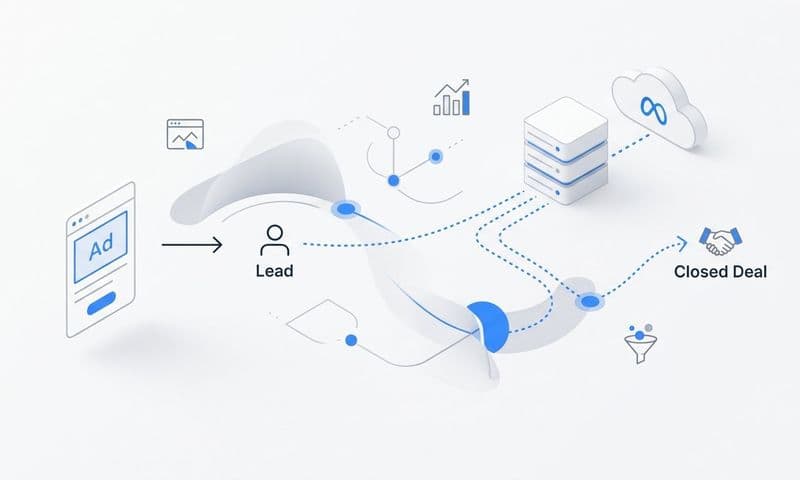
The critical gap? Your attribution platform typically stops tracking at "lead created." It has no idea that lead became a $50,000 customer three months later. Meanwhile, your CRM records that $50,000 deal without knowing it started with a specific LinkedIn ad, included three blog post visits, and converted after a retargeting campaign.
Picture this scenario: A prospect clicks your Facebook ad on Monday, visits your pricing page Tuesday, downloads a case study Wednesday, and submits a demo request Thursday. Your attribution platform sees all four touchpoints. But when that lead becomes a $50,000 customer two months later, your CRM records the revenue without connecting it back to that original Facebook ad. You're making budget decisions blind to which marketing actually drives revenue.
What "Integration" Really Delivers
True integration creates bidirectional data flow that enriches both systems and fundamentally changes what you can measure. Here's what actually happens:
Marketing Touchpoints Flow Into Your CRM: When someone converts, your attribution platform doesn't just send a name and email address. It sends the complete journey—every ad clicked, every page visited, every piece of content consumed, with timestamps and UTM parameters. Your sales team sees exactly how this lead discovered you and what they're interested in.
Revenue Outcomes Flow Back to Your Attribution Platform: When deals close in your CRM, that revenue data flows back to your attribution platform. Now your attribution system knows that Facebook ad didn't just generate a lead—it generated $50,000 in revenue. That LinkedIn campaign didn't just fill your pipeline—it closed three deals worth $150,000 combined.
This is especially powerful for multi-touch attribution, where understanding the full customer journey—from first click to closed deal—determines which channels deserve more budget and which are just generating vanity metrics.
The transformation is profound. With integration, you discover that your LinkedIn ads generate fewer leads than Facebook, but LinkedIn leads close at three times the rate and double the deal size. Without integration, you might have cut LinkedIn budget based on lead volume alone—a $500,000 mistake.
Integration doesn't just add more data to your reports—it fundamentally changes which questions you can answer and which decisions you can make with confidence.
The Two Systems That Need to Talk
Marketing attribution platforms and CRM systems weren't designed to work together—they were built to solve different problems. Attribution platforms track the marketing side of your business: every ad click, landing page visit, content download, email open, and form submission. They answer questions like "Which campaign drove this lead?" and "How many touchpoints did it take to convert?"
Your CRM, on the other hand, lives in the sales and revenue world. It tracks what happens after someone becomes a lead: qualification calls, opportunity creation, deal progression, proposal negotiations, closed revenue, and customer lifetime value. It answers questions like "Which leads are worth pursuing?" and "How much revenue did we close this quarter?"
Here's the problem: these systems operate in silos, each with a massive blind spot.
Your attribution platform sees the entire journey up to the moment someone fills out a form or books a demo. It knows that prospect clicked your Facebook ad on Monday, visited your pricing page Tuesday, downloaded a case study Wednesday, and submitted a demo request Thursday. But when that lead becomes a $50,000 customer two months later? Your attribution platform has no idea. It stopped watching at "lead created."
Your CRM sees the opposite half of the story. It knows a $50,000 deal closed, that it took six weeks to close, and that the customer came from the enterprise segment. But it doesn't know that deal started with a specific Facebook ad, or that the prospect engaged with three pieces of content before converting, or that a retargeting campaign brought them back after they went dark for a week.
This disconnect creates a dangerous situation: you're making budget decisions based on which channels generate the most leads, not which channels generate the most revenue. You're celebrating campaigns that fill your pipeline with tire-kickers while overlooking the quiet performers that consistently close high-value deals.
Think about what this means in practice. Your attribution dashboard shows Facebook delivering leads at $30 each while LinkedIn delivers leads at $90 each. Based on cost per lead, Facebook looks like the clear winner. But without CRM integration, you don't know that LinkedIn leads close at three times the rate and two times the deal size—making LinkedIn dramatically more profitable despite the higher cost per lead.
This is why integration matters. When these two systems actually talk to each other—when your attribution platform sends complete touchpoint history to your CRM, and your CRM sends revenue outcomes back to your attribution platform—you stop flying blind. You can finally see which specific ads, keywords, campaigns, and content pieces drive actual revenue, not just form submissions.
The goal isn't to replace either system. It's to make both systems smarter by filling in each other's blind spots, creating a complete view from first click to closed deal.
What "Integration" Really Delivers
True integration isn't just about moving data from one system to another. It's about creating a continuous feedback loop that fundamentally changes what you can see, measure, and optimize.
At its core, integration establishes bidirectional data flow between your attribution platform and CRM. Marketing touchpoints—ad clicks, UTM parameters, landing page visits, content downloads, email engagement—flow from your attribution platform into your CRM, enriching every lead record with complete journey history. Then the magic happens in reverse: revenue events flow back from your CRM to your attribution platform. Deal creation, opportunity values, closed-won status, final revenue amounts—all of this feeds back into your marketing intelligence system.
This creates something most marketing teams have never experienced: an enriched customer journey that spans from first anonymous website visit to final signed contract. Every touchpoint lives in one connected view. You can see that a prospect clicked a LinkedIn ad on Monday, downloaded a whitepaper on Wednesday, attended a webinar the following week, requested a demo two weeks later, and closed as a $75,000 customer six weeks after that first click.
The real power emerges in closed-loop reporting. Instead of celebrating campaigns that generate the most form submissions, you start optimizing for campaigns that generate the most revenue. Many teams use BigQuery GA4 marketing attribution to analyze this data at scale, combining Google Analytics 4 event data with CRM revenue outcomes for comprehensive reporting.
Revenue attribution becomes possible for the first time. You can assign actual dollar values to marketing touchpoints based on real closed deals. That Facebook ad didn't just generate 50 leads—it generated $250,000 in closed revenue. That blog post didn't just get 1,000 views—it assisted in $180,000 worth of deals. These insights transform budget conversations from defending marketing spend to demonstrating marketing ROI.
Consider what this means in practice. Your LinkedIn ads generate 30 leads per month while Facebook delivers 150. Without integration, Facebook looks like the obvious winner—five times the volume at similar cost per lead. But integration reveals the complete story: LinkedIn leads close at 25% with an average deal size of $40,000, generating $300,000 in monthly revenue. Facebook leads close at 4% with $15,000 average deals, generating $90,000 monthly. LinkedIn delivers more than 3x the revenue despite generating 80% fewer leads.
Without integration, you might have shifted budget away from LinkedIn to scale Facebook's lead volume—a decision that would have cost you over $200,000 in monthly revenue. With integration, you confidently double down on LinkedIn and optimize Facebook campaigns to attract higher-quality prospects instead of just more prospects.
This is the fundamental shift integration enables: from marketing activity tracker to revenue intelligence system. You stop optimizing for metrics that don't matter and start optimizing for the only metric that does—revenue generated per dollar spent.
Why CRM Integration Transforms Your Marketing Intelligence
Most marketing teams are optimizing for the wrong metrics. They celebrate low cost-per-lead numbers and high lead volumes because that's what their attribution dashboards show. But here's the uncomfortable truth: lead volume and revenue impact often move in opposite directions.
CRM integration doesn't just add more data to your reports. It fundamentally changes which questions you can answer and which decisions you can make with confidence. Let's break down exactly how this transformation happens.
The Lead Quality Blind Spot
Without CRM integration, you're flying blind on the metric that actually matters—revenue per marketing dollar spent. Your attribution platform shows you which channels generate the most leads at the lowest cost. Your CRM shows you which deals close and for how much. But the connection between them? That's where the expensive mistakes happen.
Here's a scenario that plays out constantly: Your Facebook campaigns generate 100 leads monthly at $20 cost per lead—that's $2,000 in ad spend. Google Ads delivers 50 leads at $40 each, also $2,000 spent. Facebook looks twice as efficient based on lead volume and cost metrics.
But when you connect your CRM data, the story flips completely. Those Google leads close at 20% with an average deal value of $10,000. That's 10 customers generating $100,000 in revenue from your $2,000 investment. Meanwhile, Facebook leads close at just 2% with $3,000 average deals—2 customers and $6,000 in revenue for the same spend.
Google delivers 16x more revenue per dollar spent, but without CRM integration, you'd never know it. You'd keep celebrating Facebook's "efficiency" while systematically underinvesting in your most profitable channel. For e-commerce businesses, marketing attribution for e-commerce becomes even more critical as purchase behavior and customer lifetime value vary dramatically across acquisition channels.
The Multi-Touch Attribution Problem
Most B2B buyers don't convert on their first visit. They click an ad, browse your website, leave, come back through organic search, download a resource, get retargeted, attend a webinar, and finally request a demo. That's six touchpoints before they even talk to sales.
Without CRM integration, your attribution platform can track all six touchpoints—but it has no idea which combination actually drives revenue. Did that webinar attendee who clicked three retargeting ads close a deal? Or did they ghost your sales team after the first call?
With CRM integration, you can see the complete picture. You discover that prospects who attend webinars and then engage with retargeting ads close at 35%, while those who skip the webinar close at just 8%. That insight is worth hundreds of thousands in optimized ad spend—but it's invisible without the connection between marketing touchpoints and revenue outcomes.
This becomes especially powerful when you implement GA4 marketing attribution alongside your CRM integration, giving you both the granular event tracking of Google Analytics 4 and the revenue outcomes from your sales pipeline.
The Channel Mix Optimization Gap
Here's where most marketing teams make their most expensive mistakes: channel budget allocation. Without CRM integration, you're allocating budget based on which channels generate the most leads or the lowest cost per lead. With CRM integration, you allocate based on which channels generate the most revenue per dollar spent.
The difference is staggering. A marketing team we analyzed was spending 60% of their budget on Facebook because it generated 70% of their leads. When they integrated their CRM data, they discovered Facebook was generating only 20% of their revenue. LinkedIn, which received just 15% of budget, was driving 45% of revenue.
They reallocated budget to match revenue contribution rather than lead volume. The result? A 40% increase in total revenue with the same marketing budget. That's the power of optimizing for the right metric.
The Sales Enablement Advantage
CRM integration doesn't just help marketing make better decisions—it transforms how sales engages with leads. When marketing touchpoint data flows into your CRM, your sales team sees exactly how each lead discovered you and what they're interested in.
Instead of cold calling with generic pitches, your sales team can reference the specific blog post the prospect read, the webinar they attended, or the case study they downloaded. This context dramatically improves conversion rates because sales conversations become relevant and personalized from the first interaction.
One sales team reported that leads with complete touchpoint history in their CRM closed 2.3x faster than leads with just basic contact information. The sales team could skip the discovery phase and jump straight into addressing the specific problems the prospect had already researched on the website.
The Lifetime Value Connection
The most sophisticated benefit of CRM integration emerges over time: understanding which marketing channels drive the highest lifetime value customers, not just the most customers.
You might discover that organic search generates customers who stay for an average of 18 months, while paid social generates customers who churn after 6 months. Even if paid social has a lower cost per acquisition, organic search delivers 3x more lifetime value per customer.
Without CRM integration, you'd never see this pattern. You'd keep optimizing for acquisition cost while systematically attracting customers who don't stick around. With integration, you can shift budget toward channels that attract customers who stay, grow, and refer others—even if those channels have higher upfront acquisition costs.
This is the fundamental transformation CRM integration enables: from optimizing for marketing efficiency to optimizing for business outcomes. You stop celebrating vanity metrics and start driving real revenue growth.
How Marketing Attribution CRM Integration Actually Works
Understanding what integration delivers is one thing. Understanding how it actually works—the technical mechanics, data flows, and system requirements—is what separates teams who implement it successfully from those who struggle with half-broken integrations that create more problems than they solve.
Let's break down exactly how data moves between systems, what gets tracked, and what you need to make it work.
The Technical Architecture
At its core, marketing attribution CRM integration relies on three technical components working together: your attribution platform, your CRM, and the connection layer that moves data between them.
Your attribution platform sits on your website, tracking visitor behavior through JavaScript pixels or server-side tracking. It captures every page view, form submission, button click, and conversion event. It also captures UTM parameters, referral sources, ad click IDs, and campaign identifiers from your marketing channels.
Your CRM stores lead records, opportunity records, and customer records. Each record has a unique identifier and contains fields for contact information, deal values, pipeline stages, close dates, and revenue amounts.
The connection layer—whether it's a native integration, API connection, or middleware platform like Zapier—moves data between these systems bidirectionally. When someone converts on your website, the attribution platform sends their complete touchpoint history to your CRM. When deals progress or close in your CRM, that revenue data flows back to your attribution platform.
The Data That Flows From Attribution to CRM
When a prospect converts—fills out a form, books a demo, starts a trial—your attribution platform sends a rich data package to your CRM. This isn't just name and email. It's the complete marketing journey.
Here's what flows:
Touchpoint History: Every ad clicked, every page visited, every piece of content consumed, with timestamps. Your CRM receives a chronological record of how this person discovered you and what they engaged with.
For teams evaluating different platforms, comparing Measured alternatives or WeTracked alternatives helps identify which attribution tools offer the most comprehensive CRM integration capabilities and data transfer options.
Campaign Attribution: UTM parameters, ad campaign names, ad set IDs, keyword data, and referral sources. Your sales team knows exactly which marketing campaign brought this lead in.
Engagement Metrics: Time on site, pages viewed, content downloads, email opens, and video watches. This behavioral data helps sales prioritize leads and personalize outreach.
Device and Location Data: Browser, device type, geographic location, and company information (if available through IP lookup). This context helps sales understand who they're talking to.
All of this data gets attached to the lead record in your CRM, creating a complete picture of the prospect before sales ever makes contact.
The Data That Flows From CRM to Attribution
The reverse flow is equally important. As leads progress through your sales pipeline, your CRM sends status updates and revenue data back to your attribution platform.
Here's what flows back:
Lead Status Changes: When a lead gets qualified, disqualified, or converted to an opportunity, that status update flows back to your attribution platform. You can see which marketing campaigns generate qualified leads versus junk leads.
Opportunity Creation: When a lead becomes a real sales opportunity, your attribution platform learns which marketing touchpoints led to pipeline creation. You can measure marketing's impact on pipeline generation, not just lead generation.
Deal Values: The estimated or actual value of each opportunity flows back, allowing your attribution platform to calculate potential revenue by channel, campaign, and touchpoint.
Closed-Won Revenue: When deals close, the final revenue amount flows back to your attribution platform. This is the critical data that transforms your attribution from activity tracking to revenue tracking.
Closed-Lost Reasons: When deals don't close, the reason codes flow back. You can see which marketing channels generate leads that lose to competitors, pricing objections, or timing issues.
This reverse flow is what enables true closed-loop attribution. Your attribution platform can now show you not just which campaigns generated leads, but which campaigns generated revenue.
The Matching Logic
The trickiest part of integration is matching: ensuring that the lead record in your CRM corresponds to the correct visitor session in your attribution platform, and that revenue events in your CRM get attributed to the right marketing touchpoints.
Most integrations use email address as the primary matching key. When someone fills out a form, their email address gets sent to both systems. When revenue data flows back from your CRM, the integration matches that email address to the original visitor session and attributes revenue to the associated touchpoints.
But email matching has limitations. If someone uses a different email address in your CRM than they used on your website, the match fails. If someone converts anonymously (through a phone call or in-person event) and gets manually added to your CRM, there's no website session to match to.
Sophisticated integrations use multiple matching methods: email address, phone number, company domain, and custom identifiers. They also support offline conversion import, allowing you to manually upload conversions that happened outside your website and attribute them to marketing touchpoints based on timeframe and source.
The Attribution Model Layer
Once data flows bidirectionally, your attribution platform applies attribution models to assign credit for revenue across multiple touchpoints. This is where you decide how to distribute credit when a customer interacts with five different marketing campaigns before converting.
Common attribution models include:
First-Touch Attribution: All credit goes to the first marketing touchpoint. Useful for understanding which channels drive initial awareness.
Last-Touch Attribution: All credit goes to the final touchpoint before conversion. Useful for understanding which channels drive final conversions.
Linear Attribution: Credit is distributed equally across all touchpoints. Simple but often inaccurate because not all touchpoints have equal impact.
Time-Decay Attribution: More recent touchpoints receive more credit. Useful when you believe later interactions have more influence on conversion decisions.
Position-Based Attribution: Extra credit goes to first and last touchpoints, with remaining credit distributed among middle touchpoints. Balances awareness and conversion influence.
For complex B2B sales cycles, account based marketing attribution becomes essential, tracking touchpoints across multiple contacts within the same target account and attributing revenue at the account level rather than the individual lead level.
The attribution model you choose dramatically affects which channels appear most valuable. A channel that excels at first-touch (driving awareness) might look weak under last-touch attribution (driving conversions), and vice versa. The best practice is to analyze multiple models and understand how each channel contributes across the customer journey.
The Technical Requirements
To make integration work, you need several technical components in place:
Attribution Tracking Pixel: JavaScript code on your website that tracks visitor behavior and captures conversion events. This must be properly implemented on all pages, including thank-you pages and conversion confirmation pages.
CRM API Access: Your attribution platform needs API credentials to read and write data in your CRM. This typically requires admin-level permissions and proper API rate limit management.
Webhook Configuration: Real-time data sync often relies on webhooks—automated notifications that trigger when specific events occur in either system. These need to be configured to fire on relevant events like form submissions, deal closures, and status changes.
Custom Field Mapping: Your CRM needs custom fields to store attribution data—fields for first-touch source, last-touch source, all touchpoints, UTM parameters, and revenue attribution. These fields must be mapped correctly in the integration configuration.
Data Governance: You need clear rules for data retention, privacy compliance, and data quality. What happens when someone requests data deletion? How do you handle duplicate records? What's your policy on tracking anonymous visitors?
Most modern attribution platforms provide pre-built integrations with major CRMs like Salesforce, HubSpot, and Pipedrive. These native integrations handle most technical complexity automatically, but they still require proper configuration and testing.
The Testing and Validation Process
Integration isn't complete when data starts flowing—it's complete when you've validated that the right data flows accurately and reliably. This requires systematic testing.
Start with a test conversion. Fill out a form on your website using a test email address. Verify that a lead record appears in your CRM with complete touchpoint history. Check that UTM parameters, referral source, and engagement data all transferred correctly.
Then test the reverse flow. Move that test lead through your sales pipeline—mark it as qualified, convert it to an opportunity, add a deal value, and mark it closed-won. Verify that each status change flows back to your attribution platform and that revenue gets attributed to the correct marketing touchpoints.
Test edge cases: What happens when someone converts twice with different email addresses? What happens when a deal gets reopened after closing? What happens when someone converts offline and gets manually added to your CRM?
For mobile app businesses, mobile marketing attribution adds another layer of complexity, requiring integration between mobile attribution platforms, web attribution platforms, and CRM systems to track users across devices and platforms.
Run data quality audits regularly. Check for orphaned records (leads in your CRM with no attribution data), mismatched records (leads attributed to the wrong touchpoints), and missing data (revenue events that didn't flow back to your attribution platform).
Integration is never "set it and forget it." It requires ongoing monitoring, maintenance, and optimization to ensure data continues flowing accurately as your marketing stack evolves.
Ready to elevate your marketing game with precision and confidence? Discover how Cometly's AI-driven recommendations can transform your ad strategy—**Get your free demo** today and start capturing every touchpoint to maximize your conversions.