
Your marketing team just celebrated a major win. Facebook Ads Manager shows 200 conversions this month, and you've been scaling that campaign aggressively. But when you check your CRM, only 120 of those customers actually came from Facebook. Google Analytics claims credit for 95 of the same conversions. Your email platform says it drove 40 of them.
Which number is real? And more importantly—which campaigns should you actually be scaling?
This isn't just a reporting headache. It's a budget allocation crisis that's costing you real money. When attribution data conflicts across platforms, you end up pouring budget into channels that look successful but aren't actually driving results. Meanwhile, the campaigns that truly influence conversions get starved of investment because their impact remains invisible.
The problem isn't that you lack attribution data. Most marketing teams are drowning in it. The issue is that this data lives in fragmented silos—each platform using different conversion windows, attribution models, and tracking methodologies. Your Facebook pixel sees one customer journey. Google Analytics sees another. Your CRM sees a third. None of them talk to each other, and none of them show the complete picture.
Research shows that businesses with fragmented attribution systems typically misallocate 25-35% of their marketing budget to underperforming channels. That's not a rounding error. For a company spending $50,000 monthly on marketing, that's $12,500-$17,500 wasted every single month on campaigns that don't actually drive the results they're credited with.
The solution isn't another analytics dashboard or a fancier reporting template. It's implementing a unified attribution system that tracks every customer touchpoint across all platforms, connects those interactions to actual revenue, and shows you exactly which marketing efforts drive real business results.
This guide walks you through the complete implementation process, step-by-step. You'll learn how to audit your current attribution landscape, choose the right attribution models for your business, implement server-side tracking that captures data traditional analytics miss, connect all your marketing platforms and sales systems, configure sophisticated multi-touch attribution logic, and build validation systems that ensure your data stays accurate.
By the end, you'll have a roadmap to build an attribution system that actually works—one that shows you the true impact of every marketing dollar you spend and gives you the confidence to scale what's working while cutting what isn't.
Let's walk through how to implement marketing attribution that drives real ROI, step-by-step.
Step 1: Audit Your Current Attribution Landscape
Before you can fix your attribution system, you need to understand exactly what you're working with. Most marketing teams discover they're running 3-7 different attribution systems simultaneously—each claiming credit for the same conversions, each using different methodologies, and none of them talking to each other.
This audit reveals where your attribution data lives, where it conflicts, and where critical gaps exist. Skip this step, and you'll build your new attribution system on top of a broken foundation.
Inventory Your Existing Data Sources
Start by cataloging every platform currently tracking conversions and customer interactions. This includes the obvious ones—Google Analytics, Facebook Pixel, LinkedIn Insight Tag—but also the systems marketing teams often forget: your CRM, email platform, phone tracking software, chat tools, and any third-party analytics.
For each system, document three critical details: what events it captures, how it defines conversions, and what attribution model it uses by default. You'll quickly discover the chaos. Google Analytics might count a conversion when someone completes a purchase. Facebook claims credit if someone clicked an ad within 7 days. Your CRM attributes the sale to whoever created the contact record.
Here's where it gets interesting. An e-commerce business running this inventory discovered that Google Analytics showed 100 conversions last month, Facebook claimed credit for 85 of those same purchases, and their email platform said it drove 40 of them. The math doesn't work because each platform uses different conversion windows and attribution rules.
Create a spreadsheet listing every tracking system, the events each one captures, its default attribution model, and its conversion window. This becomes your attribution baseline—the messy reality you're starting from.
Identify Attribution Gaps and Conflicts
Now that you know what you're tracking, identify what you're missing. The biggest attribution gaps typically fall into three categories: offline conversions not connected to online touchpoints, cross-device customer journeys creating attribution breaks, and high-value interactions that aren't tracked at all.
Phone calls represent one of the most common blind spots. A B2B company might generate leads through LinkedIn ads, but those prospects call the sales team directly. If those calls aren't tracked and connected back to the LinkedIn campaign, that channel looks like it's underperforming when it's actually driving your highest-value conversions.
These attribution gaps don't just create reporting confusion—they directly undermine marketing performance improvement by causing budget misallocation to underperforming channels. When you can't see which touchpoints influence conversions, you end up scaling campaigns based on incomplete data.
Cross-device tracking presents another major gap. Your customer researches products on mobile during their commute, compares options on their work computer during lunch, and completes the purchase on their home laptop that evening. If your mobile marketing attribution system can't connect those three sessions to the same person, you're missing two-thirds of their customer journey.
Document every gap you find: offline conversions, cross-device breaks, untracked touchpoints, and channels where attribution data conflicts. Be brutally honest. The gaps you ignore now will undermine your entire attribution implementation later.
Map Your Complete Customer Journey
With your data sources inventoried and gaps identified, map out how customers actually move through your marketing funnel. This isn't about creating an idealized customer journey—it's about documenting the messy, non-linear paths real customers take before converting.
Start by analyzing a sample of recent conversions. Pull data from your CRM, analytics platforms, and any other systems that capture customer touchpoints. For each conversion, trace backward to identify every marketing interaction that preceded it. You'll likely discover that customers interact with 5-12 touchpoints before converting, spanning multiple channels and devices.
A B2B software company mapping their customer journey found that their typical conversion path included: initial awareness through a LinkedIn ad, website visit to read blog content, return visit from organic search, webinar registration from an email campaign, webinar attendance, demo request, sales call, and finally purchase. That's eight touchpoints across five different channels—and their B2B marketing attribution system was only capturing three of them.
For e-commerce businesses, the journey might be shorter but equally complex. Customers might discover products through Instagram ads, compare prices through Google Shopping, read reviews on your site, abandon their cart, receive a retargeting email, and finally complete the purchase. Understanding these patterns helps you identify which touchpoints truly influence conversions versus which ones just happen to be present in the customer journey.
Document the most common paths to conversion, noting where attribution data exists and where it's missing. This map becomes your blueprint for what your attribution system needs to capture and how different touchpoints should be weighted in your attribution model.
Step 2: Define Your Attribution Goals and Model
With your current attribution landscape mapped, you need to define what success looks like for your business. Attribution isn't one-size-fits-all—the right model depends on your sales cycle length, average deal size, marketing channel mix, and business objectives.
This step determines how credit gets distributed across touchpoints and ensures your attribution system answers the questions that actually matter for your business decisions.
Choose the Right Attribution Model
Attribution models determine how credit for conversions gets distributed across the various touchpoints in a customer journey. The model you choose fundamentally shapes how you evaluate channel performance and allocate budget.
Last-click attribution gives 100% credit to the final touchpoint before conversion. It's simple and matches how most advertising platforms report by default, but it ignores all the marketing that built awareness and consideration. First-click attribution does the opposite—crediting only the initial touchpoint. It helps you understand what drives awareness but tells you nothing about what closes deals.
We compare the leading options in our WooCommerce Instagram ad tool roundup.
Linear attribution distributes credit equally across all touchpoints. If a customer interacted with five marketing channels before converting, each gets 20% credit. This approach values every interaction but doesn't account for the reality that some touchpoints influence conversions more than others.
Time-decay attribution gives more credit to touchpoints closer to conversion, acknowledging that recent interactions typically have more influence on purchase decisions. Position-based (U-shaped) attribution assigns 40% credit to the first touchpoint, 40% to the last, and distributes the remaining 20% among middle interactions.
For most businesses, the optimal approach involves understanding the types of marketing attribution models available and selecting one that aligns with your sales cycle. B2B companies with long sales cycles often benefit from position-based or time-decay models that recognize both awareness-building and deal-closing touchpoints. E-commerce businesses with shorter purchase cycles might find linear or time-decay models more appropriate.
Align Attribution with Business Objectives
Your attribution model should answer specific business questions. Are you trying to understand which channels drive new customer acquisition? Which touchpoints influence repeat purchases? Which campaigns generate the highest lifetime value customers?
A subscription software company might care most about which marketing channels acquire customers with the lowest churn rates and highest expansion revenue. Their attribution system needs to track not just initial conversions but also subsequent product usage, upgrade behavior, and retention metrics. Standard attribution models that only measure initial conversion miss the complete picture.
An e-commerce business might prioritize understanding which channels drive first-time buyers versus repeat customers. Their marketing attribution for e-commerce needs to segment attribution data by customer type and potentially use different models for each segment.
Define 3-5 specific questions your attribution system must answer. Examples: "Which paid channels generate customers with the highest 90-day LTV?" or "What's the optimal budget split between awareness and conversion campaigns?" or "Which content types most effectively move prospects from consideration to purchase?"
These questions determine what data you need to capture, how you'll structure your attribution logic, and which reports you'll build. Without clear objectives, you'll end up with an attribution system that generates impressive dashboards but doesn't actually inform decisions.
Set Up Conversion Tracking Standards
Before implementing tracking, establish standards for how conversions get defined and measured across all platforms. Inconsistent conversion definitions create the attribution chaos you're trying to solve.
Start by defining your conversion events with precision. "Purchase" seems straightforward, but does it fire when someone clicks "Buy Now," when payment processes successfully, or when the order ships? Each definition creates different conversion counts and different attribution results.
For B2B businesses, conversion definitions get even more complex. Is a conversion when someone fills out a contact form, when they book a demo, when they become a qualified lead, or when they close as a customer? Your attribution system needs to track all of these as separate events, but you need to decide which one represents your primary conversion for attribution purposes.
Document the exact trigger conditions for each conversion event. Specify the page URL, form submission, button click, or other action that constitutes a conversion. Define the conversion value—actual revenue for e-commerce, estimated deal size for B2B, or lifetime value for subscription businesses.
Establish conversion windows that match your sales cycle. If customers typically convert within 7 days of their first interaction, a 30-day attribution window gives too much credit to early touchpoints. If your B2B sales cycle averages 90 days, a 7-day window misses most of the customer journey.
Create a conversion tracking specification document that every team member and platform follows. This becomes your source of truth for what gets tracked, how it's measured, and how attribution credit gets assigned.
Step 3: Implement Server-Side Tracking Infrastructure
Client-side tracking—the JavaScript pixels most marketing platforms use—is increasingly unreliable. Ad blockers, browser privacy features, and iOS tracking restrictions mean you're missing 20-40% of conversions with traditional tracking methods.
Server-side tracking captures conversion data on your server before sending it to marketing platforms, bypassing browser-based restrictions and providing more accurate attribution data.
Set Up Server-Side Tracking for Key Platforms
Server-side tracking works by capturing conversion events on your server, then sending that data to advertising platforms through their server-to-server APIs. Instead of relying on browser pixels that users can block, your server communicates directly with Facebook, Google, and other platforms.
Start with your highest-spend advertising platforms. For most businesses, that means Facebook Conversions API and Google Ads offline conversion tracking. These platforms provide APIs specifically designed to receive server-side conversion data.
Implementation requires technical work but follows a consistent pattern. When a conversion occurs on your website—someone completes a purchase, submits a form, or takes another valuable action—your server captures that event along with identifying information like email address, phone number, or user ID.
Your server then sends this conversion data to the advertising platform's API, including the conversion event, value, timestamp, and user identifiers. The platform matches this server-side data with ad impressions and clicks to attribute the conversion to the correct campaign.
For Facebook Conversions API, you'll need to set up an endpoint on your server that captures conversion events, then use Facebook's API to send those events with parameters like event name, event time, user data (hashed email, phone, etc.), and custom data like purchase value. Google Ads offline conversion tracking follows a similar pattern but uses Google's API and requires Google Click IDs (GCLIDs) to match conversions to clicks.
The technical implementation varies based on your website platform. E-commerce platforms like Shopify and WooCommerce have plugins that simplify server-side tracking setup. Custom websites require developer work to build the server-side tracking infrastructure.
Implement Cross-Domain and Cross-Device Tracking
Customer journeys rarely stay on a single domain or device. Someone might click your ad on mobile, research on their laptop, and convert on their tablet. Your attribution system needs to recognize these as the same person.
Cross-domain tracking becomes critical if your marketing funnel spans multiple domains—perhaps your main website, a separate checkout domain, or landing pages on different subdomains. Without proper cross-domain tracking, each domain appears as a separate session, breaking attribution chains.
Implement cross-domain tracking by passing user identifiers between domains. When someone clicks from your main site to your checkout domain, append a tracking parameter to the URL that carries their user ID. Your checkout domain reads this parameter and continues the same session instead of starting a new one.
For Google Analytics, this means configuring cross-domain tracking in your GA4 property and ensuring all domains are properly linked. For advertising platforms, it means maintaining consistent user identifiers across domains so conversions can be matched back to ad clicks regardless of which domain they occur on.
Cross-device tracking requires user authentication. When someone logs into your website or app, you can connect their activity across all devices where they're logged in. Without authentication, cross-device tracking relies on probabilistic matching—using signals like IP address, browser fingerprints, and behavior patterns to guess when different sessions belong to the same person.
Implement a consistent user ID system across your website, app, and backend systems. When someone creates an account or logs in, assign them a unique identifier that persists across sessions and devices. Pass this identifier to your analytics and advertising platforms so they can connect cross-device activity.
Build a Unified Customer Database
Your attribution system needs a single source of truth for customer data. This unified database connects marketing touchpoints to actual customers and revenue, enabling accurate attribution across the entire customer journey.
Start by implementing a customer data platform (CDP) or building a custom database that aggregates data from all your marketing and sales systems. This database should store every customer interaction—ad clicks, website visits, email opens, form submissions, purchases, support tickets, and any other touchpoint.
The key is consistent customer identification. Each record in your database needs a unique customer ID that connects all their interactions across channels and devices. When someone clicks a Facebook ad, visits your website, submits a form, and later makes a purchase, all four events should link to the same customer ID.
Implement identity resolution logic that matches anonymous website visitors to known customers. When someone who previously visited anonymously later submits a form with their email address, your system should retroactively connect their earlier anonymous sessions to their customer record.
Your unified database becomes the foundation for multi-touch attribution. Instead of relying on individual platform data that only sees part of the customer journey, you have a complete record of every touchpoint. This enables sophisticated attribution analysis that accurately credits each marketing channel for its role in driving conversions.
Step 4: Connect Marketing Platforms and Sales Systems
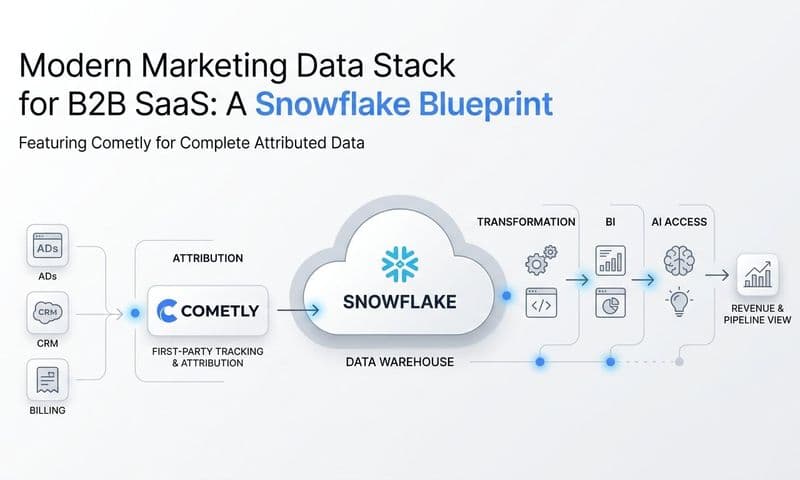
Attribution only works when all your marketing platforms and sales systems talk to each other. The Facebook ad that generated initial awareness needs to connect to the Google search that drove consideration, the email that prompted action, and the CRM record that shows the final sale.
This integration layer ensures conversion data flows between systems and enables true multi-touch attribution across your entire marketing stack.
Integrate Advertising Platforms with Analytics
Your advertising platforms need to send conversion data to your analytics system, and your analytics system needs to send conversion data back to advertising platforms. This bidirectional data flow enables both accurate reporting and automated campaign optimization.
Start by connecting your advertising platforms to Google Analytics or your analytics tool of choice. Import cost data from Facebook Ads, Google Ads, LinkedIn Ads, and other platforms so you can analyze ROI alongside conversion data. Most platforms offer native integrations or API connections that automatically sync daily spend and impression data.
Configure conversion tracking so your analytics platform receives conversion events from all advertising channels. This typically involves implementing tracking pixels or using server-side tracking to send conversion data to your analytics tool whenever someone completes a valuable action.
Then set up the reverse flow—sending conversion data from your analytics or CRM back to advertising platforms. This is where tools like GA4 marketing attribution become valuable, as they can track conversions and feed that data back to ad platforms for optimization. Facebook Conversions API and Google Ads offline conversions enable you to send server-side conversion data that advertising algorithms use to optimize campaign delivery.
This bidirectional integration solves two problems. First, it gives you unified reporting where you can see performance across all channels in one place. Second, it improves campaign performance by giving advertising platforms more accurate conversion data to optimize against.
Connect CRM and Revenue Data
Marketing attribution isn't complete until it connects to actual revenue. Your CRM holds the truth about which leads became customers, how much they spent, and their lifetime value. Connecting this revenue data back to marketing touchpoints is what transforms attribution from interesting reporting into actionable business intelligence.
Integrate your CRM with your attribution system so every customer record includes their complete marketing journey. When a lead enters your CRM, bring along the data about which ads they clicked, which pages they visited, which emails they opened, and which campaigns they engaged with.
Most modern CRMs offer native integrations with marketing platforms or support custom API connections. Salesforce, HubSpot, and Pipedrive all provide ways to sync marketing data with customer records. The goal is ensuring that when a deal closes, you can trace it back to every marketing touchpoint that influenced that customer.
For B2B businesses, this CRM integration is critical because the conversion that matters isn't form submission—it's closed revenue. Your attribution system might show that LinkedIn ads generate lots of leads, but if those leads never close, that channel isn't actually performing. Only by connecting CRM data can you attribute revenue to marketing channels rather than just lead volume.
Implement revenue tracking that updates as customer value changes. If a customer makes repeat purchases or upgrades their subscription, that additional revenue should be attributed back to the original marketing channels that acquired them. This lifetime value attribution shows which channels acquire the most valuable customers, not just the most customers.
Set Up Automated Data Syncing
Manual data exports and imports don't scale and introduce errors. Your attribution system needs automated data syncing that keeps all platforms updated in real-time or near-real-time.
Implement API-based integrations that automatically sync data between systems. When a conversion occurs on your website, it should automatically flow to your analytics platform, CRM, and advertising platforms without manual intervention. When a deal closes in your CRM, that revenue data should automatically update your attribution reports.
Use integration platforms like Zapier, Make, or custom API connections to build these automated workflows. Set up triggers that fire when specific events occur—a new purchase, a form submission, a deal stage change—and actions that update other systems with that data.
Build error handling and monitoring into your data syncs. Set up alerts that notify you when syncs fail or when data discrepancies appear between systems. Regularly audit your integrations to ensure data flows correctly and completely.
The goal is a marketing stack where data flows seamlessly between all systems, giving you real-time visibility into campaign performance and attribution without manual reporting work. When you can track digital marketing performance automatically across all platforms, you spend less time on reporting and more time on optimization.
Step 5: Configure Multi-Touch Attribution Logic
With tracking implemented and systems connected, you need to configure the attribution logic that determines how credit gets distributed across touchpoints. This is where your attribution model comes to life and starts informing actual business decisions.
The attribution logic you build here determines which channels get credit for conversions and ultimately shapes how you allocate marketing budget.
Build Custom Attribution Rules
Standard attribution models—first-click, last-click, linear—provide a starting point, but most businesses benefit from custom rules that reflect their specific customer journey and business model.
Start by analyzing your customer journey data to identify which touchpoints genuinely influence conversions versus which ones are just present in the path. A customer might see a display ad, but did that ad actually influence their decision, or were they already planning to purchase?
Build attribution rules that weight touchpoints based on their actual influence. You might decide that initial awareness touchpoints (first ad click, first website visit) get 30% credit, middle-funnel interactions (content engagement, email clicks) get 20% credit, and bottom-funnel actions (demo requests, cart additions) get 50% credit.
For B2B businesses, consider implementing account based marketing attribution rules that credit touchpoints at the account level rather than individual level. When multiple people from the same company interact with your marketing before one person converts, all those touchpoints should be considered in attribution.
Create rules for different conversion types. A newsletter signup might use a last-click model since it's a low-commitment action, while a high-value purchase uses a position-based model that credits both awareness and closing touchpoints.
Document your attribution rules clearly so everyone understands how credit gets assigned. These rules should be transparent and logical, not black-box algorithms that no one can explain.
Handle Complex Customer Journeys
Real customer journeys are messy. People interact with your marketing across multiple devices, take breaks for days or weeks, engage with both paid and organic channels, and sometimes convert through offline channels like phone calls.
Your attribution logic needs to handle these complexities without breaking. Implement rules for common edge cases: What happens when someone clicks multiple ads from the same channel? How do you attribute conversions that happen weeks after the last tracked touchpoint? How do you handle customers who interact with both paid and organic search?
For multi-device journeys, implement cross-device attribution rules that connect touchpoints across devices when possible. If someone clicks an ad on mobile, researches on desktop, and converts on tablet, all three touchpoints should be included in attribution if they can be connected to the same user.
Handle offline conversions by implementing conversion import workflows. When someone calls your sales team or visits a physical store, capture that conversion and connect it back to their digital marketing touchpoints. This might involve asking customers how they heard about you, matching phone numbers to CRM records, or using location data to connect store visits to ad exposure.
Build attribution logic that handles long sales cycles. If your B2B sales cycle averages 90 days, your attribution window should extend at least that long. Implement time-decay rules that give more credit to recent touchpoints while still acknowledging early awareness-building interactions.
Create Attribution Reports and Dashboards
Attribution data is only valuable if it's accessible and actionable. Build reports and dashboards that answer your specific business questions and inform actual marketing decisions.
Start with channel-level attribution reports that show how much credit each marketing channel receives for conversions and revenue. This is your primary tool for budget allocation—understanding which channels drive the most valuable results when you account for their full role in the customer journey.
Create campaign-level reports that break down attribution by specific campaigns within each channel. You might discover that Facebook as a channel performs well, but 80% of that value comes from 20% of your campaigns. This granular attribution enables you to optimize within channels, not just across them.
Build customer journey reports that show common paths to conversion. Visualize the most frequent sequences of touchpoints that lead to purchases. These reports reveal patterns like "customers who engage with blog content before seeing retargeting ads convert at 3x the rate of those who only see ads."
Implement cohort analysis that compares attribution patterns across different customer segments. Do high-value customers follow different paths than low-value ones? Do repeat customers have different attribution patterns than first-time buyers? These insights inform not just budget allocation but also targeting and messaging strategies.
Make your attribution dashboards accessible to everyone who makes marketing decisions. Sales teams should see which marketing touchpoints influence their deals. Executives should see ROI by channel. Marketing managers should see campaign-level performance. Build different views for different stakeholders, all drawing from the same unified attribution data.
Step 6: Validate and Optimize Your Attribution System
Attribution implementation isn't finished when your tracking goes live. You need ongoing validation to ensure data accuracy and continuous optimization to improve attribution quality as your marketing evolves.
This final step builds the processes that keep your attribution system reliable and valuable over time.
Run Attribution Accuracy Tests
Before trusting your attribution data for major budget decisions, validate that it's actually accurate. Run controlled tests that verify your tracking captures conversions correctly and attributes them to the right sources.
Start with conversion tracking validation. Make test purchases or complete test conversions yourself, then verify that those conversions appear correctly in all your systems—analytics, CRM, advertising platforms, and attribution reports. Check that conversion values are accurate, timestamps are correct, and user identifiers match across systems.
Test cross-domain tracking by clicking through your funnel across multiple domains and verifying that the session remains connected. Test cross-device tracking by interacting with your marketing on multiple devices and checking whether those touchpoints connect to the same customer record.
Validate attribution logic by analyzing specific customer journeys and manually calculating what attribution credit each touchpoint should receive based on your rules. Compare your manual calculations to what your attribution system reports. Discrepancies indicate bugs in your attribution logic that need fixing.
Run holdout tests to measure attribution accuracy. For a small percentage of your traffic, disable certain tracking or attribution features, then compare reported conversions to actual conversions. This reveals how much data you're missing due to tracking limitations.
Document all validation tests and their results. When you find issues, fix them immediately and retest. Your attribution system is only as valuable as it is accurate.
Monitor Data Quality and Completeness
Attribution data quality degrades over time as tracking breaks, integrations fail, and platforms change their APIs. Implement ongoing monitoring that alerts you to data quality issues before they undermine your attribution accuracy.
Set up automated data quality checks that run daily or weekly. Monitor for sudden drops in tracked conversions, missing data from specific platforms, discrepancies between systems, and unusual patterns that might indicate tracking problems.
Track data completeness metrics: What percentage of conversions have complete attribution data? How many customer journeys have gaps where touchpoints are missing? What percentage of conversions can be matched to specific marketing sources versus appearing as "direct" traffic?
Build alerts that notify you when data quality metrics fall below acceptable thresholds. If your conversion tracking suddenly drops by 20%, you need to know immediately so you can investigate and fix the issue before it affects business decisions.
Regularly audit your integrations to ensure data still flows correctly between systems. Platform API changes, software updates, and configuration changes can break integrations without warning. Monthly integration audits catch these issues before they cause major data gaps.
Continuously Optimize Attribution Models
Your attribution model should evolve as your business and marketing strategy change. What works for a startup focused on rapid customer acquisition might not work for a mature business optimizing for customer lifetime value.
Regularly analyze whether your current attribution model accurately reflects which marketing drives business results. Compare attributed conversions to actual revenue. If channels that receive high attribution credit don't correlate with revenue growth, your model might be crediting the wrong touchpoints.
Run incrementality tests to measure the true impact of marketing channels. For specific channels, run holdout tests where you pause spending and measure the actual impact on conversions. If pausing a channel that receives 30% attribution credit only reduces conversions by 10%, that channel is getting too much credit in your model.
Experiment with different attribution models and compare results. Run parallel attribution analysis using multiple models—first-click, last-click, linear, time-decay, position-based—and see which one best predicts business outcomes. The model that most accurately identifies high-performing channels is the one you should use.
Update your attribution rules as your customer journey changes. If you launch new marketing channels, expand into new markets, or change your sales process, your attribution model needs to adapt. Quarterly attribution model reviews ensure your system stays aligned with business reality.
Putting It All Together
You now have a complete roadmap for implementing marketing attribution that actually works. Start with your audit—understanding what you're currently tracking and where the gaps exist. Then define clear attribution goals aligned with your business model, whether that's B2B with long sales cycles or e-commerce with quick conversions.
The technical implementation—server-side tracking, platform integrations, and multi-touch attribution logic—might seem complex, but each step builds on the previous one. Focus on getting your foundation right with accurate tracking and unified customer identification before diving into sophisticated attribution models.
Remember that attribution implementation isn't a one-time project. Your system needs ongoing validation, testing, and optimization as your marketing channels evolve and customer behavior changes. The businesses that succeed with attribution treat it as a continuous process, not a checkbox to complete.
The difference between fragmented attribution and a unified system isn't just better reporting—it's the confidence to scale what's working and cut what isn't. When you can see the true impact of every marketing dollar across the entire customer journey, budget allocation becomes strategic rather than guesswork.
Ready to implement attribution that shows you exactly which campaigns drive real revenue? Get your free demo and see how Cometly's AI-powered attribution platform captures every customer touchpoint, connects your marketing channels and CRM, and provides the accurate data you need to scale with confidence.