
You're staring at your marketing dashboard at 11 PM on a Thursday, and the numbers don't add up. You've spent $50,000 this month across Google Ads, Facebook campaigns, email marketing, and content distribution. Traffic is up. Engagement looks solid. But when your CEO asks which channels are actually driving revenue, you realize you don't have a confident answer.
You know Facebook shows 200 conversions. Google claims 150. Your email platform reports 75. But when you check your actual revenue, the math doesn't work. The platforms are taking credit for the same customers, and you're left guessing which channels deserve more budget and which ones are just expensive vanity metrics.
This is the marketing mix attribution gap—the disconnect between what you're spending and what you can prove is working. It's not just a reporting problem. It's a strategic blindness that leads to misallocated budgets, missed growth opportunities, and that uncomfortable feeling in executive meetings when someone asks about marketing ROI.
Here's what makes this challenge particularly frustrating: the traditional marketing mix framework you learned—Product, Price, Place, Promotion—still matters. But the way we measure and optimize those elements has completely transformed. Today's customers interact with 8-12 touchpoints before converting, switching between devices, jumping across channels, and making decisions based on combinations of factors that single-channel analytics completely miss.
The marketers who've figured this out aren't just running campaigns. They're orchestrating integrated marketing mix strategies where every element—from product positioning to pricing psychology to channel distribution to promotional messaging—works together with measurable synergy. They know exactly which combinations drive revenue because they've built the attribution infrastructure to see it.
This guide breaks down how modern marketing mix strategy actually works when you can measure it properly. You'll understand how the classic 4Ps framework evolves into a data-driven optimization system. You'll see why attribution modeling isn't just a nice-to-have—it's the foundation that makes strategic mix decisions possible. And you'll learn the specific steps to transform your marketing mix from educated guesswork into a measurable competitive advantage.
By the end, you'll know exactly how to audit your current mix performance, identify the optimization opportunities hiding in your attribution data, and build an integrated strategy where every marketing dollar works harder because you can see how all the pieces fit together.
Let's start with what marketing mix strategy really means in 2026—and why the textbook definition needs a serious upgrade.
Decoding Marketing Mix Strategy for Modern Marketers
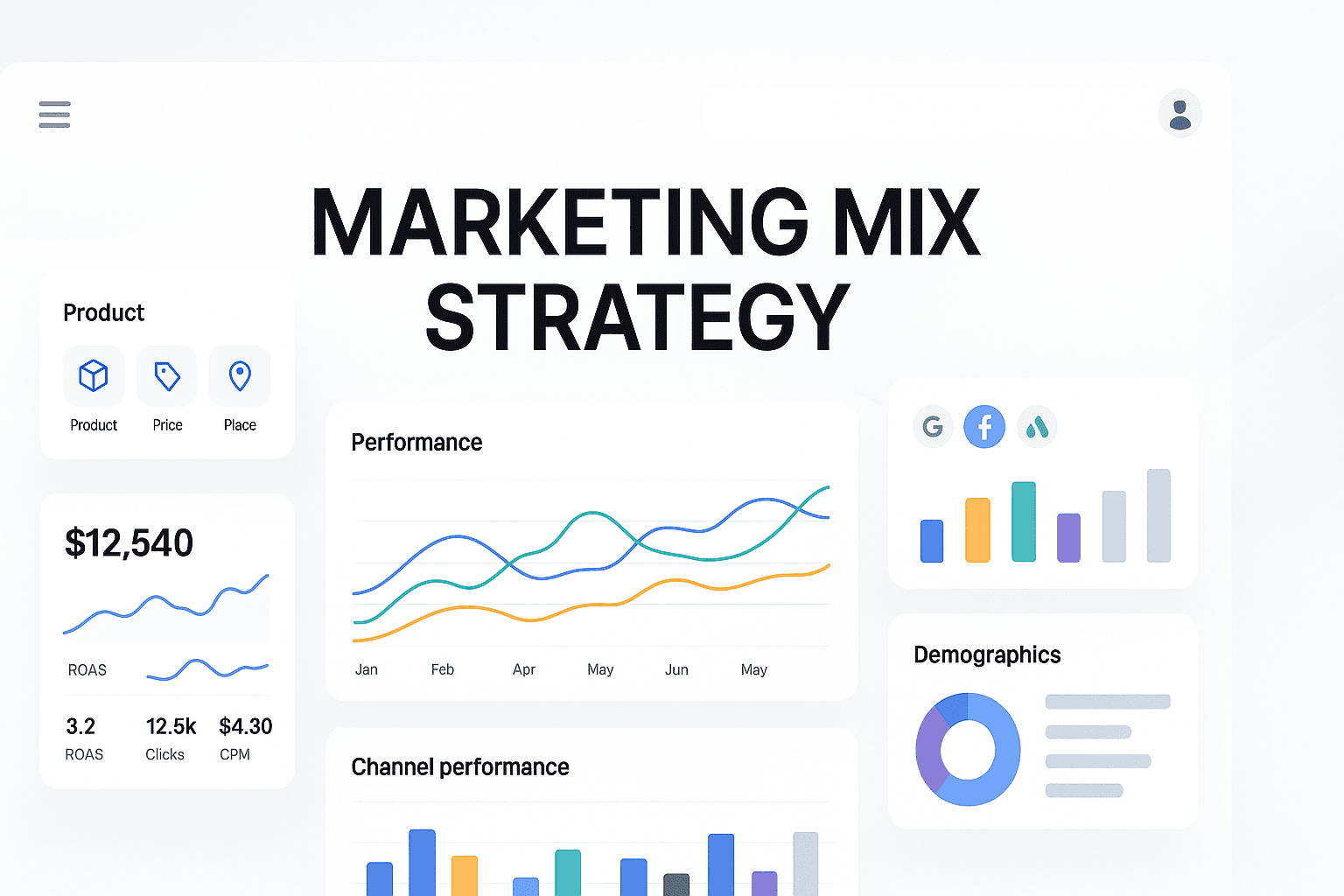
Marketing mix strategy is the systematic approach to optimizing how your Product, Price, Place, and Promotion decisions work together to drive revenue. But here's what most textbooks won't tell you: the framework Jerome McCarthy introduced in the 1960s was designed for a world where customers saw a TV ad, walked into a store, and bought a product. That linear journey is dead.
Today's marketing mix strategy requires something the original framework never anticipated: real-time performance data and cross-channel attribution. Your customers don't follow neat paths anymore. They see your Instagram ad on mobile during their morning commute, research your product on desktop at lunch, read comparison articles that evening, and convert three days later after clicking a Google search ad. Every touchpoint influences the outcome, but traditional analytics only credits the last click.
This is where modern marketing mix strategy diverges from the textbook version. It's not just about having the right product at the right price in the right place with the right promotion. It's about understanding which combinations of those elements actually drive conversions—and which ones just look good in isolation but fail when measured holistically.
The Foundation: Beyond the Basic 4Ps
The 4Ps remain relevant because they represent the fundamental levers you control as a marketer. Product decisions determine what you're selling and how it's positioned. Pricing strategy influences perceived value and customer acquisition economics. Place covers your distribution channels and how customers access your offering. Promotion encompasses all the ways you communicate value and drive awareness.
But here's the evolution: each of these elements now generates data that informs the others. Your promotional campaigns reveal which product features resonate with different audiences. Your pricing tests show how channel-specific customers respond to different value propositions. Your distribution strategy determines which promotional messages work best in each context.
Think about a SaaS company balancing a freemium product strategy with enterprise pricing, multi-channel distribution through direct sales and partnerships, and integrated campaigns across paid search, content marketing, and email. The marketing mix isn't just about managing each element independently—it's about orchestrating them based on attribution data that shows which combinations drive the highest lifetime value customers.
Evolution to Attribution-Driven Mix Optimization
The shift from intuition-based marketing mix decisions to evidence-based optimization represents one of the most significant transformations in modern marketing. This evolution requires marketing teams to develop strong data analytics capabilities that connect customer behavior, channel performance, and revenue outcomes into actionable insights. Without these analytical foundations, marketing mix strategy remains theoretical rather than practical—a framework without the measurement infrastructure to make it work.
Digital transformation hasn't just added new channels to your marketing mix. It's fundamentally changed how customers make decisions and how you need to measure effectiveness. The average B2B buyer now interacts with 27 pieces of content before making a purchase decision. E-commerce customers touch 8-12 different channels before converting. Your marketing mix strategy needs to account for these complex journeys, not just individual channel performance.
This is where multi-touch attribution becomes non-negotiable. Consider an e-commerce brand that was ready to cut their display advertising budget because it showed poor last-click conversion rates. When they implemented proper attribution modeling, they discovered those "underperforming" display ads were actually influencing
Decoding Marketing Mix Strategy for Modern Marketers
Marketing mix strategy is the systematic approach to optimizing how your Product, Price, Place, and Promotion decisions work together to drive measurable business outcomes. It's not the textbook theory you learned in business school—it's a data-driven framework for allocating resources across channels, coordinating messaging across touchpoints, and measuring the combined impact of everything you do.
The concept originated with Jerome McCarthy in 1960, when marketing was simpler. You had a product, set a price, chose distribution channels, and ran promotions. The customer journey was linear: see an ad, visit a store, make a purchase. Attribution was obvious because there weren't many variables to track.
That world doesn't exist anymore.
Today's marketing mix operates in an environment where customers interact with 8-12 touchpoints before converting, switch between devices mid-journey, and make decisions influenced by combinations of factors that single-channel analytics completely miss. The 4Ps framework still matters—you still need the right product at the right price in the right places with the right promotion. But the way you optimize those elements has fundamentally changed.
The Foundation: Beyond the Basic 4Ps
Modern marketing mix strategy requires understanding how each element influences and amplifies the others through the lens of attribution data. Your product positioning affects which promotional channels perform best. Your pricing strategy changes customer behavior across different distribution channels. Your promotional messaging needs to adapt based on where customers are in their journey and which touchpoint they're experiencing.
Think about a SaaS company balancing a freemium product strategy. Their marketing mix isn't just about the 4Ps in isolation—it's about how those elements create a coordinated system. The product decision (freemium vs. paid-only) directly impacts pricing strategy (where to set the paid tier threshold), which influences distribution choices (self-service signup vs. sales-assisted), which determines promotional approach (product-led growth content vs. demo-focused campaigns).
When that SaaS company uses attribution data to measure performance, they discover something critical: their "low-performing" educational content actually influences 60% of paid conversions, even though it rarely gets last-click credit. Their promotional mix looks inefficient until they see how content marketing, paid search, and email campaigns work together to move prospects through the journey.
This is where marketing mix strategy separates from marketing mix theory. Strategy means making resource allocation decisions based on how elements perform together, not in isolation. It means understanding that cutting your content budget because it doesn't show direct conversions might destroy the awareness that makes your paid search campaigns work.
The foundation of effective marketing mix strategy is recognizing that optimization happens at the system level, not the channel level. You're not trying to maximize each P independently—you're trying to find the combination that delivers the best overall business outcomes. That requires measurement infrastructure that shows you how the pieces interact, not just how they perform alone.
Evolution to Attribution-Driven Mix Optimization
The shift from intuition-based marketing mix decisions to evidence-based optimization represents one of the most significant transformations in modern marketing. This evolution requires marketing teams to develop strong data analytics capabilities that connect customer behavior, channel performance, and revenue outcomes into actionable insights.
Digital
Evolution to Attribution-Driven Mix Optimization
The marketing mix framework hasn't changed since the 1960s. Product, Price, Place, Promotion—the 4Ps remain the foundation of strategic marketing. But the way we measure and optimize those elements has been completely transformed by digital technology and customer behavior shifts.
Here's what changed: customers used to follow predictable, linear paths. They'd see a TV ad, visit a store, make a purchase. Simple. Today's buyer journey looks nothing like that. They discover your brand on Instagram, research on Google, compare prices on your website, abandon their cart, see a retargeting ad on Facebook, read reviews, get an email offer, and finally convert three weeks later on their phone during lunch.
That complexity creates a massive problem for traditional marketing mix strategy. When you're managing budgets across eight different channels and customers are touching 10-12 points before converting, how do you know which mix elements actually drive revenue? The old approach—allocating budget based on last-click conversions or gut feeling—leaves money on the table and misses the channel interactions that make your marketing work.
This is where attribution-driven optimization transforms marketing mix from theory into competitive advantage. Instead of guessing which channels deserve more budget, you can see exactly how different mix elements work together throughout the customer journey. Multi-touch attribution reveals that your "underperforming" display ads actually influence 40% of your email conversions. Your content marketing that shows zero last-click conversions? It's touching 60% of customers who later convert through paid search.
The shift requires integrating data across every touchpoint in your marketing mix. Your CRM needs to talk to your ad platforms. Your email system needs to connect with your analytics. Your website tracking needs to follow customers across devices. When these systems work together, you stop seeing isolated channel performance and start seeing the complete picture of how your marketing mix drives revenue.
Consider an e-commerce brand spending $100K monthly across Google Ads, Facebook, email, and content. Their last-click attribution showed display ads delivering a 0.5% conversion rate—terrible performance that screamed "cut this budget." But when they implemented multi-touch attribution, they discovered something surprising: 40% of customers who converted through email had previously clicked a display ad. The display campaigns weren't converting directly, but they were driving brand awareness that made email campaigns dramatically more effective.
That insight changed everything. Instead of cutting display budget, they optimized the coordination between display messaging and email campaigns. The result? Overall conversion rates increased 23% with the same total budget—just allocated based on actual attribution data instead of assumptions.
This is what modern marketing mix strategy looks like. It's not about choosing between Product, Price, Place, and Promotion. It's about understanding how those elements interact across every customer touchpoint, then optimizing the combinations that drive the highest return. The framework is the same. The measurement capability is what changed the game.
Why Your Marketing Mix Strategy Determines Your Competitive Edge
Here's the uncomfortable truth: your competitors are looking at the same marketing channels, targeting similar audiences, and probably spending comparable budgets. The difference between companies that dominate their markets and those that struggle for scraps often comes down to one factor—how strategically they optimize their marketing mix based on real performance data.
This isn't about having a bigger budget. It's about having a smarter system.
Revenue Impact of Strategic Mix Optimization
When you optimize your marketing mix based on accurate attribution data rather than platform-reported metrics, the financial impact shows up fast. Companies that implement data-driven mix optimization typically see 25-40% improvements in overall marketing ROI within the first six months—not because they're spending more, but because they're allocating existing budgets to the combinations that actually drive revenue.
The math is straightforward but powerful. Let's say you're spending $50,000 monthly across five channels. If your current customer acquisition cost is $200, that's 250 new customers per month. Now imagine reallocating that same $50,000 based on multi-touch attribution insights that reveal which channel combinations work together most effectively. Suddenly your CAC drops to $140, and you're acquiring 357 customers with the same budget—a 43% increase in customer acquisition efficiency.
This improvement compounds over time. Better budget allocation leads to lower customer acquisition costs. Lower CAC means you can afford to invest more in customer experience improvements across your product, pricing, and service delivery. Those improvements increase customer lifetime value, which expands your budget capacity for acquisition. The cycle reinforces itself, creating a sustainable competitive advantage that competitors struggle to replicate without similar attribution infrastructure.
The challenge most marketing teams face isn't just optimizing their mix—it's proving the financial impact of those optimizations to leadership and stakeholders. To accurately calculate marketing ROI across your entire marketing mix, you need attribution systems that connect every touchpoint to actual revenue, not just platform-reported conversions that inflate performance. This accurate ROI measurement becomes the foundation for confident budget reallocation decisions and strategic mix optimization.
Competitive Differentiation Through Mix Mastery
The real competitive advantage of sophisticated marketing mix strategy isn't just financial—it's strategic. When you understand how your product positioning, pricing psychology, distribution channels, and promotional messaging work together across the customer journey, you create an integrated experience that competitors can't easily copy.
Think about two SaaS companies selling similar project management tools. Company A manages each marketing channel independently—their Google Ads team optimizes for clicks, their content team focuses on traffic, their email team measures open rates, and their pricing team makes decisions based on competitor analysis. Each team hits their individual metrics, but the customer experience feels disjointed. Messaging conflicts across channels. Pricing promotions undermine value perception. The path from awareness to purchase feels fragmented.
Company B takes a different approach. They use attribution data to understand that customers who engage with educational content first, then see retargeting ads highlighting specific features, and receive personalized email sequences based on their content interests convert at 3x higher rates than other paths. They align their product messaging, pricing offers, and promotional timing across all channels based on this insight. The customer experience feels cohesive and intentional
Why Your Marketing Mix Strategy Determines Your Competitive Edge
Here's the uncomfortable truth: your competitors are looking at the same marketing channels, targeting similar audiences, and probably spending comparable budgets. The difference between the companies that dominate their markets and those that struggle to justify their marketing spend isn't creativity or budget size—it's strategic mix optimization.
When you optimize your marketing mix with proper attribution data, you're not just improving efficiency. You're building a competitive moat that's nearly impossible to replicate because it's based on your unique customer data, channel synergies, and market position.
Revenue Impact of Strategic Mix Optimization
Let's talk about what actually happens when you move from guesswork to data-driven marketing mix decisions. Companies that implement proper attribution and optimize their mix based on real performance data typically see overall marketing ROI improvements of 25-40%. That's not a marginal gain—it's the difference between a marketing department that's seen as a cost center and one that's recognized as a growth engine.
This improvement comes from three specific areas. First, budget allocation efficiency jumps dramatically when you can see which channels actually drive conversions versus which ones just take credit for them. You stop funding vanity metrics and start investing in real revenue drivers.
Second, customer acquisition costs drop significantly—often by 20-35%—when you eliminate wasted spend on low-attribution channels and double down on high-converting combinations. You're not spending less on marketing; you're spending smarter by reallocating budget to channels that work together to drive conversions.
Third, lifetime value improvements emerge when you coordinate your mix elements strategically. When your product positioning, pricing strategy, distribution channels, and promotional messaging all work together based on attribution insights, customers don't just convert—they convert at higher values and stick around longer.
Consider what happened when a B2B software company finally implemented proper attribution across their marketing mix. They discovered that their "underperforming" content marketing was actually influencing 60% of their paid search conversions. Their LinkedIn ads weren't converting directly, but they were warming up prospects who later converted through email campaigns.
Armed with this insight, they reallocated 30% of their budget from last-click channels to the influence channels that were actually driving the customer journey. The result? Customer acquisition costs dropped by 32% while lead quality scores increased by 28%. Same budget, completely different results—all because they could finally see how their marketing mix elements worked together.
The challenge most marketing teams face isn't just optimizing their mix—it's proving the financial impact of those optimizations to leadership and stakeholders. To accurately calculate marketing ROI across your entire marketing mix, you need attribution systems that connect every touchpoint to actual revenue, not just platform-reported conversions that inflate performance.
This accurate ROI measurement becomes the foundation for confident budget reallocation decisions and strategic mix optimization. When you can show executives exactly which combinations of marketing mix elements drive revenue—not just clicks or impressions—you transform from order-taker to strategic advisor.
Competitive Differentiation Through Mix Mastery
Here's what separates market leaders from everyone else: they've figured out that marketing mix strategy isn't just about efficiency—it's about creating customer experiences that competitors can't
Your Marketing Mix Mastery Starts Now
The difference between marketing teams that struggle with attribution and those that dominate their markets comes down to one thing: visibility. When you can see exactly how your product positioning, pricing strategy, distribution channels, and promotional campaigns work together to drive revenue, you stop guessing and start growing.
The marketing mix framework isn't optional anymore. Your competitors are already using attribution data to optimize their budgets, coordinate their messaging, and capture market share while you're still debating which channels "feel" like they're working. Every day without proper attribution is another day of misallocated budget and missed opportunities.
But here's the good news: you don't need to figure this out alone. The technical complexity of connecting your CRM, ad platforms, email tools, and analytics systems into a unified attribution system is exactly what Cometly was built to solve. We track every touchpoint across your entire marketing mix, showing you which combinations actually drive conversions—not which platforms take credit for the same customer.
Ready to transform your marketing mix from educated guesswork into a measurable growth engine? Cometly's attribution platform connects every element of your marketing mix to show you exactly what's working. See which combinations of channels, messages, and tactics actually drive revenue. Make confident budget decisions backed by real data. Build the competitive advantage that comes from knowing your numbers better than anyone else in your market.
Get your free demo and see how attribution clarity transforms marketing mix strategy from theory into results.