You're tracking clicks. You're monitoring impressions. You're watching engagement rates climb. But when your CEO asks which campaigns actually drove revenue last quarter, you're staring at a dashboard that can't give a straight answer.
This is the paradox of modern marketing: we have more data than ever before, yet many teams still can't confidently say which efforts are worth scaling and which are burning budget. The problem isn't lack of information—it's the gap between collecting metrics and extracting the insights that drive profitable decisions.
Marketing research and analytics form the bridge across this gap. Research helps you understand your audience, market dynamics, and competitive landscape before you spend a dollar. Analytics shows you what's actually working once campaigns are live, connecting every touchpoint to real revenue outcomes. Together, they transform scattered data points into a clear roadmap for scalable growth.
This guide breaks down how to build a research and analytics foundation that moves you beyond surface-level metrics to true performance understanding. You'll learn practical frameworks for connecting the dots between customer behavior and campaign results—the kind of clarity that lets you scale with confidence instead of crossing your fingers and hoping.
The Two Pillars: How Research and Analytics Work Together
Think of marketing research and analytics as two sides of the same coin, each serving a distinct but complementary purpose in your growth strategy.
Marketing research is your proactive intelligence gathering. It happens before you launch campaigns, helping you understand who your customers are, what motivates their decisions, and how your competitors are positioning themselves. Research answers questions like: What pain points keep our target audience up at night? Which channels do they trust most? What messaging resonates with different customer segments?
This is where you map customer journeys, conduct competitive analysis, and identify the triggers that move prospects from awareness to purchase. Research informs your strategy—it tells you where to invest, what to say, and how to differentiate.
Marketing analytics, on the other hand, is your performance measurement engine. It kicks in once campaigns are running, tracking what's actually happening across every touchpoint. Analytics answers different questions: Which ad creative is driving conversions? How many touches does it take before someone buys? What's the true ROI of each marketing channel?
Analytics validates your research assumptions and reveals optimization opportunities you couldn't see in advance. It shows you which hypotheses were correct and which need adjustment. Understanding what analytics in marketing truly means is the first step toward building this capability.
Here's where the magic happens: research without analytics is just guesswork with extra steps. You might understand your audience deeply, but without measurement, you can't prove what works or iterate toward better results. Analytics without research is equally problematic—you're optimizing in a vacuum, making tactical improvements without strategic direction.
The synergy between these two pillars creates a continuous improvement cycle. Research informs your initial strategy and campaign design. Analytics measures results and surfaces unexpected patterns. Those insights feed back into your research, refining your understanding of customer behavior. This loop accelerates learning and compounds your competitive advantage over time.
Many marketing teams treat these as separate functions—one team does market research while another owns performance reporting. The most effective organizations integrate them tightly, using research to frame analytics questions and using analytics findings to guide future research priorities.
Building Your Marketing Research Foundation
Strong marketing research starts with knowing which questions to ask and which methods will actually answer them. The foundation splits into two main approaches, each with specific use cases.
Primary Research: This is original data you collect directly from your target audience. Surveys, customer interviews, focus groups, and user testing sessions all fall into this category. Primary research gives you insights competitors can't access—direct feedback about your specific product, messaging, and market position.
Use primary research when you need to understand customer motivations, test new positioning concepts, or validate assumptions about audience needs. The trade-off is time and cost—conducting quality primary research requires significant investment, but the specificity of insights often justifies the expense.
Secondary Research: This involves analyzing existing data from industry reports, competitor websites, market studies, and published research. It's faster and more cost-effective than primary research, making it ideal for understanding broader market trends, sizing opportunities, and benchmarking against competitors.
Start with secondary research to establish baseline market understanding, then use primary research to fill specific knowledge gaps relevant to your unique situation.
Customer journey mapping transforms abstract research into practical campaign strategy. Map every touchpoint where prospects interact with your brand—from initial awareness through consideration, purchase, and post-sale experience. For each stage, identify what questions customers are asking, what information they need, and what might prevent them from moving forward.
This exercise reveals where your marketing needs to show up and what messages matter most at each stage. A prospect researching solutions needs educational content and comparison frameworks. Someone ready to buy needs proof points, pricing clarity, and friction-free conversion paths. Your journey map guides content creation, channel selection, and budget allocation.
Competitive analysis frameworks help you identify white space opportunities and differentiation angles. Don't just track what competitors are doing—understand why they're doing it and where they're vulnerable. Analyze their messaging, channel mix, content strategy, and customer reviews. Look for patterns in what they emphasize and what they avoid mentioning.
The goal isn't to copy competitors but to find positioning territory they've left undefended. Where are customers expressing frustration that no one is addressing? Which benefits are competitors under-communicating? These gaps become your strategic opportunities.
Essential Analytics Metrics That Actually Matter
Most marketing dashboards are cluttered with metrics that feel important but don't drive decisions. The key is distinguishing between vanity metrics that make you feel good and performance metrics that reveal what's actually working.
Vanity metrics include things like total impressions, page views, and follower counts. They're easy to move upward and satisfying to report, but they rarely correlate with business outcomes. A campaign can generate millions of impressions while producing zero revenue. Performance metrics, by contrast, connect directly to business results: customer acquisition cost, conversion rate by channel, revenue per campaign, and customer lifetime value. Mastering the right marketing analytics metrics separates high-performing teams from those drowning in meaningless data.
The shift from vanity to performance requires asking a simple question about every metric: "If this number improves, does revenue improve?" If the answer isn't a clear yes, that metric probably belongs in a secondary dashboard, not your primary decision-making view.
Attribution models determine how you assign credit for conversions across multiple touchpoints—and your choice dramatically impacts which channels appear successful. Understanding the options helps you select the model that reflects your actual customer journey.
First-Touch Attribution: Gives all credit to the initial touchpoint that brought someone into your ecosystem. This model favors top-of-funnel channels like content marketing and brand awareness campaigns. It's useful for understanding what's driving new audience discovery but ignores everything that happens after that first interaction.
Last-Touch Attribution: Assigns full credit to the final touchpoint before conversion. This model favors bottom-of-funnel channels like retargeting and branded search. It shows what closes deals but overlooks the earlier touchpoints that built awareness and consideration.
Multi-Touch Attribution: Distributes credit across all touchpoints in the customer journey, recognizing that conversions typically result from multiple interactions. This approach provides the most accurate picture of how channels work together, though it requires more sophisticated tracking infrastructure. Many teams struggle with attribution challenges in marketing analytics before finding the right model for their business.
Many customer journeys involve five, ten, or more touchpoints before purchase. Someone might discover you through organic search, engage with social content, click a display ad, read email nurture sequences, and finally convert through a retargeting campaign. Single-touch models would credit either the first or last interaction, completely missing the role of everything in between.
Cross-platform tracking has become significantly more complex due to privacy changes and browser restrictions. iOS privacy updates limit tracking across apps and websites. Cookie deprecation means traditional web tracking methods are losing effectiveness. Third-party data sources that marketers relied on for years are disappearing.
Server-side tracking has emerged as a solution to these challenges. Instead of relying on browser cookies that users can block or delete, server-side tracking captures conversion events directly on your server and sends them to analytics platforms. This method is more accurate, respects user privacy, and isn't affected by browser restrictions. It requires more technical setup but delivers significantly better data quality in today's privacy-first environment.
Connecting the Dots: From Data Collection to Actionable Insights
Raw data sitting in isolated platforms tells you nothing. The value emerges when you connect information from every source into a unified view of customer behavior and campaign performance.
Most marketing teams operate with data fragmentation: Facebook Ads shows one set of metrics, Google Ads reports different numbers, your CRM tracks leads separately, and website analytics captures yet another perspective. Each platform uses different attribution windows, conversion definitions, and tracking methods. Reconciling these sources manually is time-consuming and error-prone.
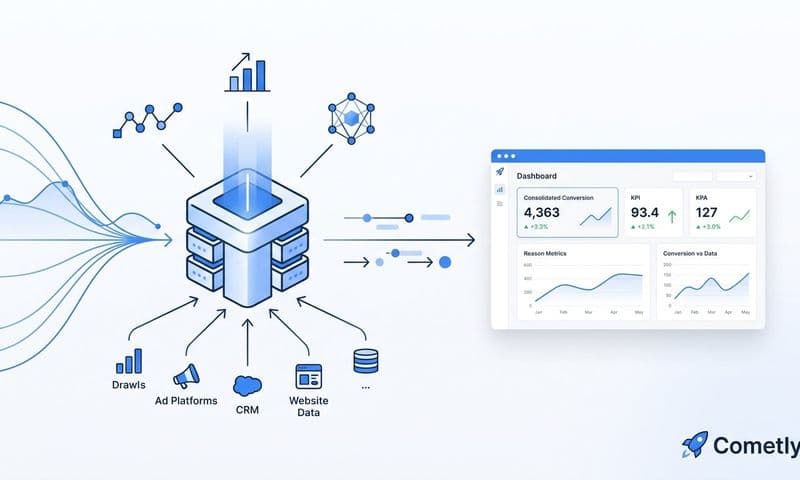
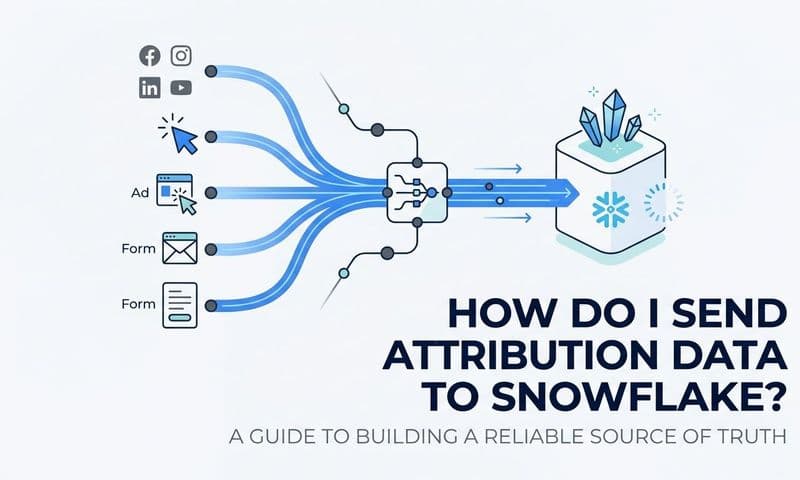
Integration solves this by centralizing data from ad platforms, CRM systems, website analytics, and offline conversion sources into a single source of truth. When someone clicks an ad, visits your website, submits a lead form, and eventually becomes a customer, you can trace that entire journey and accurately attribute revenue back to the original marketing touchpoint. The relationship between data analytics and marketing has never been more critical for achieving this unified view.
Building this unified view requires connecting several key data sources. Your ad platforms (Meta, Google, LinkedIn, TikTok) provide campaign performance and click data. Your website analytics tracks on-site behavior and conversion events. Your CRM holds lead information and sales outcomes. Payment processors capture actual revenue. Email platforms track nurture engagement.
The technical challenge is ensuring these systems talk to each other reliably. When someone converts, that conversion event needs to flow back to your ad platforms so their algorithms can optimize for similar customers. When a lead becomes a customer weeks later, that revenue needs to connect back to the original marketing touchpoint that started the journey.
Once data is integrated, the real work begins: transforming numbers into decisions that improve performance. This means moving beyond reporting what happened to understanding why it happened and what to do next.
Start by identifying patterns across successful campaigns. Which audience segments convert at the highest rates? Which creative themes drive the most engagement? Which channels play supporting roles versus primary conversion drivers? Look for correlations between campaign characteristics and outcomes.
The most valuable insights often emerge from comparing performance across different dimensions. How do conversion rates vary by traffic source? Does customer lifetime value differ between channels? Which campaign types have the best return on ad spend? These comparisons reveal where to double down and where to cut back. Understanding the role of analytics in digital marketing helps you frame these questions correctly.
Turn insights into action by establishing clear decision rules. If a campaign's cost per acquisition exceeds your target by more than 20% after spending a minimum test budget, pause it. If an audience segment shows 50% higher conversion rates than average, create dedicated campaigns for that segment. If certain creative formats consistently outperform others, shift budget toward top performers.
Putting Analytics Into Action: A Practical Framework
Analytics only creates value when insights drive action. Establishing regular review cadences ensures you're consistently optimizing rather than letting campaigns run on autopilot.
Weekly Reviews: Focus on tactical optimizations and quick wins. Check campaign pacing against budget and goals. Identify underperforming ad sets or keywords to pause. Spot high-performers that deserve increased budget. Review creative fatigue indicators and refresh ads showing declining engagement. Weekly reviews catch issues before they burn significant budget and capitalize on opportunities while they're hot.
Monthly Reviews: Zoom out to strategic patterns and channel performance. Compare actual results against monthly targets. Analyze which channels are delivering the best ROI and whether budget allocation matches performance. Review audience segments to identify expansion opportunities. Assess whether your attribution model is reflecting reality or needs adjustment. Monthly reviews inform budget reallocation and strategic pivots. Effective marketing analytics and reporting practices make these reviews actionable rather than just informational.
Quarterly Reviews: Step back to evaluate overall strategy and long-term trends. Examine customer acquisition costs over time—are they improving or degrading? Review customer lifetime value by cohort and channel. Assess whether your marketing mix has evolved with market conditions. Identify major strategic shifts needed for the next quarter. Quarterly reviews ensure your tactics remain aligned with business objectives.
AI-powered analytics tools accelerate this process by automatically identifying patterns that would take hours to spot manually. Machine learning algorithms can analyze thousands of campaigns simultaneously, flagging anomalies, predicting which campaigns are likely to scale successfully, and recommending budget adjustments based on performance trends. Exploring AI marketing analytics reveals how these tools can transform your optimization workflow.
These tools excel at processing large datasets to surface non-obvious insights. They might notice that campaigns targeting a specific geographic region consistently outperform others, or that certain keyword combinations drive higher-value customers, or that conversion rates spike on particular days of the week. AI catches patterns humans miss because it can analyze more variables simultaneously.
One of the most powerful applications of analytics is feeding enriched conversion data back to ad platforms. When you send detailed conversion information—including revenue value, customer type, and downstream actions—back to Meta, Google, and other platforms, their optimization algorithms get smarter. They learn which users are most likely to become valuable customers, not just which users are most likely to click or submit a form.
This feedback loop improves targeting precision over time. Ad platforms use your conversion data to find similar high-value users and optimize delivery toward audiences that drive real business results. The better data you provide, the more effectively platforms can optimize your campaigns automatically.
Turning Insights Into Scalable Growth
Marketing research and analytics aren't separate disciplines competing for resources—they're interconnected processes that fuel each other and compound your competitive advantage over time.
Research provides the strategic foundation by helping you understand your market, audience, and competitive landscape before you spend budget. Analytics validates those assumptions in real-time, measuring what's actually driving conversions and revenue. The insights from analytics feed back into research, refining your understanding and informing smarter strategies.
This continuous loop separates teams that scale profitably from those that burn budget hoping something works. When you know which touchpoints matter most in the customer journey, which channels deliver the best ROI, and which campaigns are worth scaling, you can make confident decisions instead of educated guesses. Learning how to leverage analytics for marketing strategy is essential for building this decision-making capability.
The competitive advantage comes from accuracy and speed. Accurate attribution shows you exactly which marketing efforts drive revenue, eliminating wasted spend on channels that look good on paper but don't convert. Real-time data access lets you optimize faster than competitors who wait for monthly reports to make decisions.
As privacy regulations tighten and tracking becomes more complex, the gap widens between marketers with sophisticated analytics infrastructure and those relying on outdated methods. Server-side tracking, multi-touch attribution, and AI-powered optimization aren't nice-to-have features anymore—they're requirements for staying competitive.
Start by auditing your current analytics setup. Can you trace a customer's complete journey from first touch to revenue? Do you trust your attribution model to accurately credit marketing efforts? Are you feeding quality conversion data back to ad platforms? If any answer is no, you're leaving growth on the table. Selecting the right marketing analytics platform can address these gaps systematically.
The path forward is clear: integrate your data sources, implement accurate tracking across all touchpoints, and establish regular review cadences that turn insights into action. Build the infrastructure that connects research to strategy and analytics to optimization.
Your Next Move: From Data to Decisions
The marketers winning in today's environment aren't necessarily spending more—they're spending smarter, guided by complete visibility into what's actually driving results.
You can continue operating with fragmented data, making decisions based on incomplete information and hoping your campaigns scale. Or you can build the analytics foundation that transforms every dollar spent into a learning opportunity and every campaign into a step toward more profitable growth.
The choice isn't whether to invest in research and analytics—it's whether you'll do it before or after your competitors gain an insurmountable advantage. Every day without accurate attribution is another day of misallocated budget and missed opportunities.
Ready to elevate your marketing game with precision and confidence? Discover how Cometly's AI-driven recommendations can transform your ad strategy—Get your free demo today and start capturing every touchpoint to maximize your conversions.