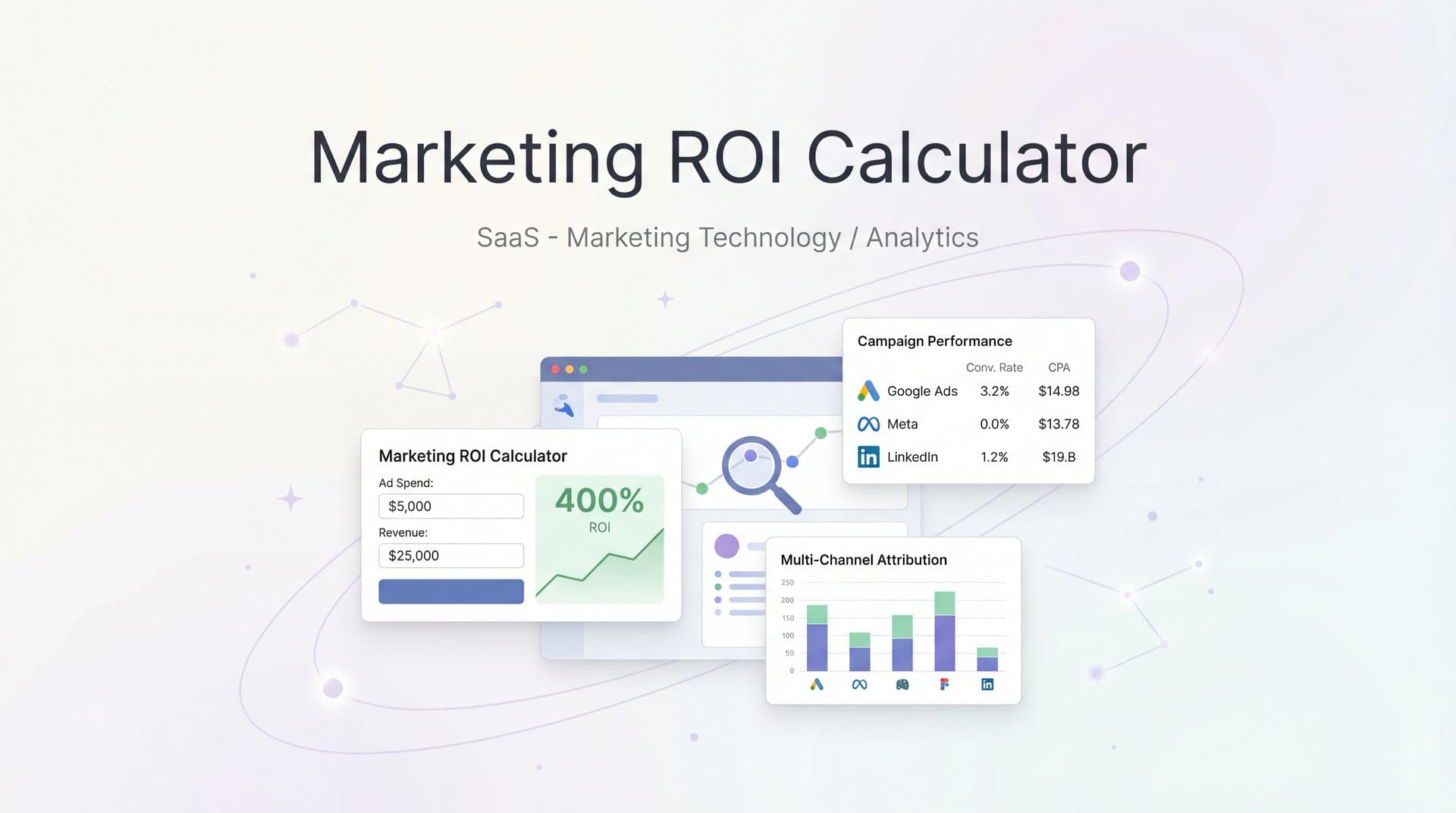
Every marketer knows the frustration: you run campaigns across multiple platforms, spend significant budget, and then struggle to prove what's actually working. A marketing ROI calculator is only as good as the data and methodology you feed into it.
The difference between marketers who accurately measure ROI and those who guess comes down to how strategically they approach the calculation process.
This guide covers seven battle-tested strategies that transform your ROI calculations from rough estimates into reliable decision-making tools. Whether you're justifying budget to executives or optimizing campaign spend, these approaches will help you calculate marketing ROI with confidence and precision.
1. Establish a Complete Revenue Attribution Framework First
The Challenge It Solves
Most marketing teams jump straight into ROI calculations without first building a solid attribution foundation. They plug platform-reported conversions into their calculator and wonder why the numbers don't match what the sales team sees in the CRM. The problem isn't the calculator—it's the incomplete data feeding into it.
Without a complete attribution framework connecting every marketing touchpoint to actual revenue outcomes, your ROI calculator becomes a sophisticated guessing machine. You're calculating return on investment using conversion data that might be missing 30-40% of the actual customer journey.
The Strategy Explained
Building a complete revenue attribution framework means creating a system that tracks customers from their very first interaction with your brand through to closed revenue. This requires connecting your ad platforms, website analytics, CRM, and any other tools where customer interactions happen.
Think of attribution as the foundation of a house. Your ROI calculator is the structure you build on top. If the foundation is incomplete or unstable, everything above it becomes unreliable. A proper framework captures every touchpoint—from the first Facebook ad click to the email nurture sequence to the sales call that closes the deal.
The goal is creating a single source of truth where you can see exactly which marketing activities influenced each revenue outcome. Only then can you accurately calculate what you're getting back for every dollar invested.
Implementation Steps
1. Map your complete customer journey from awareness through purchase, identifying every platform and touchpoint where prospects interact with your brand.
2. Implement tracking that connects ad platform data to website behavior, CRM records, and revenue outcomes using a unified customer identifier across all systems.
3. Establish data validation processes to ensure your attribution system is capturing conversions that your CRM confirms actually closed, creating a feedback loop between marketing data and sales reality.
Pro Tips
Start with your highest-value conversion paths first. If most of your revenue comes through a specific funnel, perfect attribution there before expanding to lower-volume channels. Also, build in regular audits where you compare attributed revenue to actual closed deals—this catches tracking gaps before they corrupt your ROI calculations.
2. Track True Customer Acquisition Costs Beyond Ad Spend
The Challenge It Solves
When marketers calculate ROI using only ad spend, they're measuring an incomplete picture. You might think you're getting a 300% return, but when you factor in the designer who created the ad creative, the marketing automation platform subscription, and the team hours spent managing campaigns, that number drops significantly.
This incomplete cost tracking leads to overconfident budget decisions. You scale campaigns that look profitable on paper but actually operate on razor-thin margins once you account for the full cost structure.
The Strategy Explained
True customer acquisition cost includes every expense that contributes to acquiring a customer. Ad spend is just the most visible component. You also need to factor in creative production costs, software subscriptions for your marketing stack, agency fees if you use external partners, and the fully-loaded cost of your internal team's time.
Let's say you spend $10,000 on Facebook ads and acquire 50 customers. That's $200 per customer in ad spend. But if you also paid $2,000 for video production, $500 for your marketing automation platform, and your team spent 40 hours managing the campaign at a blended rate of $75/hour, you've actually spent $15,500 to acquire those 50 customers—$310 each, not $200.
This comprehensive view of costs ensures your ROI calculator reflects economic reality, not just the most obvious expenses.
Implementation Steps
1. Create a comprehensive cost inventory that includes ad spend, creative production, software subscriptions, agency fees, and internal labor allocated to each campaign or channel.
2. Develop a time-tracking system where team members log hours against specific campaigns, then multiply those hours by your organization's fully-loaded cost per hour (salary plus benefits and overhead).
3. Build a standardized cost template that you apply consistently across all campaigns, ensuring you're not comparing apples to oranges when evaluating channel performance.
Pro Tips
For software costs, allocate them proportionally based on usage. If your marketing automation platform costs $500/month and 60% of your email sends support paid acquisition campaigns, allocate $300 of that cost to acquisition. Don't forget to include one-time setup costs amortized over a reasonable period—that $5,000 landing page build should be spread across the campaigns that use it.
3. Incorporate Customer Lifetime Value Into Your Calculations
The Challenge It Solves
Calculating ROI based on initial transaction value dramatically understates marketing effectiveness for any business with repeat purchases or ongoing subscriptions. A campaign that looks marginally profitable on first purchase might actually be highly profitable when you account for the next two years of customer revenue.
This myopic view of value causes marketers to underfund channels that acquire high-quality customers with strong retention. You optimize for immediate conversion value and miss the bigger picture of customer worth over time.
The Strategy Explained
Customer lifetime value (CLV) represents the total revenue you can expect from a customer over their entire relationship with your company. When you calculate marketing ROI using CLV instead of initial purchase value, you're measuring the true return on your acquisition investment.
For a subscription business, this is straightforward: if your average customer stays for 18 months at $100/month, their CLV is roughly $1,800 (adjusted for churn patterns). For transactional businesses, you need to look at historical purchase frequency and average order value to project lifetime value.
The transformation in ROI calculations can be dramatic. A campaign that costs $150 to acquire a customer who makes a $200 initial purchase looks like a 33% return. But if that customer has a CLV of $1,800, you're actually seeing a 1,100% return on that acquisition investment.
Implementation Steps
1. Calculate your baseline CLV by analyzing historical customer cohorts, tracking average revenue per customer over 12, 24, and 36-month periods depending on your business model.
2. Segment CLV by acquisition channel to identify which sources bring higher-value customers, as CLV often varies significantly between customers acquired through different marketing channels.
3. Build conservative and optimistic CLV scenarios into your ROI calculator, using conservative estimates for budget planning and optimistic ones for understanding upside potential.
Pro Tips
Apply a discount rate to future revenue when calculating CLV—a dollar earned 18 months from now is worth less than a dollar earned today. Also, track how your CLV predictions compare to actual customer behavior over time, refining your calculations as you gather more data. Many businesses find that CLV varies significantly by customer acquisition source, making channel-specific CLV calculations essential for accurate ROI measurement.
4. Segment ROI Calculations by Channel and Campaign Type
The Challenge It Solves
Blended ROI metrics hide the truth about what's working. When you average performance across all channels, you mask the fact that some channels deliver 500% ROI while others operate at break-even or worse. This leads to continued investment in underperforming channels and missed opportunities to scale winners.
Marketing teams that rely on overall ROI numbers can't make strategic optimization decisions. They know their total marketing is profitable, but they don't know which specific activities deserve more budget and which should be cut or restructured.
The Strategy Explained
Channel-level ROI segmentation means calculating separate returns for each distinct marketing channel and campaign type. You're not just looking at whether marketing as a whole is profitable—you're understanding the specific contribution and efficiency of Facebook ads versus Google Search versus email marketing versus content marketing.
This granular view reveals performance patterns that blended metrics obscure. You might discover that Facebook drives high-volume but lower-quality leads with 150% ROI, while LinkedIn drives fewer leads with 400% ROI because they convert at much higher rates and have stronger CLV.
The strategy also extends to campaign-type segmentation within channels. Brand awareness campaigns, retargeting campaigns, and bottom-funnel conversion campaigns all serve different purposes and should be evaluated with different ROI expectations.
Implementation Steps
1. Define your channel taxonomy clearly, establishing consistent categories for how you'll segment performance (paid social, paid search, organic social, email, content, etc.).
2. Ensure your attribution system tags every conversion with its originating channel and campaign type, creating clean data that allows for accurate segmentation in your ROI calculations.
3. Build a reporting dashboard that displays ROI by channel side-by-side, making it easy to compare efficiency and identify reallocation opportunities.
Pro Tips
Don't just segment by channel—also segment by campaign objective. Your prospecting campaigns should be evaluated differently than your retargeting campaigns. Prospecting typically has higher acquisition costs but brings in new customers, while retargeting is more efficient but has a limited addressable audience. Understanding this nuance prevents you from making the mistake of killing prospecting because retargeting shows better immediate ROI.
5. Account for Attribution Lag and Sales Cycle Length
The Challenge It Solves
Using arbitrary lookback windows like 7 or 30 days disconnects your ROI calculations from business reality. If your average sales cycle is 45 days but you're measuring ROI with a 30-day window, you're systematically undercounting conversions and undervaluing your marketing efforts.
This mismatch between measurement windows and actual customer behavior leads to premature conclusions about campaign performance. You might kill a campaign after two weeks because it "isn't working," when in reality it's driving conversions that just haven't closed yet.
The Strategy Explained
Attribution lag refers to the time between when someone first interacts with your marketing and when they actually convert. For B2B companies or high-consideration purchases, this lag can stretch weeks or even months. Your ROI calculator needs to account for this reality.
The strategy involves setting lookback windows that match your actual sales cycle length. If your data shows that 80% of customers convert within 60 days of first touch, use a 60-day attribution window. This ensures you're capturing the full impact of your marketing activities.
You also need to build in conversion lag when evaluating recent campaigns. A campaign that launched three weeks ago in a 60-day sales cycle business hasn't had time to show its full results yet. Your ROI calculation should either wait for the full cycle to complete or use projected conversion rates based on early indicators.
Implementation Steps
1. Analyze your historical conversion data to determine your actual average time-to-conversion, calculating the window within which 80-90% of conversions occur after first touch.
2. Configure your attribution system to use this data-driven lookback window instead of platform defaults, ensuring you're capturing conversions that happen outside the typical 7-day or 30-day windows.
3. Build conversion lag into your ROI reporting by flagging campaigns that haven't had sufficient time to complete their full sales cycle, preventing premature performance judgments.
Pro Tips
Different channels often have different lag patterns. Paid search typically converts faster than content marketing or organic social. Consider using channel-specific lookback windows for maximum accuracy. Also, track how your conversion lag changes over time—improvements in your sales process or funnel optimization can shorten the window, while moving upmarket or adding product complexity might lengthen it.
6. Validate Calculator Inputs with Server-Side Tracking
The Challenge It Solves
Browser-based tracking has become increasingly unreliable. iOS privacy changes, ad blockers, and cookie restrictions mean that pixel-based tracking often misses significant portions of your actual conversions. When your ROI calculator uses incomplete conversion data, it systematically undervalues your marketing performance.
Marketing teams often see a growing gap between platform-reported conversions and what actually shows up in their CRM. This discrepancy makes it nearly impossible to calculate accurate ROI—you're working with flawed input data that understates your actual results.
The Strategy Explained
Server-side tracking moves conversion tracking from the browser to your server, bypassing many of the limitations that affect traditional pixel tracking. When a conversion happens, your server sends that data directly to ad platforms and your analytics tools, creating a more complete and reliable data picture.
This approach captures conversions that browser-based tracking misses due to ad blockers, privacy settings, or tracking prevention features. It also gives you control over exactly what data gets sent and when, allowing for more sophisticated tracking strategies like delayed conversion attribution or custom event parameters.
For ROI calculations, server-side tracking means your input data is substantially more accurate. You're capturing closer to 100% of actual conversions rather than the 60-80% that pixel tracking might catch in today's privacy-focused environment.
Implementation Steps
1. Implement server-side conversion tracking using tools like Cometly that connect your CRM and conversion data directly to ad platforms, ensuring accurate data flow regardless of browser limitations.
2. Validate your server-side implementation by comparing tracked conversions to actual CRM outcomes over a test period, confirming that your server-side system is capturing conversions your pixel tracking missed.
3. Update your ROI calculator to use server-side conversion data as the source of truth, replacing or supplementing pixel-based conversion counts with more reliable server-validated numbers.
Pro Tips
Don't completely abandon pixel tracking when you implement server-side—use both in parallel during a transition period to understand the gap and validate your implementation. Also, take advantage of server-side tracking's ability to send enriched conversion data back to ad platforms. When you can tell Facebook or Google not just that a conversion happened but also the actual revenue value and customer quality indicators, their algorithms optimize more effectively.
7. Build Feedback Loops to Continuously Refine Calculations
The Challenge It Solves
Most marketing teams treat their ROI calculator as a static tool. They set it up once, then use the same methodology and assumptions indefinitely. Meanwhile, their business evolves, customer behavior shifts, and the accuracy of their calculations slowly degrades without anyone noticing.
This static approach means you're making budget decisions based on increasingly outdated assumptions. Your CLV estimates might be based on customer cohorts from two years ago. Your cost allocations might not reflect recent changes in your team structure or tool stack.
The Strategy Explained
Building feedback loops means creating a systematic process for comparing your projected ROI to actual outcomes, then using those insights to refine your calculation methodology. You're treating your ROI calculator as a living system that improves with each campaign cycle.
This involves regularly comparing what your calculator predicted would happen to what actually happened. If you projected a 250% ROI on a campaign and it delivered 180%, you need to understand why. Was your cost tracking incomplete? Did conversions take longer than your lookback window captured? Did CLV assumptions prove optimistic?
Each discrepancy becomes a learning opportunity to improve your methodology. Over time, your ROI calculations become increasingly accurate because you're continuously calibrating them against reality.
Implementation Steps
1. Schedule quarterly ROI calculation audits where you compare projected performance to actual outcomes across your major campaigns and channels, documenting discrepancies and investigating root causes.
2. Update your calculator's assumptions and methodology based on these audits, adjusting factors like average conversion lag, CLV estimates, and cost allocations to reflect current reality rather than historical assumptions.
3. Create a changelog for your ROI calculation methodology so your team understands how and why calculations have evolved, maintaining institutional knowledge about what works and what doesn't.
Pro Tips
Involve your sales and finance teams in these feedback loops. Sales can validate whether the quality of marketing-sourced leads matches what your ROI calculations assume. Finance can confirm whether your cost allocations align with actual accounting. This cross-functional validation catches blind spots that a marketing-only review might miss. Also, don't just look at aggregate performance—examine outliers. The campaigns that significantly overperformed or underperformed relative to projections often reveal the most valuable insights for refining your methodology.
Your Implementation Roadmap
Accurate marketing ROI calculation isn't about finding the perfect formula—it's about building a measurement system that captures the full picture of your marketing impact.
Start by establishing complete attribution across your customer journey, connecting every touchpoint from first click to closed revenue. Then layer in true costs that go beyond ad spend to include creative, tools, and team time. Incorporate customer lifetime value to understand the long-term return on acquisition investment, not just the initial transaction.
Segment your calculations by channel and campaign type so you can see exactly what's working and what isn't. Account for your actual sales cycle length rather than using arbitrary measurement windows. Validate everything with server-side tracking to overcome the limitations of browser-based pixels.
Finally, treat your ROI calculator as a living system that improves with each campaign cycle. Build feedback loops that compare projections to reality, then use those insights to continuously refine your methodology.
The marketers who master these strategies don't just measure ROI—they use it to confidently scale what works and cut what doesn't. They justify budget increases with data executives trust. They optimize spend with precision rather than guesswork.
Ready to elevate your marketing game with precision and confidence? Discover how Cometly's AI-driven recommendations can transform your ad strategy—Get your free demo today and start capturing every touchpoint to maximize your conversions.