At its heart, marketing ROI is a simple but powerful idea: it tells you how much profit you’re making for every single dollar you put into your marketing efforts. It’s the ultimate report card for your campaigns, showing whether you’ve built a powerful growth engine or just an expensive hobby.
Think of it as a financial health checkup for your entire marketing strategy.
What Does Marketing ROI Actually Mean?
 Unlocking Your Marketing ROI Meaning and True Impact
Let's ditch the jargon for a second. Imagine you're a farmer. You spend $100 on seeds (that's your marketing cost). You plant them, water them, and at the end of the season, you sell your harvest for $600 (your revenue).
Your profit, after subtracting the cost of the seeds, is $500.
Marketing ROI answers the question, "For every dollar I spent on seeds, how many dollars in profit did I get back?" In this case, you turned $100 into $500 of pure profit. That’s a 500% ROI, or a 5:1 return. It’s that straightforward, and it's the foundation for proving your marketing's worth to anyone, especially the C-suite.
To help you get a quick handle on these concepts, here’s a simple breakdown of what each component means and why it's so important for your strategy.
Marketing ROI Core Concepts at a Glance
Component | What It Means | Why It Matters |
|---|---|---|
Marketing Investment | The total cost of a campaign including ad spend, tools, and labor | This is the I in ROI. You need an accurate spend baseline to measure returns correctly |
Sales Growth | The increase in revenue directly attributed to marketing efforts | This reflects the top line impact of your marketing activities |
Net Profit | Revenue from a campaign minus the total marketing investment | This is the true bottom line contribution that sustains the business |
ROI Ratio (for example 5 to 1) | For every dollar invested, how many dollars in profit were generated | The clearest way to communicate performance and compare channels or campaigns |
This table provides a foundational understanding, which is crucial because a firm grip on ROI is what separates strategic marketers from those who just spend the budget.
Why Mastering ROI Is Non-Negotiable
Without a solid understanding of ROI, marketing teams are basically flying blind. You can't tell which strategies are hitting the mark and which are just draining your budget. Here’s why getting this right is so critical:
- Justifying Budgets: It’s a lot easier to ask for more money—and get it—when you can walk into a meeting and show a clear, positive return on what you’ve already spent.
- Optimizing Spend: ROI data shines a light on your best-performing channels and campaigns. This lets you confidently move money from what’s not working to what’s crushing it, maximizing your overall impact. Turning raw numbers into actionable data is the key to making smarter decisions.
- Proving Your Value: ROI translates your marketing activities into the one language every part of the business understands: profitability. It’s how you prove that marketing isn't just a cost center but a direct driver of the company's bottom line.
Marketing ROI serves as a crucial metric for marketers to justify spending and optimize strategies. According to a recent global survey, 65% of marketing leaders expect to see direct connections between social media campaigns and business goals, underscoring how critical ROI measurement has become.
Ultimately, a deep understanding of marketing ROI empowers you to make strategic, data-backed decisions. It’s what fuels sustainable growth and solidifies marketing's role as a true revenue driver in the organization.
Calculating Marketing ROI with Clear Examples
 Unlocking Your Marketing ROI Meaning and True Impact
Alright, enough with the theory. Let's get our hands dirty and break down how you actually calculate marketing ROI. There are a few different ways to slice it, but one core formula gives you a solid starting point for just about any campaign.
The simplest, most fundamental formula is this:
(Sales Growth - Marketing Cost) / Marketing Cost
This little equation gives you a ratio or percentage that tells you how much you earned for every dollar you put in. If the result is 4 (or 400%), it means you pocketed $4 in net revenue for every single $1 you spent.
But here’s the thing: the math isn't the hard part. The real challenge is getting the numbers you plug into the formula right.
Defining Your Total Marketing Cost
To get a real, honest-to-goodness ROI figure, you have to count every single expense tied to your campaign. This is where so many marketers mess up. They only count ad spend, which inflates their ROI and leads to some seriously bad strategic calls down the line.
Your total marketing cost should be a full accounting of all direct and indirect expenses:
- Ad Spend: The obvious one. This is what you pay directly to platforms like Google, Meta, or TikTok.
- Creative Fees: Any money spent on design, copywriting, or video production. This includes agency retainers and freelancer invoices.
- Software and Tools: A slice of the subscription fees for your analytics platforms, marketing automation software, or social media schedulers.
- Team Salaries: An allocated portion of the salaries for the internal team members who planned, executed, and managed the campaign.
Getting this number right is the first step toward an ROI figure you can actually trust. We dive even deeper into this in our guide on how to calculate return on marketing investment.
An accurate marketing ROI meaning depends on honesty. If you only track ad spend, you're not measuring your true investment. You’re only measuring one piece of it, which gives you a misleading picture of profitability.
Isolating Sales Growth Attributable to Marketing
Next up is "Sales Growth." You need to figure out how much revenue was generated because of your marketing efforts. This isn't your total revenue; it's the lift above and beyond what you would have made anyway.
For instance, if your business usually brings in $50,000 a month and, during your new campaign, you hit $80,000, your attributable sales growth is $30,000. This step is crucial for proving the direct financial impact of your work.
Practical ROI Calculation Examples
Let's run the numbers on a couple of real-world scenarios to see how this all comes together.
Example 1: A Simple Ecommerce Google Ads Campaign
- Total Marketing Cost: $5,000 (this includes $4,000 in ad spend and $1,000 for management fees).
- Sales Growth: The campaign drove $25,000 in direct sales.
ROI Calculation:
- ($25,000 - $5,000) / $5,000 = 4
- That translates to a 400% ROI, or a 4:1 return. For every dollar they put in, they got $4 back in net revenue. Simple and effective.
Example 2: A Complex B2B Content Marketing Initiative
- Total Marketing Cost: $15,000 (this covers writer salaries, software subscriptions, and promotional spend over six months).
- Sales Growth: The content generated leads that eventually closed into new contracts worth $75,000.
ROI Calculation:
- ($75,000 - $15,000) / $15,000 = 4
- Once again, we land at a 400% ROI.
As you can see, the same basic formula works whether you're running a quick ad campaign or a long-term content play. It’s a versatile framework that gives you a consistent way to measure what’s working.
Understanding the Nuance Between ROI and ROMI
In boardrooms and strategy sessions, you’ll often hear Marketing ROI and Return on Marketing Investment (ROMI) used as if they’re the same thing. They’re close, but there’s a subtle and powerful distinction between them. Getting this right is the key to analyzing your campaign performance with real precision.
Think of it this way: your overall business ROI is the big picture, the final score of the entire game. ROMI, on the other hand, is like the instant replay of a specific, game-changing play. It isolates the performance of a single marketing campaign to see how it really did.
ROMI often measures the incremental profit generated by a specific marketing initiative, separate from your baseline sales. It answers the question, "How much extra profit did our Black Friday campaign create that we wouldn't have earned otherwise?"
This distinction is crucial. A broad ROI calculation might look healthy, but a granular ROMI analysis can reveal that a specific campaign is actually a money pit. Or, it could uncover a hidden gem that’s driving massive returns you need to double down on.
ROMI vs ROI: A Practical Comparison
Let’s break this down with a simple example to make it crystal clear:
- Broad ROI Perspective: Your company's total annual profit divided by its total annual investment. This includes everything—operations, sales, marketing, R&D, the whole nine yards.
- Specific ROMI Perspective: The profit generated specifically from your new holiday promotion, divided by the cost of running only that promotion.
This focused view lets you compare the effectiveness of different marketing actions—like paid search versus content marketing—on an apples-to-apples basis. It helps you understand not just if marketing is working, but which parts of your marketing are working best. The relationship between ROI and Return on Ad Spend (ROAS) offers a similar level of specific insight, which you can dive into in our guide comparing ROI vs ROAS.
Introducing Customer Lifetime Value for Advanced ROI
To truly level up your understanding of marketing ROI meaning, you have to look beyond the first sale. A single transaction just doesn't tell the whole story. This is where Customer Lifetime Value (CLV) becomes an indispensable part of the equation.
CLV projects the total net profit a business can expect to make from a single customer over their entire relationship with you.
By factoring CLV into your ROI calculations, you shift your focus from short-term wins to long-term, sustainable profitability. A campaign might have a modest immediate ROMI, but if it attracts high-value customers who make repeat purchases for years, its true ROI could be absolutely enormous.
Navigating the Challenge of Marketing Attribution
Calculating your return feels straightforward when the formula is simple. But what happens when the journey from a prospect to a paying customer isn't a straight line?
This is where we hit the single biggest obstacle in measuring marketing ROI accurately: marketing attribution. It’s the messy, complicated process of figuring out which touchpoints deserve credit when a customer finally decides to buy.
Think of it like a soccer team scoring a goal. The striker who kicked the ball in gets all the glory, but what about the midfielder who made the perfect pass? Or the defender who started the whole play from the back? Giving all the credit to the striker would be a massive oversimplification. Marketing is the same game. A customer might see a Facebook ad, read one of your blog posts, click a Google search result, and finally convert from an email campaign. Each interaction played a part.
This visual shows just how interconnected everything is, with metrics like ROMI and CLV all feeding into the central concept of marketing ROI.
 Unlocking Your Marketing ROI Meaning and True Impact
This interconnectedness is exactly why attributing success to a single touchpoint can be so misleading. To get an accurate ROI, you need a holistic view.
Common Attribution Models and Their Flaws
To untangle this web, marketers use different attribution models. Each one offers a different perspective on which touchpoint deserves the credit, but none of them are perfect. And if you rely on just one, you’re guaranteed to get a skewed view of what’s truly driving results.
- First-Touch Attribution: This model gives 100% of the credit to the very first interaction a customer has with your brand. It’s useful for understanding what brings people into your orbit, but it completely ignores every single thing you did afterward to nurture them toward a sale.
- Last-Touch Attribution: The most common—and simplest—model. This one gives 100% of the credit to the final touchpoint before conversion. It’s easy to track, sure, but it almost always overvalues bottom-of-the-funnel activities while undervaluing the channels that built awareness and trust in the first place.
- Linear Attribution: This model tries to be fair by distributing credit equally across every single touchpoint in the customer's journey. While it's a step up from single-touch models, it makes the flawed assumption that every interaction has the exact same impact.
Even with better analytics, the attribution challenge is real. Marketers have increased their data usage by 230% between 2020 and 2024, yet a staggering 41% still say they can't measure performance effectively across multiple channels. This gap highlights just how complex it is to prove what caused a conversion. You can see more on this in this recent marketing data report.
Choosing the right model is critical for understanding the true marketing ROI meaning. If you rely solely on a last-touch model, you might defund a blog that generates most of your initial leads, accidentally crippling your entire sales funnel. To dig deeper into this, check out our guide on how to measure marketing attribution.
Actionable Strategies to Boost Your Marketing ROI
Knowing your numbers is the first step. The real goal is to make them grow. Improving your marketing ROI isn’t about guesswork; it’s about deploying precise, proven strategies that directly fatten your bottom line. It’s a shift from just tracking results to actively engineering better ones.
The key is to chase efficiency and effectiveness at the same time. You need strategies that not only cut waste but also amplify what’s already working. This creates a powerful feedback loop that fuels continuous improvement.
Leverage Marketing Automation for Efficiency
One of the fastest ways to juice your returns is by automating repetitive, time-sucking tasks. Marketing automation platforms can handle everything from email nurture sequences to lead scoring, freeing up your team to focus on high-value strategic work instead of getting bogged down in manual execution.
That efficiency goes straight to your bottom line. By 2025, businesses that invest in marketing automation report an average ROI of 544% over three years. That’s a serious return. By automating personalized customer journeys at scale, you slash labor costs while simultaneously lifting conversion rates.
Double Down on High-Performing Channels
Once you have a clear picture of attribution, you’ll see which channels are your true growth engines. Instead of spreading your budget thinly across every platform under the sun, a high-ROI approach means reallocating your resources to the channels that consistently deliver the goods.
For content marketers, this might mean identifying niches where your message is really landing. For example, tactics like finding low-competition keywords for content marketing can give your content a serious visibility boost. This targeted approach makes sure every dollar you invest is going where it will generate the biggest return.
The core principle here is simple: feed your winners and starve your losers. Data-driven budget reallocation is one of the most direct ways to immediately lift your overall marketing ROI.
Systematically Optimize for Conversions
Even tiny improvements in your conversion rates can have a massive impact on your final ROI. This is where Conversion Rate Optimization (CRO) becomes your best friend. It’s all about creating a disciplined process of testing and refining every single element of your campaigns.
- A/B Test Everything: From ad copy and headlines to landing page layouts and calls-to-action, continuous testing gives you hard data on what truly resonates with your audience.
- Refine Your Funnel: Dig into user behavior to identify and fix friction points in the customer journey. A smoother path to purchase means more conversions from the same amount of traffic.
When you build a culture of systematic testing, you turn your marketing into a well-oiled machine that is constantly fine-tuning its own performance. For a deeper dive, check out our guide with more tips on how to improve marketing ROI.
Answering Your Key Marketing ROI Questions
Once you start digging into marketing ROI, the real-world questions pop up fast. This is where the theory meets the road. Think of this section as your quick-reference guide for the most common hurdles marketers hit when trying to connect their work to the bottom line.
What Is a Good Marketing ROI?
There's no magic number here. A "good" marketing ROI depends entirely on your industry, profit margins, and business model. But if you're looking for a general benchmark, a 5:1 ratio (or 500%) is a solid target. That means for every $1 you put into marketing, you get $5 back in revenue.
Of course, context is everything.
- A high-growth startup might be thrilled with a 2:1 ratio if their primary goal is grabbing market share.
- An established brand with a dialed-in campaign might not settle for anything less than 10:1.
The most important benchmark is your own profitability. As long as your ROI is high enough to comfortably cover your cost of goods sold (COGS), you’re in the green.
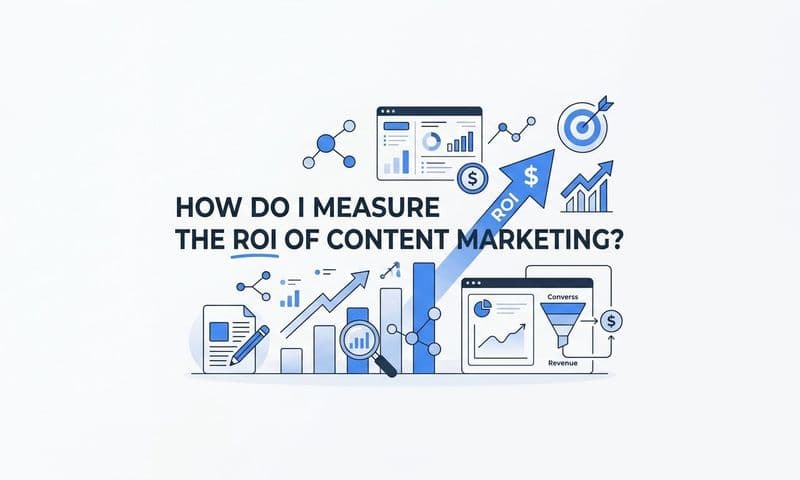
How Do I Measure ROI for SEO or Content Marketing?
This is a classic. Channels like SEO and content marketing don't deliver results overnight, which makes tracking their ROI tricky. You have to shift your mindset from short-term campaigns to long-term value.
The trick is to connect your investment over time to the revenue generated from organic sources. It requires patience, but the payoff is a clear view of your most sustainable marketing channel.
Don't look at last week's numbers. Instead, track organic traffic growth, the number of leads coming from organic search, and their conversion rates over a 12-month period. To get the revenue side of the equation, assign a monetary value to each lead based on your average customer value.
Why Is My Marketing ROI Negative?
Seeing a negative ROI is a gut punch, but it’s not a reason to panic. It’s a crystal-clear signal that something is broken. Your costs are officially higher than the revenue your campaign is generating, and it's time to play detective.
Common culprits include:
- Targeting the wrong audience.
- Ad creative or messaging that just isn't landing.
- A clunky landing page or a broken website experience.
- A fundamental mismatch between what your marketing promises and what your product delivers.
A negative ROI means it’s time to hit pause on the ad spend. Dive deep into your analytics to find the weak link in your funnel, run some tests to fix it, and only then should you even think about scaling back up.
Stop guessing and start proving your marketing's value. Cometly provides a complete attribution platform that unifies your data, tracks every touchpoint, and reveals the true ROI of your campaigns. See how Cometly can help you make data-driven decisions today.