

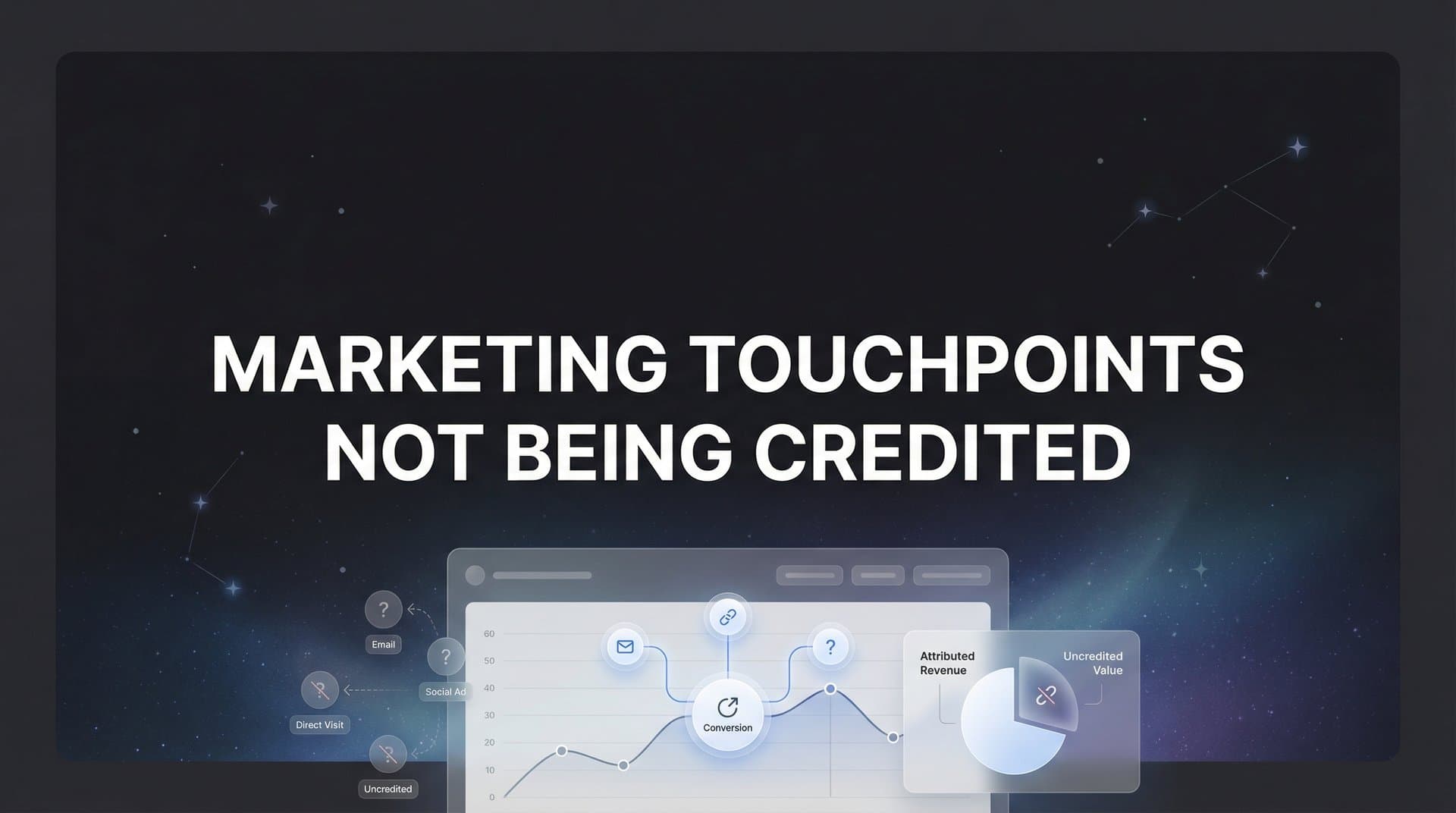
You launch a campaign, watch the conversions roll in, and then check your attribution dashboard. The data says "direct traffic" or hands all the credit to a single last click. But you know that's not the full story. Somewhere between that first ad impression and the final purchase, your marketing touchpoints disappeared into a black hole.
This isn't just a reporting headache. It's a budget killer.
When your attribution data fails to capture the real customer journey, you're making decisions in the dark. You cut campaigns that were actually working. You double down on channels that just happened to be last in line. And worst of all, you feed incomplete data back to ad platforms, teaching their algorithms to optimize for the wrong signals.
The good news? Understanding why touchpoints go uncredited is the first step toward fixing broken attribution and making marketing decisions you can actually trust.
The Real Price of Invisible Touchpoints
Here's what happens when your attribution data has gaps: you see a conversion attributed to "direct" traffic and assume the customer just typed in your URL. In reality, they saw your Facebook ad three days ago, clicked a Google search result yesterday, and opened your email this morning before converting.
Every one of those touchpoints played a role. But if your tracking only caught the last one, you're operating with a fundamentally incomplete picture of what drives revenue.
The immediate consequence is misallocated budget. You look at your dashboard, see that Facebook "isn't working," and cut the budget. Meanwhile, Facebook was actually introducing prospects to your brand, starting journeys that eventually converted through other channels. You just killed your top-of-funnel engine based on faulty data.
But the damage compounds. When you cut effective campaigns, your overall conversion volume drops. You then increase spend on whatever channels are still showing conversions in your broken attribution system, even though they might just be capturing credit for work other channels did. Your cost per acquisition climbs. Your marketing efficiency drops.
Then there's the algorithm problem. Modern ad platforms like Meta and Google use conversion data to optimize targeting and bidding. When you feed them incomplete conversion signals because your tracking missed touchpoints, their AI optimizes based on a distorted reality. The platforms think they're learning what works, but they're actually learning from corrupted data.
This creates a vicious cycle: bad attribution leads to bad budget decisions, which leads to worse campaign performance, which generates even worse data for the algorithms to learn from. Your campaigns become less effective over time, and you can't figure out why. Understanding these attribution challenges in marketing analytics is essential for breaking this cycle.
For marketing teams, there's also a credibility cost. When leadership asks which campaigns drive revenue and you can't provide confident answers because half your touchpoints are uncredited, your strategic recommendations lose weight. Finance wants to know ROI by channel. Sales wants to understand which marketing sources generate the best leads. And you're stuck explaining why your attribution data has gaps instead of delivering insights.
Why Your Touchpoints Vanish Into Thin Air
The problem isn't that attribution is hard in theory. It's that the modern customer journey is specifically designed to break traditional tracking methods.
Cross-Device Journeys Break the Thread: Your prospect sees your ad on their phone during their morning commute. They research your product on their tablet that evening. They convert on their laptop at work the next day. Each device has different cookies, different identifiers, different tracking contexts. Traditional browser-based tracking sees three separate visitors, not one continuous journey.
This isn't an edge case anymore. The typical B2B buyer researches across multiple devices before converting. When your tracking can't connect these touchpoints to the same person, each device interaction looks like a new visitor. The mobile ad that started the journey gets no credit. The tablet research session disappears entirely. Only the final desktop conversion gets recorded, usually as "direct" traffic.
Privacy Changes Created Massive Data Gaps: Apple's App Tracking Transparency requirement fundamentally changed the game. Apps now have to ask permission before tracking users across other apps and websites. Most users decline. The result is that a significant portion of iOS traffic simply can't be tracked using traditional methods.
Browser cookie restrictions compound the problem. Safari blocks third-party cookies by default. Firefox does the same. Chrome has announced similar plans. These privacy protections are good for users, but they create blind spots in your attribution data. When a prospect clicks your ad but their browser blocks the tracking cookie, that touchpoint never gets recorded. This is why many marketers are turning to performance marketing tracking software that can work around these limitations.
Cookie consent requirements add another layer. GDPR and similar regulations require explicit user consent before setting tracking cookies. Many visitors decline or ignore the consent banner entirely. Every declined consent is another lost touchpoint in your attribution data.
Platform Silos Hide the Full Picture: Meta's ad dashboard shows conversions it tracked. Google Ads shows conversions it tracked. LinkedIn shows conversions it tracked. But here's the problem: they're all looking at the same conversions and claiming credit independently.
Each platform only sees its own touchpoints. Meta doesn't know about the Google search that happened before the Facebook click. Google doesn't know about the LinkedIn ad that introduced the prospect to your brand. Your attribution reports from each platform add up to 300% of your actual conversions because everyone's claiming credit for the same sales.
Without a unified view that captures touchpoints across all platforms, you can't see which channels are truly driving results versus which ones are simply intercepting customers who were already going to convert.
When Your Attribution Model Becomes the Problem
Sometimes the issue isn't missing data. It's that your attribution model is systematically hiding touchpoints that actually matter.
Last-Click Attribution Erases the Journey: This is the default model in most analytics platforms, and it's brutally simple: whoever gets the last click before conversion gets 100% of the credit. Everything else gets zero.
Imagine a customer journey: they see your Facebook ad, click it, browse your site. Three days later they see a Google search ad, click through, read your blog. A week later they get your email, click through, and convert. Last-click attribution gives the email 100% credit and ignores Facebook and Google entirely.
This systematically undercredits awareness and consideration channels. Top-of-funnel campaigns that introduce prospects to your brand show zero ROI because they rarely get the last click. You look at the data, conclude these campaigns don't work, and cut them. Then your overall conversion volume drops because you eliminated the channels that were starting customer journeys.
First-Click Has the Opposite Blind Spot: First-click attribution gives 100% credit to whatever touchpoint started the journey. The Facebook ad that introduced the prospect gets all the credit. The Google search ad that answered their specific question gets nothing. The email that finally convinced them to buy gets nothing.
This creates a different distortion. Your nurturing campaigns and bottom-of-funnel tactics appear worthless because they never get credit for closing deals. You might conclude that retargeting doesn't work or that email campaigns have no ROI, when in reality they're essential for converting the awareness your first-touch channels created. Learning about different attribution models in digital marketing helps you choose the right approach for your business.
Multi-Touch Attribution Shows the Complete Story: This is where attribution starts reflecting reality. Multi-touch models distribute credit across all the touchpoints in a customer journey, acknowledging that conversions result from multiple interactions, not a single magic moment.
Linear attribution gives equal credit to every touchpoint. Time-decay attribution gives more credit to recent touchpoints while still acknowledging earlier ones. Position-based attribution emphasizes the first and last touchpoints while giving some credit to the middle. Data-driven attribution uses machine learning to determine how much credit each touchpoint type actually deserves based on conversion patterns.
The key insight: different touchpoints play different roles in the customer journey. Awareness channels introduce prospects. Consideration channels educate them. Decision channels convert them. A complete attribution model captures all these roles instead of pretending only one touchpoint mattered.
How Server-Side Tracking Captures What Browsers Miss
Traditional tracking relies on browser cookies and JavaScript. A visitor clicks your ad, your website sets a cookie, and future visits get tracked by reading that cookie. This worked fine until privacy protections, ad blockers, and cookie restrictions started breaking the system.
Server-side tracking takes a fundamentally different approach. Instead of relying on the visitor's browser to track and report data, your server captures the data directly and sends it to your analytics platforms and ad networks.
The Technical Difference That Matters: With client-side tracking, everything depends on the visitor's browser cooperating. If they use an ad blocker, your tracking script gets blocked. If they decline cookies, you can't track their journey. If they browse in private mode, each session looks like a new visitor. You're at the mercy of browser settings and privacy tools.
Server-side tracking bypasses these limitations. When a visitor interacts with your site, your server captures the event data directly. Ad blockers can't block your server. Cookie restrictions don't apply because the tracking happens server-to-server, not in the browser. Privacy mode doesn't matter because you're not relying on browser storage.
This means you capture touchpoint data that client-side tracking would miss entirely. The visitor who has an ad blocker installed still gets tracked. The iOS user who declined app tracking still appears in your attribution data. The privacy-conscious prospect browsing in incognito mode still contributes to your understanding of the customer journey. Implementing the right marketing campaign tracking software makes this process seamless.
Feeding Better Data to Ad Platforms: Here's where server-side tracking creates a compounding advantage. When you capture more complete conversion data, you can send that enriched data back to Meta, Google, and other ad platforms through their server-side conversion APIs.
This matters because ad platforms use conversion data to optimize their algorithms. When you only send them the conversions that browser-based tracking caught, they're optimizing based on incomplete information. They think certain audiences and ad types drive conversions when they're actually just the ones that happened to get tracked.
Server-side tracking lets you send complete conversion data, including conversions that happened after the visitor used an ad blocker or declined cookies. The ad platforms get a more accurate picture of what's working. Their algorithms optimize based on reality instead of a subset of reality. Your targeting improves. Your cost per conversion drops. Your campaigns become more efficient.
Connecting the Dots Across Your Entire Revenue Journey
Capturing touchpoints is only half the battle. The other half is connecting them into a coherent view of how prospects become customers.
Unified Tracking Across Every Channel: Your customer journey doesn't respect platform boundaries. A prospect might see your Facebook ad, search for your brand on Google, visit from a LinkedIn post, receive your email, and finally convert through a direct visit. To understand what drove that conversion, you need to track all these touchpoints and connect them to the same person.
This requires integration across your entire marketing stack. Your ad platforms need to feed data into a central attribution system. Your website needs to track visits and connect them to ad clicks. Your CRM needs to report when tracked visitors become leads and customers. Your email platform needs to log opens and clicks as touchpoints. A comprehensive marketing campaign attribution platform brings all these data sources together.
When these systems work together, you can trace the complete journey from first impression to closed revenue. You see which channels introduce prospects, which ones nurture them, and which ones convert them. You understand how different touchpoints work together instead of treating each one in isolation.
Capturing Offline Touchpoints: Not every important touchpoint happens online. A prospect might click your ad, then call your sales team. They might attend a webinar, then book a demo. They might see your trade show booth, then visit your website a week later.
These offline interactions are often the highest-value touchpoints in B2B customer journeys. A sales call or product demo frequently plays a decisive role in whether a prospect converts. But if your attribution system only tracks digital touchpoints, these crucial interactions are invisible. Effective tracking for B2B marketing campaigns must account for these offline moments.
Complete attribution connects your CRM data to your marketing touchpoints. When a prospect books a demo, that event gets logged as a touchpoint in their journey. When they have a sales call, that gets captured too. When they finally convert, you can see the entire sequence: the Facebook ad that introduced them, the Google search that brought them back, the webinar they attended, the demo they booked, and the sales conversation that closed the deal.
From Clicks to Revenue Attribution: Here's where attribution gets truly valuable: connecting touchpoints not just to conversions, but to actual revenue. A conversion might be a free trial signup or a demo request. But what you really want to know is which touchpoints drove customers who actually paid you money.
Revenue attribution tracks the journey all the way through to closed deals and recurring revenue. You can see which ad campaigns generated your highest-value customers. You can identify which content pieces appear most often in the journeys of customers who spend the most. You can compare channels not just by conversion volume but by the actual revenue they drive.
This transforms marketing from a cost center that generates leads into a revenue driver with clear ROI. When you can show that specific campaigns and channels drive specific revenue amounts, budget conversations change completely. You're not defending marketing spend anymore. You're allocating investment toward proven revenue sources.
Turning Attribution Insights Into Smarter Budget Decisions
Having complete attribution data is pointless if you don't act on it. Here's how to use accurate touchpoint tracking to make better marketing decisions.
Audit Your Current Attribution Gaps: Start by identifying where you're losing touchpoint data right now. Check what percentage of your conversions show up as "direct" traffic. Look for channels that have high click volume but low attributed conversions. Review your cross-device tracking capabilities. Test whether your tracking works with ad blockers enabled.
These gaps represent blind spots in your marketing decision-making. Every uncredited touchpoint is a piece of the puzzle you're missing when you decide where to allocate budget. Document these gaps so you know what you're working to fix. Using a marketing campaign tracking spreadsheet can help you organize and identify these data gaps systematically.
Prioritize Based on Value: Not all attribution gaps matter equally. A missing touchpoint on a channel that drives 5% of your traffic is less urgent than missing attribution on a channel that drives 40% of your traffic. Similarly, gaps that affect high-value customer journeys matter more than gaps in low-value segments.
Focus first on capturing touchpoints for your highest-volume channels and highest-value customer segments. These are the areas where incomplete attribution is costing you the most in terms of misallocated budget and missed optimization opportunities.
Reallocate Based on Complete Data: Once you have accurate attribution showing which touchpoints actually drive conversions and revenue, use it to guide budget decisions. Identify channels that are contributing to customer journeys but getting undercredited in last-click models. These are often your awareness and consideration channels that start journeys but don't close them.
Look for channels that are getting credit but aren't actually driving incremental conversions. These are often bottom-funnel channels that intercept customers who were already going to convert. They're not worthless, but they don't deserve the same budget priority as channels that create new demand. Leveraging AI-powered marketing budget allocation tools can help you make these decisions with greater precision.
Use your attribution data to test hypotheses. If your data suggests Facebook is undercredited, try increasing budget there and measure the impact on overall conversion volume, not just Facebook-attributed conversions. If a channel appears to be overcredited, try decreasing budget and see if your overall results actually suffer.
Making Every Touchpoint Count
Uncredited touchpoints aren't just a reporting inconvenience. They're a direct threat to your marketing ROI and your ability to make confident decisions about where to invest your budget.
When half your customer journey is invisible, you're flying blind. You cut campaigns that work. You scale campaigns that don't. You feed incomplete data to ad platform algorithms, making them less effective over time. And you lose credibility with leadership because you can't confidently answer which marketing investments actually drive revenue.
Solving this requires three things: tracking the complete customer journey across all devices and channels, using attribution models that credit all touchpoints instead of just the first or last, and feeding enriched conversion data back to ad platforms so their optimization algorithms work with accurate information.
The technology exists to capture touchpoints that traditional tracking misses. Server-side tracking bypasses browser limitations. Unified attribution platforms connect data across your entire marketing stack. Multi-touch attribution models distribute credit across the real customer journey instead of pretending only one touchpoint mattered.
The question is whether you're willing to fix your attribution gaps or keep making budget decisions based on incomplete data. Every day you operate with broken attribution is another day of misallocated budget and missed opportunities to scale what actually works.
Ready to elevate your marketing game with precision and confidence? Discover how Cometly's AI-driven recommendations can transform your ad strategy. Get your free demo today and start capturing every touchpoint to maximize your conversions.



