A successful Marketo and Salesforce integration is the engine of your entire revenue operation. It creates a single source of truth that finally gets marketing and sales on the same page. This isn't just about syncing data—it’s about enabling smarter marketing, proving ROI, and creating a customer journey that actually makes sense from first click to final sale.
Why a Seamless Integration Is a Revenue Game Changer
Connecting Marketo and Salesforce isn't a simple IT project; it's a strategic move that hits the bottom line. When these two powerhouses work in harmony, they create a powerful feedback loop. Marketing finally gets to see which campaigns are actually generating pipeline and closed-won deals in Salesforce. At the same time, sales gets a real-time feed of lead engagement from Marketo.
This shared intelligence is the bedrock of any high-performing revenue team.
 Guide to marketo and salesforce integration: Boost CRM & Marketing Alignment
Without this connection, both departments are flying blind. Marketing might be pumping out thousands of leads, but without sales outcome data, they have no idea which sources are gold and which are garbage. On the flip side, sales reps are stuck chasing cold leads with zero context on their interests or what they've been engaging with. A broken sync is a recipe for operational chaos, frustrated teams, and missed revenue targets.
Unlocking Strategic Advantages
A properly configured integration lets you move past basic lead management and into more sophisticated, revenue-focused strategies. The two-way data flow is what makes it all possible:
- Sophisticated Account-Based Marketing (ABM): Your sales team can flag target accounts right in Salesforce. Marketo picks up that signal and launches highly personalized ad campaigns and nurture sequences. As soon as there's engagement, that activity flows right back to Salesforce, alerting the reps that it's time to act.
- Crystal-Clear Attribution: By tying marketing activities directly to sales outcomes, you can finally answer the question, "What's actually working?" This is the core of closed-loop marketing, letting you measure campaign ROI with confidence instead of guesswork.
- A Flawless Customer Journey: When a lead requests a demo, their entire history of marketing interactions syncs over to Salesforce. This arms your sales reps with the context they need for a relevant, productive conversation, improving the experience from the very first touchpoint.
To really get a feel for the power behind connecting systems like Marketo and Salesforce, it helps to start by understanding different types of integrations and what they can do for your business.
A well-executed Marketo and Salesforce integration transforms data into a shared language. It’s the difference between marketing and sales having separate maps and them using the same GPS to reach a common destination—revenue growth.
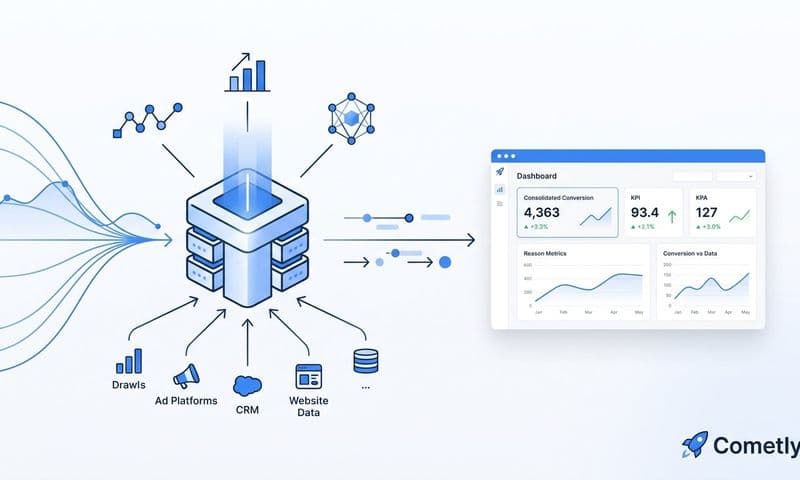
Ultimately, this unified system becomes the backbone for proving marketing’s contribution to the bottom line. It also sets the stage for modern attribution tools like Cometly, which can plug into this ecosystem to deliver even deeper insights. By layering ad platform data on top of your CRM and marketing automation data, you get a complete picture of every touchpoint.
You can dive deeper into this topic by exploring our guide to closed-loop marketing. This unified approach is what turns your data into decisive, revenue-driving action.
Your Pre-Flight Checklist for a Successful Sync
A successful Marketo and Salesforce integration is all about the prep work, not just the technical setup. Seriously, the number one reason these integrations fail—and create a massive headache for marketing and sales—is because teams rush into the configuration without laying the proper groundwork first.
Think of it like building a house. You wouldn't pour the walls without a solid foundation, right? The same logic applies here. Taking the time to audit your data, define your internal processes, and get your teams on the same page will save you countless hours of troubleshooting down the road.
Establish Dedicated Integration Users
First things first: you absolutely need to create dedicated user profiles in both Marketo and Salesforce. These aren't for actual people. They’re service accounts that exist only for the integration to pass data back and forth. Using an existing employee’s credentials is a rookie mistake—if that person leaves the company and their account gets shut down, your entire sync breaks instantly.
Here's how to do it right:
- In Salesforce: Create a new user with a dedicated "Marketo-Salesforce Sync" profile. This profile needs API access and specific read/create/edit permissions on the objects you care about, like Leads, Contacts, Accounts, Opportunities, and Campaigns. Don't just hand it full System Administrator privileges; grant only what's necessary to get the job done.
- In Marketo: Create a dedicated API-only user role with only the permissions needed to access and modify the data you plan to sync.
This approach keeps the integration's activities isolated, making it much easier to track changes and figure out what’s going on if something breaks.
Conduct a Practical Data Audit
The old "garbage in, garbage out" saying is painfully true for integrations. If you sync messy, inconsistent data from one system to the other, you're just creating a bigger, more expensive mess. Before you connect a single thing, you have to get a clear picture of the current state of your data in both platforms.
Don't skip the data audit. It's the most important step you can take to ensure the long-term health of your Marketo and Salesforce integration. A clean database is the foundation of reliable reporting and effective automation.
Start by asking a few simple questions:
- Is our data complete? Are key fields like
Lead Source,Country, orIndustryactually filled out consistently in both systems? Or is it a patchwork of missing information? - Is our data formatting consistent? Do you have mismatched picklist values? For example, does Salesforce use "USA" while Marketo uses "United States"? Little things like this will cause sync failures left and right.
- How bad is our duplicate problem? Take an honest look at your duplicate leads and contacts. You need a solid plan to merge or purge these records before you turn on the sync.
For any organization trying to build a scalable tech stack, it’s worth reviewing a comprehensive guide on data integration best practices to build a strong governance framework from day one.
Define Your Data Governance Strategy
Once you’ve audited your data, it's time to get marketing and sales ops in the same room to agree on the rules of the road. This is your chance to define the logic that will govern your lead lifecycle and prevent the all-too-common friction between teams.
Your governance strategy needs to clearly document a few key things:
- Lead Ownership Rules: Who owns a lead at any given time? At what exact point does a lead officially pass from marketing to sales?
- Deduplication Criteria: How will the system identify and handle duplicate records? Is an email address the one true unique identifier, or is it something else?
- Lifecycle Stage Definitions: What are the exact, agreed-upon definitions for a Marketing Qualified Lead (MQL) and a Sales Qualified Lead (SQL)? What specific actions or scores trigger these stage changes?
Getting written sign-off on these definitions is non-negotiable. It forces both teams to align on the process and stops future arguments about lead quality or follow-up times before they can start. This document becomes your shared playbook for revenue operations.
Architecting Your Data Flow and Field Mapping
With your pre-flight checks complete, it's time to get into the technical heart of the Marketo and Salesforce integration. This is where you lay the tracks for how data moves between your two most critical systems. Get it right, and information flows logically, accurately, and efficiently. Get it wrong, and you're signing up for a future filled with sync errors and reporting nightmares.
At its core, the relationship is pretty straightforward: a Marketo Person record syncs to either a Salesforce Lead or a Salesforce Contact object. The native sync is smart enough to check for an existing Contact with the same email address before creating a new Lead, which helps prevent some obvious duplicates.
But the real work isn't in the concept; it's in the execution—deciding exactly which pieces of information make that journey.
Before you map a single field, adopt a "less is more" mindset. One of the most common mistakes I see is teams trying to sync every single field from Marketo to Salesforce. This just clutters up your CRM, slows down sync performance, and overwhelms your sales team with noise. Stick to the data that is genuinely actionable for sales or absolutely essential for reporting.
This diagram nails the foundational mindset you need before diving in, focusing on users, auditing, and governance.
 Guide to marketo and salesforce integration: Boost CRM & Marketing Alignment
A successful sync doesn't start with the tech. It starts with defining who needs what data, cleaning up what you already have, and setting clear rules before you connect anything.
Crafting a Meticulous Field Mapping Strategy
Field mapping is exactly what it sounds like: telling the integration which field in Marketo goes to which field in Salesforce. Meticulous is the keyword here. One tiny mismatch, like trying to push a text field from Marketo into a number field in Salesforce, will break the sync for that entire record.
Your first move should be to create a mapping document—a simple spreadsheet will do. List every field you think needs to sync and document these key details for each:
- Marketo Field Name: The exact name as it appears in Marketo.
- Salesforce Field API Name: The precise API name (e.g.,
LeadSource, not "Lead Source"). - Data Type Match: Confirm the field types are compatible (e.g., Marketo
Stringto SalesforceText). - Sync Direction: Decide which way the data should flow for this specific field.
Pro Tip: Never, ever assume field types match just because the names are similar. Always check in both systems. A Picklist in Salesforce and a String field in Marketo can cause persistent sync headaches if their values aren't perfectly aligned.
Choosing the Right Sync Direction
The direction of your data flow isn't an all-or-nothing decision. You have to set it on a field-by-field basis, which strategically determines which system is the ultimate source of truth for that piece of information.
You've got three main options:
- Marketo to Salesforce (SFDC): Data only flows from Marketo to Salesforce. This is perfect for marketing-generated data that sales needs to see but shouldn't ever edit, like
Behavior ScoreorLast Interesting Moment. - Salesforce to Marketo: Information only flows from Salesforce back to Marketo. This is your go-to for sales-owned data, like
Account Owneror a customSales Status, that marketing needs for segmentation but has no business changing. - Bidirectional: Data flows both ways, and the most recent update wins. Use this one sparingly. It's great for fields where both teams legitimately need to make edits, such as
Email AddressorPhone Number, but overusing it can lead to accidental data overwrites and a lot of confusion.
A solid grasp of how different systems and data points connect is fundamental. To see the bigger picture, it can be helpful to explore the core principles of building a connected data ecosystem.
The table below is a handy checklist for some of the most critical fields to map. Think of it as a starting point for your own mapping document.
Essential Field Mapping Checklist
The Lead Source field should be set up as a string or picklist in Marketo and a picklist in Salesforce, with the recommended sync direction being Marketo to Salesforce. This field exists to track the original channel that acquired the lead, such as Paid Search or Organic, which makes it foundational for attribution and performance reporting.
The Lead Status field is typically a string in Marketo and a picklist in Salesforce, and it should sync from Salesforce to Marketo. This is important because sales is usually the source of truth for lead status, and marketing needs that status to properly segment leads and run the right nurture sequences based on where the lead is in the sales process.
The Behavior Score field should be an integer in Marketo and a number field in Salesforce, syncing from Marketo to Salesforce. This gives the sales team a clear quantitative signal of engagement and intent, helping them prioritize outreach and focus on leads that are showing real buying behavior.
The Email Address field should be an email field type in both platforms, and it should be bidirectional. Email is the primary identifier for a lead, so it needs to stay accurate and current regardless of whether updates happen in marketing workflows or sales activity.
The UTM_Campaign__c field should be a string in Marketo and a text field in Salesforce, syncing from Marketo to Salesforce. This field captures campaign tracking data so you can tie leads and revenue back to specific marketing efforts inside Salesforce for attribution and ROI reporting.
The Do Not Call field should be a boolean in Marketo and a checkbox in Salesforce, syncing bidirectionally. This ensures compliance by allowing either system to mark a person as opted out of calls, preventing accidental outreach and keeping both systems aligned.
The Account Owner field should be a string in Marketo and a user lookup field in Salesforce, syncing from Salesforce to Marketo. This helps marketing know who owns the account so alerts can be routed correctly and outreach can be personalized based on ownership.
The Lifecycle Stage field should be a string or picklist in both systems and sync bidirectionally. This is a shared field that tracks a person’s stage in the funnel, such as MQL, SQL, or Customer, ensuring both marketing and sales are operating from the same funnel definitions and progression rules.
This checklist isn't exhaustive, but it covers the core data points that fuel alignment between sales and marketing. Use it to guide your own internal audit and ensure you're not missing any mission-critical fields.
A Practical Example: Mapping UTM Parameters
Let's walk through a real-world scenario that every data-driven marketer needs: mapping UTM parameters. You want to capture source data from a Marketo form and get it into Salesforce for attribution reporting.
First, you'd create five custom fields in Marketo: UTM_Source, UTM_Medium, UTM_Campaign, UTM_Content, and UTM_Term. Then you’d set up your Marketo forms to grab these values from the URL when someone submits a form.
Next, you need to create matching custom fields in Salesforce on the Lead object. You'd head over to Setup > Object Manager > Lead > Fields & Relationships and create five new Text fields. Make sure to give them clear API names like UTM_Source__c, UTM_Medium__c, etc.
Finally, in your mapping document and inside the Marketo sync settings, you’d establish the one-to-one mapping.
With this simple architecture in place, every new lead who fills out a form gets their acquisition source data permanently stamped onto their Salesforce record. Your sales team gets immediate context, and you get the data you need to build powerful attribution reports that show which campaigns are actually driving pipeline.
Configuring Sync Rules and Lead Lifecycle Automation
Okay, your architecture is mapped out, and your fields are aligned. Now comes the fun part: defining the rules of engagement. This is where the Marketo and Salesforce integration stops being a simple data pipe and starts acting like an intelligent automation engine. You’re about to move from just moving data to controlling its flow based on your actual business strategy.
The whole point here is to stop treating every lead the same. Instead of blasting your Salesforce instance with a firehose of raw leads, you’re creating a smart filter. This ensures that only prospects who have shown real interest get passed to sales, making your reps dramatically more efficient and focused.
Setting Precise Sync Criteria
The heart of this entire process is the Marketo Sync with Salesforce filter. Think of it less like an on/off switch and more like a bouncer at an exclusive club. You get to set the exact criteria a person must meet before they ever get near Salesforce.
A great way to do this is by building a smart list in Marketo that acts as your sync trigger. A person only gets added to this list—and synced to Salesforce—if they meet specific conditions you’ve defined.
- Behavioral Triggers: Maybe their behavior score hits a threshold of 75 or higher.
- High-Intent Actions: They could fill out a high-value form, like "Request a Demo" or "Contact Sales."
- Demographic Fit: You could set rules like their job title must contain "Manager" or "Director," and their industry has to match your ideal customer profile (ICP).
This keeps your Salesforce environment clean and laser-focused on leads that are actually actionable. When sales reps see a new lead from marketing, they can trust it’s already been vetted and is worth their time.
Building a Smart Lead Lifecycle
Once you’ve nailed down who syncs, the next step is automating what happens next. A well-defined lead lifecycle creates a seamless, automated handoff from marketing to sales, completely getting rid of manual lead routing and the risk of good leads falling through the cracks. It's essential for properly managing the different stages of a lead.
Your automation should be built around clear status changes that follow a prospect’s journey.
- Lead Creation in Marketo: A new person enters your database. At this point, they're nurtured with automated campaigns and content.
- MQL (Marketing Qualified Lead) Trigger: The lead meets your sync criteria (e.g., score > 75). Marketo automatically syncs the person to Salesforce as a new Lead.
- Sales Assignment: Salesforce assignment rules kick in, routing the new lead to the right sales rep based on territory, industry, or whatever rules you've set up.
- SQL (Sales Qualified Lead) Conversion: The sales rep connects with the lead and qualifies them. They then convert the Lead object into a Contact, Account, and Opportunity in Salesforce.
- Closed-Loop Feedback: This conversion data syncs right back to Marketo, enriching the original person record. This provides priceless data for your attribution reporting.
This intelligent handoff is the cornerstone of true sales and marketing alignment. Marketing generates qualified interest, and sales acts on it immediately, armed with a complete history of the prospect's marketing engagements. There are no gray areas and no "who's lead is it anyway?" arguments.
To really put this on steroids, you can explore various platforms for lead scoring and auto-routing in CRM. This ensures leads are handled with maximum efficiency based on their unique engagement and fit.
Empowering ABM with Real-Time Data
This level of automation is an absolute game-changer for Account-Based Marketing (ABM) strategies. When real-time engagement data from Marketo flows directly into Salesforce, it completely transforms how sales teams approach their target accounts. They're no longer making cold calls; they're following up on tangible signals of interest.
The integration gives B2B teams the rich customer data they need to build highly personalized and targeted campaigns based on account-level insights. We've seen companies with this setup implement automated lead scoring where prospects are only transferred once they hit specific engagement thresholds, complete with their full activity history. The result? Dramatically shorter sales cycles.
Imagine a sales rep looking at a target account in Salesforce. Because of the integration, they don’t just see a static company record. They see a live feed of activity. They know that three key decision-makers from that account just attended a webinar, another downloaded a whitepaper, and a third has been poking around the pricing page. This is the kind of actionable intelligence that turns a good sales team into a great one.
Troubleshooting Common Sync Errors and Pitfalls
Even the most carefully planned Marketo and Salesforce integration is going to hit a few bumps. A data sync isn't a "set it and forget it" machine; it's a living process, and things will pop up. The real goal isn't to achieve flawless perfection but to build a solid playbook for when things go sideways. That way, you can diagnose and fix issues fast, without your entire operation grinding to a halt.
Think of your sync dashboard as your command center. Get in the habit of checking the Marketo sync logs and keeping an eye on Salesforce notifications. Most problems leave a digital trail, and learning to read the signs is the first step to fixing them quickly.
Decoding API Limit Errors
One of the first gremlins you'll probably run into is the dreaded Salesforce API call limit. Salesforce gives your entire organization a set number of API calls it can make in a 24-hour period. A busy Marketo instance—especially during a huge list import or a major campaign launch—can burn through that allowance surprisingly fast.
When this happens, the sync just stops dead in its tracks until the limit resets. You’ll see errors like API_LIMIT_EXCEEDED lighting up your logs.
The fix is all about reducing the number of calls Marketo is making.
- Trim the Fat from Your Sync: Are you syncing dozens of fields just because you can? Every single updated field on a synced record can eat up an API call. Go back to your field map and get ruthless—if it isn't driving action for sales or marketing, cut it.
- Batch Your Updates: Instead of syncing every tiny change the second it happens, use Marketo's smart campaigns to batch updates. For example, you could push a lead score update once a day instead of after every single web page visit.
- Find the Other Culprits: Marketo might be the main suspect, but it's rarely the only app talking to Salesforce. Other tools connected to your CRM are also using those precious API calls. Run an audit in Salesforce (Setup > Company Information) to see your total usage and identify other chatty applications that might be contributing to the problem.
Tackling Sync Queue Backlogs
A long sync queue is another classic headache. You might see new leads taking hours—not minutes—to show up in Salesforce, leaving your sales team waiting. This kind of backlog can happen for a lot of reasons, from a massive list upload in Marketo to a temporary slowdown on the Salesforce side.
The immediate fix is often just patience; the queue will usually clear itself out. But if this becomes a regular occurrence, you're looking at a symptom of a much deeper inefficiency.
A consistently clogged sync queue is a sign that your integration is working too hard, not too smart. It often points to overly broad sync rules that are trying to push too much low-value data between systems.
For instance, trying to sync every single person who ever enters your Marketo database is a recipe for a permanent traffic jam. This is where that filtered sync approach we covered earlier comes in. By only pushing leads that meet certain criteria (like reaching MQL status), you dramatically slash the volume of records hitting the queue in the first place.
Resolving Formula Field Failures
Salesforce formula fields are incredibly useful, but they're a notorious source of sync failures if you're not careful. The problem is simple: formula fields are read-only. By definition, they calculate a value based on other fields, so Marketo can't write data directly into them.
If you accidentally map a Marketo field to a Salesforce formula field and set the sync to go from Marketo to Salesforce, every single attempt to update that record will fail. You'll typically see an error message mentioning a "read-only field" or an inability to update.
Luckily, the solution is straightforward:
- Pull up your field mapping document and hunt for any instances where a Marketo field is mapped to a Salesforce formula field.
- Once you find one, change the sync direction. The sync for that specific field must be set to Salesforce to Marketo only. This lets Marketo read the calculated value from Salesforce without ever trying to write to it.
- If you need to send data from Marketo that gets used in a Salesforce formula, create a brand new, writable field in Salesforce to act as the destination. Then, you can simply reference that new field in your formula calculation.
Supercharging Your Integration with Advanced Attribution
Getting your Marketo and Salesforce integration live and stable is a huge win. Seriously, pop the champagne. But that’s just the starting line, not the finish. The real value comes when you start using this newly unified data stream to build powerful, closed-loop reports that finally—finally—prove marketing's direct impact on revenue.
This is where you graduate from simply handing off leads to generating true business intelligence.
The bidirectional data flow you worked so hard to establish is the engine for all of this. It lets you see exactly which marketing campaigns and channels in Marketo are creating pipeline and, more importantly, closing deals in Salesforce. No more fuzzy math or loose correlations. You can now draw a straight, undeniable line from a marketing touchpoint to a sales outcome.
 Guide to marketo and salesforce integration: Boost CRM & Marketing Alignment
Beyond Native Reporting Capabilities
While the out-of-the-box reporting in both Marketo and Salesforce is useful, it leaves some massive blind spots, especially at the top of the funnel. Your sync tells you what happened after a lead entered your ecosystem, but what about the journey that brought them there in the first place? This is where modern attribution platforms come into play.
These tools are built to sit on top of your integration, unifying all your scattered data points into one cohesive story. They plug directly into your ad platforms (think Google Ads, Facebook Ads, LinkedIn Ads) and layer that top-of-funnel touchpoint data over your mid-funnel Marketo engagement data and bottom-funnel Salesforce revenue data.
The result is a complete, multi-touch attribution picture that tells the entire customer story. You can finally see the messy, complex web of interactions that actually leads to a sale, not just the last click.
Unifying Ad Spend with CRM Outcomes
Let's walk through a common scenario. You’re running a big campaign on LinkedIn. A prospect clicks an ad, browses a few pages on your site, but doesn't convert. A week later, they get a nurture email from Marketo, click a link, and download a whitepaper. Two weeks after that, a sales rep reaches out, and that lead eventually becomes a customer in Salesforce.
Without an advanced attribution tool, you’d probably only credit the email nurture or the sales rep’s outreach. You would completely miss the fact that the $5,000 you spent on that initial LinkedIn campaign was the critical first touch that kicked off the entire journey.
Attribution platforms bridge the gap between ad spend and revenue. They connect the anonymous clicks from ad platforms to the known leads in your CRM, giving you the clarity needed to invest your marketing budget with confidence.
By connecting these dots, you can finally answer the questions that keep you up at night:
- Which specific ad campaigns are generating the most qualified pipeline?
- What's our true cost per acquisition (CPA) when we look at the entire sales cycle?
- Which channels deserve more budget, and which ones are just burning cash?
Turning Raw Data into Actionable Intelligence
Having all this data is one thing; using it to make smart decisions is another entirely. A dedicated attribution platform doesn't just collect data—it helps you make sense of it. You can build dashboards that visualize the entire customer journey, compare channel performance side-by-side, and even model how changes in your marketing mix might impact revenue.
This level of insight is a game-changer for any marketing team. Budget meetings are no longer based on hunches or vanity metrics. Instead, you can walk in with hard data showing exactly how much pipeline and revenue each marketing dollar is generating. Seeing a live demo of multi-touch attribution can make these concepts click, showing you exactly how this applies to your business model.
Ultimately, supercharging your integration with attribution is about making your data work for you. It transforms your connected systems from a simple operational tool into a strategic engine for growth, justifying your marketing spend and guiding your strategy with undeniable proof.
Ready to connect every touchpoint from first click to final sale? With Cometly, you can unify your ad spend, marketing automation, and CRM data into a single source of truth. Eliminate wasted spend and prove your marketing ROI with confidence. Get a demo and see what you've been missing. Learn more at https://www.cometly.com.