Running paid ads across multiple countries sounds like a growth success story. And it is, until you try to figure out which campaigns are actually working.
When your revenue comes in as euros from a German campaign, pounds from a UK audience, yen from Japan, and dollars from the US, comparing performance across those markets becomes a nightmare. You end up with a patchwork of spreadsheets, manual currency conversions, and gut-feel decisions that no data-driven marketer should have to rely on. The numbers look different depending on when you pulled the report, which platform you're looking at, and what the exchange rate happened to be that day.
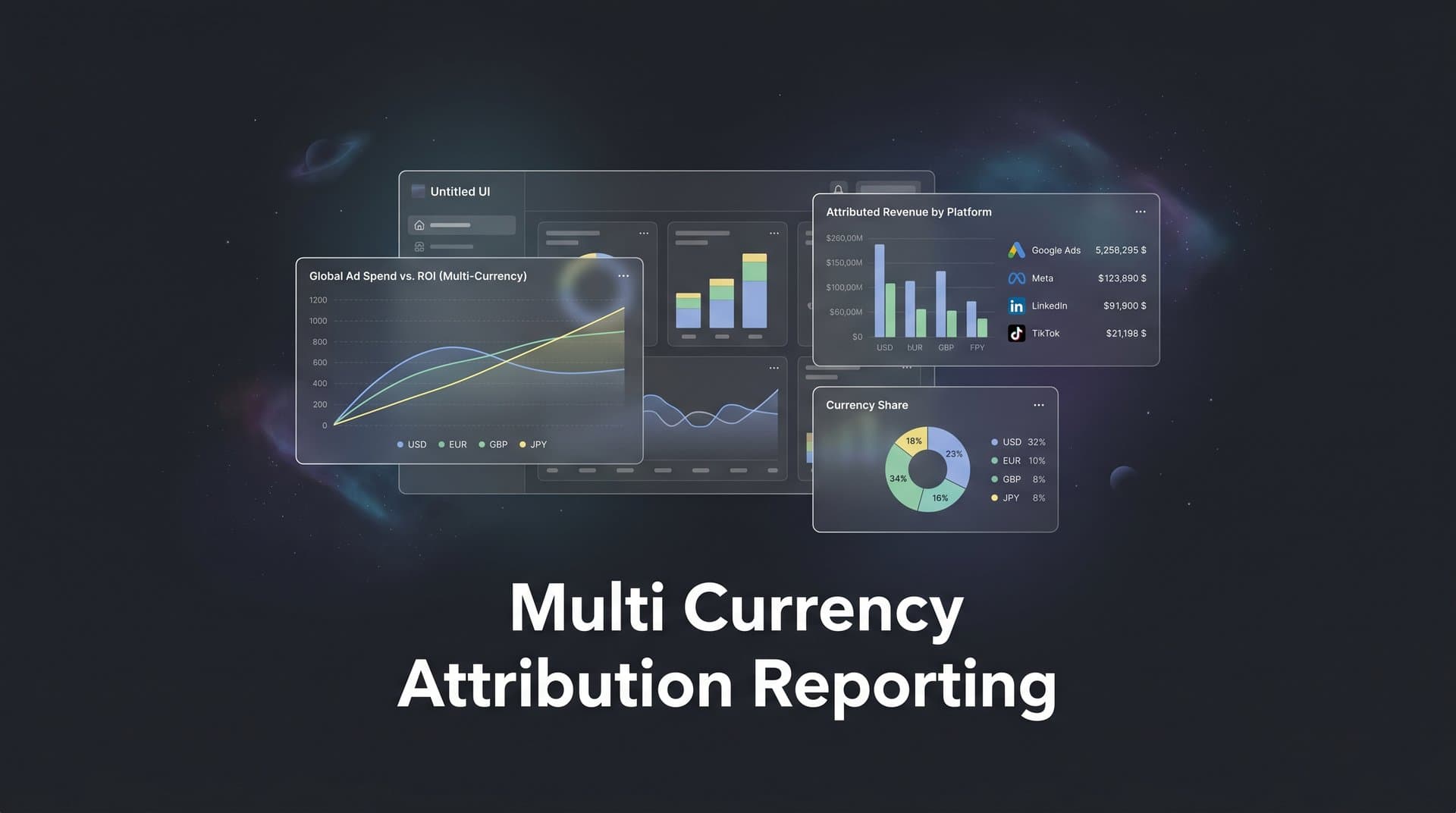
This is the core problem that multi currency attribution reporting solves. Instead of forcing you to reconcile fragmented data from Meta, Google, TikTok, and other platforms, each reporting in their own default currencies, it creates a single normalized view of performance across every market, channel, and campaign. Every conversion is measured on the same scale, so you can make budget decisions based on what's actually driving revenue, not what looks best due to a favorable exchange rate.
As more businesses scale internationally and ad spend stretches across regions, this capability moves from "nice to have" to genuinely essential. Let's break down why currency fragmentation is such a serious problem, and how to build an attribution setup that handles it properly.
Why Currency Fragmentation Breaks Traditional Attribution
Most attribution tools were built with a single market in mind. They pull conversion data from your ad platforms, assign credit to touchpoints, and report on ROAS. Clean and simple, as long as everyone is operating in the same currency. The moment you introduce multiple currencies, that clean simplicity falls apart.
Here's the core issue: ad platforms report revenue in the currency of the account or region by default. Meta might report your UK campaign revenue in GBP, your US campaign in USD, and your European campaigns in EUR. When you try to compare ROAS across those campaigns in a traditional attribution tool, you're comparing numbers that aren't actually on the same scale. It's the classic apples-to-oranges problem, and it leads to real misallocation of budget.
Think about what happens in practice. A campaign in the UK generates strong conversion volume, but GBP is trading at a relatively high value against USD. When that revenue gets reported, it looks exceptionally profitable compared to a campaign in a market with a weaker currency. A marketer looking at raw numbers might pour more budget into the UK campaign, not because it's genuinely outperforming, but because the currency math makes it look that way. Meanwhile, a campaign in a market with a weaker currency might be generating excellent conversion rates and customer lifetime value, but the reported ROAS looks modest by comparison. That campaign gets underfunded.
The problem gets worse because exchange rates don't stay still. A campaign generating revenue in GBP will show a different ROAS value depending on whether you pull the report on Monday or Friday, even if nothing about the campaign's actual performance changed. This kind of attribution reporting mismatch introduces noise that has nothing to do with marketing performance.
For businesses spending significantly across multiple regions, this isn't a minor rounding error. Currency distortion can accumulate into meaningful misallocations over time, redirecting budget away from genuinely high-performing markets toward ones that simply benefit from a stronger currency at the moment of reporting. Traditional attribution tools, without a normalization layer, have no way to account for this.
The result is that marketers lose confidence in their data. They start second-guessing reports, adding manual adjustments, or making decisions based on platform-reported numbers that don't reflect actual business performance. That's a problem that no amount of dashboard customization can fix without addressing the underlying currency fragmentation.
The Core Components of a Proper Multi Currency Setup
Understanding the problem is the easy part. Building a system that actually solves it requires getting a few foundational elements right. Multi currency attribution reporting isn't just about converting numbers from one currency to another. It's about normalizing data across the entire customer journey before attribution logic is applied.
There are three building blocks that every solid multi currency attribution setup needs.
A unified base reporting currency: You need to choose a single currency that all revenue will be normalized into for reporting purposes. For most global businesses, this is USD, but it could be any currency that matches your internal financial reporting. The key is consistency. Every conversion, from every market, gets expressed in this base currency before it enters your attribution model.
Real-time or near-real-time exchange rate integration: The exchange rate you use matters enormously, and when you capture it matters just as much. Best practice is to use the exchange rate at the time of the transaction, not a weekly or monthly average. Averages smooth out volatility in ways that can mask real performance shifts. If a campaign runs during a period of currency movement, using an average rate will misrepresent what actually happened. Daily rate refreshes at minimum are necessary for accuracy, with transaction-time rates being the gold standard.
Server-side tracking that captures conversion data at the source: This is where the technical foundation gets critical. Server-side tracking captures the conversion event, including the original transaction currency and the exact amount, at the moment it occurs. That data is then normalized before it flows into your attribution model and before it's synced back to ad platforms. This is fundamentally different from relying on pixel-based tracking or platform-reported estimates, which often lack the currency precision needed for accurate normalization.
The distinction between simple currency conversion and true multi currency attribution is worth emphasizing. True multi currency attribution normalizes data across the entire customer journey first, then applies attribution logic. This matters because if you apply attribution models before normalization, you risk assigning skewed credit to touchpoints based on distorted revenue values. The sequence is: capture the transaction in its original currency, normalize to base currency, then apply first-touch, last-touch, linear, time-decay, or whatever multi-touch attribution model you're using.
Getting this sequence right is what separates a system that produces trustworthy global performance data from one that just looks like it does.
Common Pitfalls That Distort Global Campaign Data
Even teams that understand the importance of currency normalization often run into specific mistakes that undermine the accuracy of their reporting. These pitfalls are worth knowing in advance because they're easy to overlook until the data starts telling stories that don't match reality.
Using the wrong exchange rate snapshot timing: This is the most common mistake. Teams often use end-of-month exchange rates, weekly averages, or whatever rate their finance team happens to use for accounting purposes. The problem is that these rates don't reflect what the exchange rate actually was at the moment each conversion occurred. During periods of currency volatility, the difference between a transaction-time rate and a monthly average can be significant enough to meaningfully distort ROAS calculations. Your attribution data should use the rate that was in effect when the customer converted, full stop.
Platform-level attribution silos: Meta reports in one currency. Google reports in another. TikTok and LinkedIn each have their own defaults. When you pull performance data from each platform separately and try to compare it, you're working with numbers that haven't been normalized against each other. This is a common challenge when managing attribution across multiple platforms, and without a centralized normalization layer, cross-channel comparisons are unreliable.
Ignoring currency impact on ad platform algorithm optimization: This one has consequences that extend beyond your internal reporting. Ad platforms like Meta and Google use conversion value data to train their bidding algorithms. If you're feeding back conversion values that are distorted by currency inconsistencies, those algorithms learn from inaccurate signals. They may optimize toward audiences or bid levels that look profitable based on distorted data, but don't actually deliver the best return. This is why the normalization work you do internally needs to flow back to the platforms through conversion APIs, not just inform your own dashboards.
Each of these pitfalls compounds the others. Inconsistent exchange rates create noisy data. Noisy data makes cross-platform comparisons unreliable. Unreliable comparisons lead to budget decisions that feed inaccurate signals back to platform algorithms. The whole system degrades from a single weak link in the normalization chain.
How to Set Up Multi Currency Attribution the Right Way
Getting this right requires a deliberate setup process. Here's how to approach it in a logical sequence that addresses each layer of the problem.
Step 1: Choose your base reporting currency and establish your exchange rate source. Decide which currency all revenue will be normalized into. Then identify your exchange rate data source and set a refresh cadence. A reliable financial data provider or central bank rate feed works well for this. Daily rate updates are the minimum standard for accuracy. If your transaction volume and business sensitivity warrant it, consider transaction-time rate capture for the most precise normalization. Document this decision and make sure it's applied consistently across every data source feeding your attribution platform.
Step 2: Implement server-side tracking that captures original transaction data. Pixel-based tracking has limitations in capturing precise transaction currency and value, particularly with browser privacy changes and iOS restrictions reducing its reliability. Server-side tracking solves this by capturing conversion events directly from your server, recording the exact currency and amount at the moment of conversion. This data is then normalized to your base currency before it's passed to your attribution model and before it's synced back to ad platforms via conversion APIs. The normalization happens at the server level, so every downstream system receives clean, consistent data.
Step 3: Connect your attribution platform to your CRM and payment systems. Platform-reported revenue is an estimate. Actual revenue lives in your payment processor and CRM. Connecting these systems to your attribution platform means that real transaction data, in the original currency and at the actual amount, flows directly into your attribution model. Using revenue attribution reporting templates can help structure this data effectively. This also ensures that when you apply attribution logic, you're distributing credit based on verified revenue, not platform estimates that may not account for refunds, failed payments, or currency discrepancies.
When these three steps are in place, you have a foundation where every touchpoint in every market is measured against the same standard. A conversion in Tokyo and a conversion in Toronto are both expressed in your base currency, using the exchange rate at the time they occurred, sourced from your actual payment data. Now you can start making decisions with real confidence.
Turning Normalized Data Into Smarter Budget Decisions
Here's where the investment in proper setup pays off. Once all your revenue data is normalized into a single base currency, the comparisons that were previously unreliable become genuinely useful.
You can look at ROAS across regions, channels, and campaigns and trust that the numbers reflect actual performance rather than currency artifacts. A campaign in Southeast Asia that was previously undervalued because of a weaker local currency might reveal itself as one of your most efficient markets when measured on a normalized basis. Conversely, a campaign that looked impressive due to a strong currency might show more modest true returns. These insights directly change where incremental budget should go.
AI-powered attribution platforms can accelerate this process significantly. Rather than manually reviewing normalized data across dozens of campaigns and markets, AI can surface the patterns, identifying which ads, audiences, and channels are genuinely outperforming. Following multi-channel attribution best practices ensures these insights are reliable across every market you operate in.
The feedback loop to ad platforms is equally important. When you feed normalized, enriched conversion values back to Meta and Google through their respective conversion APIs, you're giving their bidding algorithms accurate revenue signals to optimize against. An algorithm that knows a conversion in Germany is worth a certain normalized value, and a conversion in Brazil is worth a different normalized value, can make smarter bid adjustments across both markets. Understanding multi-channel attribution for ROI helps ensure these signals translate into genuine return improvements across your global campaigns.
This is the compounding benefit of getting multi currency attribution right. Better data improves your own decisions. And better data fed back to platforms improves the algorithmic decisions being made on your behalf, often at a scale and speed that no human team can match manually.
Building a Global Attribution Strategy That Scales
The principles behind multi currency attribution reporting are straightforward even if the implementation requires care. Normalize early, normalize consistently, and let accurate data drive both your decisions and the platform algorithms working on your behalf.
This is not just a finance or operations concern. The way you handle currency normalization directly affects how your marketing budget is allocated across global markets, which campaigns get scaled, which get cut, and how efficiently your ad spend converts to revenue. Getting it wrong means making growth decisions based on data that doesn't reflect reality. Getting it right means every dollar of ad spend is being evaluated and directed on an equal footing, regardless of where in the world it's working.
As your business scales internationally, the complexity only increases. More markets, more currencies, more platforms, and more touchpoints in the customer journey all multiply the opportunities for currency distortion to creep in. Building the right foundation now, with server-side tracking, real-time exchange rate normalization, and a centralized attribution layer connected to your actual revenue data, means that complexity doesn't have to translate into confusion.
Multi currency attribution reporting removes the guesswork from international campaign management. It replaces the patchwork of spreadsheets and manual conversions with a single, trustworthy view of what's driving revenue across every market you operate in. That clarity is what allows marketing teams to move quickly, scale confidently, and allocate budgets based on evidence rather than assumption.
If you're ready to stop letting currency fragmentation distort your global campaign data, Cometly's attribution platform brings together server-side tracking, multi-touch attribution, and conversion sync in one place. Every touchpoint gets captured, every conversion gets normalized, and the data that flows back to your ad platforms is accurate and enriched. Get your free demo today and start building a global attribution strategy that gives you a clear picture of what's actually driving your revenue.