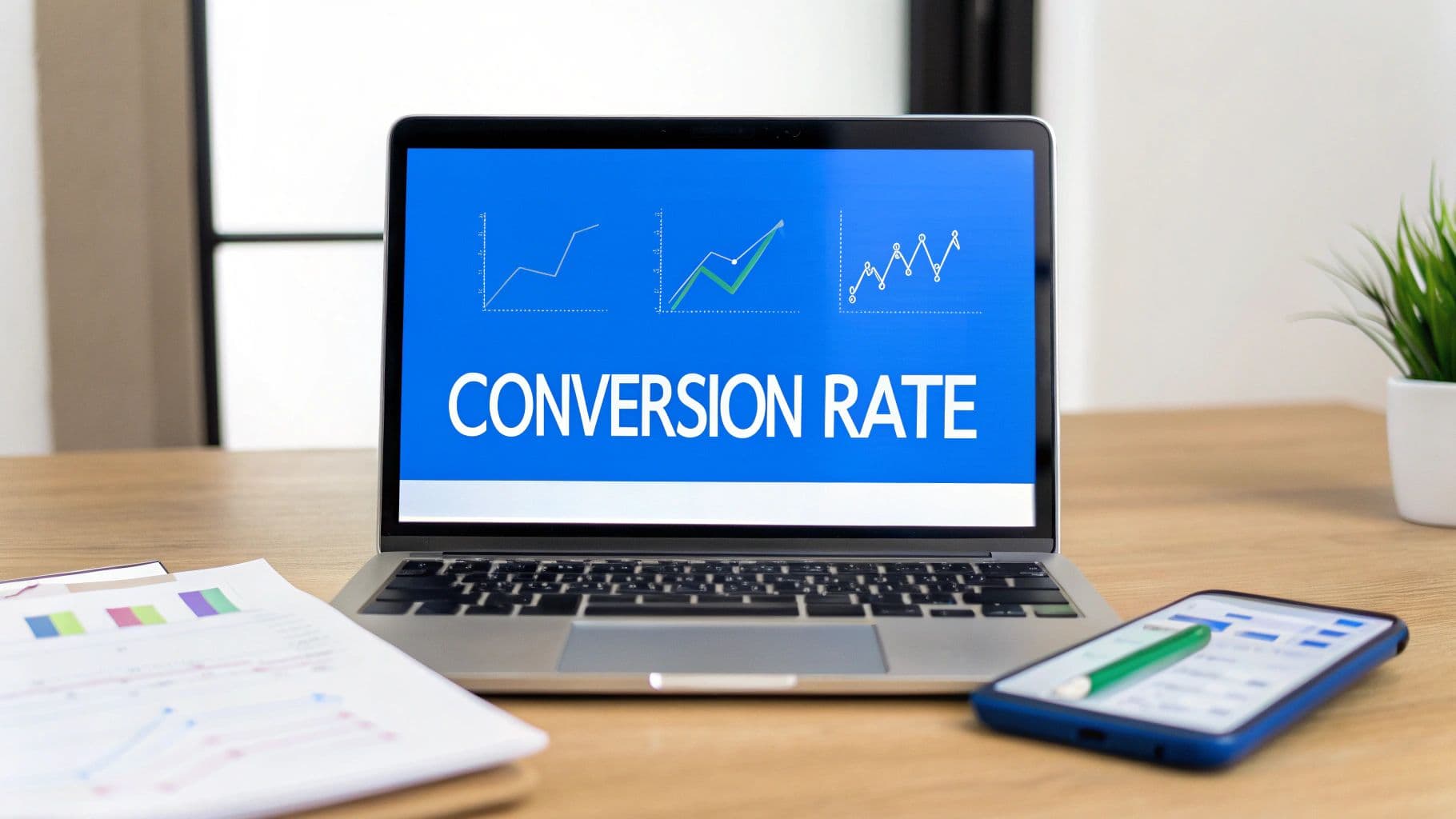
Your sales conversion rate is the percentage of people who take a specific action you want them to take, like making a purchase. It’s calculated with a simple but powerful formula: (Total Conversions / Total Visitors) x 100%.
In short, it’s the metric that tells you if your marketing is actually working.
Why Your Sales Conversion Rate Matters
 Optimizing Your Sales Conversion Rate
Think of your website like a physical store. Every visitor is a potential customer walking through the door. But not everyone who browses the aisles is going to buy something. Your sales conversion rate reveals exactly how many of those window shoppers turn into actual buyers.
It’s the ultimate scorecard for your entire sales funnel. This single number cuts through all the noise of vanity metrics like traffic and impressions. A million visitors sounds great, but it means nothing if none of them convert. A high conversion rate, on the other hand, is a clear signal that your messaging, offer, and user experience are all clicking into place.
The Foundation of Profitability
Understanding your conversion rate is the first real step toward building a sustainable business. It has a direct, and often dramatic, impact on your return on investment (ROI). If you manage to double your conversion rate from 1% to 2%, you’ve just doubled your sales from the exact same amount of traffic.
And you did it without spending a single extra dollar on ads.
This kind of efficiency is what separates businesses that scale from those that stagnate. A healthy conversion rate lowers your customer acquisition cost (CAC), which means more profit from every sale. It turns your ad budget from a shot in the dark into a predictable revenue-generating machine. You can dig deeper into making these connections by exploring effective marketing analytics.
A focus on conversion rate optimization is a focus on maximizing value. It ensures that the traffic you work so hard to acquire isn't wasted, turning potential interest into tangible revenue and long-term customer relationships.
More Than Just a Number
It's tempting to ask, "What is a good sales conversion rate?" but there’s no magic number. A "good" rate is completely dependent on your context—your industry, your audience, and your offer.
Several key factors will always influence what you should be aiming for:
- Industry: An e-commerce brand selling $20 t-shirts will naturally have a higher conversion rate than a B2B SaaS company with a six-month sales cycle and a five-figure price tag.
- Traffic Source: Leads from a targeted email campaign are usually much warmer and convert at a higher rate than cold traffic from a broad social media ad.
- Product Price: High-ticket items demand more trust and consideration, which almost always leads to lower conversion rates compared to impulse buys.
- Device: Desktop users often convert at a higher rate for complex purchases, while mobile is king for discovery and simpler transactions.
By tracking this metric, you get a powerful diagnostic tool. It shines a spotlight on friction points in your customer journey. Is your checkout process too confusing? Is your pricing page unclear? Your conversion rate holds the answers, pointing you straight to the areas that need fixing.
How to Accurately Calculate Your Conversion Rate
On the surface, the formula for calculating your sales conversion rate looks simple. But as any experienced marketer knows, the real challenge is hiding in the details. Getting a number you can actually trust means looking past the basic equation and defining exactly what each variable means for your business. The integrity of your entire data foundation depends on getting this right.
Your first move is to get crystal clear on what counts as a "conversion." For an eCommerce store, it’s almost always a completed purchase. But for other businesses, a conversion could be a new lead submitting a form, a user signing up for a free trial, or even just someone adding an item to their cart. Each of these actions is a critical step in the customer journey and needs a solid definition.
Once you’ve defined your conversion, the next decision is how you’re going to count your visitors. This is a common pitfall that can seriously skew your results. You need to decide whether to track total sessions or unique users.
Users vs. Sessions: What Is the Difference?
Imagine a potential customer visits your website three times in one day before finally buying something. If you calculate your conversion rate based on sessions, you’re dividing one conversion by three separate visits. This gives you a lower, and potentially misleading, rate.
But if you calculate it based on unique users, you're looking at one conversion from one person, no matter how many times they visited. This method usually gives you a more accurate picture of how well you’re turning individuals into customers. There’s no single "correct" answer here, but whatever you choose, consistency is everything for meaningful analysis over time.
A truly accurate sales conversion rate isn't a single, monolithic number. It's a collection of segmented data points that, when viewed together, tell the complete story of your customer's journey and your marketing effectiveness.
The Power of Segmentation
A single, site-wide conversion rate is a decent starting point, but the real insights—the ones that drive growth—come from segmentation. By breaking down your data, you can uncover hidden patterns and pinpoint your strongest and weakest areas. This is where accurate tracking and attribution become the bedrock of smart decision-making.
Think about calculating conversion rates for specific segments:
- By Traffic Source: Compare how organic search traffic performs against paid ads from Google or Facebook. This shows you which channels are delivering not just clicks, but actual paying customers.
- By Device: Analyze how users on desktop, mobile, and tablet convert. You might discover that while mobile brings in the most traffic, desktop users are far more likely to complete a purchase—a clear signal that your mobile experience needs work.
- By Customer Group: Break down your audience by new vs. returning visitors, or by different demographic groups. This helps you understand who your most valuable customers are so you can tailor your messaging right to them.
This granular approach is essential because performance varies wildly from one segment to the next. For example, the global average eCommerce sales conversion rate hovers around 3.06%, but that number changes dramatically when you add context. The Food & Beverage industry sees rates as high as 6.23%, while Luxury & Jewelry is much lower at 0.95%.
Device also plays a huge role. Desktop users convert at a higher rate (3.22%) than mobile users (2.96%), even though mobile drives most of the world's online traffic. To see how these numbers shift by industry and season, you can explore detailed benchmark data from Dynamic Yield.
Ultimately, building this solid data foundation is what allows you to move from guessing to knowing. By understanding not just your overall rate but the nuances within your data, you can make surgical adjustments that genuinely move the needle. To learn more about this crucial metric, check out our guide on what is conversion rate.
Setting Realistic Goals with Industry Benchmarks
Knowing your sales conversion rate is one thing; knowing if it’s any good is another. This is where industry benchmarks become your most valuable compass. Trying to evaluate your performance in a vacuum is like guessing your car's speed without a speedometer—you’re moving, but you have no idea if you’re keeping pace or falling behind.
Benchmarks give you the context you need to set realistic, achievable goals. They help you understand what's possible in your market and keep you from chasing arbitrary numbers that don’t apply to your business. After all, a "good" conversion rate isn't a universal standard; it’s a reflection of your industry's unique dynamics.
Just look at this regional breakdown of average conversion rates. Performance can shift based on geography alone.
 Optimizing Your Sales Conversion Rate
The data shows the Americas leading in conversion efficiency at 3.2%, which should absolutely influence how you set targets for different market segments.
Why Every Industry Plays by Different Rules
Comparing a B2B SaaS company to an eCommerce fashion brand is a classic apples-to-oranges scenario. Each operates under a completely different set of rules that directly impact their typical sales conversion rates.
Several key factors drive these differences:
- Purchase Price and Complexity: A $50,000 B2B software subscription requires multiple decision-makers, demos, and a lengthy sales cycle. In contrast, a $50 pair of shoes is often an impulse buy. Higher price points and complexity naturally lead to lower conversion rates.
- Sales Cycle Length: B2C eCommerce purchases can happen in minutes. B2B sales cycles, however, can stretch for months, involving a ton of consideration and trust-building. Our latest B2B benchmark report for 2023 dives deeper into these unique challenges at https://www.cometly.com/post/b2b-benchmark-2023.
- Level of Trust Required: A customer needs a basic level of trust to buy a t-shirt online. A business, on the other hand, needs immense confidence to invest in a new CRM that will impact its entire operation.
Understanding these industry-specific nuances is the first step toward effective goal-setting. It shifts your focus from chasing an imaginary ideal to optimizing performance within the real-world constraints of your market.
Channel Performance Varies Across Sectors
Just as industries differ, so does the effectiveness of various marketing channels. A channel that is a conversion goldmine for one sector might be a complete dead-end for another. This is why a strategic view of your marketing mix is just as important as your overall conversion rate.
To give you a clearer picture, here’s a breakdown of how different marketing channels typically perform.
Marketing Channel | Average Conversion Rate | Top Performing Industries |
|---|---|---|
Paid Search | 3.2 percent | B2B Services, Finance, Real Estate |
Organic Search | 2.7 percent | Education, Healthcare, B2B Technology |
Email Marketing | 10.3 percent | Ecommerce, Retail, SaaS nurturing campaigns |
Social Media Paid | 1.9 percent | Fashion, CPG, Entertainment |
Referral | 4.5 percent | SaaS, Professional Services, FinTech |
As you can see, the channel really matters. According to a 2025 report from Ruler Analytics, the average conversion rate across fourteen major industries is 2.9%. However, sectors with higher-priced or more complex products—like automotive and real estate—often see higher conversion rates than B2C services, especially from high-intent channels. You can read the full research about conversion rate benchmarks on Ruler Analytics to explore these findings further.
Using Benchmarks to Guide Your Strategy
So, how do you turn this information into action? Start by finding benchmarks that are as specific to your business as possible. Look for data that aligns with your:
- Industry and Niche: Are you in B2B tech, or more specifically, cybersecurity SaaS for small businesses? The more granular, the better.
- Business Model: Subscription-based models will have different benchmarks than one-time purchase models.
- Primary Marketing Channels: Compare your performance against benchmarks for the channels you rely on most, whether that's paid social, organic search, or email.
Once you have this context, you can set smarter goals. If your conversion rate is significantly below the industry average, it's a clear signal that there's friction in your sales funnel that needs immediate attention. If you're performing at or above the average, you can focus on more advanced optimization tactics to become a leader in your space.
Identifying Common Barriers to Conversion
 Optimizing Your Sales Conversion Rate
It’s one of the most frustrating feelings for any marketer. Traffic is up, people are adding products to their carts, but the sales just aren't closing. It feels like you’re searching for a ghost in the machine.
The problem usually isn’t a lack of interest. It’s friction—those silent, annoying barriers that stop a motivated customer dead in their tracks. These conversion killers are the small obstacles that turn a smooth path to purchase into a frustrating dead end. Finding them is the first step to plugging the leaks in your sales funnel.
The Psychology of Checkout Friction
The final steps of a purchase are emotionally charged. A customer has decided they want your product and they're ready to commit. That moment is built on momentum and trust. Any unexpected hurdle feels like a bait-and-switch, instantly shattering that trust and sending them running.
This is especially true with surprise costs. Think about it: you agree to buy a car for a set price, but right as you're signing the papers, the dealer tacks on hundreds in hidden fees. You'd feel cheated. The same thing happens online when a customer hits the final checkout screen and gets slammed with unexpectedly high shipping costs or taxes.
This psychological break is the number one driver of cart abandonment. By late 2024, the global eCommerce shopping cart abandonment rate had climbed past 70%. The main culprit, especially in markets like the US? Unexpected costs.
Device type matters, too. Even though mobile generates over 70% of traffic, desktops and tablets still convert better, which tells you the buying experience on those devices is just less frustrating. You can discover more insights about global conversion rates on Statista.
Common Conversion Killers to Watch For
While surprise fees are a huge problem, they’re just one of many potential roadblocks. If you audit your customer's journey from start to finish, you'll likely find several sneaky issues hurting your sales conversion rate.
Here are some of the most common culprits we see:
- A Complicated Checkout Process: Forcing users to create an account before they can buy is a classic conversion killer. Every extra field they have to fill out, and every extra click they have to make, increases the odds they'll just give up.
- A Lack of Trust Signals: In a world full of online scams, customers need reassurance. If your site is missing security badges, customer reviews, or a clear return policy, it can feel sketchy. People won’t enter their credit card info if they don't trust you.
- A Poor Mobile Experience: A website that’s a nightmare to use on a smartphone is a surefire way to lose sales. Pinching and zooming to read text or trying to tap tiny buttons is an infuriating experience that will send mobile users straight to your competitors.
Understanding where these issues happen is everything. Pinpointing the exact moment a user leaves is the key to diagnosing the problem. Analyzing your data to identify specific funnel drop-off points will show you precisely where your process is breaking down.
By systematically finding and fixing these barriers, you create a smoother, more trustworthy path for your customers. This doesn't just boost your sales conversion rate—it builds the kind of positive experience that brings people back again and again.
Actionable Strategies to Boost Your Conversion Rate
 Optimizing Your Sales Conversion Rate
Alright, you understand what your conversion rate is and you've spotted the friction points. That was the diagnosis. Now it’s time for the treatment.
This is where you turn those insights into action—the kind of action that actually grows your bottom line. Forget random guesses. What follows is a tactical playbook of proven methods to reduce friction, build trust, and create a far more persuasive experience for your customers.
Enhance Your Landing Pages
Think of your landing page as the first handshake. It's where you make your case and convince a visitor to take the next step. If that first interaction is weak, confusing, or uninspiring, you’ve lost them before they even see what you’re selling.
A few tweaks here can make a world of difference:
- Compelling Calls-to-Action (CTAs): Your CTA button needs to be impossible to ignore. Ditch passive words like "Submit" and use action-oriented language like "Get My Free Demo." Test different colors, sizes, and placements until you find what grabs the most attention.
- Leverage Social Proof: People trust other people, not brands. Make sure your customer testimonials, star ratings, and logos of well-known clients are front and center. This is how you build instant credibility and erase doubt.
- Crystal-Clear Value Proposition: A visitor should know what you do and why it matters within three seconds. Your headline has to answer their one burning question: "What's in it for me?"
Simplify the Checkout Process
The checkout is the final frontier. It's the most crucial—and fragile—part of the entire sale. Even the tiniest bit of friction here can send a motivated buyer running for the hills, abandoning their cart forever. Your only job is to make this process invisible.
Here’s your checkout optimization checklist:
- Offer a Guest Checkout Option: Forcing someone to create an account is a legendary conversion killer. Let them buy as a guest. Always.
- Implement a Progress Bar: Show people where they are in the process (e.g., Shipping > Payment > Confirmation). It manages expectations and calms the anxiety of a seemingly endless form.
- Minimize Form Fields: Only ask for what you absolutely need to complete the sale. Every extra field you ask them to fill out is another reason to give up and leave.
The core principle of checkout optimization is momentum. Once a customer decides to buy, your job is to remove every single obstacle from their path and guide them effortlessly across the finish line.
Build Foundational Trust Signals
Trust is the invisible currency of every online sale. Without it, the best product in the world won't convert. You have to proactively build that trust at every single touchpoint, reassuring customers that their information is safe and their purchase is a smart one.
Start with these non-negotiables:
- Display Security Seals: Feature badges from recognized providers like Norton or McAfee prominently. These little logos are powerful visual cues that tell customers their payment info is locked down and secure.
- Showcase Customer Reviews: Put authentic customer reviews and ratings right on your product pages. One study found that products with reviews have a conversion rate that is 270% higher than those without. Let your happy customers do the selling for you.
- Offer a Clear Return Policy: A transparent, no-hassle return policy removes almost all the perceived risk from a purchase. Make it dead simple to find and even simpler to understand.
The Power of A/B Testing
Putting these strategies into practice is a huge step forward, but how do you know which changes are really moving the needle? The answer is disciplined A/B testing. Instead of throwing spaghetti at the wall and hoping something sticks, you change just one variable at a time—a headline, a button color, a form field—and measure the impact.
A/B Testing Ideas for Conversion Rate Optimization
This data-backed approach takes the guesswork out of optimization. It allows you to make small, incremental improvements that compound into massive gains over time. Here are a few ideas to get you started.
Element to Test | Variation A (Control) | Variation B (Test) | Primary Metric to Track |
|---|---|---|---|
Headline | High Quality Widgets for Sale | Widgets That Save You 10 Hours a Week | Click Through Rate |
CTA Button Color | Blue button | Orange button | Form submissions |
Social Proof | Text testimonials | Video testimonials | Add to cart rate |
Checkout Form | Five fields | Three fields with optional fields removed | Cart abandonment rate |
Product Image | Standard product shot | Product in use lifestyle shot | Conversion rate |
By testing one element against another, you can definitively prove what resonates with your specific audience, ensuring every change you make is a step in the right direction.
For a deeper dive into practical, founder-tested methods to enhance your website's performance and turn more visitors into buyers, read this founder's playbook on improving ecommerce conversion rates.
Making Smarter Decisions with Better Attribution
Optimizing your site is a huge step, but it only solves half the puzzle. To really move the needle on your sales conversion rate, you have to know which marketing efforts are actually bringing in your best customers. This is where marketing attribution becomes your secret weapon.
Think of the customer journey like a series of dominoes. The final domino is the sale, sure, but what pushed the first one over? Answering that question is the whole point of attribution. It’s all about giving credit to every single touchpoint—every ad, email, and blog post—that guided a customer toward buying from you.
The problem is, far too many businesses are still stuck using models that are flat-out misleading.
The Problem with Last-Click Attribution
The most common offender is last-click attribution. This model gives 100% of the credit for a sale to the very last thing a customer touched before converting. Imagine a customer sees your ad on Facebook, reads a blog post a week later, and then finally clicks a Google ad to make a purchase.
With a last-click model, that Google ad gets all the glory. The Facebook ad and the blog post, which did the heavy lifting of introducing your brand and building genuine interest, are completely ignored. This creates a dangerously skewed view of your marketing performance, leading you to undervalue—and maybe even cut funding for—the channels that are actually filling the top of your funnel.
Accurate attribution isn't just about getting the numbers right—it's about making data-driven decisions that directly boost your sales conversion rate by investing in what truly works.
This flawed approach is also why you see major data discrepancies between your analytics and what ad platforms report, making it impossible to calculate a reliable Return on Ad Spend (ROAS).
Gaining a Complete View with Cometly
This is exactly the problem Cometly was built to solve. Instead of relying on a flawed, partial picture, Cometly’s advanced attribution technology gives you a complete, panoramic view of the entire customer journey. It tracks every single interaction, from the first ad someone saw to the final click that sealed the deal.
Armed with this complete data, you can finally see which channels and campaigns are most effective at each stage of the funnel. You might discover that while your Google Ads are fantastic at closing deals, your TikTok campaigns are an absolute powerhouse for generating that crucial initial awareness and interest.
This level of insight allows for much smarter budget allocation. Instead of blindly pouring money into last-click channels, you can confidently invest across the full journey. Cometly’s ad platform sync also closes those data gaps, ensuring your ROAS calculations are precise and trustworthy. Understanding the complete story behind each conversion is essential, and you can learn more about how to measure marketing attribution in our detailed guide.
By moving beyond simplistic models and embracing a more accurate view of your marketing, you can stop guessing and start making decisions that predictably increase your sales conversion rate and maximize your ROI.
Got Questions About Conversion Rates? We've Got Answers.
As you dive deeper into optimizing your sales funnel, a few common questions always seem to pop up. Let's tackle some of the most frequent ones to clear up any confusion and reinforce what we've covered.
What Is a Good Sales Conversion Rate?
Honestly, there’s no magic number here. A "good" sales conversion rate is completely relative to your industry, the price of your product, where your traffic is coming from, and your overall business model.
Think about it this way: an ecommerce store selling $20 t-shirts might be thrilled with a 5% conversion rate. Meanwhile, a B2B SaaS company closing $10,000 annual contracts would probably be celebrating a 0.5% rate. The real goal isn't to hit some universal average; it's to measure your performance against relevant benchmarks for your specific market.
How Often Should I Check My Conversion Rate?
While it’s tempting to refresh your dashboard every hour, you'll get more meaningful insights by checking in on a weekly or bi-weekly basis. This cadence helps smooth out the random daily spikes and dips, giving you a much clearer trend line to analyze.
Of course, if you've just launched a major campaign or rolled out a big website change, you’ll want to check more frequently to see the immediate impact.
The goal is to track trends, not react to daily noise. Consistent monitoring allows you to spot meaningful patterns over time, helping you make informed strategic adjustments rather than knee-jerk reactions.
Does More Traffic Always Mean More Sales?
Not at all. In fact, this is one of the biggest myths in marketing. Traffic quality will always beat traffic quantity.
You could double your website visitors overnight, but if they're not the right audience for what you're selling, your conversion rate will crater, and your sales might not budge. A much smarter strategy is to focus on attracting qualified leads who are genuinely interested in your offer. Real growth comes from converting the right traffic, not just getting more of it.
Ready to stop guessing and start knowing exactly which marketing efforts drive your sales? Cometly provides crystal-clear attribution, eliminating data discrepancies and showing you the full customer journey. Get started with Cometly today and maximize your ROI.