You've analyzed last quarter's campaign data. You know which ads performed well, which channels delivered conversions, and where you overspent. Now comes the hard part: deciding where to allocate next quarter's budget. Will those winning campaigns continue to perform? Should you double down on the channel that drove the most leads, or shift spend to the platform with better cost-per-acquisition? You're making million-dollar decisions based on rearview mirror data, hoping the road ahead looks the same.
This is where predictive analytics changes everything. Instead of reacting to what already happened, you can forecast what's likely to happen next—and adjust your strategy before you spend a dollar. Predictive analytics transforms marketing from a reactive discipline into a proactive one, enabling teams to anticipate which campaigns will drive revenue, which audiences will convert, and which creative will resonate before committing budget.
The value proposition is straightforward: better forecasting leads to smarter spend allocation and higher ROI. When you can predict performance with confidence, you scale winners faster, cut losers sooner, and stop wasting budget on campaigns that were never going to deliver. This article breaks down how predictive analytics works in marketing, what data powers accurate predictions, and how to build a framework that turns forecasting into your competitive advantage.
From Hindsight to Foresight: How Predictive Analytics Changes Marketing Decisions
Traditional marketing reporting tells you what happened. You see impressions, clicks, conversions, and revenue—all historical data that confirms whether your campaigns succeeded or failed. This backward-looking approach is useful for understanding past performance, but it doesn't help you make better decisions about future spend. You're constantly playing catch-up, adjusting budgets after campaigns underperform or scrambling to scale winners once they've already proven themselves.
Predictive analytics flips this model. Instead of asking "what happened," it answers "what will likely happen and why." It uses historical data, statistical algorithms, and machine learning to forecast future campaign outcomes before you commit budget. The approach identifies patterns in your past performance—which audiences converted, which creative drove engagement, which channels delivered the highest lifetime value—and projects those patterns forward to predict future results.
Think of it like weather forecasting for marketing. Meteorologists don't just report yesterday's temperature; they analyze atmospheric patterns, historical trends, and current conditions to predict tomorrow's weather. Predictive analytics in marketing does the same for your campaigns. It processes your historical ad performance, customer journey data, conversion patterns, and revenue outcomes to forecast which campaigns will perform best under current market conditions.
The core components work together in a continuous cycle. First, you collect data across every marketing touchpoint—ad clicks, website visits, email opens, CRM events, and purchases. Then algorithms identify patterns in that data: which customer behaviors signal high purchase intent, which ad characteristics correlate with conversions, which channels drive the most valuable customers. Finally, the system generates probability-based forecasts: this campaign has an 80% likelihood of exceeding your target ROAS, this audience segment will likely convert at twice the rate of your baseline, this creative variation will probably drive 30% more engagement.
The shift from hindsight to foresight changes how marketing teams operate. Instead of waiting weeks to see if a campaign works, you can forecast performance during the planning phase. Instead of spreading budget evenly across channels and hoping for the best, you can allocate spend based on predicted returns. Instead of testing creative in the wild and measuring results after the fact, you can forecast which variations will resonate before launching. This proactive approach compresses decision cycles, reduces wasted spend, and gives you the confidence to scale aggressively when predictions indicate strong performance.
The Data Foundation: What Fuels Accurate Marketing Predictions
Predictive analytics is only as good as the data behind it. If your tracking is incomplete or your attribution is broken, your predictions will be skewed—no matter how sophisticated your algorithms. The foundation of accurate forecasting starts with comprehensive data collection across every stage of the customer journey.
The critical data inputs include ad performance metrics from every platform you run campaigns on: impressions, clicks, cost-per-click, conversion rates, and return on ad spend. But surface-level ad metrics aren't enough. You need customer journey touchpoints—every interaction a prospect has with your brand before converting. This includes initial ad clicks, website visits, content downloads, email engagement, retargeting impressions, and any other touchpoint that influences the path to purchase.
CRM events add another essential layer. When prospects become leads, request demos, sign up for trials, or engage with sales teams, those events signal buying intent. Connecting CRM data to marketing touchpoints reveals which campaigns drive qualified leads versus low-value traffic. Conversion data completes the picture: purchases, subscriptions, revenue amounts, and customer lifetime value. This is where marketing activity connects to business outcomes.
Data quality directly impacts prediction accuracy. If your tracking only captures 60% of conversions because browser-based pixels miss iOS users or cross-device journeys, your predictive models will undervalue the campaigns that drive those missing conversions. If your attribution only sees the last click before purchase, you'll miss the awareness and consideration touchpoints that actually initiated the customer journey. Incomplete data creates blind spots—and blind spots produce bad predictions.
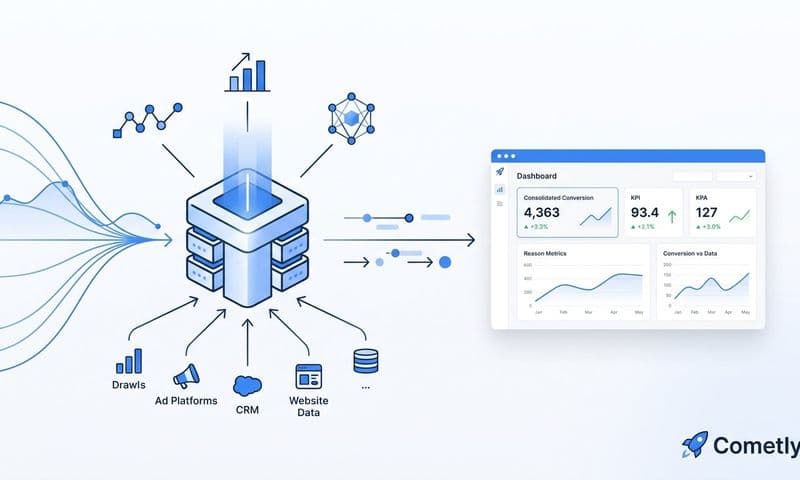
This is why connecting data analytics for marketing across platforms matters so much. Your customer journeys don't happen in silos. A prospect might see a Facebook ad, click a Google search result, visit your website three times, open two emails, and then convert through a retargeting campaign. If your data lives in separate platforms—Facebook Ads Manager, Google Analytics, your email tool, your CRM—you can't see the complete journey. Predictive models built on fragmented data will optimize for individual touchpoints rather than the multi-touch sequences that actually drive conversions.
Server-side tracking has become increasingly important for maintaining data quality. As browser-based tracking faces limitations from iOS privacy changes, cookie restrictions, and ad blockers, server-side approaches ensure you capture conversion events accurately. When your tracking infrastructure can reliably connect ad clicks to revenue outcomes across devices and platforms, your predictive models have the complete, accurate data they need to generate reliable forecasts.
Five Ways Predictive Analytics Optimizes Campaign Performance
Once you have the data foundation in place, predictive analytics unlocks specific optimization opportunities that directly impact campaign performance and ROI. These applications move beyond theoretical forecasting into practical, revenue-driving decisions.
Budget Allocation Forecasting: Instead of distributing budget based on past performance or gut instinct, predictive models forecast which channels and campaigns will deliver the highest returns in the next period. The system analyzes historical ROAS patterns, seasonal trends, audience saturation levels, and competitive dynamics to predict where each dollar will work hardest. If the model forecasts that Google Search will outperform Facebook next month based on search volume trends and your conversion history, you can shift budget proactively rather than waiting for performance data to confirm the opportunity.
Audience Targeting Optimization: Predictive analytics identifies high-value customer segments most likely to convert before you spend on reaching them. By analyzing which demographic, behavioral, and firmographic characteristics correlate with past conversions and high lifetime value, the models score your available audiences by conversion probability. This lets you prioritize budget toward the segments with the highest predicted return while avoiding low-probability audiences that would waste spend. The approach is particularly powerful for cold prospecting—instead of testing broad audiences and learning through trial and error, you can target the prospects most likely to behave like your best existing customers.
Creative and Messaging Performance: Historical engagement patterns reveal which creative elements drive results. Predictive models analyze past ad performance to forecast which new variations will resonate. If your data shows that ads featuring customer testimonials consistently outperform product-focused creative, or that benefit-driven headlines generate higher click-through rates than feature-focused ones, the system can predict which new creative concepts will likely succeed. This doesn't eliminate testing—it makes testing more efficient by prioritizing the variations most likely to win.
Conversion Probability Scoring: Not all leads are created equal. Predictive marketing analytics ranks prospects by their likelihood to purchase based on behavioral signals and engagement patterns. A lead who visited your pricing page three times, opened every email, and engaged with a sales rep has a higher conversion probability than someone who clicked one ad and bounced. By scoring leads predictively, you can prioritize sales follow-up on high-probability prospects, adjust nurture sequences based on conversion likelihood, and allocate retargeting budget toward the audiences most likely to close. This ensures your team focuses energy where it will generate the most revenue.
Timing Optimization: Campaign performance varies by day, week, season, and market conditions. Predictive models identify optimal windows for campaign launches and budget increases by analyzing when your historical conversions peak and when competitive pressure is lowest. If your data shows that B2B conversions spike on Tuesday mornings and drop on Fridays, or that Q4 performance always exceeds Q1 by a predictable margin, you can time campaigns to match those patterns. The system can also predict when audience fatigue will set in, signaling when to refresh creative or pause campaigns before performance declines.
Building Your Predictive Analytics Workflow: A Practical Framework
Moving from concept to implementation requires a structured approach. Predictive analytics isn't a tool you turn on—it's a workflow you build around comprehensive data, accurate attribution, and AI-powered pattern recognition.
Step 1: Establish Comprehensive Tracking Across All Marketing Touchpoints
Start by ensuring you capture every interaction that matters. This means tracking not just ad clicks and purchases, but every touchpoint in between: website visits, page views, form submissions, email opens, video views, content downloads, demo requests, and trial sign-ups. The goal is to build a complete record of how prospects interact with your brand across channels and devices.
Server-side tracking becomes essential here. Browser-based pixels and cookies miss significant portions of your traffic due to iOS limitations, ad blockers, and cross-device journeys. Implementing server-side tracking ensures you capture conversion events accurately, even when browser-based methods fail. This completeness is critical—predictive models trained on partial data will produce partial predictions.
Step 2: Connect Attribution Data to Revenue Outcomes
Tracking touchpoints is only valuable if you can connect them to business results. Your attribution system needs to link every marketing interaction to actual revenue: which campaigns drove purchases, which channels delivered high lifetime value customers, which touchpoints contributed to conversions even if they weren't the last click.
Multi-touch attribution reveals the full customer journey rather than crediting only the final interaction before purchase. When you can see that a prospect clicked a Facebook ad, visited through organic search, returned via email, and converted through a retargeting campaign, you understand the complete sequence that drove the sale. Understanding attribution challenges in marketing analytics helps you build systems that capture this complete view, feeding predictive models with the context they need to forecast which touchpoint combinations will likely produce future conversions.
The connection to revenue matters because predictions should forecast business outcomes, not vanity metrics. A model that predicts clicks is less valuable than one that predicts revenue. When your attribution connects marketing activity directly to dollars earned, your predictive analytics can optimize for what actually matters: ROI.
Step 3: Use AI-Powered Tools to Identify Patterns and Generate Recommendations
Once you have comprehensive tracking and accurate attribution, AI and machine learning can process that data at scale to identify patterns humans would miss. Modern platforms analyze millions of data points to spot correlations between customer behaviors and conversion outcomes, recognize which campaign characteristics predict success, and forecast performance under different scenarios.
The key is moving from insight to action. Predictive analytics should generate specific, actionable recommendations: increase budget on this campaign by 20%, shift spend from Channel A to Channel B, prioritize this audience segment, test this creative variation. When AI identifies that certain campaigns are likely to outperform based on current trends, you can act on those predictions immediately rather than waiting for performance data to confirm what the model already forecasted.
This is where feeding enriched conversion data back to ad platforms creates a powerful feedback loop. When you send accurate, complete conversion information to Facebook, Google, and other channels, their algorithms learn which audiences and placements drive real results. This improves their optimization and targeting, which in turn generates better performance data, which feeds more accurate predictions. The cycle compounds over time.
Common Pitfalls That Undermine Marketing Predictions
Even teams that invest in predictive analytics often struggle to generate accurate forecasts. The failure points typically stem from data problems rather than algorithmic limitations.
Relying on Platform-Reported Data That Misses Cross-Channel Journeys: If you build predictive models using only Facebook Ads Manager data or only Google Analytics data, you're optimizing based on an incomplete picture. Platform-reported metrics don't capture how customers move between channels. A prospect might discover your brand through Facebook, research through Google, and convert through email—but if you only see each platform's data in isolation, you'll misattribute the conversion and build predictions on false assumptions about what drives results.
Building Models on Incomplete Attribution: When your attribution only captures last-click conversions or misses significant portions of your traffic due to tracking limitations, your predictive models inherit those blind spots. If you can't see the full funnel—the awareness touches that started the journey, the consideration interactions that built interest, and the decision-stage touchpoints that closed the sale—your predictions will systematically undervalue the campaigns that drive early-stage engagement. This leads to budget allocation decisions that starve top-of-funnel campaigns in favor of bottom-funnel retargeting, ultimately shrinking your pipeline.
Ignoring the Feedback Loop: Predictive analytics improves over time as models learn from actual outcomes. But this only works if you feed results back into the system. When you send enriched, accurate conversion data back to your ad platforms, their algorithms get smarter about finding similar high-value prospects. Many teams run predictive models in isolation without closing this loop—they generate forecasts but don't use those insights to improve the data quality flowing back to their advertising platforms. This breaks the compounding effect where better data leads to better predictions, which lead to better targeting, which generates better data.
Putting Predictive Analytics Into Action
The path to effective predictive analytics starts with a foundation most marketing teams overlook: accurate attribution. Before you can forecast future performance, you need a complete, accurate view of past performance. This means capturing every touchpoint, connecting those touchpoints to revenue, and ensuring your data isn't riddled with blind spots from incomplete tracking.
Once that foundation exists, focus on connecting predictions to revenue rather than surface metrics. A forecast that tells you which campaigns will drive the most clicks is interesting. A forecast that tells you which campaigns will generate the highest return on ad spend is actionable. Platforms focused on marketing attribution with revenue tracking provide the connection between marketing activity and actual business outcomes that makes predictions meaningful.
The competitive advantage comes down to speed and confidence. Marketers who can anticipate performance don't waste weeks testing campaigns that were never going to work. They identify winners early and scale them aggressively. They spot underperformers before they drain budget and cut them quickly. They allocate spend based on forecasted returns rather than gut instinct or outdated assumptions. This proactive approach compresses decision cycles, reduces wasted spend, and drives higher ROI than reactive optimization ever could.
Think about what this means for your next campaign planning cycle. Instead of distributing budget evenly and hoping for the best, you forecast which channels will deliver the highest returns and allocate accordingly. Instead of testing ten audience segments and learning through trial and error, you prioritize the three segments most likely to convert based on historical patterns. Instead of launching creative variations blindly, you predict which concepts will resonate and test only the highest-probability winners. Every decision becomes data-driven rather than guesswork.
The Foundation of Better Forecasting
Predictive analytics transforms marketing from reactive reporting to proactive optimization. Instead of analyzing what happened and hoping future results follow the same patterns, you forecast what will likely happen and adjust strategy before committing budget. This shift from hindsight to foresight gives marketing teams the confidence to scale winners faster, cut losers sooner, and allocate spend based on predicted returns rather than past performance.
But predictions are only as good as the data behind them. If your tracking is incomplete, your attribution is broken, or your data lives in silos across disconnected platforms, your forecasts will be skewed. The foundation of accurate predictions is complete, accurate tracking of the customer journey—every touchpoint, every channel, every conversion connected to revenue outcomes.
This is where comprehensive attribution becomes non-negotiable. You need to capture every interaction a prospect has with your brand, connect those interactions to actual purchases and revenue, and feed that enriched data back to your ad platforms to improve their targeting and optimization. When your attribution is complete and your tracking is accurate, your predictive models have the context they need to generate reliable forecasts. Exploring predictive marketing analytics platforms can help you identify solutions that combine these capabilities into a unified system. When that foundation is missing, even the most sophisticated algorithms will produce predictions that lead you astray.
The marketers who win in the next decade won't be the ones with the biggest budgets. They'll be the ones who can anticipate performance, allocate spend intelligently, and optimize proactively based on data-driven forecasts. Understanding how to leverage analytics for marketing strategy gives you that capability—but only if you build it on a foundation of complete, accurate attribution that captures every touchpoint and connects it to revenue.
Ready to elevate your marketing game with precision and confidence? Discover how Cometly's AI-driven recommendations can transform your ad strategy—Get your free demo today and start capturing every touchpoint to maximize your conversions.