Making decisions with yesterday's data is a recipe for disaster. A real-time analytics platform gives you instant clarity, processing and showing you what's happening within seconds so you can optimize campaigns and maximize ROI on the fly.
This guide will demystify the technology and give you a clear path to gaining a decisive competitive edge.
The End of Waiting: Your Guide to Real-Time Analytics
Let's be honest: trying to win a race by only looking in the rearview mirror is a losing strategy. But that's exactly what you're doing when you rely on traditional batch analytics, where data reports are often 24 to 48 hours old. In a market where customer behavior can shift in minutes, this delay isn't just an inconvenience—it's a critical vulnerability.
This is the core problem every marketer faces: wasting ad spend and missing out on huge opportunities because the data is stale. A real-time analytics platform solves this by creating a direct, live feed from customer actions straight to your dashboard. Instead of getting a daily newspaper of yesterday's news, you get a live stream of what’s happening right now.
From Reaction to Proaction
The shift from batch to real-time isn't just about speed; it's about completely transforming your decision-making process. With instant insights, you can stop reacting to old news and start acting on current events.
- Spot Problems Instantly: Notice a sudden drop in conversions? Real-time data helps you pinpoint a broken checkout link or a failing ad creative in minutes, not after a full day of wasted budget.
- Seize Opportunities: See a specific ad blowing up with an audience? You can immediately double down on what's working, reallocating budget to the highest-performing campaigns before the trend fades.
- Achieve True Accuracy: By capturing data directly—often through server-side tracking—these platforms bypass the delays and inaccuracies that plague older methods, giving you a trustworthy view of performance.
The demand for this immediacy is reshaping the industry. The real-time analytics market has seen explosive growth, projected to skyrocket from USD 51.36 billion in 2024 to USD 151.17 billion by 2035. This surge shows just how critical instant data has become for staying ahead. You can learn more about the future of this growing market.
A real-time platform collapses the time between a customer action and your ability to understand it. This closes the gap where money is wasted and opportunities are lost.
By bringing all your data sources together, you can finally create a single source of truth that is always up-to-date. To see how this works in practice, check out our guide on building a unified analytics platform. This guide will show you how to stop guessing and start knowing, giving your team the clarity needed to drive real growth.
How Real-Time Analytics Platforms Actually Work
To really get what makes a real-time analytics platform tick, you have to compare it to the old way of doing things. Think of traditional batch processing like getting a weekly newspaper. You get a full report, sure, but by the time it lands on your doorstep, the news is already stale.
Real-time analytics, on the other hand, is like a live news feed buzzing on your phone. You get insights the second they happen.
This isn’t magic—it’s just a completely different way of building the plumbing. Instead of collecting data in big, slow batches, these platforms are designed to handle a constant, never-ending flow of information. This ensures the data you’re looking at reflects what’s happening right now, not what happened yesterday or last week.
This diagram nails the shift from looking in the rearview mirror to seeing what’s right in front of you.
 The Real Time Analytics Platform Your Guide to Instant Insights
As you can see, real-time systems cut out the waiting game entirely. They move businesses from being reactive (batch analytics) to being proactive.
The Three Pillars Of Real-Time Analytics
At its heart, any real-time analytics platform is built on three core ideas that work together to serve up insights with almost no delay. If you understand these pillars, you’ll see how these systems turn raw events into smart decisions in moments.
- Streaming Data Ingestion: This is where it all starts. Instead of waiting to pull data in hourly or daily chunks, the platform grabs every single event—a click, a purchase, a form fill—the instant it happens. Tech like server-side tracking is key here, creating a reliable data stream that isn't derailed by ad blockers or browser quirks.
- Continuous Data Processing: Once an event is captured, it’s processed immediately. The system doesn't wait around for a big dataset to build up. It uses a specialized engine to analyze individual events as they stream in, turning them into meaningful metrics right away.
- Low-Latency Visualization: The final piece is getting that processed data onto your dashboard with as little delay as possible—we're talking seconds. This requires a database and query engine built for pure speed, letting you filter, group, and explore live data without the frustrating lag you find in most BI tools.
The entire real-time pipeline, from data capture to dashboard visualization, is designed to minimize latency at every step. The goal is to shrink the time between a customer action and your ability to make a decision based on it.
From Technical Process To Marketing Victory
So, how does this techy stuff actually help you in the real world? Let's say you're running a flash sale. A customer buys something from your Shopify store, and Stripe processes the payment.
With a real-time analytics platform, here’s what goes down:
- Instantly Captured: Server-side tracking immediately grabs the purchase event with all the juicy details—which ad they clicked, the campaign source, and how much they spent.
- Analyzed on the Fly: The platform crunches the numbers on the spot, attributing that sale to the correct Facebook ad and updating metrics like your Return On Ad Spend (ROAS).
- Visible in Seconds: You see the sale pop up on your dashboard almost instantly, giving you immediate confirmation that your flash sale is killing it.
This immediate feedback loop is what makes rapid optimization possible. You can double down on winning ads or pull the plug on failing ones based on data that's minutes old, not hours.
Seeing the impact of your changes right away is what makes things like advanced A/B and multivariate testing so powerful. For anyone managing massive datasets, the architecture behind these systems is critical; our guide on choosing a big data analytics platform digs deeper into that. Ultimately, this capability turns marketing from a guessing game into a precise, data-driven operation.
Essential Features That Deliver Instant Insights
A powerful real time analytics platform is more than just a fast dashboard. It’s an engine, built with specific, interconnected features designed to deliver immediate, actionable clarity. These components work together to turn raw data streams into profitable decisions, moving way beyond buzzwords to solve real-world marketing challenges.
Understanding these core functions is key to seeing how a platform turns a firehose of live data into a clear picture of what’s actually driving your growth. They are the gears that make the machine work, ensuring the insights you see are not only fast but also deeply reliable.
 The Real Time Analytics Platform Your Guide to Instant Insights
Server-Side Tracking: The Foundation Of Accuracy
The entire promise of real-time analytics falls apart if the data is junk. This is where server-side tracking comes in—it’s the non-negotiable foundation for accuracy. Old-school, browser-based pixels are notoriously unreliable. They get zapped by ad blockers, network hiccups, and privacy updates from Apple’s iOS.
Server-side tracking bypasses these headaches completely. Instead of relying on a customer's browser to report an action, it records events directly from your server. For example, when a purchase is completed on Shopify, your server sends that conversion data straight to your analytics platform. It creates an unbreakable, accurate record.
This method ensures you capture a complete picture of every single conversion, giving you data you can actually trust to make budget decisions.
Multi-Touch Attribution: Uncover The Full Story
Hardly any customer sees one ad and immediately buys. Their journey is a series of touchpoints across different channels—a Facebook ad, a Google search, an email newsletter, and maybe a retargeting campaign later on. A true real-time analytics platform connects these dots as they happen with multi-touch attribution.
Instead of dumping all the credit on the final click, it maps out the entire customer journey, showing you how different channels work together to drive a sale. This immediate feedback reveals which initial touchpoints are most effective at generating awareness and which ones are best at closing the deal.
By visualizing the complete path to purchase in real time, you can stop overinvesting in last-click channels and start funding the campaigns that truly build momentum and drive incremental revenue.
The real-time analytics sector is exploding. Some projections show the market growing from USD 25 billion in 2023 to a massive USD 193.71 billion by 2032. For SaaS startups and ad agencies, this means real-time attribution, powered by tech like Cometly's server-side tracking, is becoming essential. It helps uncover hidden ROI leaks and can improve targeting precision by up to 35%.
Low-Latency Dashboards: From Data To Decision In Seconds
Capturing real-time data is only half the battle; you need to see it and act on it instantly. This is the job of low-latency dashboards, which are built to visualize streaming data with almost zero delay—often just a few seconds.
To really deliver, real-time analytics platforms often feature dynamic business intelligence dashboard examples that are much more than static charts. These interfaces are built for speed, allowing you to:
- Spot Trends Immediately: Watch campaign performance change minute by minute, not day by day.
- Diagnose Problems Fast: Instantly see if a sudden drop in ROAS is due to a specific ad or a technical issue on your site.
- Optimize On The Fly: Make data-backed decisions to shift budget to winning ads while a campaign is still live.
This capability shrinks the decision-making cycle from days to minutes, giving you a powerful competitive edge. For a closer look at how these dashboards provide immediate clarity, check out the core Cometly analytics features that make it happen.
Seamless Integrations: A Unified Marketing View
Finally, a real-time analytics platform has to be the central hub for your entire marketing ecosystem. This requires seamless, one-click integrations with the tools you already use every day. Without them, you’re stuck with siloed data and an incomplete picture of what's going on.
Key integrations should always include:
- Ad Platforms: Syncing with Facebook Ads, Google Ads, and TikTok Ads is non-negotiable for accurate attribution and ad spend optimization.
- E-commerce and Payments: Connecting to Shopify, WooCommerce, and Stripe ensures every single sale is tracked and attributed correctly.
- CRMs and Email Tools: Integrations with platforms like Salesforce or Klaviyo link your marketing efforts directly to customer lifetime value.
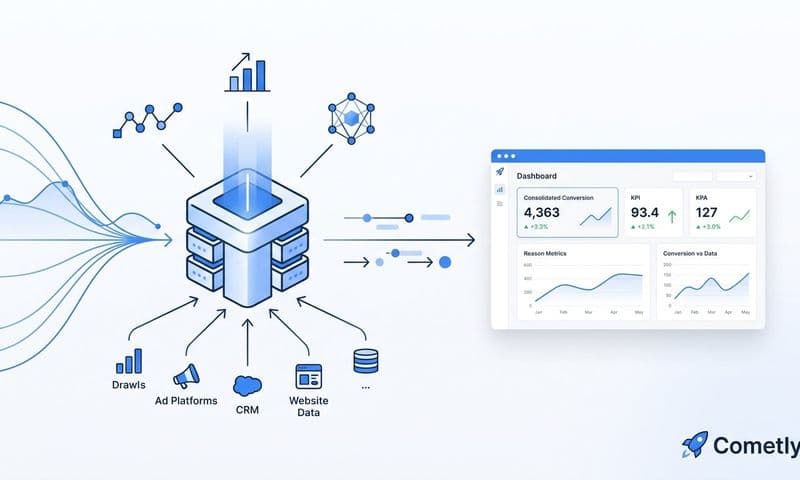
These connections create a unified, real-time view of performance, ensuring every piece of data—from ad click to final sale—is part of a single, coherent story.
How to Choose the Right Real Time Analytics Platform
Picking the right real time analytics platform is a huge decision, one that can make or break your ability to grow. With the market exploding, the number of options can feel paralyzing. But if you focus on a few core pillars—accuracy, implementation, integrations, and scalability—you can cut through the noise and find a true partner for your business.
This isn't just about ticking off a feature list. It's about asking the right questions to figure out if a platform is actually built to solve your challenges. A great platform doesn't just show you data; it delivers trustworthy insights you can act on with confidence, often within minutes.
Data Accuracy and Latency
First things first: data integrity. If the data is wrong or slow, nothing else matters. The whole point of a real-time platform is to get accurate information with almost no delay.
When you're vetting vendors, you need to push past the surface-level claims. Here are the critical questions to ask:
- What is your typical latency from event to dashboard? Look for answers in seconds or minutes, not hours. Anything over 15 minutes starts to lose its "real-time" advantage.
- How does your platform handle discrepancies with ad network reporting? Delays from platforms like Facebook are common. A solid system should have a clear process for reconciling data to make sure your attribution is spot-on.
- Is server-side tracking native to your platform? This is non-negotiable for accuracy. Server-side tracking bypasses the problems with browser-based pixels, ensuring you capture every conversion without interference from ad blockers or iOS updates.
Ease of Implementation and Use
The most powerful platform on earth is useless if your team can't set it up or figure out how to use it. Modern solutions are built for marketers, not just developers. The goal is to get from sign-up to actionable insights as quickly as possible, without a long, code-heavy setup process.
Look for a platform that clearly prioritizes a smooth user experience:
- Zero-Code Setup: Can you get the system live in under an hour without writing a single line of code?
- Intuitive Dashboards: Is the interface designed for quick analysis, letting you spot trends and drill down into campaign performance with ease?
- Clear Documentation and Support: Does the vendor provide comprehensive guides and responsive customer support to help you actually get value out of the tool?
Choosing a real time analytics platform means investing in a central nervous system for your marketing operations. It needs to be reliable, fast, and easy to integrate, becoming an extension of your team rather than another complex tool to manage.
Integrations and Scalability
Your analytics tool can't operate in a silo. It has to connect seamlessly with your entire marketing and sales stack to give you a complete view of the customer journey. On top of that, it needs to grow with you, handling more and more data without slowing down or becoming a security risk.
Investment in this sector is booming, with over USD 1.79 billion injected by top investors recently. This has fueled rapid innovation, allowing platforms to process data at the edge and cut latency to mere milliseconds. For e-commerce brands, this can boost conversion rates by 15-25%. You can learn more about the trends shaping the real-time analytics market.
Make sure your chosen platform is future-proof by checking its integration capabilities and scalability. Can it connect with all your essential tools—from ad platforms and CRMs to e-commerce storefronts? A platform with a huge library of one-click integrations, like Cometly, ensures you can build a comprehensive and accurate data ecosystem without the headache.
To get a better sense of what a complete solution looks like, explore our deep dive into the top marketing analytics platforms available today.
Real World Scenarios Where Real Time Analytics Win
Theory is one thing, but the real power of a real time analytics platform snaps into focus when you see it in the wild. These platforms aren't just about getting your charts faster; they're about dodging bullets, grabbing opportunities, and changing the entire rhythm of your business. The gap between acting now and acting tomorrow can literally be thousands of dollars in wasted ad spend or lost sales.
So, let's get out of the clouds and look at some concrete examples where getting data in minutes, not days, makes all the difference. These stories show how real-time insights translate directly into money in the bank.
 The Real Time Analytics Platform Your Guide to Instant Insights
The E-commerce Crisis Averted
Picture an e-commerce brand launching a major campaign for a new product line. They're pouring $5,000 per day into a killer Facebook ad that’s driving a ton of traffic. Everything looks great. But then, their real-time dashboard shows the conversion rate has suddenly cratered, dropping from a healthy 4% to nearly zero in less than an hour.
With a traditional analytics tool, this fire might not get noticed for 24 hours. By that point, they would've torched their entire daily budget for absolutely nothing.
But because they're using a real time analytics platform, the marketing manager gets an instant alert. A quick glance at the live data confirms it: traffic is still pouring in, but nobody is checking out. Within minutes, they find the culprit—a recent site update broke the checkout button on mobile devices.
The team immediately hits pause on the high-spend ad campaign, scrambles to fix the broken code, and gets the ads running again.
The Result: Instead of flushing $5,000 down the drain and losing a full day of sales, they caught the problem after only $200 of unproductive spend. They sidestepped a major financial hit and saved their campaign's momentum, all because they could see the problem as it happened.
The SaaS Mid-Day Budget Shift
Now think about a SaaS company chasing leads on LinkedIn. They kick off the week with three different ad creatives for a new feature, all driving traffic to a demo request page. The mission: find the winning creative fast and put all the budget behind it.
Thanks to real-time attribution, they don’t have to wait until tomorrow’s report. By lunchtime on day one, their dashboard is screaming a clear message: Creative B is pulling in 70% of all qualified demo requests, and its cost per acquisition is half of the other two.
This isn't an end-of-day insight; it's a mid-day command. The marketing team immediately reallocates the budget from the two duds and triples down on Creative B while the campaign is still hot. Having a real-time grip on customer journey analytics gives them an almost unfair advantage.
The Proactive Marketing Agency
For any digital marketing agency, keeping clients happy is job number one. But when you’re managing dozens of accounts, it’s easy for performance to dip without anyone noticing—until an angry email from the client lands in your inbox.
A sharp, modern agency, however, uses a unified real time analytics platform to watch over all client campaigns from one central dashboard. One afternoon, the system flags a sudden, sharp spike in cost-per-click for one of their biggest clients.
The account manager jumps on it instantly. She quickly discovers a new competitor has crashed the ad auction, bidding up the prices. Armed with this insight, she immediately adjusts the bidding strategy and tweaks the ad targeting to a more profitable audience segment.
Then, she sends a proactive report to the client explaining the market shift and the exact steps she took to protect their performance. What could have been a painful conversation about poor results becomes a masterclass in expert management, cementing the client's trust.
Why Real-Time Analytics Is No Longer Optional
In today's hyper-competitive market, waiting for data is a losing game. The speed of business has accelerated so much that decisions made on yesterday's information are already out of date. Relying on batch processing is like trying to navigate a freeway by only looking in the rearview mirror—you can see where you’ve been, but you’re blind to the opportunities and dangers directly ahead.
The shift to a real-time analytics platform isn't just a luxury for industry giants anymore; it's a fundamental necessity for survival and growth. The benefits are just too significant to ignore. You can stop wasting ad spend by catching underperforming campaigns in minutes, not days. You finally get accurate, multi-touch attribution that reveals the true customer journey, letting you invest in channels that actually drive revenue.
The Future Is Predictive and Automated
This evolution doesn't stop at just seeing data faster. The next frontier, which is already taking shape, involves plugging AI and machine learning directly into these platforms. This powerful combination is unlocking capabilities that were once the stuff of science fiction:
- Predictive Insights: AI algorithms analyze streaming data to forecast trends, predict customer churn, and identify high-value audiences before your competitors even know they exist.
- Automated Optimizations: Instead of just alerting you to a problem, intelligent systems will soon be able to take action automatically. Think reallocating budgets, pausing failing ads, and adjusting bids in real time to maximize ROI without any human intervention.
The ultimate goal is to move from reactive decision-making to a proactive, automated growth engine. Stop guessing and start knowing. It’s time to embrace the clarity and control that a real-time analytics platform provides.
Making this change is the logical next step for any data-driven team. It’s about arming yourself with the truth—instant, accurate, and actionable—so you can confidently build a more profitable and resilient business.
Got Questions About Real-Time Analytics?
Even when the benefits are clear, jumping into new tech always brings up a few practical questions. Let's tackle some of the most common ones marketers ask when they're thinking about a real-time analytics platform.
Think of this as the final gut-check before you can confidently move forward and start tapping into the power of instant, accurate data.
What’s the Real Difference Between a Real-Time Platform and Google Analytics?
It boils down to two things: speed and accuracy. While Google Analytics is a household name, its standard reports can lag by up to 48 hours. This means you're often making today’s decisions with yesterday’s data, which is a huge disadvantage when you're managing fast-moving campaigns.
A true real-time analytics platform erases that delay, giving you insights in minutes or even seconds. This means you can make on-the-fly budget changes and optimizations. On top of that, platforms with server-side tracking give you fundamentally more accurate data by getting around the limits of browser pixels—like issues from iOS updates and ad blockers—giving you a much clearer picture of attribution.
Is It a Headache to Set Up a Real-Time Analytics Platform?
Not anymore. Older systems might have needed a team of developers and some serious coding, but modern platforms are built for marketers. The best tools are designed to be user-friendly, so you can get up and running without a technical background.
Many of today's top platforms offer a zero-code setup you can knock out in under an hour. It’s usually as simple as adding a script to your website and using one-click integrations to link your ad accounts, e-commerce store, and CRM.
This means even smaller teams can get their hands on sophisticated, real-time analytics without needing a dedicated engineering team to manage it. It really levels the playing field.
How Does a Real-Time Platform Actually Improve Marketing ROI?
A real-time analytics platform boosts your return on investment (ROI) in three very direct ways, turning your data into profit:
- Cuts Wasted Ad Spend: With immediate feedback on how your ads are performing, you can instantly spot and pause underperforming campaigns or creatives. This stops you from burning cash on ads that just aren't converting.
- Uncovers True Attribution: Accurate, multi-touch attribution finally shows you which channels and campaigns are genuinely driving revenue. This lets you shift your budget from low-impact channels to your top performers with total confidence.
- Supercharges Ad Platform Algorithms: When you send precise, server-side conversion data back to ad networks like Facebook and Google, you’re essentially "teaching" their algorithms who your best customers are. This sharpens your audience targeting, which drives down your customer acquisition costs and boosts your overall returns.
Ready to stop guessing and start knowing exactly what drives your growth? Cometly provides the real-time clarity you need to optimize ad spend, achieve accurate attribution, and scale your business with confidence. Get started today and see your marketing ROI in real time.