You're staring at yesterday's campaign performance while your competitors are already optimizing based on what's happening right now. That Facebook ad that stopped converting three hours ago? Still burning through your budget. That Google campaign that just hit its stride? You won't know to scale it until tomorrow's report arrives. Meanwhile, every minute of delay costs real money.
This is the reality for marketers still relying on traditional analytics that batch-process data overnight. By the time you see the numbers, the moment to act has already passed.
Real-time analytics software eliminates this gap entirely. It processes customer actions—clicks, conversions, revenue—as they happen, giving you the power to respond immediately instead of reacting to history. For paid advertisers managing campaigns across Meta, Google, TikTok, and LinkedIn, this shift from delayed reporting to instant visibility isn't just convenient. It's become the difference between scaling profitably and watching budget disappear into underperforming ads.
From Batch Reports to Instant Insights: How Marketing Data Evolved
For decades, marketing analytics followed a predictable rhythm. Data collected throughout the day would queue up, waiting for overnight processing. Reports would generate on a schedule—maybe once daily, maybe every few hours if you had sophisticated systems. Marketers would log in each morning to see how yesterday's campaigns performed, then make decisions based on information that was already 12 to 24 hours old.
This batch processing model made sense when computing power was expensive and data volumes were manageable. But it created a fundamental disconnect: the time gap between customer action and marketing response.
Real-time analytics represents a complete architectural shift. Instead of collecting data in batches, modern platforms use streaming data pipelines that process events the moment they occur. When someone clicks your ad, visits your landing page, or completes a purchase, that information flows immediately into your analytics system. We're talking seconds to minutes, not hours or days.
The technical infrastructure behind this capability involves event-driven architectures, distributed processing systems, and APIs that maintain constant connections between your marketing stack components. Rather than waiting for scheduled jobs to run, these systems react to each event as it happens, updating dashboards and triggering alerts in near-real-time.
Why does this shift matter now more than ever? Three converging pressures have made speed essential. First, buyer journeys have compressed dramatically—customers research, compare, and purchase faster than they did even five years ago. Second, advertising costs continue climbing across every major platform, making inefficient spending more painful. Third, your competitors who adopt real-time systems gain an immediate advantage, optimizing while you're still waiting for reports.
The marketers winning today aren't necessarily smarter or more creative. They're simply working with fresher information, making dozens of small optimizations while others make one big adjustment based on yesterday's data.
The Business Case for Speed: When Minutes Cost Money
Let's talk about what delayed data actually costs. Picture this: you launch a new campaign at 9 AM with a $500 daily budget. By 11 AM, it's clear the targeting is off—click-through rates are abysmal, and the few conversions you're getting cost three times your target CPA. But your traditional analytics won't show this until tomorrow morning's report.
That campaign runs all day, burning through your entire budget on traffic that was never going to convert. That's $500 wasted because you couldn't see the problem as it was happening.
Multiply this scenario across multiple campaigns, platforms, and days. The budget waste adds up fast. Real-time analytics software would have flagged the performance issue within the first hour, giving you time to pause, adjust targeting, or reallocate that budget to campaigns that were actually working.
The flip side is equally costly: missed opportunities to scale. You run five ad variations, and one suddenly starts converting at half your target CPA. It's printing money. But you won't know this until you review tomorrow's data, by which point audience fatigue might have already set in, or competitors might have saturated the same audience.
Real-time visibility lets you spot winners while they're hot and immediately increase budget to capture maximum value during that performance window. This is particularly critical for time-sensitive offers, seasonal campaigns, or trending topics where the window of opportunity measures in hours, not days.
Then there's the complexity problem. Managing paid advertising across Meta, Google, TikTok, and LinkedIn simultaneously means juggling four different dashboards, each with its own reporting delays and attribution logic. Without unified real-time analytics, you're constantly context-switching, trying to piece together a coherent picture of cross-platform performance.
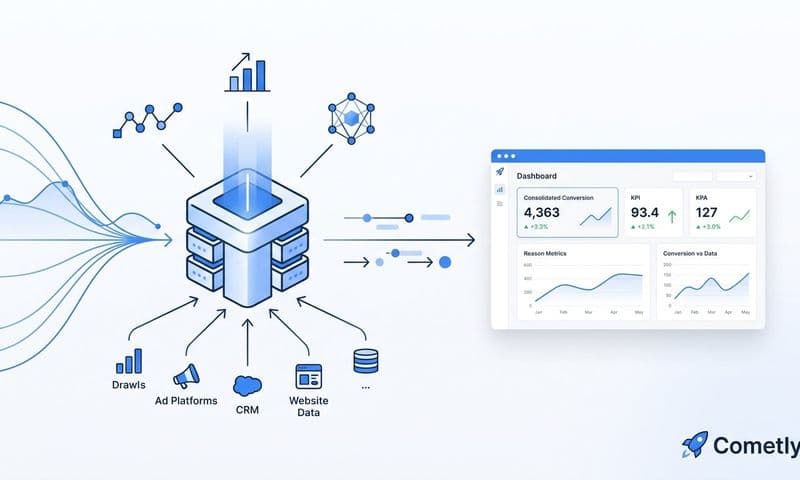
By the time you've logged into each platform, downloaded reports, and built a spreadsheet to compare them, hours have passed. Real-time analytics software aggregates data from all sources instantly, giving you a single view of what's working across your entire marketing stack.
The competitive disadvantage compounds over time. While you're making decisions based on yesterday's data, competitors with real-time systems are already three steps ahead—pausing losers, scaling winners, and testing new variations. In high-stakes markets where margins are thin and competition is fierce, this speed advantage often determines who wins.
Core Capabilities That Define Real-Time Analytics Platforms
Not all platforms claiming "real-time" capabilities actually deliver on that promise. Understanding what separates genuine real-time analytics from marketing hype starts with recognizing the core technical capabilities that make instant insights possible.
Live Data Streaming and Processing: True real-time platforms don't wait for data to accumulate before processing it. They ingest and analyze each event as it occurs—every ad click, page view, form submission, and purchase flows through the system immediately. This requires streaming data architecture that can handle thousands of events per second without lag, maintaining sub-minute latency even during traffic spikes.
The difference is tangible. When someone clicks your Facebook ad at 2:47 PM, that click should appear in your dashboard by 2:48 PM, already attributed to the correct campaign, ad set, and creative. When they convert ten minutes later, that revenue should connect to the original click instantly, updating your ROAS calculations without delay.
Dynamic Attribution Modeling: Real-time analytics becomes exponentially more valuable when it includes sophisticated attribution. This means tracking the complete customer journey—from first ad impression through multiple touchpoints to final conversion—and connecting those dots as they happen, not in batch processing overnight.
Dynamic attribution captures every interaction: the Facebook ad they clicked last week, the Google search they performed yesterday, the email they opened this morning, and the direct visit where they finally purchased. Real-time platforms process this multi-touch journey instantly, showing you which channels and campaigns actually contributed to revenue, not just which one happened to be last.
This matters because attribution determines where you allocate budget. If your system only updates attribution models daily, you're optimizing based on incomplete information. Real-time dynamic attribution ensures every decision reflects the actual customer journey as it's unfolding.
Actionable Alerts and AI Recommendations: Raw data flowing in real-time only matters if it drives action. The best platforms transform instant data into immediate optimization opportunities through intelligent alerting and AI-powered recommendations.
This might look like automatic notifications when campaign performance drops below threshold, suggestions to increase budget on ads exceeding ROAS targets, or alerts when conversion rates spike unexpectedly. AI can analyze patterns across thousands of data points to surface opportunities human marketers might miss—identifying which audiences, placements, or creative elements are driving outsized results right now.
The combination of instant data and intelligent analysis creates a system that doesn't just show you what's happening, but actively guides you toward better decisions in the moment when those decisions matter most.
Connecting the Dots: Real-Time Tracking Across Your Marketing Stack
Real-time analytics can't exist in isolation. The platform's ability to deliver instant insights depends entirely on how well it integrates with the tools you already use—your ad platforms, website, CRM, and e-commerce system. Without seamless connections across your marketing stack, you're back to manual data collection and delayed reporting.
Think about the typical customer journey. Someone sees your Facebook ad, clicks through to your website, browses several pages, fills out a lead form, and eventually becomes a customer tracked in your CRM. For real-time analytics to work, the platform needs direct integrations with Facebook Ads, your website tracking, and your CRM—capturing each event as it happens and connecting them into a unified journey.
This integration imperative extends to every channel you use. Google Ads, TikTok, LinkedIn, email platforms, SMS tools—each requires its own connection. The more comprehensive your integrations, the more complete your real-time visibility becomes. Gaps in integration create blind spots where customer actions go untracked, breaking the attribution chain.
Server-Side Tracking Advantages: Here's where real-time analytics platforms separate themselves through technical sophistication. Traditional client-side tracking—JavaScript pixels that run in the user's browser—increasingly fails due to ad blockers, browser privacy features, and iOS App Tracking Transparency restrictions.
Server-side tracking solves this by processing events on your server before sending them to analytics platforms. When someone converts on your website, the conversion data flows through your server to your analytics platform directly, bypassing browser limitations entirely. This maintains tracking accuracy even when client-side methods fail, ensuring your real-time data remains reliable and complete.
For marketers, this technical detail matters because it directly affects data quality. Real-time analytics built on unreliable client-side tracking gives you instant access to incomplete information. Server-side tracking ensures the instant data you're seeing actually reflects reality.
Feeding Better Data Back to Ad Platforms: The most sophisticated real-time analytics platforms don't just receive data—they send it back. This capability, often called conversion sync or Conversions API integration, closes the loop by feeding enriched conversion data back to Meta, Google, and other ad platforms in real time.
Why does this matter? Ad platform algorithms optimize based on conversion signals. The more accurate and timely those signals, the better the algorithms perform. By sending server-side conversion data back to platforms immediately, you give their machine learning systems higher-quality information to work with, improving targeting, bidding, and optimization.
This creates a virtuous cycle: better data leads to better ad performance, which generates more conversions, which provides even more data to optimize against. Real-time analytics platforms that excel at bidirectional data flow—receiving and sending—deliver compounding value over time.
Evaluating Real-Time Analytics Solutions: What to Look For
Shopping for real-time analytics software means cutting through marketing claims to understand actual capabilities. Not every platform that promises "real-time" delivers the same level of performance, accuracy, or reliability. Knowing the right questions to ask helps you identify solutions that will actually meet your needs.
Data Latency Benchmarks: Start by getting specific about what "real-time" means for each vendor. Ask directly: What's the typical latency between an event occurring and it appearing in the dashboard? Some platforms update every few minutes, others within seconds. For paid advertising optimization, you want latency measured in seconds to minutes, not tens of minutes or hours.
Request concrete examples. If someone clicks an ad right now, how long until you see it? When a conversion happens, how quickly does it attribute back to the source campaign? Vague answers like "near real-time" or "within minutes" should raise flags. Look for vendors who can demonstrate actual performance with specific numbers.
Attribution Accuracy: Real-time data loses value if it's inaccurately attributed. Dig into how the platform handles multi-touch attribution. Does it capture every touchpoint in the customer journey, or only first and last click? Can it track cross-device journeys where someone clicks an ad on mobile but converts on desktop?
Ask about attribution model flexibility. The best platforms let you compare multiple models—first touch, last touch, linear, time decay, position-based—to understand how different approaches change your view of channel performance. Real-time access to multiple attribution models gives you more confidence in optimization decisions.
Verify that the platform maintains attribution accuracy across all your channels. Some solutions excel at tracking paid ads but struggle with organic social, email, or direct traffic. Gaps in attribution create blind spots that undermine the value of real-time insights.
Scalability and Reliability: Real-time analytics platforms must handle your data volume without degrading performance. Ask how the system performs during traffic spikes—Black Friday, product launches, viral moments. Does latency increase when event volume doubles or triples?
Reliability matters just as much as speed. A platform that delivers instant insights 95% of the time but crashes during your biggest sales day isn't truly real-time. Look for uptime guarantees, redundancy measures, and track records of maintaining performance under load.
Consider your growth trajectory. If you're managing three ad accounts today but plan to scale to fifteen next year, can the platform handle that expansion without requiring a complete reimplementation? Scalability should be built into the architecture, not an expensive add-on.
Putting Real-Time Data to Work: Practical Applications
Understanding what real-time analytics software can do matters less than knowing how to actually use it. The best platforms become force multipliers for marketing teams who integrate instant insights into their daily workflows and decision-making processes.
Daily Optimization Workflows: Smart marketers start each day with a real-time performance review. Instead of waiting for scheduled reports, they check live dashboards to see what happened overnight and what's trending this morning. Which campaigns exceeded ROAS targets? Which ones are burning budget without converting?
This immediate visibility enables micro-optimizations throughout the day. Pause underperformers before they waste more budget. Increase spending on winners while they're hot. Shift budget between platforms based on real-time performance. These small, frequent adjustments compound into significantly better overall results compared to making one big optimization based on yesterday's data.
Real-time analytics also reveals patterns you'd miss in daily reports. Maybe your TikTok ads consistently underperform between 2-4 PM but crush it in the evening. With instant data, you can adjust dayparting strategies immediately rather than waiting weeks to notice the pattern in aggregated reports.
Campaign Launch Monitoring: Launching new campaigns becomes far less risky when you can watch performance in real time. Instead of setting and forgetting, you monitor the first few hours closely, ready to intervene if something's wrong.
Did you accidentally target the wrong audience? Real-time data shows it immediately through poor engagement rates and high CPCs. Is your landing page broken? You'll see clicks without conversions within the first hour. Catching these issues fast—before they burn through your daily budget—turns potential disasters into minor course corrections.
This capability is particularly valuable for testing new channels, audiences, or creative approaches. Real-time feedback lets you fail fast and pivot quickly, rather than committing full budgets to experiments that aren't working.
Revenue Attribution Clarity: Perhaps the most transformative application of real-time analytics is understanding exactly which marketing activities drive actual revenue, not just clicks or leads. When conversions attribute back to source campaigns instantly, you gain unprecedented clarity about what's working.
This matters because many conversions happen hours or days after the initial click. Traditional analytics might show a campaign generated 50 clicks today but won't connect those to the 15 conversions that happen tomorrow. Real-time attribution connects the dots as conversions occur, giving you a complete picture of campaign value that updates continuously.
For businesses with longer sales cycles, this means finally seeing the full impact of top-of-funnel campaigns that influence purchases weeks later. For e-commerce, it means knowing within minutes whether that new Facebook campaign is actually driving revenue or just generating cheap clicks that don't convert.
Moving Forward with Real-Time Marketing Intelligence
Real-time analytics software has evolved from a competitive advantage to a fundamental requirement for serious paid advertising. The gap between marketers who can see and respond to performance instantly versus those waiting for yesterday's reports continues to widen. In markets where every percentage point of efficiency matters, that gap often determines who scales profitably and who burns budget chasing outdated insights.
The core evaluation criteria remain straightforward: actual data latency measured in seconds to minutes, comprehensive multi-touch attribution that captures every customer touchpoint, seamless integrations across your entire marketing stack, and reliable performance that scales with your growth. Platforms that excel in these areas transform how marketing teams work—shifting from reactive optimization based on history to proactive decision-making based on what's happening right now.
The practical benefits compound over time. Daily micro-optimizations add up to substantially better campaign performance. Faster detection of winners and losers means budget flows to what's working instead of what worked yesterday. Complete revenue attribution clarity reveals the true value of every channel and campaign, enabling confident investment decisions backed by data, not guesswork.
For marketing teams managing complex paid advertising across multiple platforms, real-time analytics eliminates the friction of juggling disconnected dashboards and delayed reports. It creates a single source of truth that updates continuously, turning the chaos of multi-channel marketing into a coherent, actionable view of performance.
Ready to elevate your marketing game with precision and confidence? Discover how Cometly's AI-driven recommendations can transform your ad strategy—Get your free demo today and start capturing every touchpoint to maximize your conversions.