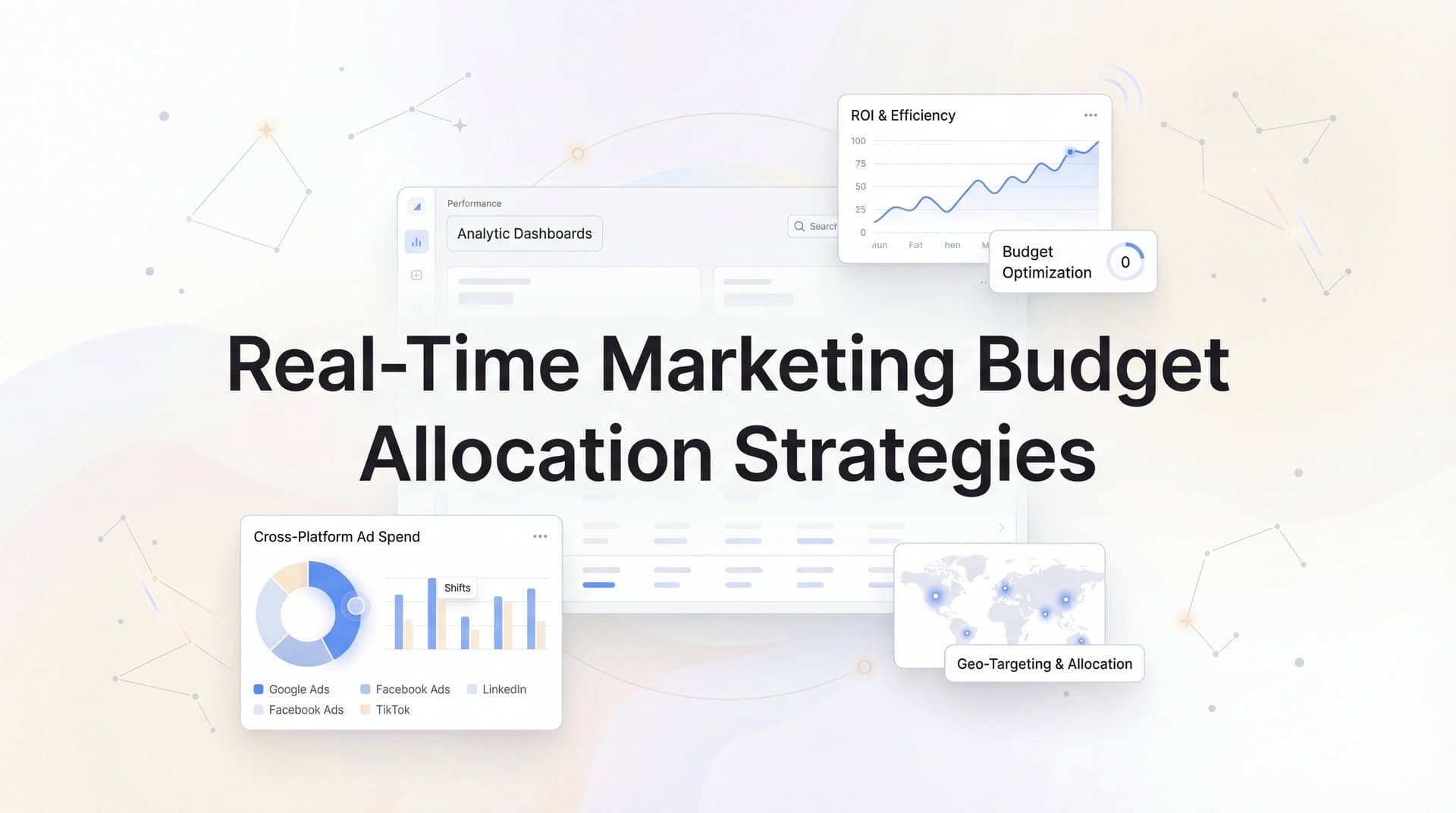
Your marketing budget is moving right now. While you read this, ad platforms are spending your money, campaigns are performing at different rates, and customer behavior is shifting. The question isn't whether your budget should be dynamic—it's whether you have the systems in place to move it where it matters most.
Most marketing teams still operate on outdated allocation models. They set monthly budgets in spreadsheets, check performance weekly, and make adjustments when it's already too late. Meanwhile, high-performing campaigns hit their daily caps while underperforming channels continue burning through budget.
Real-time budget allocation changes this equation entirely. Instead of reacting to last week's data, you're responding to what's happening right now. When a campaign starts converting at 3x your target ROAS, you scale it immediately. When another channel's performance drops, you shift that budget before wasting another dollar.
The businesses winning in today's marketing landscape aren't necessarily spending more—they're reallocating faster. They've built systems that connect their data, automate decision-making, and treat their total ad budget as a fluid resource that flows toward performance.
This guide breaks down seven strategies that make real-time budget allocation practical and profitable. You'll learn how to build the data foundation that makes fast decisions possible, create rules that scale spend automatically, and leverage AI to spot opportunities human analysis might miss. Whether you're managing $10,000 or $1 million in monthly ad spend, these approaches help you maximize every dollar.
1. Build a Unified Data Foundation First
The Challenge It Solves
Real-time budget allocation is impossible when your performance data lives in separate silos. When you need to check Meta Ads Manager for Facebook performance, Google Ads for search campaigns, and your CRM for actual revenue data, making fast allocation decisions becomes a guessing game. By the time you've pulled reports from five platforms and tried to reconcile the numbers, market conditions have already changed.
Data fragmentation creates blind spots. You might see that Google Ads drove 200 conversions, but without connecting that to your CRM, you don't know if those conversions became customers or which ones generated revenue. This disconnect makes it nearly impossible to allocate budget based on actual business outcomes.
The Strategy Explained
Building a unified data foundation means connecting every marketing touchpoint—ad platforms, website analytics, CRM, and payment systems—into a single source of truth. This isn't about creating another dashboard to check; it's about creating a system where all your marketing data flows into one place automatically.
The goal is to see the complete picture in real time. When someone clicks a Facebook ad, visits your website, downloads a lead magnet, and eventually becomes a customer, you need to track that entire journey and connect it to the original ad spend. This complete view is what makes intelligent budget allocation possible.
Think of it like upgrading from individual instrument readings to a cockpit display. Instead of checking fuel, altitude, and speed separately, you see everything integrated on one screen. That integration is what allows pilots to make split-second decisions—and it's what allows marketers to reallocate budget with confidence.
Implementation Steps
1. Audit your current data sources and identify every platform where marketing performance data exists, including ad platforms, analytics tools, CRM systems, and payment processors.
2. Implement a marketing attribution platform that can ingest data from all these sources and connect individual customer journeys from first click through final conversion.
3. Set up server-side tracking to ensure accurate data collection that isn't affected by browser limitations, ad blockers, or privacy restrictions that impact pixel-based tracking.
4. Verify data accuracy by comparing platform-reported conversions against your attribution system for at least one week, troubleshooting any discrepancies before making budget decisions based on this data.
Pro Tips
Start with your highest-spend platforms first. If 80% of your budget goes to Meta and Google, get those integrated before worrying about smaller channels. Also, prioritize tracking revenue over conversions—knowing which campaigns drive actual dollars matters more than knowing which drive the most form fills or sign-ups.
2. Set Dynamic Budget Thresholds Based on ROAS
The Challenge It Solves
Static budgets force you to make allocation decisions before you know how campaigns will perform. You set a $500 daily budget for a campaign, and it hits that cap by noon—even when it's converting at 5x your target ROAS. Meanwhile, another campaign with a $500 budget continues spending all day despite barely breaking even.
Manual budget adjustments can't keep pace with performance fluctuations. By the time you notice a campaign performing well, check the data, get approval, and increase the budget, you've already missed hours of potential conversions. The opportunity cost of this delay compounds across all your campaigns.
The Strategy Explained
Dynamic budget thresholds create automated rules that scale spend up or down based on real-time return on ad spend. Instead of setting fixed daily budgets, you define performance criteria that trigger budget changes automatically. When a campaign exceeds your target ROAS, the system increases its budget. When performance drops below acceptable levels, it reduces spend or pauses the campaign entirely.
This approach treats budget as a performance-based resource rather than a predetermined allocation. High performers get more fuel. Underperformers get less. The system makes these adjustments continuously throughout the day, responding to performance changes as they happen rather than waiting for human intervention.
The key is setting thresholds that balance aggressiveness with safety. You want to scale winners quickly, but not so aggressively that you destabilize campaigns or exhaust your total budget on a temporary performance spike.
Implementation Steps
1. Calculate your minimum acceptable ROAS by channel, accounting for different conversion values and customer lifetime values across platforms (a lead from LinkedIn might be worth more than one from Facebook).
2. Create tiered threshold rules that define budget actions at different performance levels—for example, increase budget by 20% when ROAS exceeds target by 50%, decrease by 20% when it drops 30% below target, and pause when it falls 50% below target.
3. Set maximum budget caps that prevent any single campaign from consuming your entire budget during a scaling event, typically limiting individual campaigns to 40-50% of your total daily spend.
4. Implement a minimum data requirement that prevents rules from triggering on insufficient sample sizes—typically requiring at least 20-30 conversions before making automated budget changes.
Pro Tips
Build in time delays to prevent overreaction to short-term fluctuations. Instead of scaling immediately when ROAS spikes, require that performance threshold to hold for at least 2-3 hours. This prevents your system from chasing temporary anomalies. Also, review your automated decisions weekly to identify patterns and refine your thresholds over time.
3. Use Multi-Touch Attribution for Smarter Allocation
The Challenge It Solves
Last-click attribution creates a distorted view of channel performance that leads to terrible budget decisions. When you only credit the final touchpoint before conversion, channels that introduce customers or nurture them through consideration get zero credit—and zero budget. Your awareness campaigns on YouTube might be driving customers who convert through Google search, but last-click models make YouTube look ineffective.
This attribution blindness causes teams to underfund top-of-funnel channels and over-invest in bottom-funnel ones. You end up with a budget allocation that starves the channels feeding your conversion funnel, eventually depleting the pipeline those bottom-funnel campaigns depend on.
The Strategy Explained
Multi-touch attribution distributes conversion credit across all the touchpoints in a customer journey, showing how each channel contributes to the final outcome. When someone sees a Facebook ad, clicks a Google search ad, visits directly, and then converts through an email link, multi-touch attribution shows the role each channel played rather than crediting only the email.
Different attribution models weight these touchpoints differently. Linear attribution splits credit equally. Time-decay gives more credit to recent touchpoints. Position-based models emphasize first and last touches. The right model depends on your business, but any multi-touch approach provides a more accurate view than last-click.
This complete picture changes budget allocation fundamentally. Instead of asking "which channel gets the last click?" you're asking "which channels contribute most to conversions?" That shift reveals the true value of awareness and consideration channels that traditional attribution overlooks.
Implementation Steps
1. Choose an attribution model that matches your customer journey length and complexity—position-based works well for B2B with long sales cycles, while time-decay suits e-commerce with shorter purchase windows.
2. Analyze historical data using your chosen multi-touch model to identify channels that are currently underfunded based on their actual contribution to revenue, not just last-click conversions.
3. Create channel-specific budget allocations that reflect attributed revenue rather than last-click conversions, typically shifting 15-30% of budget from bottom-funnel to mid and top-funnel channels.
4. Monitor how changes in top-funnel spend affect bottom-funnel conversion volume over the next 30-60 days, as there's often a lag between awareness investment and conversion impact.
Pro Tips
Don't abandon last-click data entirely. Compare multi-touch and last-click attribution side by side to understand the difference. Channels with large gaps between their multi-touch and last-click credit are often being systematically underfunded. These represent your biggest reallocation opportunities.
4. Implement Cross-Platform Budget Fluidity
The Challenge It Solves
Platform-specific budget silos prevent optimal allocation across your total ad spend. When you allocate $5,000 to Meta and $5,000 to Google at the beginning of the month, you're locked into that split regardless of how performance evolves. If Meta campaigns start converting at 6x ROAS while Google drops to 2x, you can't easily shift budget between platforms without manual intervention and approval processes.
These rigid allocations also create artificial constraints. A high-performing Meta campaign might hit its platform budget cap while you still have unspent budget sitting in an underperforming Google campaign. Your total spend stays on target, but the distribution is completely wrong.
The Strategy Explained
Cross-platform budget fluidity treats your total advertising budget as a single pool that flows dynamically to top performers regardless of platform. Instead of setting separate Meta, Google, and TikTok budgets, you define a total daily or monthly spend target and let performance determine how that budget gets distributed.
This requires infrastructure that can monitor performance across all platforms simultaneously and make reallocation decisions based on comparative performance. When Meta campaigns outperform Google, budget automatically shifts from Google to Meta. When TikTok starts converting efficiently, it pulls budget from wherever performance is weaker.
The strategy works because it removes the artificial barriers between platforms. Your budget follows performance wherever it appears, rather than being constrained by predetermined platform allocations that were based on last month's data or educated guesses.
Implementation Steps
1. Calculate your total available ad budget and set platform-agnostic performance targets based on blended ROAS or CPA goals across all channels combined.
2. Establish minimum and maximum platform allocation percentages to prevent any single platform from consuming your entire budget—typically setting floors at 10-15% and ceilings at 50-60% per platform.
3. Create a reallocation schedule that checks cross-platform performance at defined intervals (hourly for large budgets, daily for smaller ones) and shifts budget toward platforms exceeding targets.
4. Set up a centralized budget management system or work with a platform that can execute cross-platform budget changes automatically based on your performance rules.
Pro Tips
Build in stabilization periods when shifting budget between platforms. Don't move more than 20-30% of a platform's budget in a single day, as dramatic shifts can destabilize campaign learning and performance. Gradual reallocation gives platforms time to adjust while still capturing performance opportunities.
5. Leverage AI-Powered Optimization Recommendations
The Challenge It Solves
Human analysis can't process the volume and complexity of modern marketing data fast enough for real-time decisions. When you're running dozens of campaigns across multiple platforms with hundreds of ad variations, identifying which specific elements are driving performance becomes overwhelming. By the time you've analyzed yesterday's data, today's opportunities have already passed.
We cover this in more depth in our guide to generate ad variations with AI.
Pattern recognition at scale is where humans struggle most. You might notice that campaigns targeting a specific audience segment are performing well, but miss that this only applies during certain hours, in certain geographies, when combined with specific creative formats. These multi-dimensional patterns are exactly what drive optimal budget allocation, but they're nearly impossible to spot manually.
The Strategy Explained
AI-powered optimization uses machine learning to analyze performance data across all your campaigns, identify patterns that predict success, and recommend specific budget allocation changes. Instead of you manually reviewing reports and making decisions, AI continuously processes your data and surfaces actionable insights.
Modern AI tools analyze performance at multiple levels simultaneously—campaign, ad set, creative, audience, time of day, device type, and more. They identify which combinations of these variables produce the best results and recommend budget shifts to capitalize on high-performing patterns while reducing spend on underperformers.
The key advantage is speed and scale. AI can evaluate thousands of performance scenarios in seconds, comparing current results against historical patterns to predict which budget changes will drive the best outcomes. This allows you to act on opportunities that would take hours or days to identify through manual analysis.
Implementation Steps
1. Implement an AI-powered attribution and analytics platform that ingests data from all your marketing channels and has built-in optimization recommendation capabilities.
2. Define your optimization goals clearly within the AI system—whether you're optimizing for ROAS, customer acquisition cost, lifetime value, or a blended metric that accounts for multiple business objectives.
3. Start with AI recommendations in advisory mode, reviewing suggested budget changes before implementing them manually to build confidence in the system's logic and accuracy.
4. Gradually shift toward automated implementation of AI recommendations, beginning with smaller budget changes and expanding to larger reallocations as you validate the system's performance over time.
Pro Tips
AI recommendations are only as good as the data feeding them. Ensure your tracking is accurate and complete before trusting AI-driven budget decisions. Also, review the reasoning behind AI recommendations regularly—understanding why the system suggests certain changes helps you identify data quality issues and refine your optimization goals.
6. Feed Better Conversion Data Back to Ad Platforms
The Challenge It Solves
Ad platform algorithms optimize toward the conversion data you send them, but most marketers send incomplete or inaccurate signals. When browser-based tracking misses conversions due to ad blockers or iOS privacy restrictions, platforms like Meta and Google receive a distorted view of which ads actually drive results. They optimize toward phantom patterns that don't reflect reality.
This data gap creates a vicious cycle. Platforms receive poor conversion signals, so they optimize poorly. Performance suffers, so you reduce budget. Meanwhile, competitors feeding platforms better data get better algorithmic performance and win the auction dynamics that determine ad delivery.
The Strategy Explained
Conversion data enrichment involves sending ad platforms complete, accurate conversion information that includes the full customer journey and actual business value. Instead of just telling Meta that a conversion happened, you send enriched events that include the conversion source, the customer's total order value, whether they're a new or returning customer, and their predicted lifetime value.
Server-side tracking is the foundation of this strategy. By tracking conversions on your server rather than relying solely on browser pixels, you capture data that traditional tracking misses. You then send this complete conversion data back to ad platforms through their Conversions API or similar server-side integration.
When platforms receive better data, their algorithms make better optimization decisions. They learn which audiences, creatives, and placements actually drive valuable conversions, not just which ones trigger trackable browser events. This improves targeting, bidding, and budget allocation within the platform's own systems.
Implementation Steps
1. Implement server-side tracking that captures conversions independently of browser-based pixels, ensuring you have a complete record of all conversion events regardless of client-side tracking limitations.
2. Set up Conversions API integrations with your major ad platforms (Meta, Google, TikTok) to send server-tracked conversion data directly from your server to their systems.
3. Enrich conversion events with additional value signals before sending them to platforms—include order value, customer type, product categories, and any other data that helps platforms understand conversion quality.
4. Configure value-based optimization in your ad platforms, allowing their algorithms to optimize toward high-value conversions rather than treating all conversions equally.
Pro Tips
Don't turn off your browser pixels when implementing server-side tracking. Run both in parallel, with server-side as your source of truth for internal decisions and pixels providing backup signals to platforms. This dual approach maximizes data coverage while maintaining compatibility with platform optimization systems.
7. Create a Real-Time Budget Review Cadence
The Challenge It Solves
Even with automated systems and AI recommendations, human oversight remains essential for context and strategic decisions. Market conditions change, competitors launch new campaigns, seasonality affects performance, and product priorities shift. Automated rules can't account for all these variables, and without regular human review, your budget allocation can drift away from business objectives.
Many teams swing between two extremes—either checking performance obsessively throughout the day without a structured decision framework, or reviewing only weekly when it's too late to capture opportunities. Both approaches waste time and miss the balance between automation and strategic oversight.
The Strategy Explained
A real-time budget review cadence establishes structured checkpoints where you evaluate performance data and make strategic allocation decisions based on a clear framework. This isn't about micromanaging every campaign fluctuation—it's about creating regular moments to assess whether your automated systems are working as intended and whether business priorities require manual intervention.
The review frequency depends on your budget size and market dynamics. High-spend accounts benefit from multiple daily reviews. Smaller budgets might review once daily or every other day. The key is consistency and having a defined decision framework that prevents arbitrary changes while allowing strategic adjustments when warranted.
These reviews focus on exception management and strategic opportunities. You're looking for performance anomalies that automated rules might miss, competitive dynamics that require strategic response, and opportunities to test new allocation strategies based on emerging patterns.
Implementation Steps
1. Define your review frequency based on total ad spend—budgets over $50,000 monthly typically warrant twice-daily reviews, $10,000-50,000 monthly benefits from daily reviews, and smaller budgets can review every 2-3 days.
2. Create a standardized review dashboard that shows key metrics at a glance: total spend vs. budget, ROAS by channel, top performing campaigns, bottom performing campaigns, and any automated budget changes made since the last review.
3. Establish decision criteria that define when human intervention is required—for example, when any channel's performance changes by more than 40% day-over-day, when total spend pacing is off by more than 15%, or when a new campaign opportunity emerges.
4. Document all manual budget changes and the reasoning behind them, creating a decision log that helps you identify patterns in your strategic interventions and refine your automated rules over time.
Pro Tips
Schedule your reviews at times when you can actually make changes. A 9 AM review lets you adjust budgets for the full business day. A 2 PM review catches lunch-hour performance shifts. Avoid late-day reviews unless you're running campaigns in different time zones. Also, assign clear ownership—one person should be responsible for each review to prevent decision paralysis or conflicting changes.
Putting These Strategies Into Action
Real-time budget allocation isn't about implementing all seven strategies simultaneously. It's about building a progressive system that matches your current capabilities and grows with your needs.
Start with your data foundation. Without unified visibility across platforms, every other strategy becomes guesswork. Connect your ad platforms, analytics, and CRM into a single attribution system that tracks complete customer journeys. This foundation makes everything else possible.
Next, layer in dynamic budget thresholds. Even basic ROAS-based rules that automatically scale or reduce spend will outperform static allocations. You don't need sophisticated AI on day one—simple performance-based automation delivers immediate value.
From there, the path depends on your business complexity. If you run campaigns across multiple platforms, prioritize cross-platform budget fluidity. If you have longer customer journeys with multiple touchpoints, multi-touch attribution becomes critical. If you're managing dozens of campaigns with complex variables, AI-powered recommendations provide the analytical horsepower you need.
The common thread across all these strategies is moving from reactive to proactive budget management. Instead of analyzing last week's performance and adjusting for next week, you're responding to what's happening right now. That shift compounds over time—every hour you allocate budget more efficiently is an hour you're outperforming competitors still operating on monthly planning cycles.
Remember that feeding better data back to ad platforms amplifies everything else. When Meta, Google, and other platforms receive complete conversion signals, their internal algorithms work with you rather than against you. This creates a multiplier effect where your manual optimization efforts and their automated optimization reinforce each other.
Implementation doesn't require a complete overhaul of your marketing stack. Many teams start with their highest-spend platform, prove the value of real-time allocation there, and expand to other channels progressively. The key is starting—even imperfect real-time allocation beats perfect monthly planning.
Your review cadence keeps everything aligned with business reality. Automated systems handle tactical execution, but human oversight ensures strategic coherence. This combination of automation and oversight is what separates sophisticated marketing operations from both over-automated chaos and under-automated inefficiency.
Ready to elevate your marketing game with precision and confidence? Discover how Cometly's AI-driven recommendations can transform your ad strategy—Get your free demo today and start capturing every touchpoint to maximize your conversions.