Social media measurement is all about gathering and analyzing data from your social channels to figure out what’s actually working. It’s not just counting likes or followers. It’s about connecting the dots between your social activity and real business results—things like leads, sales, and customer loyalty. Done right, it helps marketers prove their ROI and fine-tune their strategies on the fly.
Why Your Social Media Measurement Needs a Rethink
 A Guide to Social Media Measurement That Actually Drives Growth
It’s easy to treat social media measurement as an afterthought—something you pull together for an end-of-month report. But that’s a huge mistake. In reality, it’s your strategic compass in a ridiculously crowded digital world. Without it, you’re just flying blind, making big decisions based on gut feelings instead of hard data.
Think of it like a pilot trying to navigate a storm. Would you trust a paper map, or would you want an advanced avionics system giving you real-time data on altitude, speed, and weather patterns? Proper measurement is your avionics. It helps you steer through market shifts, dodge expensive campaign failures, and uncover revenue opportunities you’d otherwise miss.
From Brand Expense to Growth Engine
When you get your social media measurement right, you transform your channels from what feels like a brand expense into a predictable growth engine. The moment you can accurately tie a Facebook ad or a TikTok video to a final sale, social media stops being a cost center. It becomes a source of verifiable business intelligence.
This shift is more critical than ever. The number of global social media users is expected to hit 5.42 billion in 2025, which is nearly 68.7% of the world's population. And with the average person using 6.83 different platforms every month, the opportunity to connect is massive, but so is the noise. You can find more insights like these in Sprout Social's latest social media statistics.
A truly effective social media measurement system doesn't just report on what happened; it provides the insights needed to decide what to do next. It turns historical data into a forward-looking strategy.
Building a System for Real Insights
Ultimately, your goal should be to build a system that tells you more than just which posts got the most likes. It needs to answer the tough business questions, like:
- Which platform is actually driving the most qualified leads?
- What’s our true customer acquisition cost from our social campaigns?
- How is social media influencing conversions on our other channels?
Answering these questions means moving beyond the surface-level analytics that the native platforms give you. If you have a nagging feeling your reports aren't telling the whole story, you can explore the signs you need better marketing analytics to pinpoint the gaps in your current setup.
Separating Actionable Metrics from Vanity Metrics
It's easy to get lost in a sea of social media data. You might have thousands of followers and hundreds of likes on every post, but are those numbers actually doing anything for your business? This is where you have to draw a hard line between actionable metrics and vanity metrics. Being buried in data but starved for real insights is a classic marketer frustration.
Think of your social media analytics like a car's dashboard. A shiny paint job looks great, but it won’t tell you if you’re about to run out of gas. Vanity metrics are the paint job—they look impressive on the surface but offer zero strategic value. They feel good, but they rarely help you make a smart business decision.
Actionable metrics, on the other hand, are your fuel gauge, engine temperature, and speedometer. They’re the real indicators telling you how healthy your marketing engine is and if you're on track to reach your goals. These are the numbers that connect your social media efforts to actual business outcomes.
The Allure of Vanity Metrics
Vanity metrics are the easiest numbers to find and, let's be honest, often the most flattering. They are feel-good stats that are simple to report but almost impossible to act on. While they aren't completely useless—a growing follower count can signal rising brand awareness—they just don't tell the whole story.
Common vanity metrics include:
- Total Follower Count: A huge follower list doesn't guarantee engagement or sales. Many could be bots, inactive accounts, or just people who aren’t your target audience.
- Page Likes: Just like followers, a "like" is a low-effort tap that doesn’t really correlate with customer loyalty or buying intent.
- Impressions: This just shows how many times your content was displayed on a screen. It doesn't tell you if anyone actually paid attention or if it even reached the right people.
Fixating on these numbers is like celebrating a full stadium without knowing if anyone actually bought a ticket. True social media measurement means digging deeper to find the data that drives real decisions.
Focusing on Actionable Metrics That Drive Growth
Actionable metrics give you clear insights you can actually use to refine your strategy. They answer the "so what?" question by linking social activity directly to your business goals. These are the metrics that help you justify your budget and prove your return on investment (ROI). A critical step is learning how to measure social media performance that truly matters, moving beyond the fluff.
Key Takeaway: An actionable metric is any piece of data that helps you make a strategic business decision. If a metric doesn't guide your next steps, it's likely a vanity metric.
Let's look at a few examples of actionable metrics and the real value they provide.
- Conversion Rate: This tracks the percentage of users who take a specific action after clicking a link in your post—like signing up for a newsletter, downloading an ebook, or making a purchase. It tells you exactly how persuasive your content is.
- Click-Through Rate (CTR): This shows the percentage of people who saw your post and actually clicked the link. A low CTR might mean your creative or call-to-action isn't compelling enough to grab attention.
- Cost Per Acquisition (CPA): For paid campaigns, this is the ultimate bottom-line metric. It calculates precisely how much it costs to get a new customer through a specific ad or campaign.
- Social Media Referral Traffic: This tracks how many visitors land on your website from your social channels. It’s a direct signal of how well social media is fueling your other marketing funnels.
To make this distinction crystal clear, here’s a quick comparison of vanity metrics versus their actionable counterparts.
Vanity vs Actionable Social Media Metrics
Metric CategoryExample MetricWhy It Can Be Misleading (Vanity)How to Make It ActionableAudience SizeFollower CountA large number doesn't guarantee engagement or sales.Track Follower Growth Rate and correlate it with specific campaigns or content themes.ReachImpressionsShows how many times content was seen, not if it was noticed.Focus on Reach Percentage (Reach / Followers) to see how much of your audience you're hitting.EngagementLikes per PostA 'like' is a low-effort action with weak ties to business goals.Measure Engagement Rate (Engagements / Reach) to assess content quality and relevance.Website TrafficTotal Social ReferralsDoesn't tell you what those visitors did once they arrived.Analyze Conversion Rate from Social Traffic to see if visitors are taking desired actions.Ad PerformanceAd ReachHigh reach on a bad ad just means you annoyed more people.Prioritize Cost Per Acquisition (CPA) or Return on Ad Spend (ROAS) to measure profitability.
By building a dashboard centered on these types of actionable numbers, you can move from just reporting on activity to strategically managing performance. For a deeper dive, explore these essential digital marketing performance metrics that connect directly to business results.
Building Your Social Media Measurement Framework
Tracking individual numbers is a decent start, but a truly effective social media measurement strategy is built on a repeatable system. Without a structured framework, you're just collecting data points. With one, you're building a machine that turns social media activity into real business intelligence.
Think of it like building a house. You wouldn’t just start nailing boards together and hope for the best, right? You need a blueprint that lays out the foundation, the structure, and the purpose of every single room. Your measurement framework is that blueprint, ensuring every piece of data you collect serves a specific business purpose.
This process transforms measurement from a reactive reporting task into a proactive strategic tool. It starts with your ultimate destination—your core business goals—and works backward to map the exact route you'll take to get there.
Start with Your Business Objectives
Before you track a single metric, you need to answer one critical question: What is the business actually trying to achieve? Your social media goals should never exist in a vacuum; they must be direct reflections of the company's bigger objectives.
Are you trying to drive revenue? Increase market share? Improve customer retention? Generate qualified leads? Each of these goals requires a completely different measurement approach.
A framework built on vague goals like "increase engagement" will only ever produce vague results. A framework built on a specific business objective like "reduce customer acquisition cost by 15% through social channels" provides a clear path to proving value.
For instance, a startup hungry for rapid growth will likely prioritize lead generation and sales conversions. On the other hand, an established brand might be more focused on improving customer loyalty and brand sentiment. The first step is always to define what success looks like for the business as a whole.
Map KPIs to Your Objectives
Once your business objectives are crystal clear, it’s time to pick the Key Performance Indicators (KPIs) that will track your progress. A KPI isn’t just any old metric; it’s a number directly tied to a specific business outcome. This is where you connect your day-to-day actions to the bottom line.
This simple workflow helps visualize how raw data is collected, filtered into meaningful metrics, and then used to drive strategic actions.
 A Guide to Social Media Measurement That Actually Drives Growth
This process ensures that you're not just gathering numbers, but actively using them to refine and improve your strategy over time. If you need help structuring your data visually, our guide to creating a powerful marketing KPI dashboard can provide a solid foundation.
Here’s how you might map KPIs for a few common goals:
- KPIs: Conversion rate from social, Return on Ad Spend (ROAS), Average Order Value (AOV) from social referrals.
- KPIs: Cost Per Lead (CPL), Lead Form Conversion Rate, Social Media Referral Traffic to landing pages.
- KPIs: Share of Voice, Reach, Audience Growth Rate, Brand Mentions.
This mapping exercise is the core of your framework. It’s what guarantees that every number on your report has a direct connection to business value.
Implement Essential Tracking Tools
With your objectives defined and KPIs mapped, you need the right tools to collect clean, accurate data. For modern social media measurement, two components are absolutely essential: UTM parameters and server-side tracking.
UTM parameters are tags you add to the end of a URL to see exactly where your traffic is coming from. They tell your analytics platform the source, medium, and campaign that sent a user to your site. This is how you can definitively say, "This sale came from our summer promo video on TikTok."
By using these tags correctly, you can trace a customer's journey from a specific post or ad directly to a conversion.
On top of that, server-side tracking is becoming indispensable. With increasing browser privacy restrictions and ad blockers, traditional client-side tracking (which runs in the user's browser) can miss up to 30% of conversion events. Ouch.
Server-side tracking sends data directly from your server to analytics platforms, bypassing these browser-level interruptions. This creates a much more reliable and complete dataset, ensuring your social media measurement is built on a foundation of accuracy.
Understanding How Attribution Models Connect the Dots
Picture this: a customer sees your ad on Instagram, reads a blog post a week later, and finally clicks a link in your email newsletter to make a purchase. So, who gets the credit for that sale? Was it the initial Instagram ad, the final email click, or something in between?
This is the exact question marketing attribution sets out to answer.
Attribution is all about assigning value to the different touchpoints a customer interacts with on their path to buying something. Without it, you’re basically flying blind, potentially pouring your budget into channels that only seem effective while ignoring the ones that are quietly doing the heavy lifting. Good social media measurement depends on seeing this full journey clearly.
Think of your marketing efforts like a soccer team. A goal is scored, but was it just the work of the striker who kicked the ball into the net? Of course not. The midfielders passed the ball up the field, and the defenders stopped the other team from stealing it. Attribution models are just different ways a coach might credit the whole team for the win.
Common Attribution Models Explained
Different models split the credit in different ways, and each one gives you a unique angle on your customer's journey. There’s no single "best" model—the right choice really depends on your business goals, how long your sales cycle is, and what you’re trying to figure out with your social media measurement.
- First-Touch Attribution: This is like giving all the credit to the player who made the very first pass. This model assigns 100% of the credit to the very first marketing touchpoint a customer engaged with. It’s perfect for understanding which channels are best at generating initial awareness and bringing new people into your funnel.
- Last-Touch Attribution: This model gives all the credit to the player who actually scored the goal. It assigns 100% of the value to the final touchpoint right before a conversion. It’s simple and used everywhere, but it completely ignores every single interaction that led up to that final click.
While these single-touch models are easy to wrap your head around, they often oversimplify a pretty complex process. The reality is, multiple touchpoints usually influence a single purchase, which is where more sophisticated models come into play.
Moving Beyond Single-Touch Models
To get a more accurate picture, many marketers are turning to multi-touch attribution, which recognizes that every player on the field contributes to the win. These models distribute credit across multiple touchpoints, giving you a more balanced and realistic view of what’s actually working.
Key Takeaway: Relying solely on Last-Click attribution is like watching only the last five seconds of a movie and trying to understand the entire plot. It tells you how the story ended, but you miss all the critical character development that made it happen.
Here are a few popular multi-touch approaches:
- Linear Model: This model is fair and square, giving equal credit to every single touchpoint in the customer's journey. If there were four touchpoints, each would get 25% of the credit.
- Time-Decay Model: This model gives more credit to the touchpoints that happened closer to the conversion. The first interaction gets some credit, but the last one gets the most, acknowledging that recent touchpoints often have a bigger influence.
- U-Shaped Model: This model assigns the most importance to the first and last touches, typically giving each 40% of the credit. The remaining 20% is then split evenly among all the touchpoints in the middle.
Picking the right model is a critical step in building a reliable social media measurement system. To dive deeper into these options, check out our guide on the comparison of attribution models for marketers. At the end of the day, the goal is to land on a model that fits your strategy and gives you the clearest insights into how your social media efforts are truly driving business growth.
Overcoming Common Measurement Challenges
Even the most buttoned-up social media measurement plan will eventually run into trouble. The digital world is messy, and connecting every dot from a social ad to a final sale often feels like a game of whack-a-mole. Marketers are constantly hitting frustrating roadblocks that hide the true impact of their work.
Think of it like trying to follow a single raindrop in a storm. A customer’s path to purchase is rarely a straight line. They might see your ad on TikTok, get distracted, see another one on Facebook a week later, and finally buy after a Google search. This cross-channel chaos makes it incredibly difficult to know which touchpoint actually deserves the credit.
The problem is that native analytics platforms like Meta or TikTok are walled gardens. They’re fantastic at telling you what happened inside their own world, but they have zero idea how their ads influenced actions on other channels. This creates data silos that prevent you from ever seeing the full customer journey.
Navigating Privacy Updates and Data Gaps
Adding another layer of complexity are the privacy updates from tech giants like Apple and Google. iOS 14’s App Tracking Transparency and the slow death of third-party cookies have fundamentally broken the old ways of tracking.
The result? A huge chunk of conversion data simply gets lost. Client-side tracking, which depends on pixels firing in a user's browser, gets blocked or restricted all the time. This leads to underreported sales and completely skewed ROI calculations. It's not a small glitch—for many businesses, it’s a black hole where reliable performance data used to be.
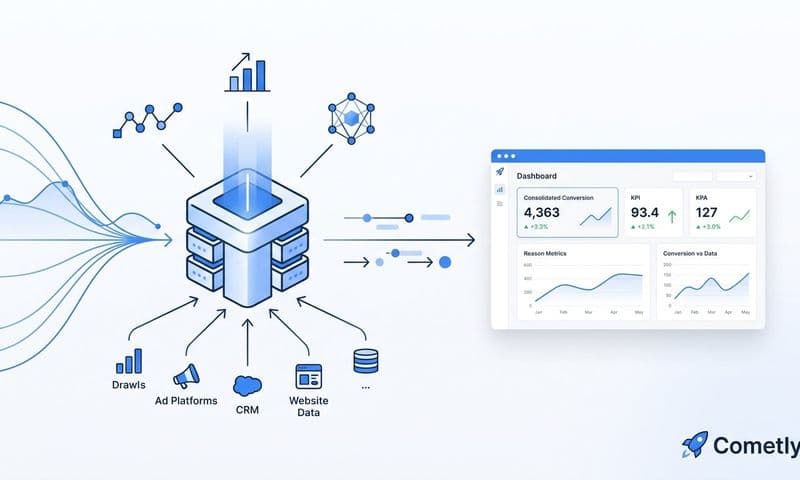
A modern attribution platform acts as a neutral third-party referee. It isn't biased toward any single ad platform and can connect data from all your marketing channels to provide a single, reliable source of truth for your measurement.
To fight back, smart marketers are shifting their focus to three key areas:
- Prioritizing First-Party Data: This is data you collect directly from your audience through email sign-ups, website forms, and customer accounts. It’s far more accurate and doesn't rely on anyone else's cookies.
- Leveraging Server-Side Tracking: Instead of relying on a user's browser, server-side tracking sends conversion data directly from your server to the ad platforms. This move bypasses most ad blockers and privacy settings, giving you much cleaner data.
- Using Blended Attribution Models: This approach mixes data from different sources—ad platforms, server-side tracking, and your own first-party data—to paint a more complete and accurate picture of what’s really working.
The Rise of AI in Modern Measurement
The next evolution in measurement leans heavily on AI-powered analytics to fill these data gaps and dig up deeper insights. Marketers are now using AI tools to crunch billions of data points, spotting trends in consumer sentiment and competitor moves that would be impossible to find manually.
In fact, most social marketers now use AI in their campaign management and analysis to make smarter, data-backed decisions. This shift helps brands move away from broad, reach-based strategies and toward focused, audience-centric campaigns built on real interaction. You can explore the latest social media trends to see how advanced analytics are reshaping the entire industry.
By adopting tools that offer server-side tracking and blended attribution, you can get back the clarity and confidence you need to measure social media effectively, even in a privacy-first world.
Crafting Reports That Actually Inspire Action
 A Guide to Social Media Measurement That Actually Drives Growth
Raw data is just noise until it sparks a decision. The final, and arguably most important, step in social media measurement is turning your numbers into a story that stakeholders can actually act on. A report packed with metrics but no narrative is just a history lesson; a great report is a roadmap for future investment.
The real key is knowing your audience. Your marketing team needs the nitty-gritty details—campaign-level CTRs, conversion rates, and creative performance—to fine-tune their day-to-day work. The C-suite, on the other hand, needs the bottom line. Fast.
Telling a Story with Data
Think of your report as a narrative with a clear beginning, middle, and end. Start with the "what"—the key results and trends you’ve uncovered. Then, dive into the "why"—your analysis of what drove those outcomes. Finally, and most critically, deliver the "so what?"—your concrete, actionable recommendations.
A report's value isn't in the data it presents but in the clarity of the decisions it enables. Always answer the question, "What should we do differently next week because of these numbers?"
This simple framework transforms a backward-looking document into a forward-looking strategy. For a practical look at putting this into action, check out this guide on measuring your creative tests in Facebook Ads reporting.
Visualizing Insights for Impact
Data visualization is your secret weapon for storytelling. Instead of burying your big wins in a dense spreadsheet, use charts and graphs to make trends pop off the page. A simple line graph showing ROAS over time is infinitely more powerful than a table of numbers.
Use these formats to highlight what matters most:
- Trend Lines: Show performance over time to illustrate progress toward your goals.
- Bar Charts: Compare the performance of different campaigns, channels, or ad creatives side-by-side.
- Pie Charts: Break down your audience demographics or where your traffic is coming from.
When you present your insights in a clear, visual format, you make it easy for anyone to grasp the main takeaways in seconds. For some inspiration on bringing it all together, see our guide to building a comprehensive digital marketing report. Your goal is to create reports that don't just get filed away—they get discussed, debated, and acted upon.
Frequently Asked Questions About Social Media Measurement
Even with a solid game plan, questions about social media measurement always pop up. The world of analytics is always in motion, and what worked last month might not give you the full picture today. This section tackles some of the most common questions marketers get stuck on, with clear, practical answers to help you navigate the tricky spots.
Think of this as sharpening the tools in your measurement kit. The core principles don't change, but how you apply them needs to bend and flex depending on your goals and the platforms you're on. Let's clear up some of the most nagging questions.
How Often Should I Review My Metrics?
There’s no one-size-fits-all answer here—the right cadence depends entirely on your goals. For your day-to-day campaigns and general channel health, a weekly review is perfect. It helps you spot trends and make small tweaks without overreacting to the normal daily ups and downs.
But if you're in the middle of a high-stakes product launch or a short-term paid campaign, you need to be checking your key performance indicators daily. That intensity is what lets you optimize ad spend and pivot your strategy on a dime before you waste any budget.
For the bigger picture—strategic planning and proving your long-term value to stakeholders—you absolutely need comprehensive monthly and quarterly reviews. These deeper dives are where you connect your social media efforts to the company's bottom line and decide where the budget should go next.
Which Is More Important: Reach or Engagement?
Ah, the classic question. The honest answer is: it depends on what you're trying to accomplish. Neither metric is better than the other; they just measure different things.
- Reach is your north star for brand awareness campaigns. If your main goal is to get your brand in front of as many new eyeballs as possible, then maximizing the number of unique viewers is priority number one.
- Engagement (your likes, comments, and shares) is the best way to gauge audience connection and content quality. A post with high engagement and lower reach can actually be more valuable than one with massive reach and crickets, because it tells you you've built a strong, loyal community.
At the end of the day, a healthy social media presence needs a good mix of both. Great engagement actually helps your content get seen by more people, giving your reach an organic boost.
How Can I Measure Social Media Success Beyond Sales?
This is a huge challenge, especially for brands with a long sales cycle where social media's impact isn't just about last-click sales. The good news is, social media drives real value in other critical areas of the business.
You can prove this by tracking metrics tied to different parts of the customer journey:
- Brand Health: Keep an eye on your share of voice and audience sentiment. This shows how social media is actively shaping how the public sees your brand.
- Audience Growth: Track your follower growth rate and reach to prove you’re expanding your pool of potential customers.
- Customer Service: Measure your response time and resolution rate on social channels. This highlights social media's role in keeping customers happy and loyal.
By connecting these non-financial wins to bigger business goals, you can paint a complete and powerful picture of your social media ROI.
Ready to stop guessing and start seeing the true impact of your social media efforts? Cometly provides a unified attribution platform that tracks every touchpoint, closes data gaps with server-side tracking, and gives you the clarity needed to optimize your ad spend with confidence. Get started with Cometly today and build a measurement system that drives real growth.