

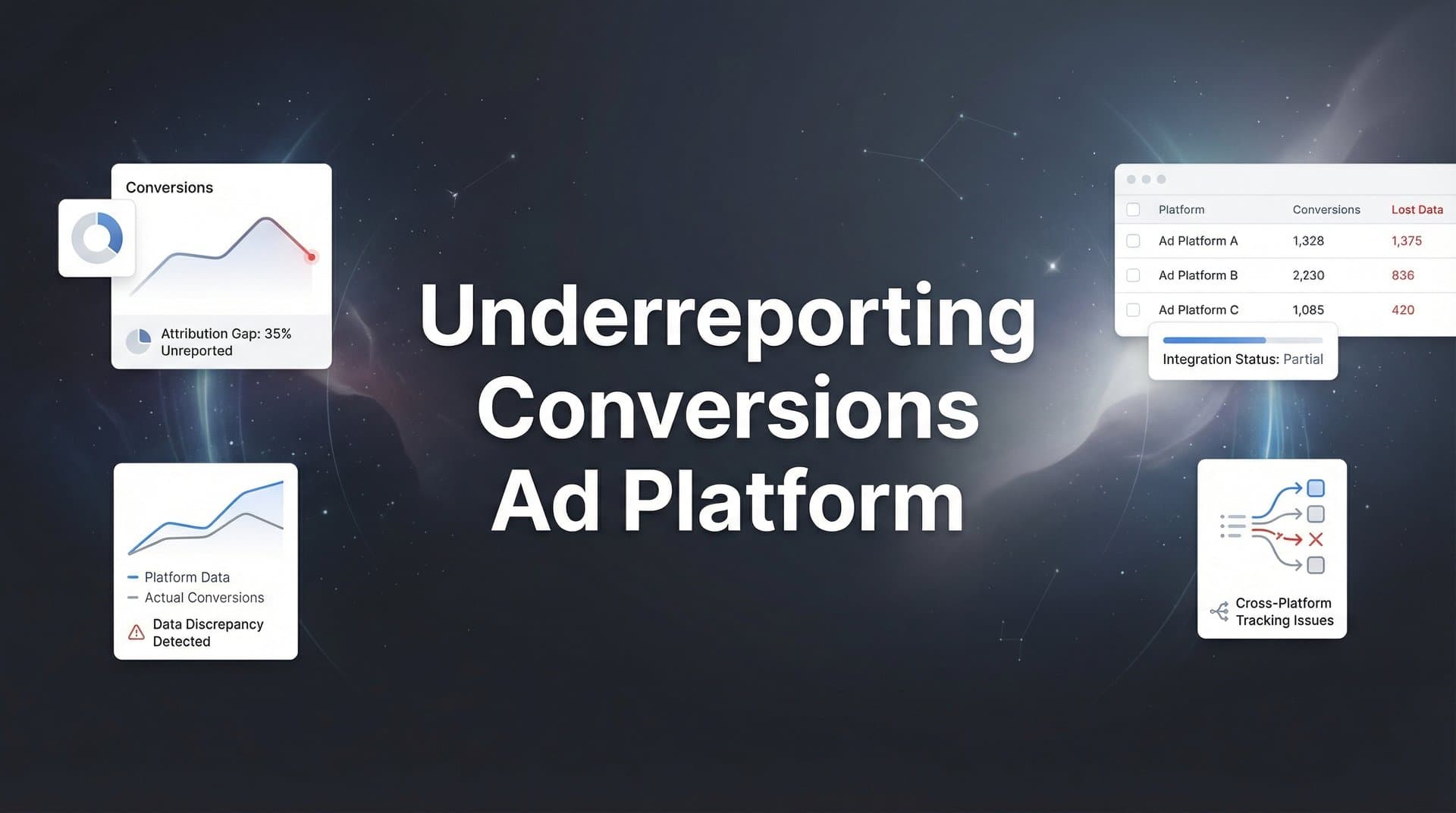
You check your CRM dashboard and see 147 sales this month. You pull up your Meta Ads Manager and it shows 89 conversions. Google Ads reports 62. You know these numbers should add up to something close to 147, but they don't. Not even close.
This isn't a glitch in your reporting. It's underreporting, and it's costing you more than you realize.
When your ad platforms can't see the conversions they're actually driving, they make decisions based on incomplete data. They pause campaigns that are working. They shift budget away from profitable ads. And their algorithms, starved of the conversion signals they need to optimize, gradually get worse at finding your best customers.
This problem affects marketers across every major platform: Meta, Google, TikTok, LinkedIn, and beyond. It's not about one platform being better or worse. It's about fundamental changes in how data flows from your customers to your ad accounts, and those changes have created a widening gap between what's really happening and what your dashboards show.
In this article, we'll break down exactly why ad platforms underreport conversions, how this creates a compounding optimization problem, and what you can do to close the gap. More importantly, you'll learn how to feed better data back to your ad platforms so their algorithms can actually do their job.
The Hidden Gap Between Real Sales and Reported Conversions
Underreporting happens when the number of conversions your ad platform attributes to its ads is lower than the actual number of conversions that occurred. This isn't about disputed attribution or giving credit to the wrong channel. This is about conversions that happened but were never recorded by the ad platform at all.
Think of it like a sales team that only gets credit for deals they personally closed in the office. Any sale that happened over the phone, via email, or through a partner? Invisible. That's what's happening to your ad platforms right now.
The gap manifests in several ways. A customer clicks your Facebook ad on their iPhone, browses your site, then returns three days later on their laptop to purchase. Facebook's pixel never sees that conversion because it can't connect the mobile click to the desktop purchase. Or a customer uses an ad blocker that prevents your tracking pixel from firing, so the conversion happens in complete darkness as far as your ad platform is concerned.
Here's where this gets expensive: you're making budget decisions based on incomplete data. That Facebook campaign showing a 2x ROAS? It might actually be delivering 3.5x when you account for the conversions it's driving but not seeing. Meanwhile, you're scaling a different campaign that looks better in the dashboard but is actually underperforming.
The downstream effects compound quickly. You pause campaigns that appear to be losing money but are actually profitable. You miss scaling opportunities because the data suggests you're at the edge of profitability when you actually have significant room to grow. And perhaps most critically, you lose confidence in your own decision-making because the discrepancy between platform and analytics data never quite adds up.
When your ad platform reports 60% of your actual conversions, you're not just missing 40% of your attribution data. You're operating with a fundamentally distorted view of what's working, and every optimization decision you make is built on that distorted foundation.
Five Technical Reasons Your Ad Platform Misses Conversions
Understanding why underreporting happens requires looking at the technical infrastructure that connects customer actions to ad platform data. Over the past few years, that infrastructure has been systematically dismantled by privacy changes, browser updates, and evolving user behavior.
iOS Privacy Changes Block the Data Flow: When Apple introduced App Tracking Transparency with iOS 14.5 in April 2021, it fundamentally changed how ad platforms receive conversion data from mobile devices. Users now see a prompt asking if they want to allow tracking, and most decline. Meta publicly acknowledged significant measurement impacts following this change. When users opt out, the Facebook pixel can't track their journey from ad click to conversion, even if that conversion happens. The ad platform simply never receives the signal that a sale occurred.
Browser-Based Tracking Is Dying: Third-party cookies, the technology that allowed ad platforms to track users across websites, are being phased out. Safari and Firefox already block them by default. Google has been working toward cookie deprecation in Chrome, and while the timeline has shifted, the direction is clear. When a user clicks your Google ad and later converts, but their browser blocks the cookie that would connect those two events, Google Ads sees nothing. The conversion happens in a tracking blind spot.
Cross-Device Journeys Break Attribution Chains: Your customer's path to purchase rarely happens on a single device. They see your ad on Instagram while scrolling on their phone during lunch. They research your product on their work laptop that afternoon. They make the purchase on their home computer that evening. Each device switch is a potential break in the attribution chain. Unless the user is logged into a platform account across all devices, the ad platform can't connect these dots. The conversion occurs, but it's orphaned from the original ad interaction. This is why many marketers struggle to track conversions across multiple platforms effectively.
Delayed Conversions Fall Outside Attribution Windows: Ad platforms use attribution windows to determine how long after an ad interaction they'll give credit for a conversion. Meta defaults to a 7-day click and 1-day view window. Google Ads uses 30 days for clicks. But many purchase decisions, especially for high-consideration products or B2B services, take longer. A customer clicks your ad, thinks about it for two weeks, then purchases. That conversion happened because of your ad, but it falls outside the attribution window. The ad platform records zero conversions for that interaction.
Ad Blockers and Privacy Tools Prevent Pixel Fires: A significant portion of internet users run ad blockers or privacy-focused browser extensions. These tools actively prevent tracking pixels from loading and firing. When a customer with an ad blocker converts on your site, your Facebook pixel or Google tag never executes. The conversion data never leaves the customer's browser. From the ad platform's perspective, nothing happened. Your backend systems record the sale, but your ad account shows nothing.
Each of these issues individually causes underreporting. Together, they create a perfect storm where ad platforms are increasingly blind to the conversions they're driving. And this isn't a problem that's going away. Privacy regulations are tightening, not loosening. Browser protections are expanding, not contracting. The gap between actual conversions and reported conversions will only widen without intervention.
How Underreporting Sabotages Your Ad Platform's AI
The underreporting problem isn't just about dashboards showing wrong numbers. It's about what happens when the machine learning algorithms powering your ad campaigns are trained on incomplete data.
Modern ad platforms don't rely on manual targeting the way they did years ago. When you launch a Facebook campaign or a Google Ads campaign, you're essentially hiring an AI to find your best customers. You provide some initial direction (audience parameters, interests, demographics), but the algorithm does the heavy lifting. It tests different users, observes who converts, and gradually learns the patterns that indicate someone is likely to become a customer.
This learning process requires conversion data. Lots of it. The algorithm needs to see which ad impressions led to conversions and which didn't. It analyzes thousands of signals: what time of day the ad was shown, what device the user was on, what content they engaged with previously, how they interacted with the ad. It builds a model predicting conversion probability for each potential impression.
Now imagine that algorithm only sees 60% of the conversions it's actually driving. It served an ad to User A at 2pm on mobile, and that person converted. But the conversion wasn't reported, so the algorithm thinks that impression didn't work. It served an ad to User B at 8pm on desktop, and that person didn't convert. The algorithm correctly sees that as a non-conversion.
What does the algorithm learn? It starts to think that characteristics similar to User B (who it correctly identified as a non-converter) are more reliable signals than characteristics similar to User A (who actually converted but the algorithm never knew). The machine learning model is being trained on bad data, and it's learning the wrong lessons. Understanding how to improve ad platform algorithm performance starts with recognizing this fundamental data problem.
This creates a feedback loop that compounds over time. The algorithm, working with incomplete conversion data, makes suboptimal decisions about who to show ads to. Because it's showing ads to slightly wrong audiences, conversion rates decline. Because conversion rates decline, there's even less conversion data to train on. The algorithm gets progressively worse at its job, not because the platform is bad, but because it's been starved of the information it needs to improve.
You'll notice this as your campaigns that used to scale easily now plateau quickly. Your cost per acquisition creeps up even though you haven't changed your strategy. Your ad platform keeps suggesting you expand your audience or increase your budget, but when you do, performance gets worse, not better.
The AI isn't broken. It's blind. And you can't optimize what you can't see.
Diagnosing the Severity of Your Underreporting Problem
Before you can fix underreporting, you need to measure it. The good news is that diagnosing the problem is straightforward if you have access to both your ad platform data and your actual sales or conversion data.
Start by pulling conversion data from your source of truth. This might be your CRM, your e-commerce platform, your payment processor, or your internal sales database. Choose a specific time period (the last 30 days works well) and count the total number of conversions. Let's say you had 200 purchases in the last month.
Next, pull the conversion data from each of your ad platforms for that same time period. Make sure you're looking at the same conversion event. If you counted purchases in your CRM, look at purchase conversions in your ad platforms, not link clicks or add-to-carts. Let's say Facebook reports 95 conversions, Google Ads reports 68, and TikTok reports 22.
Now calculate your reporting gap. Add up all the conversions your ad platforms reported: 95 + 68 + 22 = 185 conversions. Compare that to your actual total: 200 conversions. Your ad platforms collectively are seeing 185 out of 200 conversions, or 92.5%. That means you have a 7.5% underreporting gap.
That might not sound terrible, but remember: these platforms are likely over-attributing in some cases too (claiming credit for conversions they didn't influence). The real underreporting problem is often masked by over-attribution elsewhere. A more telling analysis looks at each platform individually. Many marketers discover they're dealing with multiple ad platforms showing conflicting data that makes accurate analysis nearly impossible.
If you're running significant spend on Facebook and it's only reporting 95 conversions out of your 200 total, but you know from customer surveys or post-purchase attribution that Facebook is your primary driver, you've got a serious underreporting problem on that platform specifically. The 47.5% reporting rate suggests Facebook is missing more than half the conversions it's actually driving.
Look for patterns in which conversions are being missed. Are mobile conversions underreported more than desktop? Are certain product categories or price points affected more? Do conversions that happen more than a few days after the initial ad click show up less frequently? These patterns tell you where your tracking infrastructure is weakest.
The severity of your underreporting problem determines your urgency to fix it. If you're seeing 85-95% reporting accuracy, you have some room to operate, though you're still making decisions on incomplete data. If you're below 70%, you're essentially flying blind, and every scaling decision is a gamble.
Server-Side Tracking: The Foundation for Accurate Data
The fundamental problem with browser-based tracking is that it depends on the customer's device to collect and send data. When that device blocks tracking (through privacy settings, ad blockers, or browser restrictions), the data never makes it to your ad platforms. Server-side tracking solves this by moving data collection to your own servers, where it can't be blocked.
Here's how it works. When a customer interacts with your website or completes a purchase, your server (not their browser) records that event. Your server then sends that conversion data directly to your ad platforms through their APIs. Because this happens server-to-server, it bypasses all the browser-based restrictions that cause underreporting.
The customer's ad blocker can't stop your server from recording a purchase. iOS privacy settings can't prevent your server from sending conversion data to Facebook. Cookie restrictions don't matter because your server is using first-party data it collected directly from the customer interaction on your own domain. For a deeper dive into solving these challenges, explore how to fix underreporting conversions with modern tracking methods.
Server-side tracking also gives you control over what data you send and when you send it. You can enrich conversion events with additional context that browser pixels can't access. Order value, customer lifetime value, product categories, customer segments, subscription status—all of this can be attached to conversion events and sent to your ad platforms to give their algorithms richer signals to optimize against.
The implementation requires connecting your website or application to a server-side tracking system, then integrating that system with your ad platforms through their conversion APIs. For Meta, this means implementing the Conversions API. For Google, it's Enhanced Conversions. TikTok, LinkedIn, and other platforms have similar server-side solutions.
The technical setup varies depending on your stack, but the core principle remains the same: capture conversion data on your servers where it's reliable, then send it directly to ad platforms through secure API connections. This creates a parallel tracking infrastructure that works alongside (and eventually replaces) browser-based pixels.
One critical advantage of server-side tracking is its ability to integrate with your CRM and backend systems. When a lead converts in your CRM days or weeks after the initial ad interaction, your server-side system can capture that conversion and attribute it back to the original ad click. This solves the delayed conversion problem that attribution windows create, giving you a complete picture of which ads drive results even when those results take time to materialize.
Feeding Better Data Back to Ad Platforms
Capturing accurate conversion data is only half the solution. The real power comes from sending that data back to your ad platforms so their algorithms can use it to optimize your campaigns.
This is where conversion APIs become critical. Meta's Conversions API, Google's Enhanced Conversions, and similar tools from other platforms allow you to send conversion data directly from your server to the ad platform's servers. This data supplements or replaces the data collected by browser pixels, filling in the gaps caused by tracking limitations. Learning how to sync conversions to ad platforms effectively is essential for maximizing campaign performance.
When you implement a conversion API, you're essentially giving the ad platform a more complete view of which ads are driving results. The algorithm sees conversions it was previously blind to. It can now correctly identify that the mobile ad impression at 2pm actually led to a conversion, even though the conversion happened on a different device three days later. It learns the right patterns instead of the wrong ones.
This improved data quality has a direct impact on campaign performance. The ad platform's machine learning models get better training data, so they make better decisions about who to show ads to and how much to bid. You'll notice this as improved conversion rates, lower cost per acquisition, and better scaling efficiency. Campaigns that plateaued start growing again because the algorithm finally has the information it needs to find more customers like your best converters.
The practical implementation involves several steps. First, you need to capture conversion events on your server, including key identifiers that allow the ad platform to match the conversion back to an ad interaction. This typically includes hashed email addresses, phone numbers, IP addresses, and user agent strings. These identifiers help the ad platform connect the server-side conversion data to the original ad click or impression.
Next, you configure your conversion API integration to send these events to each ad platform in their required format. The events should include not just that a conversion happened, but rich context about the conversion: order value, product details, customer information, and any other signals that help the algorithm understand what makes this conversion valuable.
Timing matters too. The faster you send conversion data to ad platforms, the faster their algorithms can learn and optimize. Real-time conversion sync ensures that when a customer purchases, that signal reaches the ad platform within seconds or minutes, not hours or days. This rapid feedback loop accelerates the learning process and improves campaign performance more quickly. Platforms that offer real-time conversion tracking give you a significant competitive advantage.
One often-overlooked benefit of conversion APIs is their ability to send offline conversions. If you're a B2B company where deals close in your CRM weeks after the initial ad interaction, you can send those closed deals back to your ad platforms as conversions. The algorithm learns that certain ad interactions led to high-value deals, even though those deals took 30 or 45 days to close. This transforms how you think about attribution windows and allows ad platforms to optimize for the outcomes that actually matter to your business.
Putting It All Together
Underreporting isn't just a dashboard problem. It's an optimization problem that gets worse over time. When your ad platforms can't see the conversions they're driving, they make poor decisions about where to spend your budget and who to target. Their algorithms, starved of accurate conversion data, gradually deteriorate in performance. What starts as a 20% reporting gap becomes a 40% gap as the feedback loop compounds.
The solution requires two parallel tracks. First, you need to capture conversions independently of ad platform pixels using server-side tracking. This gives you a reliable, complete view of what's actually happening in your business, regardless of browser restrictions, privacy settings, or attribution window limitations.
Second, you need to feed that accurate conversion data back to your ad platforms through conversion APIs. This closes the feedback loop, giving their algorithms the information they need to optimize effectively. Better data in means better performance out.
The marketers who solve this problem gain a massive advantage. They can scale confidently because they know which campaigns are truly profitable. They can optimize aggressively because their algorithms are learning from complete data. And they can outbid competitors who are still flying blind with incomplete attribution.
This isn't about spending more on ads. It's about making the money you're already spending work harder by ensuring every conversion is captured, every signal is sent, and every algorithm has the data it needs to find your best customers.
Ready to elevate your marketing game with precision and confidence? Discover how Cometly's AI-driven recommendations can transform your ad strategy. Get your free demo today and start capturing every touchpoint to maximize your conversions.



