Videos for ecommerce are your secret weapon. Think of them as dynamic digital assets—like product demos, tutorials, and customer testimonials—that your online store uses to show products in the real world. They act as your virtual salesperson, closing the gap between a static product page and the hands-on experience of shopping in a physical store to build trust and drive sales.
Why Video Is Essential for Modern Ecommerce
Picture your online store as a brick-and-mortar shop. Your static product images are like items sitting neatly on a shelf. They're informative, sure, but they’re also pretty passive.
Now, imagine a friendly, knowledgeable salesperson walks up. They grab the product, demonstrate how it works, point out its best features, and answer questions you didn't even realize you had. That salesperson is exactly what videos for ecommerce bring to your digital storefront.
Video content turns online shopping from a passive scroll into an engaging, interactive experience. It answers the critical questions that photos and text just can't. How does that dress actually flow when someone walks? What does that new gadget sound like when it powers on? How does this foundation look on real skin, not in a perfectly lit studio?
By showing instead of just telling, you erase customer hesitation and build the confidence they need to finally click "Add to Cart."
Key Video Impact Metrics at a Glance
Before we dive deep, let's look at the hard numbers. The data on video's impact is compelling and sets the stage for why a strategic approach is no longer optional.
MetricPerformance UpliftOn-Page Conversion Rate+80%User Time on Page+88%Purchase Intent+97%Product Returns-35%
These figures aren't just vanity metrics; they represent tangible improvements in customer engagement, confidence, and—most importantly—your bottom line. A well-executed video strategy directly contributes to higher revenue and a better customer experience.
Bridging the Digital Divide
In the world of ecommerce, trust is everything. And video is the fastest way to earn it. When a potential customer sees your product in action, it suddenly feels more real and tangible. This dramatically lowers the perceived risk of buying something online, sight unseen. This isn't just a hunch; the data consistently proves its impact on revenue.
For example, a simple, well-placed explainer video can clear up any confusion about a product's function and value proposition in seconds. That clarity creates a powerful ripple effect across your entire business.
According to recent data, including videos directly on e-commerce pages increases cart conversion rates by a whopping 39%, turning casual browsers into confident buyers. Explainer videos take it further, reducing product returns by 35% by setting accurate expectations upfront—fewer surprises mean happier customers and lower logistics costs.
Setting the Stage for Strategic Growth
This guide is about more than just telling you to "make more videos." We're going to give you a strategic playbook for creating, distributing, and measuring the real-world impact of your video content.
You'll learn which types of videos to use at each stage of the funnel and how to produce killer content without a Hollywood budget. Most importantly, we'll show you how to connect your video efforts directly to revenue.
If you're looking for more foundational knowledge, feel free to explore our comprehensive guides on ecommerce topics. Ultimately, a smart video strategy isn't just another expense—it's a direct investment in customer trust, higher conversions, and sustainable growth for your brand.
Matching Your Video to the Customer Journey
Using video in your ecommerce strategy isn't just about making cool content—it's about deploying the right video at the right time. Think of the path to purchase as a conversation. You wouldn't walk up to a stranger and immediately ask them to buy something, right? And you wouldn't give a big brand pitch to someone who already has their credit card out. Your video strategy needs that same level of social awareness.
Not every video is built for the same job. Each type has a specific role to play depending on where your customer is mentally. The real goal is to build a seamless video funnel that guides shoppers from the moment they first hear about you all the way to becoming a loyal fan. This strategic approach gives every video you create a clear, measurable purpose.
When you get this right, the impact is huge. A well-timed video strategy doesn't just feel better for the customer; it directly boosts your bottom line by increasing conversions and, just as importantly, cutting down on costly product returns.
 A Guide to Videos for Ecommerce That Actually Drive Revenue
This isn't just about making sales. It’s about building a more efficient business where your marketing efforts both grow revenue and reduce operational headaches.
To help you visualize this, we've broken down which video types work best at each stage of the funnel. This table gives you a clear framework for choosing the right format based on what you're trying to achieve.
Matching Ecommerce Video Types to Your Marketing Funnel
At the Top of Funnel (Awareness) stage, the primary goal is to capture attention and introduce your brand in a way that feels natural and exciting. The best video types here are brand videos, educational content, and short-form social media ads because they’re designed to stop the scroll and create curiosity without needing a hard sell. A great example is a short, visually stunning Instagram Reel that highlights the lifestyle your brand enables and makes people want to learn more.
In the Middle of Funnel (Consideration) stage, the goal shifts to building trust and answering the questions people have before they’re ready to buy. This is where product demos, explainer videos, and user-generated content (UGC) perform best because they make the product feel real, reduce uncertainty, and clearly communicate the value. A strong example is a simple, direct video on your product page showing exactly how the product solves a common problem for your target customer.
For a deeper dive into this space, see our AI UGC for ecommerce guide.
At the Bottom of Funnel (Conversion) stage, the main goal is to overcome final objections and drive the purchase decision. The most effective video types here are shoppable videos, customer testimonials, and unboxing videos because they provide reassurance and push buyers past hesitation. A perfect example is an embedded video on the checkout page featuring a customer raving about their results, paired with a clear “Buy Now” button to make the next step feel effortless.
Think of this table as your playbook. By aligning your video content with the customer's mindset at each step, you create a powerful, persuasive journey that feels natural and effective.
Top of the Funnel: The Awareness Stage
At the very top of the funnel, your potential customers might not even know you exist. The job here is simple: grab their attention. You need to introduce your brand's personality and make a memorable first impression. You’re not selling a product yet; you’re selling a feeling, an idea, or a solution to a problem they might not even have named.
Videos at this stage need to be engaging, highly shareable, and connect on an emotional level.
- Brand Videos: These are your cinematic, big-picture stories. They communicate your mission, your values, and what makes your brand different. Forget product features; focus on the lifestyle you represent or the problem you were born to solve.
- Educational Content: Think how-to guides or entertaining videos that are related to your industry but not directly about your product. For a kitchenware brand, this could be a video on "The 5 Knife Skills Every Home Cook Should Master." It provides value and builds authority.
- Social Media Ads: We're talking short, punchy, scroll-stopping videos designed for platforms like TikTok and Instagram. These are perfect for broad campaigns that build that initial brand recognition with cold audiences.
Middle of the Funnel: The Consideration Stage
Okay, they know who you are. Now they're in the consideration phase, actively researching solutions and comparing you against your competitors. Your video content needs to shift gears from broad storytelling to providing specific, value-packed information that builds trust and answers their biggest questions.
This is where you prove your product is the best choice for them.
The goal in the consideration stage is to eliminate doubt. Your videos should function as a digital product expert, providing all the details a customer would get from a hands-on experience in a physical store.
Key video types for this stage include:
- Product Demo Videos: These are your absolute workhorses. Show your product in action. Highlight its key features and benefits clearly and without fluff. How does it work? What makes it better than the alternative?
- Explainer Videos: If your product is a bit complex or totally new, an animated or live-action explainer is perfect for breaking down how it works in a simple, digestible way. This is critical for setting the right expectations and reducing post-purchase confusion.
- User-Generated Content (UGC) and Testimonials: Nothing builds trust like social proof. Authentic videos from real customers are incredibly powerful because they’re relatable. Seeing someone like them using and loving your product is more convincing than any polished ad you could ever create.
Bottom of the Funnel: The Conversion Stage
You've done the hard work. The customer is on the very edge of making a purchase. They just need one last nudge—a final boost of confidence to hit that "buy" button. Videos at the bottom of the funnel are all about overcoming final hesitations, creating a sense of urgency, and making the checkout process feel like a no-brainer.
These videos need to be direct, persuasive, and laser-focused on driving action.
- Shoppable Videos: These are a game-changer for ecommerce. By embedding a "buy now" button or product link directly within the video player, you let customers purchase the second they feel that spark of inspiration. It collapses the funnel and can send conversion rates through the roof.
- Customer Testimonials and Case Studies: While UGC is great for the middle of the funnel, a more detailed, story-driven testimonial can be the final piece of evidence a hesitant buyer needs. Hearing a full success story can seal the deal.
- Unboxing Videos: These videos are brilliant because they build excitement and validate the purchase decision before the product even arrives. They show the customer exactly what they’ll be getting, reinforcing the quality and value of their investment.
By mapping your content to each phase, you create a structured path that turns casual browsers into committed buyers. To learn more about how to structure these efforts, check out our guide on understanding the customer journey stage and how it shapes your marketing. This strategic alignment is how you turn random video views into predictable, scalable revenue.
Creating High-Converting Videos Without a Hollywood Budget
Let's bust a common myth right now: you do not need a massive budget to create ecommerce videos that actually sell. In fact, on platforms like TikTok and Instagram, audiences often respond better to authentic, scrappy content than to slick, overproduced commercials. Your smartphone is more than capable of creating high-impact videos that connect with customers and drive sales.
We break down the leading options in our ecommerce video creator tool guide.
 A Guide to Videos for Ecommerce That Actually Drive Revenue
Success here isn't about expensive cameras; it's about mastering the fundamentals. If you can nail a few non-negotiable elements, you can produce professional-looking videos that build trust and turn viewers into buyers.
Nailing the Production Basics
Before you even think about what you're going to say, you need to get the technical basics right. Poor audio or shaky footage can make even the best product look unprofessional, causing viewers to scroll right past without a second thought.
Focus on these three core areas:
- Clear Audio: Bad audio is unforgivable. Seriously. A cheap lavalier microphone that clips onto your shirt is a small investment that will instantly make your voice sound crisp and clear, cutting out distracting background noise and elevating your video's quality.
- Good Lighting: You don't need a professional lighting rig. Natural light from a window is your best friend. Just make sure you’re facing the light source to illuminate your face and the product. If you're shooting at night, a simple ring light provides soft, even lighting that gets rid of harsh shadows.
- Stable Shots: Nobody likes watching shaky video—it's distracting and looks amateur. An affordable smartphone tripod is one of the best investments you can make. It keeps your shots steady, professional, and easy on the eyes.
The difference between a video that converts and one that gets ignored often comes down to these simple details. A viewer will forgive average video quality, but they will almost never forgive bad audio.
Scripting for Action and Connection
Once your setup is solid, it's time to craft a compelling narrative. Even a 15-second video needs a clear structure to land its message. Your goal is to hook the viewer, deliver value, and guide them toward a specific action.
Every great ecommerce video script has three essential parts.
- The Hook (First 3 Seconds): You have a tiny window to stop the scroll. Start with a bold claim, an intriguing question, or a visually arresting shot. For example, a video for a stain-removing pen could open with wine spilling on a white shirt in slow motion.
- The Story (The Middle): This is where you connect with your audience's problem. Don't just list features; show the product in action solving a real-world issue. Demonstrate the "before and after" or build a story around how the product makes someone's life better. This is where you build desire and trust.
- The Call-to-Action (The End): Never leave your viewer hanging. Tell them exactly what to do next. Whether it's "Shop Now," "Learn More," or "Comment your favorite feature," a clear and persuasive call-to-action (CTA) is what turns passive viewers into active customers.
A highly effective and budget-friendly strategy is to learn how to create YouTube Shorts from existing video content, which lets you repurpose longer assets for new audiences. This approach maximizes your content's reach without needing new shoots. For more insights on crafting compelling visuals, explore our resources on ad creative to learn how to design content that truly converts.
Ultimately, creating high-converting videos for ecommerce is less about your budget and more about your strategy. A raw, authentic TikTok video often feels native to the platform and can easily outperform a polished YouTube ad simply because it meets audience expectations. Understand the platform, nail the fundamentals, and focus on telling a clear, compelling story.
If you're evaluating vendors, our ecommerce video ad generator breakdown can help.
Distributing Your Video Content for Maximum Reach
Creating a brilliant video is only half the battle. If the right people never see it, all that hard work isn't going to move the needle. This is where strategic distribution comes in—it’s the bridge between a creative asset and a revenue-generating machine.
Think of it like this: your video is a powerful engine, but your distribution channels are the roads that take it to its destination.
 A Guide to Videos for Ecommerce That Actually Drive Revenue
The key is to use a multi-channel approach that plays to each platform's unique strengths, not just "spraying and praying." You wouldn't use the same pitch in a casual chat as you would in a formal presentation, right? The same logic applies here.
Choosing the Right Platforms
Different platforms serve different roles in your customer's journey. By understanding the user's mindset on each one, you can place your videos where they'll make the biggest impact.
- TikTok & Instagram Reels (Discovery): These platforms are built for top-of-funnel awareness. People are scrolling for entertainment and to find new things, making it the perfect spot for short, engaging, and trend-driven videos that get your brand in front of fresh eyes.
- YouTube (Education & SEO): Think of YouTube as a search engine for video. This is where people go when they want to learn something. It’s ideal for longer, more in-depth content like detailed product demos, tutorials, and how-to guides that build trust and capture mid-funnel traffic.
- Facebook & Instagram Ads (Targeting): These platforms offer incredibly powerful ad targeting. You can use them to retarget people who engaged with your discovery videos or reach hyper-specific demographics with tailored video ads designed to drive conversions.
- Your Product Pages (Conversion): This is your highest-intent real estate. Simply embedding a product video on the page can boost conversions by 80% or more. It's often the final piece of the puzzle a customer needs to feel confident enough to click "buy."
The Power of Smart Repurposing
Look, creating unique content for every single platform is a fast track to burnout. The most efficient strategy is smart repurposing—adapting a single, core video into multiple formats, each tailored to a specific channel.
For instance, that detailed 10-minute YouTube product review you made can be sliced and diced into:
- Three 30-second Instagram Reels, each highlighting a single key feature.
- A 60-second Facebook ad that showcases the main problem and your solution.
- A 15-second TikTok video with a punchy demo set to trending audio.
- A 2-minute version embedded right on your product detail page.
This approach squeezes every drop of value out of your initial production investment. It ensures your message reaches the widest possible audience in a format that feels native to each platform. It’s all about working smarter, not harder.
Creating a Distribution Workflow
A structured workflow is what keeps you consistent. To manage your video distribution without getting overwhelmed, check out a social media scheduling playbook specifically for e-commerce brands. This kind of system helps you map out your content calendar and schedule posts in advance, so you maintain a steady presence everywhere.
Understanding how all these moving parts contribute to your bottom line is critical. If you're looking to get a clearer picture, our guide on performance marketing channels dives deeper into optimizing a multi-channel strategy. By combining thoughtful platform selection with an efficient repurposing workflow, you ensure your videos for ecommerce don't just get seen—they drive real business results.
How to Measure the True ROI of Your Videos
Your video just hit 10,000 views and the comments are glowing. Feels good, right? But here's the tough question: did it actually make you any money?
In ecommerce, views and likes are just vanity metrics. They’re nice for the ego, but they don't tell you a thing about revenue. If you want to measure the true return on your video strategy, you have to move past the feel-good numbers and focus on what’s actually driving your bottom line.
The end goal is always revenue. To figure out how your videos get you there, you need to track the key performance indicators (KPIs) that connect directly to sales. These are the metrics that prove your videos aren't just an expense—they're a powerful investment in growth.
Key KPIs That Actually Matter
For a minute, forget about share counts. Instead, let's zero in on the data points that draw a straight line from a video view to a completed purchase.
These are the KPIs you should be laser-focused on:
- Video Conversion Rate: This is the big one. It’s the percentage of viewers who watched a video and then took a specific action, like making a purchase. A high conversion rate is the clearest sign that a video is successfully persuading customers.
- Average Order Value (AOV) from Video: Are customers who watch your videos spending more per transaction? Tracking AOV tells you if your content is effectively upselling or pushing higher-value items.
- Video-Influenced Revenue: This metric captures the total revenue from customers who interacted with a video at any point before buying. It gives you a much broader picture of a video's financial impact, even if it wasn't the very last click.
When you shift your focus to these revenue-centric KPIs, you can finally answer the most important question: which videos for ecommerce are actually making you money?
The Problem with Platform-Native Reporting
So, you decide to track these KPIs. You log into your Facebook Ads Manager, then Google Analytics, then your TikTok dashboard. You see sales and conversions on each platform, but the numbers never quite add up. What gives?
Relying solely on platform-native reporting is like trying to determine the winner of a soccer game by only asking each player if they scored the winning goal. The striker who kicked the ball in will say yes, but so will the midfielder who made the assist and the defender who started the play.
Every platform—Facebook, Google, TikTok—is biased. They are all built to take as much credit as possible for a conversion to prove their value to you. This creates a messy, overlapping, and flat-out inaccurate view of what's actually working.
You could end up scaling a campaign on one platform that isn't the true driver of sales, all while cutting the budget from the channel that’s quietly doing all the heavy lifting in the background.
This is exactly where attribution tracking becomes essential.
How Attribution Tracking Gives You the Real Score
If the ad platforms are the players, then an attribution tool is the impartial referee. It steps back and looks at the entire customer journey, from the very first touchpoint to the final purchase.
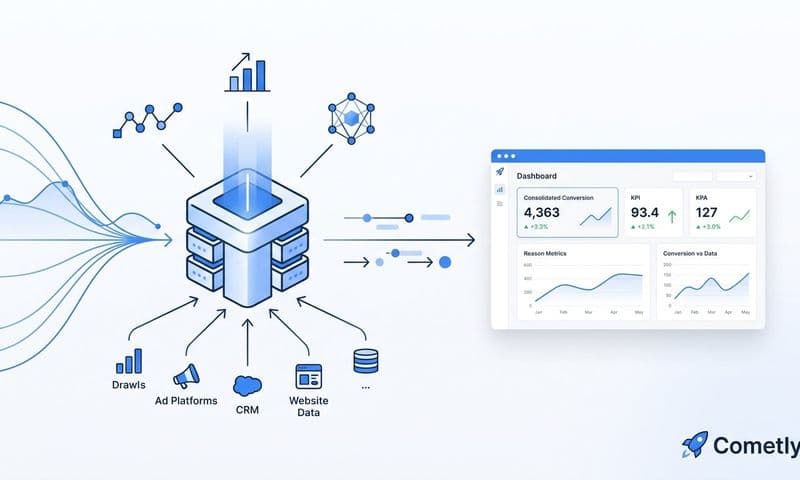
An attribution platform like Cometly gives you a single source of truth. It connects the dots between a customer seeing your video ad on TikTok, clicking a retargeting ad on Facebook a few days later, and finally buying after a Google search.
Here’s an example of how an attribution dashboard gives you a clean, unified view of performance across all your channels.
This centralized view lets you see precisely how much revenue each ad and video is generating, without the conflicting reports from individual platforms.
With this clear, unbiased data, you can finally make decisions with confidence. You’ll know which videos are your true top performers so you can double down on what works. Just as importantly, you can spot the videos that get plenty of views but fail to convert, allowing you to cut your losses and reallocate that budget to your winners.
For a deeper dive, our guide on how to measure marketing attribution breaks down the strategies involved.
Common Questions About Ecommerce Video Marketing
Jumping into video marketing can feel like a huge undertaking, especially when you’re already busy running your business. It’s totally normal to have questions about where to start, what it’s going to cost, and if it's even worth the hassle.
This section is all about cutting through the noise. We'll tackle the most common questions brands have, with straightforward answers to help you get moving. Think of this as the final piece of the puzzle, clearing up any lingering doubts and giving you a clear path forward.
How Much Should I Budget for Ecommerce Videos?
This is the big one, and the honest answer is: it really depends on your strategy. The good news? You don't need a Hollywood budget to get started. In fact, some of the most successful brands start small and scale up as the videos start paying for themselves.
Think of your budget in a few simple tiers:
- The DIY Tier ($0 - $500): This is where most brands kick things off. Your main investment here is a good smartphone, a decent microphone, and maybe a tripod. The goal is to create authentic, raw content that feels native to platforms like TikTok and Reels. Think simple product demos and user-generated-style videos. Honestly, this low-fi approach often outperforms slick, professional ads on social media.
- The Freelancer Tier ($500 - $5,000): Once you've got some traction, you might bring in a freelance videographer or editor for a specific project. This is perfect for creating a polished hero video for your homepage or a high-quality series of product demos. You get a professional look without the commitment of a full-time hire.
- The In-House/Agency Tier ($5,000+): At this stage, you’re either building out your own content team or partnering with a marketing agency. This is for brands that are ready to consistently pump out high-quality videos across multiple channels, from YouTube ad campaigns to in-depth tutorials.
The real key is to start small, test what works, and reinvest the profits back into what's driving sales. Your budget should grow as a direct result of the revenue your videos are generating.
Which Products Should I Create Videos for First?
Trying to make a video for every single product in your catalog from day one is a recipe for burnout. A more strategic approach will get you better results with way less effort. The trick is to prioritize where video will make the biggest impact.
Here’s a simple framework to get you started:
- Start with Your Best-Sellers: These products are already proven winners. A great video can pour fuel on the fire, boosting conversion rates and giving you a quick win to build momentum.
- Focus on High-Return Items: If a specific product gets returned a lot, it’s usually because customer expectations don't match reality. A video can clear things up by showing the product’s true size, function, or material, which helps cut down on returns and saves you money.
- Tackle Complex or Confusing Products: Does your product need assembly? Does it have a unique feature that's tough to explain with just text and photos? An explainer video or a quick tutorial is the perfect way to eliminate confusion and get hesitant customers over the finish line.
By focusing on these categories first, you ensure your video efforts are aimed at solving a real business problem. That makes it a whole lot easier to measure your return on investment.
How Long Should My Ecommerce Videos Be?
There’s no magic number here. The ideal video length depends entirely on the platform and what you're trying to accomplish with the video. The golden rule is simple: be as long as you need to be to get the point across, but as short as possible to keep people watching.
Here are some general guidelines to keep in mind:
- TikTok & Instagram Reels (15-30 seconds): These platforms are all about quick, snappy content. Your job is to stop the scroll, deliver a punchy message, and make an impact in under a minute. Get in, get out.
- Facebook & Instagram Ads (30-60 seconds): You have a little more breathing room here to tell a quick story and present a clear call to action. But you still have to grab their attention within the first three seconds or they're gone.
- Product Page Videos (30-90 seconds): Someone watching a video on your product page is already interested and looking for information. A concise video that highlights the key features and benefits is exactly what they need.
- YouTube Tutorials & Demos (2-10 minutes): People go to YouTube to learn. They're totally willing to watch longer videos if it provides real value. This is the spot for your deep-dive guides and comprehensive product breakdowns.
When in doubt, let the platform's user behavior guide your content's length.
Ready to stop guessing which videos are actually driving sales? Cometly provides a single source of truth, showing you exactly how much revenue each video and ad generates. With clear, unbiased attribution data, you can confidently scale your winners and stop wasting money on what doesn't work. See how Cometly can transform your marketing ROI.