A view-through conversion (VTC) happens when someone sees your ad, doesn't click on it, but heads over to your website later on and converts. This metric is all about measuring the subtle, persuasive power of your display and video ads—the stuff that sticks in a person's mind long after they've scrolled past. It captures the value of brand recall and influence, going way beyond a simple click.
The True Impact of Ads Beyond the Click
Ever wonder about the ads people see but never click? That's where the real story of ad influence often begins.
Imagine a potential customer scrolling through their feed and seeing a slick video ad for a new pair of running shoes. They get distracted and move on without clicking. A few days later, the memory of that ad pops into their head. They remember the brand, search for it directly, land on the website, and make a purchase.
That entire sequence is a view-through conversion, and for many brands, it’s the missing link in understanding their true ROI.
What Makes View-Through Conversions Different?
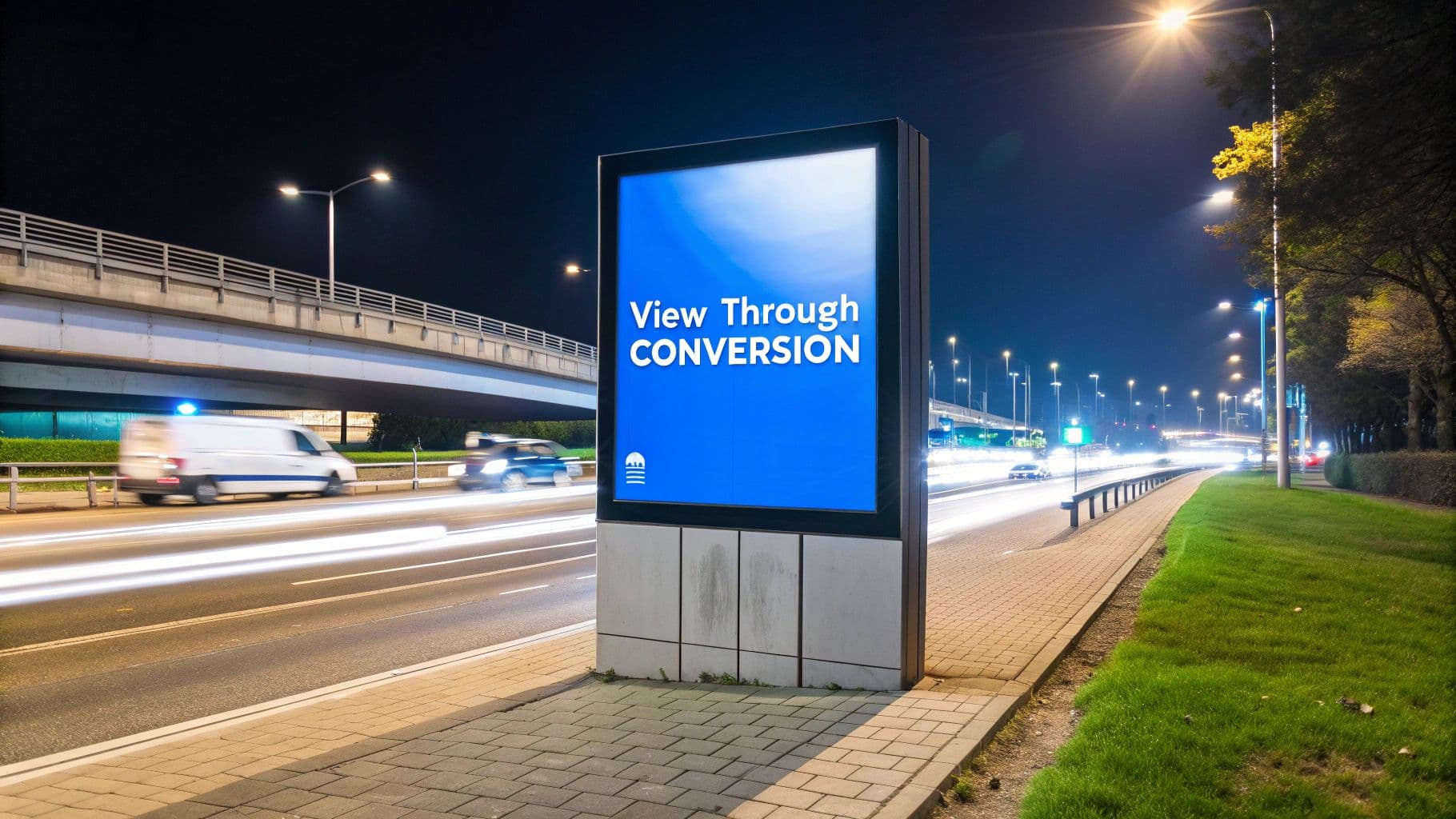
Think of a VTC like a highway billboard. Thousands of people drive by it every day. Most don’t pull over immediately, but the brand name sticks with them. When they later need that exact product or service, the billboard's message often guides their decision. It plants a seed that blossoms later on.
This is a world away from a click-through conversion (CTC), which is more like a direct response to a flyer. A user sees an ad, is immediately interested, clicks it, and converts in one seamless session.
While CTCs are straightforward and easy to measure, relying on them alone means you're ignoring a huge part of your ad's performance. Industry analysis consistently shows that VTCs can be a major driver of sales. A 2023 study, for instance, found that 28% of total conversions in some retail campaigns were driven by ad impressions, not clicks.
Click-Through vs. View-Through Conversion At a Glance
To really get a feel for how these two conversion types work, it helps to see them side-by-side. The fundamental difference boils down to the user's initial action—or lack thereof.
Attribute | Click Through Conversion (CTC) | View Through Conversion (VTC) |
|---|---|---|
User Action | User sees the ad, clicks it, and then converts on the website | User sees the ad, does not click, but later converts on the website |
Measurement | Directly tracks the journey from a specific ad click to a conversion event | Connects a conversion event back to an earlier ad impression |
Strategic Focus | Measures immediate, direct response and lower funnel performance | Measures brand recall, awareness, and the longer term influence of ads |
Getting this distinction right is crucial. It lets you appreciate the full, and often hidden, value of your display and video ad campaigns. Many conversions that might look like organic or direct traffic were actually influenced by an ad someone saw days or weeks earlier.
These are often categorized as assisted conversions, which play a vital role in the modern customer journey. If you're serious about mastering advertising effectiveness measurement, you have to look beyond the click.
How View-Through Conversion Tracking Actually Works
Let’s pull back the curtain on how a simple ad view can turn into a measurable conversion. The magic behind view-through conversion tracking isn’t some dark art; it’s just a clever way of connecting the dots over time, all without a single click.
It all starts the moment someone sees your display or video ad. At that very instant, an invisible tracking pixel—just a tiny snippet of code tucked into the ad—fires off. It doesn't grab any personal info. Instead, it places a small, anonymous identifier (usually a cookie) in the user's browser. Think of it as leaving a digital breadcrumb that says, "This person saw Ad A at this specific time."
The user then goes about their day, probably forgetting all about your ad. Later, they decide to visit your website on their own. This could be hours, days, or even weeks after seeing the ad. When they land on your site and complete a key action, like making a purchase, another tracking pixel on your website fires.
This second pixel logs the conversion event. The final step is making the connection. The ad platform’s system looks at the anonymous ID tied to that conversion and checks its records to see if that same ID was previously logged as seeing one of your ads. If it finds a match within a certain timeframe, boom—the ad view is credited with a view-through conversion.
The Technical Journey from Impression to Purchase
The whole process relies on a few core pieces working together seamlessly to bridge the gap between seeing an ad and taking action. Robust conversion tracking is the engine that drives this entire measurement system, making sure every step is recorded accurately.
Here’s a simplified breakdown of the technical flow:
- Ad Impression: A user is served your ad on a publisher's site or social media feed.
- Impression Pixel Fires: The ad's tracking pixel activates, dropping an anonymous cookie in the user's browser and logging the impression ID with a timestamp.
- User Navigates Away: The user continues browsing without clicking the ad.
- Direct or Organic Visit: At a later time, the user visits your website directly or through a search engine.
- Conversion Pixel Fires: The user completes a purchase, and the conversion pixel on your "Thank You" page activates, recording the conversion and its associated anonymous ID.
- Attribution Matching: The ad platform’s system matches the ID from the conversion event with the ID from the earlier ad impression, officially logging a view-through conversion.
This visual shows the simple yet powerful journey from a passive ad view to a completed purchase.
 Unlocking View Through Conversion for Marketers
The key insight here is that influence doesn't always require interaction. Sometimes, brand recall alone is enough to drive valuable customer actions long after the initial impression.
The All-Important Attribution Window
That "certain timeframe" I mentioned earlier? It's arguably the most critical setting in this entire process. It’s known as the attribution window (or lookback window). This setting tells the ad platform how far back in time it should look for an ad impression after a conversion happens.
An attribution window defines the period during which a conversion can be credited to an ad view. If the conversion happens outside this window, the impression gets no credit, even if it influenced the purchase.
For example, if you set a 7-day view-through attribution window, the system will only credit an ad impression if the user converts within seven days of seeing it. Setting this window correctly is crucial for accurate measurement.
The standard attribution window for VTCs is typically between 1 and 30 days, with many platforms defaulting to 7 days. Industry benchmarks suggest the average view-through conversion rate for display campaigns is between 0.5% and 2%, but this can vary wildly. For instance, retail campaigns might see rates up to 1.8%, while B2B campaigns often hover around 0.7%. Choosing the right window ensures you give your ads enough time to influence decisions without over-attributing conversions that may have happened organically anyway.
Choosing the Right Attribution Window
 Unlocking View Through Conversion for Marketers
The attribution window isn't just a technical setting; it's a strategic choice that dictates how you measure the influence of an ad impression. Think of it as a stopwatch. The moment a user sees your ad, the clock starts ticking. Any conversion they make before time runs out can be credited, at least in part, to that ad view.
Setting this window correctly is the difference between having accurate data and generating misleading reports. If it’s too short, you’ll undervalue your campaigns. If it's too long, you’ll start taking credit for sales that would have happened anyway.
For a deeper dive into the mechanics, our guide on what a conversion window is breaks it all down.
Aligning the Window with Your Sales Cycle
The ideal attribution window is directly tied to your customer's buying journey. Not all products are purchased with the same amount of thought, so a one-size-fits-all approach is a recipe for disaster. Your window needs to mirror how long it typically takes a customer to go from "I've heard of this" to "I'm buying this."
Let's look at a few common scenarios:
- Impulse Buys (Short Window): Think about products like a trendy t-shirt or a new coffee blend. The sales cycle is fast. A customer sees an ad, mulls it over for a day or two, and pulls the trigger. A 1 to 7-day window is usually perfect for capturing this quick decision-making process.
- Considered Purchases (Medium Window): Now think about something like high-end running shoes or an online course. This requires more research. A potential buyer might compare options, read reviews, and think it over for a week or two. A 14 to 21-day window gives you enough time to attribute influence properly.
- Major Investments (Long Window): For big-ticket items like B2B software, a new car, or a home renovation, the decision can take weeks or even months. Here, a 30-day window is often necessary to account for the longer consideration phase and the multiple touchpoints involved.
Setting an attribution window is about understanding your customer's clock. If their decision takes a month, but your window is only a week, you're missing a massive piece of the story.
The Dangers of Misconfigured Windows
Picking the wrong window length isn't a small mistake—it can have huge consequences for your marketing strategy and how you allocate your budget. Both extremes create unique problems that can seriously warp your perception of campaign performance.
The Pitfall of a Window That’s Too Short
A narrow window is like trying to catch rain with a thimble. You’ll only capture the most immediate conversions, completely missing the ones that happen later on. This is especially damaging for brand-awareness campaigns, whose whole job is to plant a seed that grows over time. Cut the window too short, and you might kill a campaign that was actually building a strong pipeline of future customers.
The Risk of a Window That’s Too Long
On the flip side, an overly long window can lead to "attribution creep," where your ads get credit for sales they didn't really influence. If someone sees your ad on day one and converts on day 29, dozens of other things—a friend's recommendation, an email newsletter, a blog post—could have been the real driver. This inflates your campaign's performance, making it look more effective than it is and leading you to waste money on the wrong things.
Understanding how a view through conversion fits into the broader picture is key. To really get a handle on how different marketing efforts work together, it's worth exploring the different multi-touch attribution models.
Interpreting VTC Data and Avoiding Common Pitfalls
Let’s be honest: view-through conversions often get a skeptical side-eye from marketers. It’s understandable. Unlike a direct click, a view is an indirect signal, which can make the data feel a little "soft." But learning how to read this data is what separates the good analysts from the great ones.
The trick is to stop thinking of VTCs as a direct, cause-and-effect metric. Instead, see them for what they are: a powerful indicator of influence. An ad view plants a seed. When that seed later sprouts into a conversion, the VTC is what helps you connect the dots back to that first impression.
Of course, the skepticism isn't entirely unfounded. Concerns like over-attribution are real. A user might have converted anyway, and your ad just happened to be the last one they scrolled past. This is a valid point, and it’s exactly why relying solely on VTC numbers without any other context can be so misleading.
Validating Your VTC Data
To use this metric with any real confidence, you need to validate it. The goal isn’t to prove every single VTC was 100% caused by your ad. It’s to build a rock-solid case that your campaigns are genuinely influencing behavior over time.
One of the best ways to do this is with a lift study. It’s simple in concept: you show your ads to a test group while holding them back from a similar control group. If the test group shows a statistically significant jump in conversions—including direct traffic and branded searches—you have hard evidence that your ads are driving that lift. Your VTC data is reflecting a real phenomenon.
Another powerful method is to look for correlations between your VTC data and other key metrics.
- Branded Search Volume: As your display campaigns rack up VTCs, do you also see a rise in people searching directly for your brand name on Google? This is a classic sign that your ads are building brand recall.
- Direct Traffic Increases: Did you notice a spike in users typing your URL directly into their browser right after you launched a high-VTC campaign? That’s a strong signal your ads are making your brand memorable.
- Full Conversion Path Analysis: Dive into your analytics and trace the entire customer journey. You’ll often find that many conversion paths start with an ad impression, even if another channel gets the final click.
These techniques help you build a more complete and defensible story around your ad's impact, turning a misunderstood metric into a real strategic advantage.
Common Pitfalls and How to Avoid Them
Even with proper validation, it’s easy to stumble into common traps when working with view-through data. Just being aware of them is the first step toward making sure your insights are accurate.
The biggest mistake is treating a view-through conversion with the same weight as a click-through conversion. They represent different levels of intent and should be analyzed as complementary parts of a larger journey, not as equals.
One major pitfall is attribution complexity. A user might see ads from five different campaigns before finally converting. How do you know which impression actually had the most impact? This is where understanding common attribution challenges in marketing is essential for keeping a balanced perspective. Without a clear model, you risk giving way too much credit to a single impression.
Another frequent issue is simply overestimating your impact. Just because someone saw your ad and later bought something doesn't mean your ad was the only reason. They might have already been on their way to converting. To fight this, keep your attribution windows realistic and always analyze VTC data alongside other metrics like CTCs and customer path reports. This gives you a grounded, holistic view of performance and allows you to confidently report on the true value your display and video ads bring to the table.
How Ad Platforms Are Learning to Value Impressions
For the longest time, the world of digital advertising revolved around one thing: the click. It was the undisputed king, the clearest signal of user intent. But a quiet but powerful shift is happening right now. Ad platforms are finally waking up to the massive value of influence and brand recall, with the view-through conversion moving from a background metric to a core signal for optimization.
This isn't just a small tweak. It’s a move away from a click-obsessed mindset and toward embracing the entire, often messy, customer journey. Industry giants like Google and Meta are now feeding VTC data directly into their automated bidding algorithms. They've realized that a user who sees a powerful ad but doesn't click is still an incredibly valuable prospect.
These platforms are now building sophisticated tools designed to find users who are not just likely to click, but likely to convert after simply seeing an ad. For advertisers, this is a total game-changer.
The Rise of View-Based Bidding
The clearest sign of this evolution is the rollout of new campaign types and bidding strategies built around the power of the impression. These systems are engineered to look beyond the immediate click and focus on the long-term impact of just getting your brand in front of the right eyeballs.
Take Google Ads, for instance. In 2023, they started testing 'View-Through Conversion Optimization' for their Demand Gen campaigns. This lets advertisers tell the algorithm to specifically hunt for conversions driven by ad views, not just clicks. Early reports from the test were impressive, showing campaigns using this strategy saw a 15-20% lift in overall conversion rates compared to click-only campaigns. You can read more about how Google Ads is testing VTC optimization on Search Engine Land.
This strategic pivot works by creating a powerful feedback loop for the platform's machine learning. VTC data is fed back into the ad delivery algorithm, teaching it what kind of user converts after just seeing an ad. It then goes out and finds more people who look just like them.
- Initial Impression: The algorithm shows an ad to a broad but relevant audience.
- Data Collection: It watches to see which of those users convert via a VTC within the attribution window.
- Pattern Recognition: It starts identifying common behaviors, interests, and traits among those who converted without clicking.
- Audience Refinement: The algorithm then prioritizes showing ads to new users who match this "high-influence" profile.
This whole process allows the ad platforms to optimize for the subtle, yet incredibly powerful, effect of brand recall.
By optimizing for impressions, platforms can finally reach a valuable audience segment that traditional click-based models completely miss. These are the people who absorb brand messages passively and act on them later, representing a huge pool of untapped revenue.
What This Means for Your Ad Strategy
This shift from click-based to impression-based optimization has some major implications for your ad strategy. It’s no longer enough to just create ads that scream for an immediate click. Your creative has to work harder now; it has to make a lasting impression.
Your campaigns now have a dual purpose. They need to capture immediate intent from the clickers while also building brand equity that drives future view-through actions. This means investing in high-quality, memorable ad creative that sticks in a user’s mind long after they’ve scrolled past. For advertisers who get this right, the result is more efficient campaigns and a much truer, more holistic picture of their total marketing impact.
Putting Your VTC Strategy into Action
 Unlocking View Through Conversion for Marketers
Alright, let's move from theory to practice. This is where you actually start unlocking the value of tracking a view-through conversion. Don't worry, building a solid strategy isn't as complicated as it sounds. It all boils down to getting the foundation right, then moving into smart, ongoing optimization.
First thing's first: your tracking infrastructure has to be flawless. This means triple-checking that your tracking pixels—like the Meta Pixel or Google Ads tag—are installed correctly on every key page of your website. Give extra attention to your confirmation or "thank you" pages, since that's where the conversion officially gets logged.
With your pixels firing correctly, the next step is to configure your VTC settings right inside your ad platforms. Both Google Ads and Meta Ads Manager let you customize the view-through attribution window. This is your chance to match the window to your actual sales cycle, just like we talked about earlier.
Initial Configuration in Ad Platforms
You can’t act on data you can’t see. That's why setting up your VTC columns is a simple but critical step for daily monitoring. Without this visibility, you're flying blind to the true impact your display and video ads are having.
Here’s the quick and easy way to enable VTC reporting in Google Ads:
- Head over to the Campaigns section in your Google Ads account.
- Click the Columns icon just above your performance table, then hit Modify columns.
- In the search bar, just type "View-through conv." and tick the box next to it.
- Click Apply. Just like that, VTC data will now show up as its own column in your reports.
Making this one small change immediately gives you a clearer picture of how many conversions are being influenced by impressions alone. It takes your dashboard from a click-centric report to a much more holistic view of performance. To really go deep, our guide on how to measure ad effectiveness offers more frameworks for a complete analysis.
Advanced Optimization Tactics
Now that your tracking and reporting are dialed in, you can start using VTC data to make smarter moves. This is where you turn raw numbers into real improvements in campaign performance and ROI.
A high number of view-through conversions isn't just a vanity metric. It's a loud and clear signal that your ad creative and targeting are resonating with your audience, building powerful brand recall that pays off later.
Use this data to fuel your optimization efforts:
- A/B Test Ad Creatives: Run tests comparing different ad designs, headlines, and calls-to-action. See which versions drive the highest VTCs. Ads that are memorable and eye-catching are far more likely to lead to an impression-based conversion down the road.
- Analyze Placement Reports: Jump into your placement reports and identify which websites or apps are bringing in the most VTCs. You might find a placement with a low click-through rate but a sky-high view-through rate. That's not a failure; it’s a valuable partner that’s building your brand's influence.
- Build Smarter Retargeting Audiences: Use your VTC data to create audiences of people who saw your ads but didn't click. These folks are aware of you now, making them prime candidates for a follow-up message. You can create custom campaigns to give them a gentle nudge toward converting.
Still Have Questions About VTCs?
Even after you get the basics down, the finer points of tracking a view-through conversion can be a little tricky. Let's tackle some of the most common questions marketers have so you can put these concepts to work with confidence.
Think of this as your go-to reference for clearing up any lingering confusion.
Are View-Through Conversions Actually Reliable?
This is the big one, and it's a fair question. The short answer is yes, but you need context. A famous industry experiment ran two ad campaigns to test this very thing: one with a real banner ad and another with a completely blank, invisible one.
The real ad pulled in over 2.4 million impressions and nine view-through conversions. The invisible ad? It got over 315,000 impressions and zero VTCs. That’s a strong signal that VTCs aren't just random noise—they reflect real influence from people who actually see your ads and remember you later.
What Is a Good VTC Rate?
There's no single magic number here. A "good" rate really depends on your industry, campaign goals, and how long your sales cycle is. That said, a healthy rule of thumb is seeing VTCs make up around 10–25% of your total conversions for a display or video campaign.
If your VTC rate is sky-high compared to your click-throughs, it might be a sign that your ad frequency is cranked up too high or your targeting is a bit too broad.
Which Campaign Types Support VTCs?
View-through conversions are mainly for ad formats where the primary interaction is an impression, not a click. This usually includes:
- Display Campaigns: The classic home for VTCs. Banner ads are all about building brand recall across the web.
- Video Campaigns: Perfect for measuring the delayed impact of video ads on platforms like YouTube.
- Demand Gen Campaigns: These are built from the ground up to drive awareness, making VTCs a core success metric.
While it's less common, you might sometimes see VTCs reported in Search or Shopping campaigns if the ad platform's algorithm decides a past ad view influenced a later conversion.
Should I Treat a VTC the Same as a Click?
Absolutely not, and this is a critical distinction. A click-through conversion (CTC) signals active, immediate intent—someone was interested enough to act right now. A view-through conversion signals passive influence and brand recall over time.
Both are valuable, but they tell you different parts of the customer's story. It's best to look at them as complementary metrics. Clicks measure direct response, while VTCs measure the broader, long-term impact your brand advertising is having.
Ready to get a truly accurate picture of your ad performance, including every view-through and click-through conversion? Cometly unifies your entire customer journey, providing crystal-clear attribution so you can stop guessing and start scaling. See how Cometly can transform your marketing attribution today!