You're running campaigns across Meta, Google, TikTok, and LinkedIn. Your CRM is tracking leads. Your website analytics show conversions. But when you try to answer a simple question—"Which campaign actually drove that $50,000 deal?"—you're stuck piecing together data from five different dashboards, each telling a slightly different story.
This is the reality for most marketing teams today. Data lives everywhere, updates happen on different schedules, and by the time you've reconciled the numbers, the insights are already stale. You make scaling decisions based on incomplete information because getting the complete picture takes too long.
Warehouse native analytics is changing this equation. Instead of copying your data into yet another proprietary system, this approach keeps everything in your existing data warehouse while giving you the analytical power to answer complex marketing questions in real time. It's not just a technical upgrade—it's a fundamental shift in how marketing teams access and act on their data.
How Your Data Warehouse Becomes Your Analytics Engine
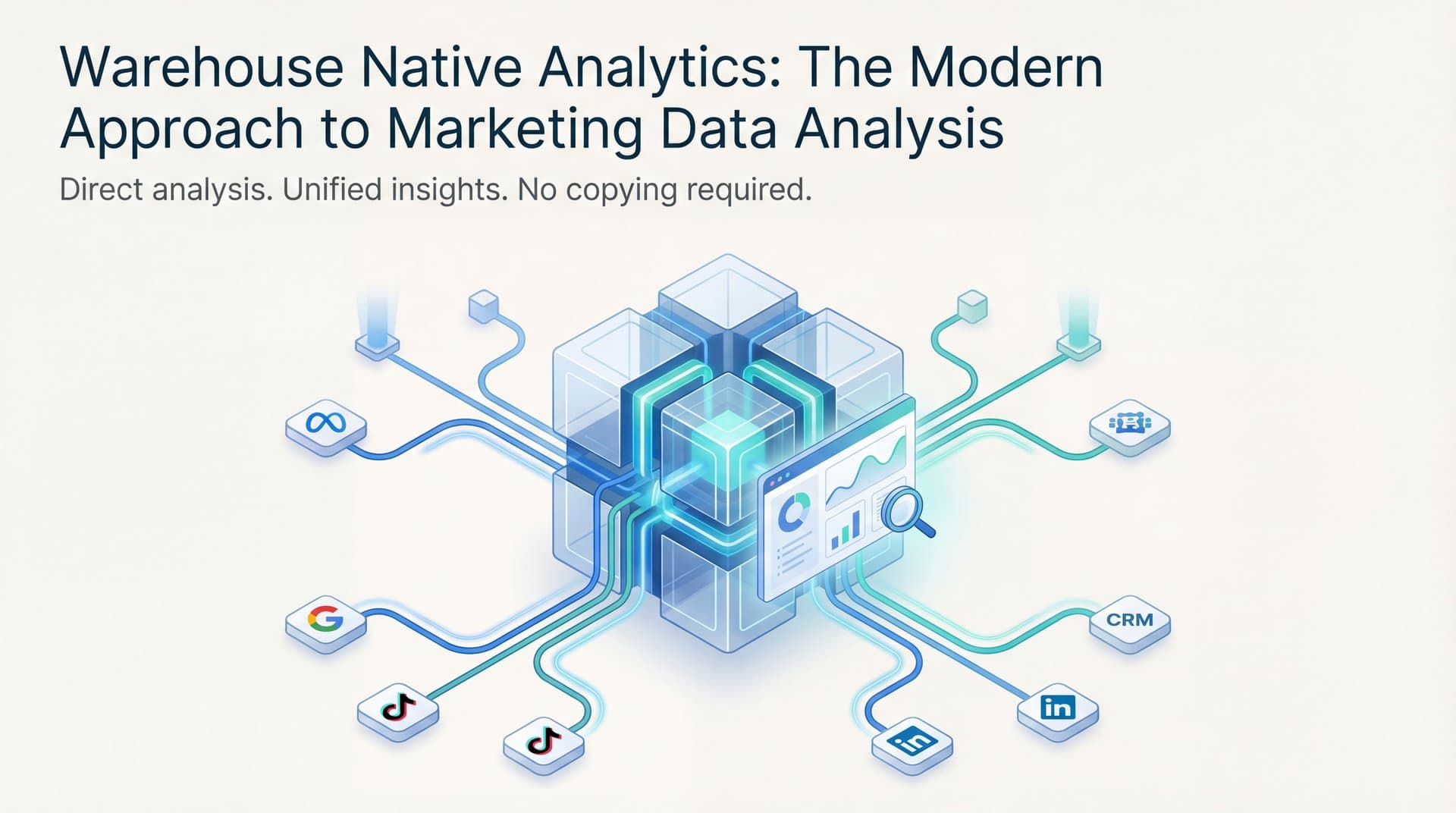
Warehouse native analytics means your analytics tools query data directly where it already lives—in platforms like Snowflake, Google BigQuery, Amazon Redshift, or Databricks. Instead of extracting your data and moving it into a separate analytics system, the analysis happens right in your warehouse.
Think of it like this: Traditional analytics architecture is like photocopying all your documents and filing them in a different cabinet every time you need to analyze them. Warehouse native is like keeping one master filing system and just looking at it from different angles when you need insights.
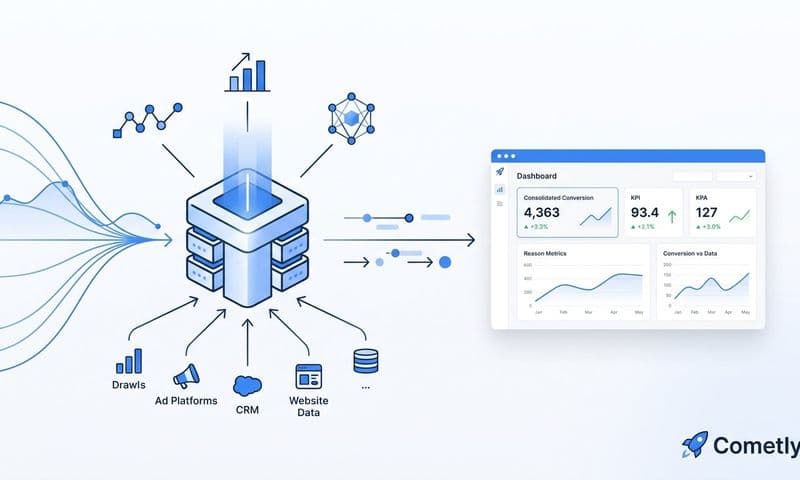
Here's what that looks like in practice. Your ad platform data, CRM records, website events, and transaction history all flow into your data warehouse through standard integrations. When you want to analyze campaign performance, the analytics tool sends queries directly to your warehouse, processes the results, and shows you the insights. The data never leaves your controlled environment.
Contrast this with how most marketing teams work today. You extract data from various sources, transform it to fit a proprietary format, and load it into an analytics platform's database. Then you extract it again to build reports. Then you extract it once more to push insights back to your ad platforms. Each step introduces latency, creates opportunities for data discrepancies, and adds complexity to your stack.
The warehouse native approach eliminates this redundancy. Your warehouse becomes the single source of truth. When your CRM updates a lead status, that change is immediately available for analysis. When a conversion happens on your website, it's queryable within seconds or minutes, not hours or days.
This isn't just about speed. It's about confidence. When every team in your organization queries the same underlying data, your marketing metrics align with your finance team's revenue reports. Your attribution analysis uses the same customer records your sales team sees in the CRM. There's no reconciliation meeting to figure out why the numbers don't match.
Why Marketing Teams Are Shifting to This Architecture
The shift to warehouse native analytics is happening because traditional approaches can't keep pace with how modern marketing teams need to work. Let's break down why this architecture is gaining momentum.
Data freshness matters more than ever. When you're spending thousands of dollars per day on paid media, waiting until tomorrow morning to see which campaigns are working isn't good enough. Warehouse native tools can query your data as soon as it arrives in your warehouse. If your data pipelines are set up for real-time ingestion, your analytics can be equally real-time. No more overnight batch processes that leave you flying blind for hours.
This immediacy changes how you manage campaigns. You can spot performance shifts during the day and adjust budgets before you've burned through your daily spend on underperforming ads. You can catch technical issues—like a broken tracking pixel—within minutes instead of discovering them the next morning after wasting a full day of budget.
For a deeper dive into this space, see our AI campaign manager guide.
Data governance and security become simpler. When your customer data lives in multiple systems, you're multiplying your compliance burden. Each system needs its own access controls, audit logs, and security protocols. Each extraction point is a potential vulnerability.
With warehouse native analytics, sensitive customer information stays in your data warehouse where your data team has already implemented enterprise-grade security controls. You grant analytics tools query access without giving them custody of your data. This makes compliance with regulations like GDPR and CCPA more straightforward because you have one system to govern, not five.
Cost efficiency improves as you scale. Traditional analytics platforms charge based on data volume or user seats. As your business grows and your data expands, those costs scale linearly or worse. You're essentially paying to store the same data twice: once in your warehouse and again in the analytics platform.
Warehouse native architecture eliminates redundant storage. You pay for warehouse compute when queries run, which is typically more cost-effective than maintaining separate data stores. Modern warehouses also separate storage and compute, so you can scale each independently based on your actual needs.
Flexibility increases dramatically. Your data team already knows SQL. Your warehouse already has the data modeling and transformation logic you've built. Warehouse native tools leverage these existing investments instead of forcing you to learn proprietary query languages or rebuild logic in yet another system.
This matters when you need custom analysis. Instead of waiting for your analytics vendor to add a feature, your team can write the SQL directly. You can join marketing data with product usage data, customer support tickets, or any other dataset in your warehouse. The analysis is limited only by your data and your team's SQL skills, not by what features your vendor has prioritized on their roadmap.
The Attribution Challenge That Warehouse Native Solves
Attribution is where traditional analytics architectures break down most visibly. The customer journey spans too many systems and happens over too long a timeframe for siloed tools to handle effectively.
Here's the problem: A potential customer sees your LinkedIn ad, clicks through to your website, downloads a guide, receives nurture emails, clicks a Google ad two weeks later, attends a webinar, and finally converts. That journey touched five different platforms, each with its own tracking, its own database, and its own idea of what "conversion" means.
Traditional attribution tools try to solve this by pulling data from each platform into their own database. But this creates new problems. The LinkedIn platform thinks it deserves credit because it drove the first click. Google Ads claims credit for the last click before conversion. Your email platform wants attribution for the nurture sequence. Meanwhile, your analytics tool is trying to reconcile three different user IDs across these platforms, and the timestamps don't quite line up because each system exported data at different times.
Warehouse native analytics changes the game by unifying all this data before analysis happens. Your ad platform data, website events, email engagement, and CRM records all flow into your warehouse through standardized pipelines. Identity resolution happens once, in your warehouse, using all available signals to connect anonymous touchpoints to known users.
When you query for attribution, you're analyzing a complete, unified dataset. The LinkedIn ad click is in the same table as the Google ad click, the email opens, and the final conversion. You can apply any attribution model—first touch, last touch, linear, time decay, or custom algorithmic approaches—to the same underlying data without worrying about whether different systems are using consistent logic.
This unified approach solves the data reconciliation nightmare. Your attribution reports use the same conversion definitions as your revenue reports because they're querying the same data. When your CFO asks which channels are driving revenue, you can show them analysis that traces directly to the transactions in your financial system. Understanding marketing attribution analytics becomes significantly easier when all your data lives in one place.
It also enables more sophisticated attribution models. You can build multi-touch attribution that considers the entire funnel, from anonymous website visits through closed deals and even post-purchase behavior. You can weight touchpoints based on engagement depth, time spent, or content consumed. You can create separate attribution models for different customer segments or product lines, all querying the same unified dataset.
Key Capabilities to Look for in Warehouse Native Analytics Tools
Not all warehouse native tools are created equal. When evaluating options for marketing analytics, focus on these essential capabilities that separate powerful solutions from basic query interfaces.
Direct warehouse connectors for major platforms. The tool should connect natively to Snowflake, Google BigQuery, Databricks, Amazon Redshift, and other enterprise data warehouses. These connectors should support modern authentication methods, handle query optimization automatically, and work within your warehouse's security model. Avoid tools that require you to expose your warehouse publicly or use outdated connection methods.
A semantic layer that speaks marketing language. Your warehouse stores data in technical schemas with names like "dim_campaign" and "fact_conversions." Marketers shouldn't need to understand star schemas to answer questions. Look for tools that provide a semantic layer—a business-friendly translation layer that maps marketing concepts like "cost per acquisition" or "ROAS by campaign" to the underlying SQL queries.
This semantic layer should handle common marketing calculations automatically. When you ask for "attributed revenue," it should know how to join your conversion events with your transaction data and apply your chosen attribution model. When you filter by "last 30 days," it should handle timezone conversions and date logic correctly.
Visualization and reporting for non-technical users. The whole point of warehouse native analytics is making your data accessible. The best tools provide intuitive interfaces where marketers can build dashboards, create reports, and explore data without writing SQL. They should offer pre-built templates for common marketing use cases: campaign performance, channel comparison, conversion funnel analysis, customer journey visualization. Investing in a well-designed data analytics dashboard can dramatically improve how your team consumes insights.
These interfaces should also allow drill-down exploration. When you see that a campaign is performing well, you should be able to click through to see which ad sets are driving results, then which specific creatives, then which audience segments. The tool generates the appropriate SQL queries behind the scenes.
Reverse ETL capabilities for closing the loop. Analysis is only half the equation. You need to push insights back to where they can drive action. Look for tools that can sync enriched data, conversion events, and audience segments from your warehouse back to your ad platforms. This creates a feedback loop where your attribution insights improve your ad targeting and optimization.
For example, when your warehouse native analytics identifies which customer attributes predict high lifetime value, you should be able to push those signals back to Meta and Google as conversion events. Their algorithms can then optimize toward the customers most likely to become valuable, not just those most likely to convert initially.
Implementing Warehouse Native Analytics for Paid Media
Moving to warehouse native analytics requires some upfront work, but the investment pays off in cleaner data and more reliable insights. Here's how to approach implementation for marketing use cases.
Start with data modeling. Your warehouse needs to be structured to support marketing analysis. This typically means building fact tables for events (ad impressions, clicks, conversions, page views) and dimension tables for entities (campaigns, ads, users, products). The goal is a schema that makes common marketing queries efficient and intuitive.
Work with your data team to define standard event properties. What constitutes a "conversion"? How do you want to track UTM parameters? What custom dimensions matter for your business—product category, customer segment, geographic region? Standardizing these definitions at the warehouse level ensures consistency across all downstream analysis.
Don't try to model everything perfectly upfront. Start with the core entities and relationships you need for basic attribution. You can add complexity as your needs evolve. The beauty of warehouse native architecture is that adding new data sources or refining your models doesn't require rebuilding your analytics stack.
Connect ad platform APIs systematically. Set up data pipelines that ingest campaign-level, ad set-level, and creative-level data from each platform you advertise on. Include spend, impressions, clicks, and any platform-specific metrics. Most modern data integration tools offer pre-built connectors for major ad platforms, so you don't need to build these from scratch.
Pay attention to data freshness requirements. Some platforms limit how frequently you can pull data via API. Others offer near-real-time webhooks for certain events. Balance your need for fresh data with API rate limits and cost considerations. For most marketing teams, hourly updates provide sufficient freshness without overwhelming your infrastructure.
Build identity resolution to connect the dots. This is where warehouse native analytics shows its power. You need logic that connects anonymous ad clicks to known users in your CRM. This typically involves matching on email addresses, phone numbers, or device IDs, combined with probabilistic matching based on behavioral patterns.
Your identity resolution logic lives in your warehouse as SQL transformations. When a user clicks an ad, you capture a click ID. When they fill out a form on your website, you capture their email and associate it with their session. Your warehouse joins these events to create a unified user profile. As new data arrives, the identity graph updates automatically.
This unified identity becomes the foundation for attribution. You can trace the path from first anonymous impression through multiple touchpoints to final conversion and beyond, all tied to a single user record.
Create dashboards that answer real questions. Work with your marketing team to identify the questions they ask most often. Which campaigns are driving the most qualified leads? What's our true cost per acquisition across all channels? Which content pieces contribute most to the customer journey? Build dashboards that answer these questions directly, without requiring the user to manipulate data or run custom queries.
The best dashboards combine high-level summaries with drill-down capability. A VP of Marketing might want to see overall channel performance at a glance, while a campaign manager needs to drill into specific ad sets and creatives. Your warehouse native tool should make both use cases easy. Exploring the best marketing analytics tools can help you identify solutions that balance simplicity with depth.
If you're evaluating vendors, our AI marketing creative generator breakdown can help.
Where Cometly Fits in the Warehouse Native Landscape
Cometly approaches marketing attribution with a focus on capturing complete customer journeys and feeding that intelligence back to ad platforms for better optimization. While many analytics tools stop at reporting, Cometly closes the loop between analysis and action.
The platform captures every touchpoint from initial ad clicks through CRM events, providing a comprehensive view of how customers move through your funnel. This includes server-side tracking that bypasses browser limitations and ad blockers, ensuring you're working with complete data rather than the partial picture that client-side tracking provides. When iOS privacy restrictions or cookie blocking interferes with standard tracking, Cometly's server-side approach maintains data accuracy.
Related reading: our complete guide to ad platform data accuracy issues.
This complete data capture feeds Cometly's AI-powered recommendations. The system analyzes performance across all your channels to identify which ads, campaigns, and audiences are genuinely driving revenue—not just clicks or initial conversions. These insights help you scale with confidence because you're optimizing toward the outcomes that matter to your business, not vanity metrics. Learn more about the power of AI marketing analytics and how it transforms decision-making.
Where Cometly particularly shines is in conversion sync capabilities. The platform doesn't just analyze your data; it pushes enriched conversion events back to Meta, Google, and other ad platforms. This feedback loop improves how ad platform algorithms optimize your campaigns. Instead of optimizing toward basic conversions, the algorithms can optimize toward the conversions that lead to revenue, based on the complete customer journey data Cometly has assembled.
For marketing teams running multi-platform campaigns, this means your attribution insights directly improve your ad performance. You're not just learning which campaigns worked in the past; you're actively making future campaigns more effective by feeding better data to the platforms' optimization systems.
Cometly integrates with your existing marketing stack, connecting to your ad platforms, CRM, and analytics tools to create that unified view of customer journeys. The platform handles the complexity of identity resolution and multi-touch attribution while providing marketers with clear, actionable insights about what's actually driving results.
Putting It All Together
The shift toward warehouse native analytics reflects a broader change in how marketing teams need to work. Fragmented data and delayed insights don't cut it when you're managing complex, multi-platform campaigns with real budget on the line. You need complete visibility into customer journeys, real-time access to performance data, and the ability to act on insights immediately.
Warehouse native architecture delivers these capabilities by keeping your data in one place and bringing the analysis to the data, rather than the other way around. It eliminates sync delays, reduces data governance complexity, and provides the flexibility to answer whatever questions your business needs to ask.
For attribution specifically, this approach solves the fundamental problem of fragmented customer journeys. When all your touchpoint data lives in a unified warehouse, you can trace complete paths from first impression to closed deal without reconciling conflicting reports from different systems. You can apply sophisticated attribution models that reflect how customers actually buy, not just which platform wants to claim credit. Understanding the attribution challenges in marketing analytics helps you appreciate why this unified approach matters so much.
The right warehouse native solution should do more than just query your data efficiently. It should provide the semantic layer that makes complex analysis accessible to marketers who don't write SQL. It should offer visualizations and dashboards that answer real questions without requiring data science degrees. And critically, it should close the loop by pushing insights back to your ad platforms so your analysis actively improves your campaign performance.
This last point separates basic analytics from platforms that drive real business value. Knowing which campaigns worked is useful. Automatically feeding that intelligence back to ad platform algorithms so they optimize toward better outcomes—that's transformative. Mastering how to use data analytics in marketing means understanding this complete cycle from insight to action.
As marketing becomes increasingly data-driven and customer journeys span more touchpoints across more platforms, the need for unified, real-time attribution will only grow. Warehouse native analytics provides the architectural foundation to meet that need. The question isn't whether to adopt this approach, but how quickly you can implement it to gain competitive advantage.
Ready to elevate your marketing game with precision and confidence? Discover how Cometly's AI-driven recommendations can transform your ad strategy—Get your free demo today and start capturing every touchpoint to maximize your conversions.