
What Is a Marketing Mix? The Complete Guide to the 4 Ps Framework
You've just launched what you believe is a game-changing product. Your team spent months perfecting the features, your pricing is competitive, and you're running ads across Facebook, Google, and LinkedIn. Each platform shows decent metrics—clicks are coming in, engagement looks solid, your email list is growing.
But something's off.
Your campaigns feel disconnected. Your Facebook ads emphasize premium quality while your Google ads compete on price. Your email nurture sequence talks about enterprise features, but your landing pages highlight ease of use for small teams. Customers are confused about what you actually offer and who it's for. Despite all the activity, revenue isn't scaling the way you projected.
This is the hidden cost of tactical marketing without strategic framework.
The problem isn't your execution—it's that you're treating each marketing decision as an isolated task rather than part of an integrated system. You're optimizing individual channels without understanding how product positioning, pricing strategy, distribution choices, and promotional messaging work together to create a cohesive customer experience.
This is exactly what the marketing mix framework solves. Originally developed in the 1960s as the "4 Ps of Marketing"—Product, Price, Place, and Promotion—this strategic framework has guided billions in successful campaigns because it forces you to think about how every marketing element influences the others. When Apple launches an iPhone, they don't just run great ads. They strategically align premium product design with premium pricing, exclusive distribution, and aspirational promotion to create an integrated brand experience that customers understand instantly.
Here's what makes this framework more relevant than ever: Modern marketing has become exponentially more complex. Your customers interact with your brand across an average of six touchpoints before purchasing. They research on mobile, compare prices across platforms, read reviews on third-party sites, and expect consistent messaging everywhere. Without a strategic framework connecting your marketing decisions, this complexity creates chaos instead of conversions.
In this guide, you'll learn exactly what a marketing mix is, why it matters for modern digital marketing, and how to implement it with proper attribution and measurement. We'll break down each of the 4 Ps with practical examples, show you how to avoid the costly mistakes that destroy campaign performance, and give you a step-by-step blueprint for building an attribution-ready marketing mix that drives predictable growth.
Understanding the Marketing Mix: Definition and Core Concepts
The marketing mix is a strategic framework that defines the key elements you control to influence customer purchase decisions. Think of it as your marketing control panel—the specific levers you can adjust to achieve your business objectives.
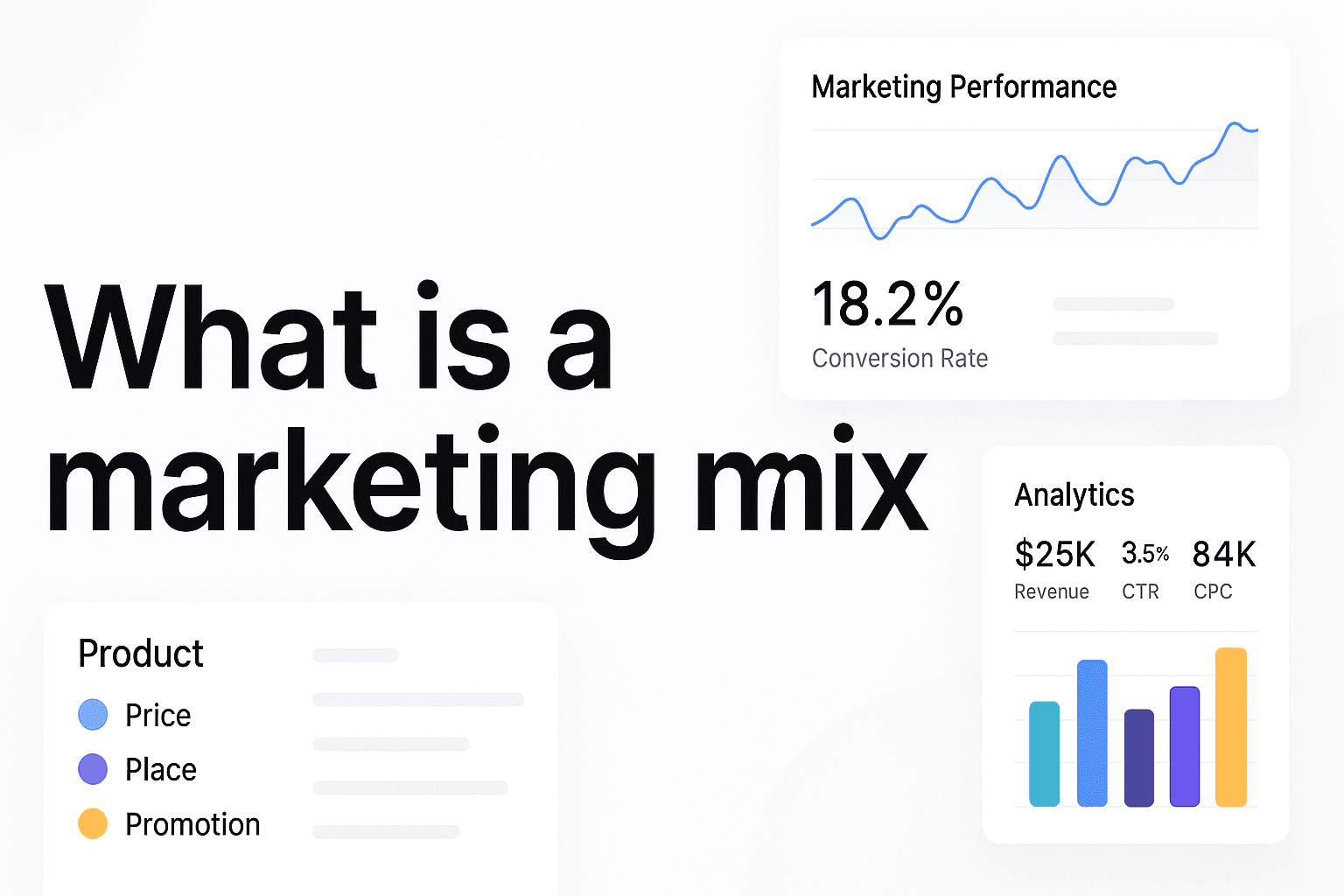
At its core, the marketing mix consists of four fundamental elements known as the 4 Ps: Product (what you sell), Price (what you charge), Place (where you sell), and Promotion (how you communicate). These aren't isolated tactics—they're interconnected decisions that must work together to create a cohesive customer experience.
Here's why this matters for your business: Every successful marketing campaign starts with strategic alignment across these four elements. When Tesla launches a new vehicle, they don't just decide on features (Product) in isolation. They simultaneously determine premium pricing that signals innovation (Price), choose direct-to-consumer sales channels that bypass traditional dealerships (Place), and craft promotional messaging that emphasizes sustainability and technology leadership (Promotion). Each decision reinforces the others.
The framework emerged in 1960 when E. Jerome McCarthy formalized the 4 Ps concept in his book "Basic Marketing: A Managerial Approach." Before this, marketing decisions were often made reactively without a systematic approach. McCarthy's framework gave marketers a structured way to think about strategy—a mental model that's still relevant six decades later because it addresses fundamental business questions that haven't changed.
Modern digital marketing has added complexity—you now manage dozens of channels, track hundreds of metrics, and target microsegments of customers. But the core questions remain the same: What are you selling? What should you charge? Where will customers find it? How will you tell them about it? The marketing mix framework helps you answer these questions in a coordinated way rather than treating each as a separate problem.
What makes this framework particularly powerful is its emphasis on integration. Poor marketing mix execution happens when companies optimize individual elements without considering how they interact. You might develop an excellent product but price it wrong for your target market. Or choose the perfect price point but distribute through channels where your customers don't shop. Or nail product, price, and distribution but create promotional messaging that contradicts your positioning.
The marketing mix also provides a common language for cross-functional collaboration. When your product team, pricing analysts, sales operations, and marketing agencies all use the same framework, strategic discussions become more productive. Instead of debating tactics in isolation, you can evaluate how changes to one element affect the others.
For attribution-focused marketers, the marketing mix framework is especially valuable because it helps you understand what you're actually measuring. When you track campaign performance, you're not just measuring promotional effectiveness—you're measuring how well your entire marketing mix resonates with customers. A campaign might "fail" not because the ads were poor, but because the product-price-place combination wasn't right for the audience you targeted.
The 4 Ps of Marketing: Breaking Down Each Element
Let's examine each element of the marketing mix in detail, with specific focus on how they impact your attribution strategy and measurement approach.
Product: What You're Offering to the Market
Product encompasses everything you're selling—the physical item or service itself, its features and benefits, quality level, design, branding, packaging, warranties, and support services. This is the foundation of your marketing mix because if your product doesn't solve a real customer problem, no amount of clever pricing, distribution, or promotion will create sustainable success.
From an attribution perspective, product decisions directly impact which metrics matter most. If you're selling a complex B2B software solution, your customer journey will involve multiple touchpoints over weeks or months, requiring sophisticated b 2 b marketing attribution to understand what's working. If you're selling impulse-purchase consumer goods, conversion cycles are shorter and attribution models can be simpler.
Product positioning also determines which channels and messages will resonate. A premium product requires promotional messaging that emphasizes quality and exclusivity, while a value product needs messaging focused on affordability and practicality. Your attribution data should reflect whether your promotional mix aligns with your product positioning—if you're seeing high click-through rates but low conversion rates, there's likely a disconnect between what your ads promise and what your product delivers.
Consider how product lifecycle stage affects your marketing mix. New products require educational content and awareness-building campaigns. Mature products compete primarily on differentiation and price. Declining products might need repositioning or line extensions. Your attribution model should account for these lifecycle differences—a new product launch campaign should be measured differently than a mature product's retention campaign.
Price: Your Pricing Strategy and Tactics
Price is the amount customers pay for your product, including list prices, discounts, payment terms, credit options, and perceived value relative to alternatives. This is the only element of the marketing mix that generates revenue—everything else represents costs. Price also sends powerful signals about your brand positioning and target market.
Pricing strategy has direct attribution implications because it affects conversion rates at every stage of your funnel. A $10 product might convert 5% of landing page visitors, while a $10,000 product might convert 0.5%—but generate far more revenue per conversion. Your attribution model must account for these differences in conversion economics when evaluating channel performance.
Price also influences which marketing channels work best. Premium-priced products often perform better with content marketing and thought leadership that builds trust over time, while value-priced products might see stronger performance from direct response advertising. Your marketing performance analysis should segment by price point to understand these dynamics.
Dynamic pricing adds another layer of complexity. If you're running promotions, offering discounts to different segments, or using algorithmic pricing, your attribution data needs to capture which price point each customer saw. A campaign might appear to perform poorly when customers saw full price but excellently when they received a discount code—without tracking this variable, you can't accurately assess campaign effectiveness.
Consider how price affects customer lifetime value calculations. A low introductory price might generate impressive acquisition metrics but poor long-term profitability if customers churn quickly. Your attribution model should connect acquisition costs to lifetime value, not just first purchase, to understand true marketing ROI.
Place: Distribution Channels and Market Coverage
Place refers to how and where customers can access your product—your distribution channels, geographic coverage, inventory management, logistics, and the entire path from your business to the end customer. In digital marketing, this includes your website, mobile app, marketplace presence, retail partnerships, and any other touchpoint where transactions occur.
Distribution decisions have massive attribution implications because they determine which customer touchpoints you can track. If you sell exclusively through your own website, you have complete visibility into the customer journey. If you sell through Amazon, retail stores, or other third-party channels, attribution becomes significantly more complex because you lose visibility into the final conversion step.
For marketing attribution for e-commerce businesses, place strategy directly impacts measurement capabilities. Omnichannel retailers need attribution models that can track customers who research online but purchase in-store, or vice versa. Pure-play e-commerce businesses have simpler attribution requirements but must still account for customers who interact with multiple digital touchpoints before converting.
Channel conflict is another consideration. If you sell both direct-to-consumer and through distributors, your marketing might drive awareness that results in purchases through partner channels—sales that don't show up in your direct attribution data. This is why many businesses implement partner tracking codes or use incrementality testing to measure the full impact of marketing across all distribution channels.
Geographic distribution also affects attribution strategy. If you're running national campaigns but only distribute in certain regions, your attribution data will show poor performance in areas where customers can't actually buy—not because the marketing failed, but because the place strategy limited conversion opportunities. Your measurement approach must account for distribution constraints when evaluating campaign performance.
Promotion: Your Communication and Persuasion Strategy
Promotion encompasses all the ways you communicate with potential and current customers—advertising, content marketing, social media, email campaigns, public relations, sales promotions, events, and any other method of conveying your message. This is typically what people think of when they hear "marketing," but it's just one element of the broader marketing mix.
Promotion is where most attribution efforts focus because promotional activities generate the trackable touchpoints that attribution models analyze. Every ad click, email open, content download, and social media interaction creates data points that feed into your attribution system. But here's the critical insight: promotional effectiveness depends entirely on how well it aligns with your product, price, and place decisions.
Your promotional mix should reflect your overall marketing mix strategy. A premium product with high prices and selective distribution requires promotional messaging that emphasizes exclusivity and quality—think Apple's minimalist ads that focus on design and innovation. A value product with competitive pricing and mass distribution needs promotional messaging that emphasizes affordability and accessibility—think Walmart's "Save Money. Live Better" positioning.
Attribution models help you understand which promotional tactics drive results, but they can't tell you whether your promotional strategy aligns with your broader marketing mix. If your ga4 marketing attribution data shows that awareness campaigns generate traffic but not conversions, the problem might not be the promotional execution—it might be a mismatch between what your promotion promises and what your product-price-place combination delivers.
Modern promotion requires integrated campaigns across multiple channels. Your customers might see a social media ad, visit your website, receive email nurture sequences, encounter retargeting ads, and read third-party reviews before purchasing. Attribution models help you understand which promotional touchpoints contribute most to conversions, but remember that promotional effectiveness is always contextual—it depends on how well your entire marketing mix resonates with your target market.
Extended Marketing Mix: The 7 Ps Framework
While the original 4 Ps framework remains foundational, many marketers now use an extended 7 Ps model that adds three additional elements: People, Process, and Physical Evidence. These additions are particularly relevant for service businesses and digital products where the traditional 4 Ps don't fully capture the customer experience.
People: The Human Element in Service Delivery
People refers to everyone involved in delivering your product or service to customers—your employees, customer service representatives, salespeople, and even customers themselves in peer-to-peer or community-driven businesses. In service industries especially, people are often inseparable from the product itself.
From an attribution perspective, people decisions affect conversion rates and customer lifetime value in ways that traditional marketing metrics might miss. A helpful customer service team can turn a frustrated prospect into a loyal customer, but this conversion might not be credited to any marketing touchpoint. Similarly, a poor sales experience can destroy the effectiveness of an otherwise excellent marketing campaign.
Consider how people strategy impacts your measurement approach. If you're running campaigns that drive phone calls or chat conversations, your attribution model needs to account for what happens during those interactions. A campaign might generate qualified leads, but if your sales team doesn't convert them effectively, the campaign will appear to underperform. This is why sophisticated attribution approaches include conversation tracking and CRM integration to measure the full customer journey.
Process: Systems and Procedures That Deliver Value
Process encompasses the systems, procedures, and workflows that deliver your product or service to customers—everything from how orders are fulfilled to how customer inquiries are handled to how returns are processed. In digital businesses, this includes your website user experience, checkout flow, onboarding sequence, and customer support systems.
Process decisions have direct attribution implications because they affect conversion rates at every stage of your funnel. A complicated checkout process might cause cart abandonment even when your marketing successfully drove qualified traffic. A slow website might increase bounce rates despite excellent ad targeting. Your attribution data will show these problems as campaign underperformance, but the root cause is process, not promotion.
This is why conversion rate optimization (CRO) is essential for accurate attribution. If you're constantly improving your processes—streamlining checkout, improving page load times, enhancing mobile experience—your attribution data will show improving campaign performance even if your promotional tactics haven't changed. You need to distinguish between performance improvements driven by better marketing versus better processes.
Physical Evidence: Tangible Proof of Value
Physical evidence refers to the tangible elements that customers use to evaluate your offering—for physical products, this includes packaging and presentation; for services, it includes your facilities, website design, documentation, and any other physical artifacts that signal quality and professionalism.
In digital marketing, physical evidence primarily manifests as your online presence—website design, content quality, social proof elements like reviews and testimonials, case studies, certifications, and any other signals that build credibility. These elements affect conversion rates but often don't show up directly in attribution data.
Consider how physical evidence impacts your attribution strategy. A professionally designed website with strong social proof might convert 5% of visitors, while an amateur-looking site converts 1%—a 5x difference in performance that has nothing to do with which marketing channels drove the traffic. Your attribution model should account for these conversion rate differences when evaluating channel performance, especially if you're comparing performance before and after website redesigns or other changes to physical evidence.
How to Develop Your Marketing Mix Strategy
Creating an effective marketing mix requires systematic analysis, strategic decision-making, and continuous optimization based on performance data. Here's a step-by-step approach to developing your marketing mix strategy with proper attribution integration.
Step 1: Conduct Comprehensive Market Research
Start by deeply understanding your target market, competitive landscape, and customer needs. This research forms the foundation for all your marketing mix decisions. You need to know who your customers are, what problems they're trying to solve, how they currently solve those problems, what alternatives they consider, and what factors influence their purchase decisions.
Use both qualitative and quantitative research methods. Conduct customer interviews to understand motivations and pain points. Analyze competitor positioning to identify gaps and opportunities. Survey your target market to quantify preferences and willingness to pay. Review industry reports and trend data to understand market dynamics.
From an attribution perspective, this research phase should also include analysis of customer journey patterns. How many touchpoints do customers typically encounter before purchasing? Which channels do they use for research versus purchase? How long is the typical consideration period? This journey mapping will inform your attribution model selection and measurement strategy.
Step 2: Define Your Target Market and Positioning
Based on your research, clearly define your target market segments and your positioning strategy for each segment. Your marketing mix must be tailored to specific customer groups—trying to appeal to everyone with a single marketing mix typically results in appealing to no one.
Document your positioning strategy explicitly: What unique value do you provide? How are you different from alternatives? Why should customers choose you? Your positioning statement should guide all subsequent marketing mix decisions—if a potential product feature, pricing strategy, distribution channel, or promotional message doesn't reinforce your positioning, it doesn't belong in your marketing mix.
For attribution purposes, segment definition is critical because different segments often have different customer journeys and respond differently to marketing touchpoints. Your attribution model should be able to segment performance by customer type so you can understand what works for each target market.
Step 3: Make Strategic Decisions for Each Marketing Mix Element
Now systematically work through each element of your marketing mix, making strategic decisions that align with your positioning and target market definition. Remember that these decisions are interconnected—each choice constrains and influences the others.
For Product decisions: Define your core offering, key features, quality level, branding, and any supporting services. Ensure your product genuinely solves the customer problems you identified in research. Consider how product decisions affect your ability to track customer behavior and measure marketing effectiveness.
For Price decisions: Determine your pricing strategy (premium, competitive, value), specific price points, discount policies, and payment terms. Your pricing should reflect your positioning and be sustainable given your cost structure. Consider how price affects conversion rates and customer lifetime value in your attribution analysis.
For Place decisions: Choose your distribution channels, geographic coverage, and logistics approach. Ensure customers can easily access your product where and when they want it. Consider how distribution choices affect your attribution capabilities—direct channels provide more data but might limit reach, while indirect channels expand reach but reduce visibility.
For Promotion decisions: Develop your messaging strategy, choose your marketing channels, and plan your campaign calendar. Your promotional mix should reach your target market efficiently while reinforcing your positioning. This is where your marketing mix modeling tutorial becomes essential—you need to understand which promotional tactics drive results and how they interact with each other.
Step 4: Implement Attribution-Ready Measurement Systems
Before launching your marketing mix, implement measurement systems that will let you track performance and optimize over time. This means setting up proper tracking across all customer touchpoints, implementing an attribution model appropriate for your business, and establishing clear KPIs for each element of your marketing mix.
Your measurement system should track both leading indicators (traffic, engagement, leads) and lagging indicators (conversions, revenue, customer lifetime value). It should be able to attribute results to specific marketing mix elements so you can understand what's working and what needs adjustment.
For businesses with mobile apps or mobile-first strategies, implementing what is mobile marketing attribution is essential to track the full customer journey across devices. For B2B companies with complex sales cycles, account based marketing attribution helps you understand how marketing influences account-level decisions rather than just individual leads.
Step 5: Test, Learn, and Optimize Continuously
Launch your marketing mix and immediately begin systematic testing and optimization. Use your attribution data to understand which elements are performing well and which need adjustment. Run controlled experiments to test alternative approaches for each marketing mix element.
The key is to test one element at a time when possible, so you can isolate the impact of each change. If you simultaneously change your pricing, distribution, and promotional messaging, you won't know which change drove any performance differences you observe.
Create a regular cadence for marketing mix review—monthly or quarterly depending on your business cycle. Analyze performance data, identify optimization opportunities, implement changes, and measure results. This continuous improvement cycle is what separates good marketing from great marketing.
Common Marketing Mix Mistakes and How to Avoid Them
Even experienced marketers make critical mistakes when developing and executing their marketing mix. Here are the most common pitfalls and how to avoid them.
Mistake 1: Optimizing Elements in Isolation
The most fundamental mistake is treating each element of the marketing mix as an independent decision rather than part of an integrated system. You might develop an excellent product but price it wrong for your target market. Or choose the perfect price point but distribute through channels where your customers don't shop.
This mistake often shows up in attribution data as inconsistent performance across channels. A campaign might perform well on some metrics but poorly on others because the underlying marketing mix isn't coherent. For example, your ads might generate high click-through rates (good promotional execution) but low conversion rates (product-price-place mismatch).
To avoid this: Always evaluate marketing mix changes holistically. When considering a price change, think through implications for product positioning, distribution strategy, and promotional messaging. When adding a new distribution channel, consider whether your product and pricing are appropriate for that channel's customers. Use your attribution data to identify disconnects between different elements of your marketing mix.
Mistake 2: Ignoring Competitive Context
Your marketing mix doesn't exist in a vacuum—it exists in a competitive marketplace where customers constantly compare your offering to alternatives. A marketing mix that would be excellent in isolation might fail because competitors offer better value or more compelling positioning.
This mistake manifests in attribution data as declining performance over time even when your marketing execution hasn't changed. If competitors improve their offerings or lower their prices, your conversion rates will decline even if your marketing tactics remain constant.
To avoid this: Regularly conduct competitive analysis to understand how your marketing mix compares to alternatives. Monitor competitor pricing, product features, distribution expansion, and promotional strategies. Use this intelligence to adjust your marketing mix proactively rather than reactively. Your attribution analysis should include competitive context—are performance changes driven by your marketing or by competitive dynamics?
Mistake 3: Misaligning Marketing Mix with Customer Journey
Different customer segments have different purchase journeys, and your marketing mix must align with how your target customers actually make decisions. A marketing mix optimized for impulse purchases won't work for considered purchases with long research cycles.
This mistake shows up in attribution data as high early-funnel engagement but poor conversion rates. You might generate lots of awareness and initial interest, but if your marketing mix doesn't support the customer's decision-making process, they'll drop out before purchasing.
To avoid this: Map your customer journey in detail and ensure each element of your marketing mix supports that journey. For long consideration cycles, your promotional strategy needs educational content and nurture sequences, not just direct response ads. Your attribution model should reflect the typical journey length—don't expect immediate conversions if your customers need weeks to make decisions.
Mistake 4: Failing to Adapt to Market Changes
Markets evolve constantly—customer preferences shift, new competitors emerge, technology changes, and economic conditions fluctuate. A marketing mix that worked perfectly last year might be completely wrong today.
This mistake appears in attribution data as gradually declining performance across all channels. If every marketing tactic seems to be working less well than before, the problem probably isn't your execution—it's that your marketing mix is no longer aligned with market realities.
To avoid this: Build regular marketing mix reviews into your planning process. Don't just optimize tactics within your existing marketing mix—periodically question whether the fundamental strategy is still correct. Use attribution data to identify early warning signs of market shifts, like changing conversion rates or shifting channel performance.
Mistake 5: Measuring Promotion While Ignoring Other Elements
Most attribution systems focus exclusively on promotional effectiveness—which ads drove conversions, which content generated leads, which emails produced sales. But promotional performance is always dependent on your product, price, and place decisions.
This mistake leads to misguided optimization where you constantly tweak promotional tactics without addressing underlying marketing mix problems. You might run dozens of ad variations trying to improve conversion rates when the real problem is that your pricing is wrong or your product doesn't meet customer needs.
To avoid this: Use attribution data to diagnose marketing mix problems, not just optimize promotional tactics. If conversion rates are low across all channels, the problem probably isn't your ads—it's your product-price-place combination. If certain customer segments convert well while others don't, you might need different marketing mixes for different segments rather than better promotional execution.
Marketing Mix in the Digital Age: Modern Considerations
While the fundamental principles of the marketing mix remain constant, digital technology has transformed how businesses implement and optimize each element. Here's what you need to know about marketing mix strategy in the modern digital environment.
Digital Product Considerations
Digital products and services have unique characteristics that affect marketing mix strategy. They typically have near-zero marginal costs (adding another user costs almost nothing), can be updated continuously, and generate extensive usage data that informs product development.
These characteristics enable product strategies that weren't possible with physical goods. You can offer freemium models where basic features are free and advanced features are paid. You can run continuous A/B tests to optimize product features. You can personalize the product experience for different user segments.
From an attribution perspective, digital products generate rich behavioral data that helps you understand which marketing messages and channels attract users who actually engage with your product versus those who sign up but never return. This engagement data should feed back into your marketing mix decisions—if users acquired through certain channels have higher engagement and retention, those channels deserve more investment even if their immediate conversion rates are lower.
Dynamic Pricing and Personalization
Digital technology enables pricing strategies that adapt in real-time based on demand, inventory, customer segment, and competitive dynamics. Airlines and hotels have used dynamic pricing for decades, but now businesses across industries can implement sophisticated pricing algorithms.
Dynamic pricing creates attribution complexity because different customers see different prices, making it difficult to compare campaign performance. A campaign might appear to perform poorly when customers saw full price but excellently when they received discounts. Your attribution system must capture which price each customer encountered to accurately assess marketing effectiveness.
Personalization extends beyond pricing to encompass personalized product recommendations, customized content, and tailored promotional messages. This means you're not really implementing a single marketing mix—you're implementing multiple marketing mixes simultaneously, each optimized for different customer segments or even individual customers.
Omnichannel Distribution and Attribution
Modern customers interact with brands across multiple channels—they might research on mobile, compare prices on desktop, read reviews on social media, and purchase in a physical store. Your distribution strategy must support this omnichannel behavior, and your attribution system must track customers across channels.
This creates significant measurement challenges. Traditional attribution models assume a linear digital journey from ad click to website conversion. But real customer journeys are messy—they span online and offline channels, involve multiple devices, and include interactions that leave no digital trace.
Solving this requires investment in identity resolution technology that can connect customer interactions across channels and devices. It also requires attribution models that can handle incomplete data and make reasonable assumptions about untracked touchpoints. Many businesses use marketing mix modeling to complement digital attribution, providing a holistic view of how all marketing activities contribute to results.
Content as Product and Promotion
In digital marketing, content often serves dual purposes—it's both a product (something valuable you give to customers) and promotion (a way to communicate your message and build awareness). A comprehensive guide, interactive tool, or educational video provides genuine value while simultaneously promoting your brand.
This blurs the traditional boundaries between marketing mix elements. Is a free calculator that helps customers solve a problem part of your product offering or your promotional strategy? The answer is both, which means your attribution approach needs to account for content's multiple roles.
Content marketing also changes the economics of promotion. Traditional advertising requires ongoing spending—when you stop paying, the ads stop running. But content marketing creates assets that continue generating value over time. A well-optimized blog post can drive traffic and conversions for years after publication, making the attribution window much longer than traditional campaigns.
Community and User-Generated Content
Digital platforms enable customers to become active participants in your marketing mix through reviews, social media posts, community discussions, and user-generated content. This peer-to-peer influence often matters more than your official promotional messages.
From a marketing mix perspective, user-generated content affects multiple elements simultaneously. It influences product perception (reviews shape how customers evaluate your offering), pricing perception (price comparison sites aggregate competitive pricing), distribution (customers discover products through social sharing), and promotion (word-of-mouth recommendations are the most trusted form of marketing).
Attribution systems struggle to capture this peer influence because it often happens outside your tracked channels. A customer might see a friend's social media post about your product, research it independently, and purchase weeks later—with no visible connection between the social post and the eventual conversion. This is why many businesses supplement digital attribution with brand lift studies and customer surveys that capture these untracked influences.
Implementing Your Marketing Mix: Action Plan
Now that you understand the marketing mix framework and modern considerations, here's a practical action plan for implementing it in your business with proper attribution integration.
Phase 1: Audit Your Current Marketing Mix (Week 1-2)
Start by documenting your current marketing mix explicitly. Many businesses operate with implicit marketing mix decisions that have evolved over time without strategic review. Make the implicit explicit by writing down:
Your current product offering: What exactly are you selling? What features and benefits? What quality level? What supporting services? How does your product compare to alternatives?
Your current pricing strategy: What do you charge? How does this compare to competitors? What discounts or promotions do you offer? What's your pricing rationale?
Your current distribution approach: Where and how can customers buy? What channels do you use? What's your geographic coverage? How do products get from you to customers?
Your current promotional mix: What marketing channels do you use? What's your messaging strategy? How much do you spend on each channel? What content do you create?
Then audit your attribution capabilities: What can you currently measure? What customer journey touchpoints are tracked? What attribution model do you use? What are the gaps in your measurement?
Phase 2: Analyze Performance and Identify Gaps (Week 3-4)
Use your attribution data and business metrics to evaluate how well your current marketing mix is performing. Look for:
Conversion rate patterns: Are conversion rates consistent across channels or highly variable? Variable rates might indicate marketing mix misalignment—your promotional messages attract people who aren't a good fit for your product-price-place combination.
Customer acquisition cost trends: Are acquisition costs rising or falling over time? Rising costs might indicate increasing competition or declining marketing mix effectiveness.
Customer lifetime value by segment: Do certain customer segments have much higher lifetime value? This suggests you should adjust your marketing mix to attract more of these high-value customers.
Channel performance inconsistencies: If certain channels perform well on awareness metrics but poorly on conversion, there's likely a disconnect between your promotional messaging and your actual offering.
Competitive positioning gaps: How does your marketing mix compare to competitors? Are there obvious areas where competitors offer better value?
Phase 3: Develop Your Optimized Marketing Mix Strategy (Week 5-6)
Based on your audit and analysis, develop an optimized marketing mix strategy that addresses identified gaps and opportunities. Document specific decisions for each element:
Product strategy: What changes will you make to your offering? New features? Quality improvements? Better positioning? Supporting services?
Pricing strategy: Will you adjust prices? Change your pricing model?
Ready to elevate your marketing game with precision and confidence? Discover how Cometly's AI-driven recommendations can transform your ad strategy—**Get your free demo** today and start capturing every touchpoint to maximize your conversions.